
business resources
The Biggest IPO Ever: What Investors Bought
06 Jul 2026

SpaceX debuted on Nasdaq on June 12, 2026, under the ticker SPCX, with the IPO priced at $135 per share. The offering totaled 555.6 million shares, while the underwriters had an option to purchase an additional 83.3 million shares if necessary.
The company targeted a valuation of about $1.77 trillion, down from an earlier $2 trillion target after the S-1 filing failed to impress some early investors. SpaceX raised around $75 billion, a figure nearly three times the previous global IPO record set by Saudi Aramco back in 2019.
A company with only one profitable division
In 2025, SpaceX reported $18.67 billion in revenue, up 33% from $14 billion in 2024. At the same time, the firm posted a net loss of $4.94 billion for the year, more than wiping out a $791 million gain it reported in the previous year.
According to its S-1 filing with the SEC, the company's business is divided into three segments. Starlink, the satellite internet service, generated $11.4 billion in revenue (roughly 61% of the total) and recorded $4.4 billion in operating profit. By March 31, 2026, the system had 10.3 million subscribers spread across 164 countries. It is the only division currently generating positive cash flow.
The space division, covering Falcon 9 launches and NASA contracts, contributed $4.1 billion in revenue but ran an operating loss, largely due to $3 billion invested in Starship development.
The AI segment (made up of xAI, Grok, and X, formerly Twitter, which were consolidated in February 2026) somehow managed to add $3.2 billion in revenue while posting a $6.4 billion operating loss, making it the group’s largest financial drain by far.
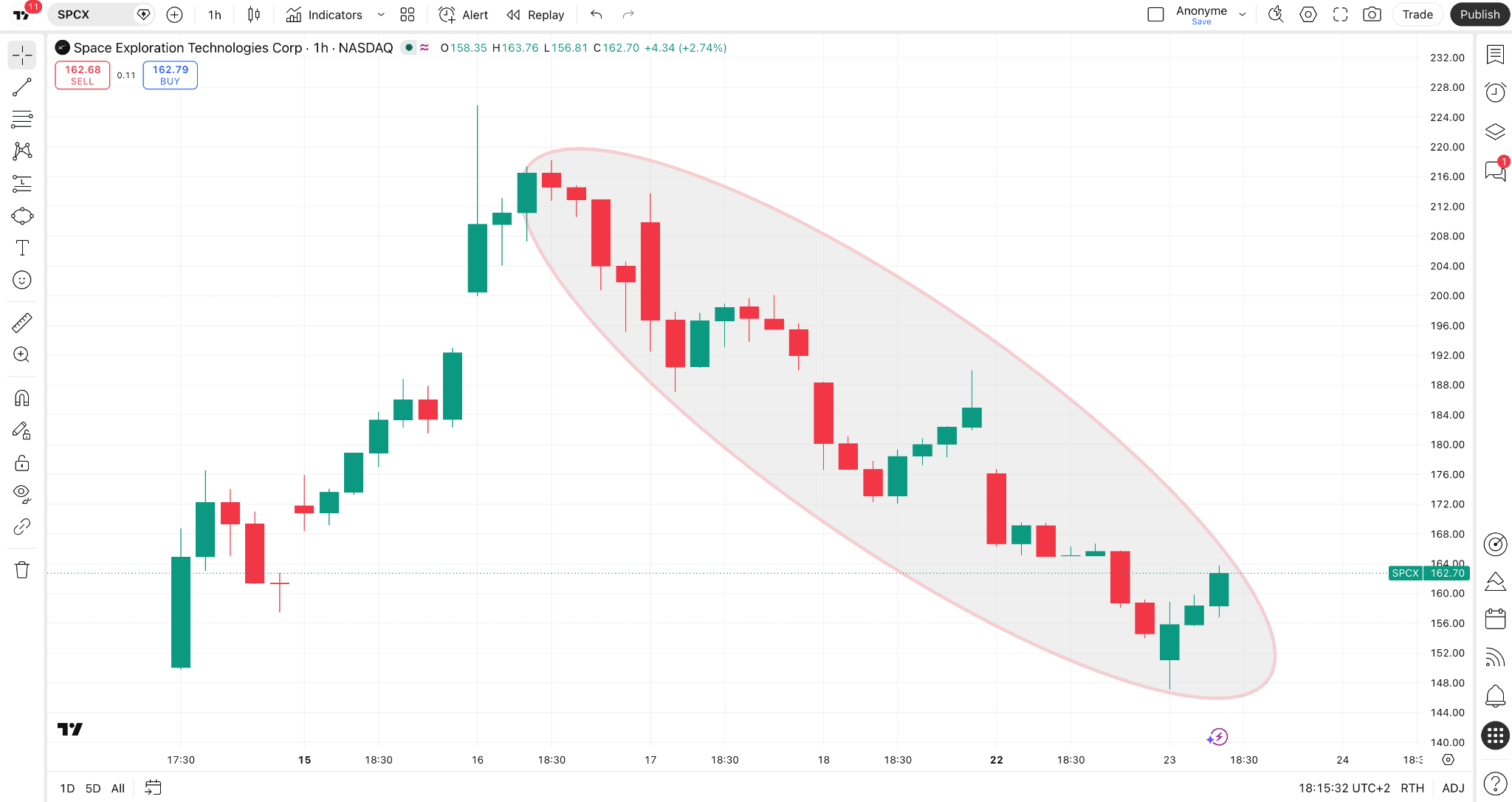
Morgan Stanley thinks SpaceX might generate about $330 billion in revenue by 2030 and later leap to something like $3.4 trillion by 2040, while the AI segment alone could reach roughly $190 billion in revenue by 2030. That sounds pretty optimistic, considering that SpaceX stock fell sharply barely a week after the IPO.
On the other hand, Goldman Sachs argues that AI revenue could increase 388% to $15.6 billion in 2026, before rising to $34.5 billion in 2027 and eventually reaching $322 billion by 2030. Goldman’s overall revenue estimate for 2030 reaches $474 billion, a figure that dwarfs the core rocket and satellite businesses most people associate with the company.
A notable anchor in the short-term picture is a compute capacity agreement signed with Anthropic in May 2026, under which the AI lab will pay $1.25 billion per month to lease capacity at SpaceX’s xAI data centers through May 2029.
At $1.77 trillion, SpaceX is priced at approximately 94 times its 2025 revenue. The average price-to-sales ratio of S&P 500 index stands at 3.38, while Tesla’s sits at 16.73. The threshold analysts have historically associated with bubble conditions is approximately 30 times. Morningstar has independently valued SpaceX at $780 billion, less than half the IPO target.
First-quarter 2026 data reinforces concerns: $4.69 billion in revenue, a $4.30 billion net loss (with an operating loss of $1.94 billion), and $7.7 billion in AI-specific capital expenditure in three months alone, out of $10.1 billion in total capex for the quarter — an annualised investment pace exceeding $30 billion.
Michael Hartnett of Bank of America has warned that the concurrent listings of SpaceX and OpenAI could push technology’s share of total market capitalization beyond every bubble peak recorded over the past century.
Michael Burry has drawn a parallel to the late 1990s, arguing that SpaceX, Anthropic, and OpenAI could collectively absorb as much capital as all technology IPOs of the year 2000, adjusted for inflation.
Elon Musk holds 93.6% of Class B super-voting shares (shares that carry ten votes each and were not made available in the public offering), giving him approximately 82.4% of all voting rights following the IPO. Investors based in China and Hong Kong have been excluded from participation on regulatory and compliance grounds.


