
business resources
The CV Buzzwords Ruining your Job Hunt

With many businesses forced to temporarily close for a few months earlier in the year, their finances have severely been impacted. So much so that they have had to take the drastic decision of making some of their employees redundant to ease cash-flow.
| •‘Best’ is the buzzword that hiring managers most hate seeing on CVs (76%) •71% are not a fan of applicants using the world ‘motivated’ on CVs •With over 4,000 appearances each on the CVs analysed, over 50% would rather candidates sway away from words such as ‘passionate’ (57%) and ‘excellent’ (54%) to highlight their skills/suitability •Interestingly, 43% of employers would prefer it if candidates didn’t use the cliché‘hardworking’ to describe their work ethic |
Those made redundant will undoubtedly be itching to get back into the job market and to do so, will be using their curriculum vitae (CV) to signal their credentials to prospective employers. Their eagerness to get back into work exemplified by an astonishing 9,900 Google searches* for ‘CV writing’ in the UK last month (June 2020). To help candidates increase their employability prospects, Resume.io consulted 562 hiring managers* across several popular industries in the UK, to discover the commonly used words on CVs they most dislike seeing.
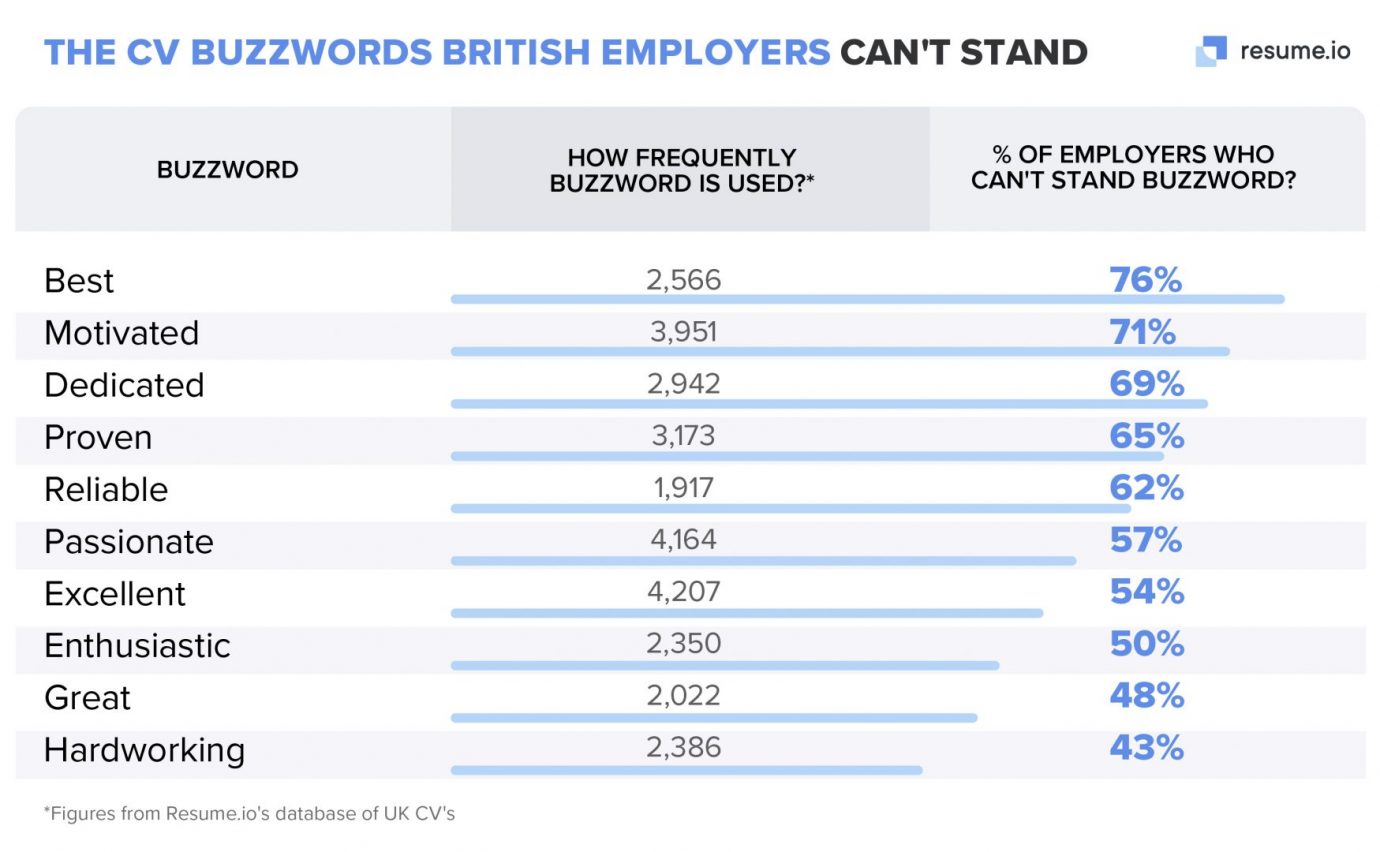
Resume.io found that ‘best’ is the word that employers most hate seeing on a CV, with 76% agreeing. The word indicates a strong ego and sense of self-importance. 71% of hiring managers are not a fan of candidates using the word ‘motivated’ on their CV. With nearly 4,000 uses of the word on CVs from Resume.io’s database, applicants might fare better with alternative options such as driven or goal oriented. ‘Dedicated’ (69%) and ‘proven’ (65%) are other words that a significant proportion of employers disapprove of on CVs. Given that a lot of individuals (4,207) are crediting some of their skills and accolades as ‘excellent’, they might be better off not doing so – as 1 in 2 (54%) hiring managers don’t look too fondly at the adjective on a CV. On the other end, 43% of employers would prefer it if candidates didn’t use the cliché ‘hardworking’ to define their work ethic.
Resume.io top tips on how to cut down buzzword usage on CVs
Don’t overstate
It is a competitive job market, so you might feel the need to describe your skills better than they are. But saying you are ‘great’ at a skill when you are only at a ‘good’ level is only going to cause you grief. Especially, if you get a job and your employer sees you’re not as great as you claimed to be.
Don’t be over-reliant on adjectives
Having a text-heavy CV does not automatically make you a better candidate, it’s all about quality over quantity. So, don’t feel the need to pack your CV with as many flattering adjectives as possible. Use them where you think they will truly give you a competitive advantage.
Give examples of achievements
It’s easy just to list a ton of skills without any evidence and in doing so, an employer might wonder if you are just making it up. So, instead of pinning all your hopes on buzzwords to solely boost your skills, use results and achievements from past professional and personal experiences to showcase those ‘excellent communication skills’, ‘proven sales record’ and ‘great teamworking skills’.


