
citiesabc, first_page
The Global AI Brain Race 2026: Which Countries Are Building the Next Generation of AI Leaders?
04 Mar 2026

The Global AI Brain Race Report 2026, published by essayHumanizer.io, evaluates more than 100 countries across a weighted framework combining AI research and development, economic integration, infrastructure, talent readiness, policy and governance, responsible AI, public opinion, and academic strength.
Its central finding: countries that align all of these pillars into one coordinated system are pulling decisively ahead.
The United States Leads by a Significant Margin
The United States ranks first with a final score of 82 out of 100, the highest of any nation and nearly double the score of the third-place country.
The study identifies the U.S. as the most structurally complete AI ecosystem in the world, leading across:
- AI R&D: 19.15 / 27.78
- Economic integration: 22.22 / 22.22 (a perfect score)
- Infrastructure: 16.21 / 16.67
- Responsible AI: 5.56
With 26 top universities for AI subjects and full economic deployment of AI technologies, no other nation currently matches the breadth and depth of the U.S. AI ecosystem.
China Holds Second Place on the Strength of Scale
China ranks second with a final score of 59 out of 100, powered by the world's largest AI education base.
With 107 top universities for AI subjects, more than four times the number in the United States, China's research and educational capacity is unmatched in volume. Its R&D score of 17.22 reflects that scale.
However, the study flags notable gaps in Policy and Governance (0.25) and Responsible AI (2.23), which constrain its overall score and raise questions about the long-term sustainability of its AI leadership model.
Asia Commands Half of the Global Top 10
One of the report's most significant findings is the degree to which Asia has consolidated AI leadership capacity.
Five of the top 10 countries are Asian:
- China (#2)
- Singapore (#3)
- South Korea (#4)
- India (#6)
- Japan (#9)
This regional concentration signals a structural shift in where future AI standards, talent, and infrastructure will be anchored.
The UK: Stable and Balanced, but Trailing the Superpowers
The United Kingdom ranks fifth with a final score of 33 out of 100.
Its position reflects consistent performance across multiple dimensions rather than dominance in any single one:
- Governance: 2.53
- Talent readiness: 5.48
- AI R&D: 2.57
- 15 top AI universities, with an average global score of 71.17
The study characterises the UK as a stable, research-driven ecosystem with strong governance credibility and academic depth. But its score of 33 is less than half of the United States' 82 and well behind China's 59, underscoring the scale of the gap between the UK and the two AI superpowers.
Smaller Nations Showing That Quality Can Offset Scale
Several countries in the top 10 demonstrate that concentrated excellence is a viable strategy, even without the institutional scale of larger nations.
- Singapore (#3, score 37) holds just two top AI universities, yet achieves the highest average AI subject score in the entire top 10 at 90.50. Its result makes the case that alignment and quality can outperform volume.
- Switzerland (#7, score 31) operates a small but precise ecosystem, with a strong average global university score of 75.40.
- Canada (#8, score 30) is research-led and institutionally stable, supported by a talent readiness score of 7.94.
The Full Top 10 Countries
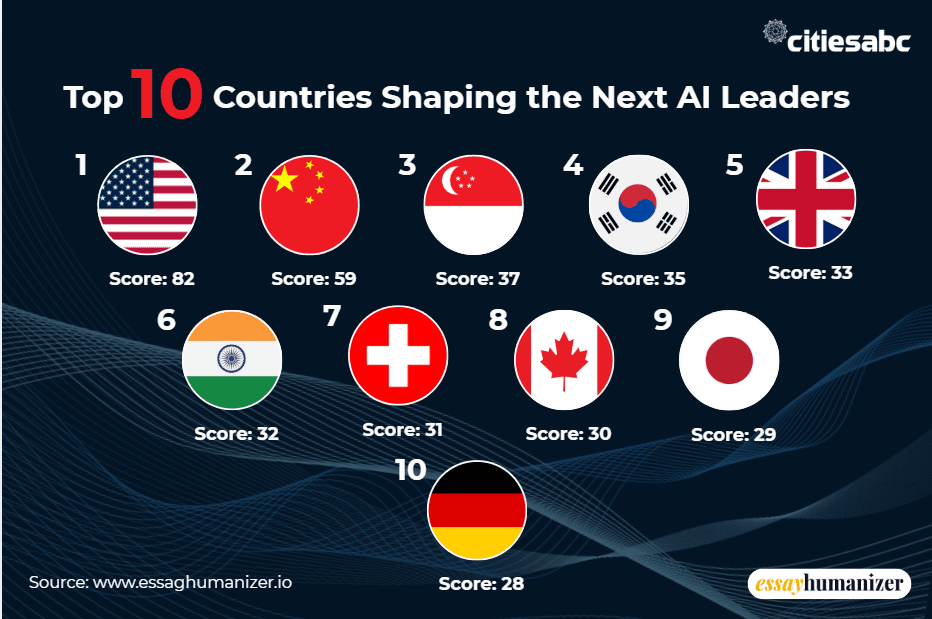
Rank | Country | Final Score |
| 1 | United States | 82 |
| 2 | China | 59 |
| 3 | Singapore | 37 |
| 4 | South Korea | 35 |
| 5 | United Kingdom | 33 |
| 6 | India | 32 |
| 7 | Switzerland | 31 |
| 8 | Canada | 30 |
| 9 | Japan | 29 |
| 10 | Germany | 28 |
Germany is notably the only European Union country in the top 10. It is supported by strong academic quality, an average AI subject score of 65.90, but limited by institutional scale, with just one top AI university.
India rounds out the top six with an exceptional talent base (9.12) and strong R&D (7.13), though infrastructure (0.65) and governance (0.11) gaps remain significant challenges.
AI Leadership Is Now a Structural Competition
The broader message of the Global AI Brain Race Report 2026 is that the nature of AI leadership has changed.
As the study's lead research director states:
"This is not just a ranking; it's a forward-looking structural analysis. Our findings show that the countries leading today are not simply ahead in research output. They are building integrated AI ecosystems across infrastructure, governance, talent, and economic adoption. Those ecosystems will determine who sets the global standards and direction of artificial intelligence over the next decade."
The countries at the top are not winning on any single metric , they are winning because they have built systems in which research, education, governance, and economic deployment reinforce one another.
For nations like the UK, which have the foundations in place but lag on scale and economic integration, the challenge ahead is less about capability and more about coordination.


