


resources, Trading Strategies & Tech
The Personal Liquidity Ladder: How Traders Should Structure Emergency Funds Before Touching the Markets
28 Sept 2026

The ladder at a glance
- Trading capital and living expenses belong in separate accounts, because a forced withdrawal during a drawdown converts a paper loss into a permanent one.
- A personal liquidity ladder ranks funding sources by speed and cost, from same-day cash through credit lines to asset sales.
- Most traders need three to six months of expenses in cash reserves before committing meaningful capital to the markets.
- Short-term credit belongs on the ladder as a bridge for genuine emergencies, never as a substitute for a reserve.
A personal liquidity ladder is a ranked structure of funding sources, ordered by how quickly each converts to spendable cash and what that speed costs. For traders, the ladder answers one question before it ever gets asked under pressure: when an unexpected expense arrives mid-drawdown, which account pays for it? Traders who cannot answer end up liquidating positions at the worst possible moment, which is how a temporary setback becomes a realized loss. The ladder exists so that market capital sits at the bottom, insulated behind cheaper and faster sources of cash.
Why should trading capital never double as an emergency fund?
The argument for separation is mechanical rather than moral. Markets price assets continuously, which means the value of a trading account is lowest precisely when volatility is highest, and volatility tends to arrive alongside the personal emergencies that force withdrawals. A trader who must pull C$2,000 from an account that is down 15 percent locks in the drawdown on that portion permanently, and no recovery in the market ever repairs it.
There is also a behavioural cost that compounds the arithmetic. Research on loss aversion has shown for decades that people take worse risks when trading money they cannot afford to lose, and practitioners describe the same pattern as trading scared money. A trader whose rent depends on this month’s performance sizes positions differently, exits winners early, and holds losers longer. Separating survival money from risk money is therefore a performance decision as much as a safety decision.
The Financial Consumer Agency of Canada recommends that households hold three to six months of regular expenses in an accessible emergency fund, and that guidance applies with extra force to anyone whose income or capital fluctuates with the market.
What do the four tiers of the liquidity ladder look like?
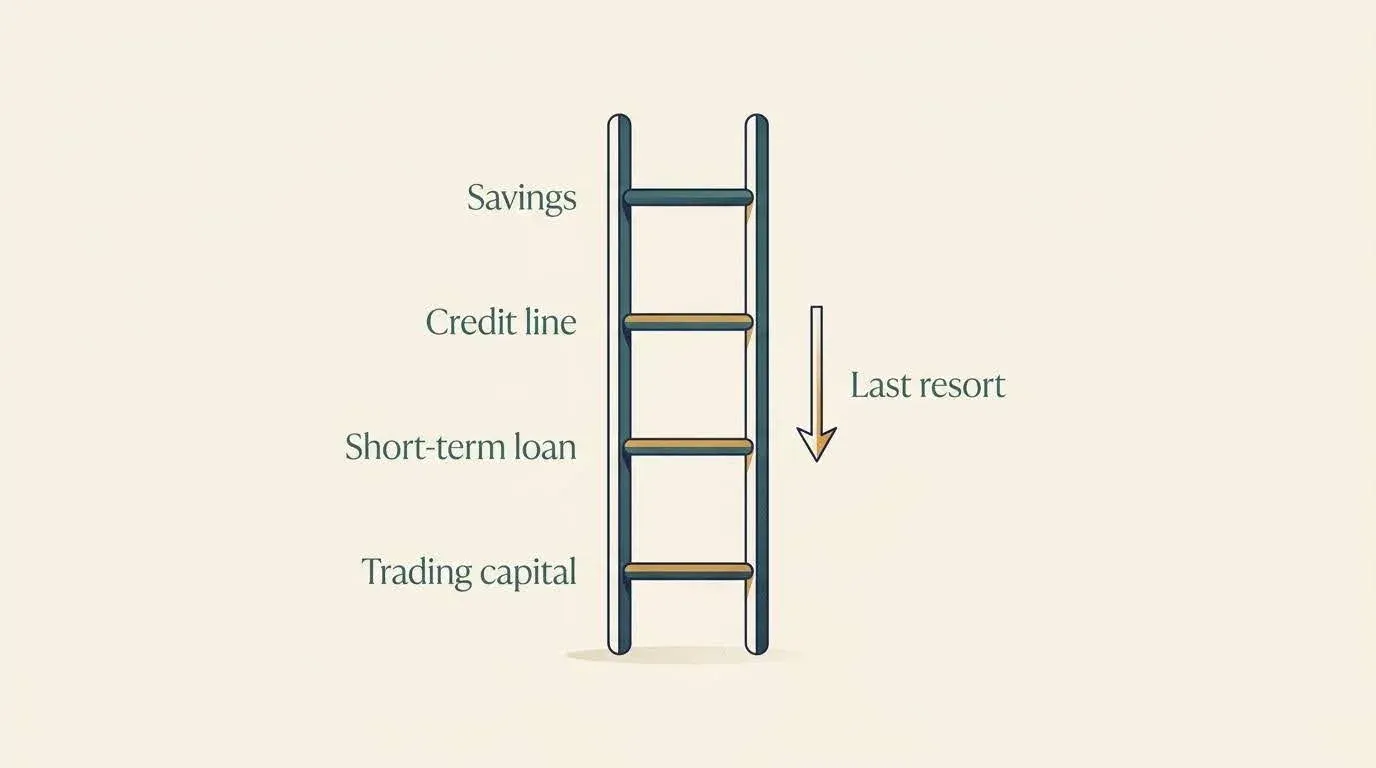
Each tier trades cost against speed. The discipline lies in exhausting each tier before touching the one below it.
| Tier | Source | Typical access time | Typical cost | Role |
| 1 | High-interest savings (the reserve) | Same day | Foregone interest only | First response for any emergency |
| 2 | Unsecured line of credit | Same day to 2 days | Prime plus 2–5% annually | Bridge when the reserve is thin |
| 3 | Regulated short-term credit | Same day | High; flat fee per $100 | Last-resort bridge for small, brief gaps |
| 4 | Trading capital / asset sales | 1–3 days settled | Realized losses, taxes, lost compounding | Touched only when tiers 1–3 are exhausted |
Tier one is boring by design, since its entire job is to exist. Rates on savings vehicles move with the policy rate, which the Bank of Canada publishes daily, so the reserve is no longer the dead weight it was in the zero-rate years.
Tier two, a personal line of credit, suits traders with banking relationships and clean credit files, though approval takes time and is best arranged long before it is needed.
Tier three is where regulated short-term lenders operate. In Canada, online lenders such as GoDay provide short-term loans for unexpected expenses, with the application completed online and funds typically delivered by e-transfer the same day. The tier exists for a narrow case: the expense is genuine, the amount is small, the reserve is depleted, and the alternative is selling positions into weakness. Provincial rules cap what this category can charge, and the flat-fee structure means the cost is knowable in advance, but it remains the most expensive rung above liquidation and should be repaid on the first cheque that allows it.
Tier four is the one the whole ladder protects. Selling assets to fund an emergency incurs the realized loss, potential tax consequences, and the permanent loss of whatever compounding those positions would have produced.
How large should the reserve be for someone with market exposure?
The standard three-to-six-month guidance assumes a salaried income, and traders rarely have one. A reasonable adjustment is to size the reserve against both fixed living costs and the volatility of income, holding closer to six months when trading income is primary and closer to three when a salary covers the bills. Funded-account traders face an additional consideration, because a personal cash crunch that tempts them into oversized positions can breach drawdown rules and destroy the funded account itself.
Payment infrastructure matters less than sizing, but it still matters. A reserve held at a different institution from the trading account adds a day of friction that discourages casual raids, while Interac e-Transfer means the money still arrives within minutes when the emergency is real.
When does short-term credit make sense for a trader, and when does it not?
The honest answer is that tier three earns its place on the ladder only under specific conditions. It makes sense when the expense cannot be deferred, the amount is modest relative to next month’s income, and drawing it protects positions with genuine recovery potential. According to the Financial Consumer Agency of Canada, a $300 short-term loan repaid over 14 days costs $45 at the common rate of $14 per $100 borrowed, which annualizes to roughly 365 percent. That figure is the reason the tier sits one rung above liquidation rather than higher.
It does not make sense as recurring income support, because a loan against next month’s pay solves nothing when next month has the same shortfall. Traders in that position have a sizing problem or an income problem, and no ladder fixes either.
Frequently asked questions
What is a personal liquidity ladder?
A ranked structure of funding sources ordered by speed and cost, designed so that emergencies are paid from cash and credit before any invested capital is touched.
How much emergency cash should a full-time trader hold?
Closer to six months of fixed expenses, since trading income is variable and the reserve must also cover stretches of flat or negative performance.
Is a short-term online loan ever cheaper than selling positions?
It can be when the position’s expected recovery exceeds the borrowing fee, but the comparison only favours borrowing for small amounts over short periods.
Should the emergency fund earn a return?
Only as a side effect, since reserves belong in insured, same-day-accessible savings, and chasing yield with them defeats their purpose.
Do funded-account traders still need a personal reserve?
More than anyone, because personal cash pressure is a common cause of the rule breaches that terminate funded accounts.
Final takeaway
The liquidity ladder is a risk-management rule applied to personal finance, and it precedes every other rule a trader follows. Cash reserves absorb the ordinary emergencies, arranged credit bridges the unusual ones, regulated short-term credit exists for the rare gap that remains, and trading capital stays invested through all of it. Traders should build the ladder in calm conditions, because the moment it is needed is the worst possible moment to design it.


