
citiesabc
Is the Traditional Economy Still Relevant in 2025?

The world today is moving faster than ever before. Technology, global trade, and digital platforms have created new ways of doing business. Yet, millions of people still live and work in ways that are very different from the modern economy. They follow what is known as the Traditional Economy.
This kind of economy is one of the oldest systems in human history. It is based on customs, culture, and simple methods of survival. Farming, fishing, hunting, and barter trade are its core features. For example, a family in a rural village may grow crops not to sell in a supermarket, but to feed themselves and exchange with neighbours.
You may wonder, does such a system still matter in 2025? The short answer is yes.
According to the International Labour Organisation, over 26% of the global workforce is still employed in agriculture, much of it in small-scale and traditional ways. In regions of Africa, Asia, and South America, many communities still rely on farming, herding, or craft-based production.
What is a traditional economy?
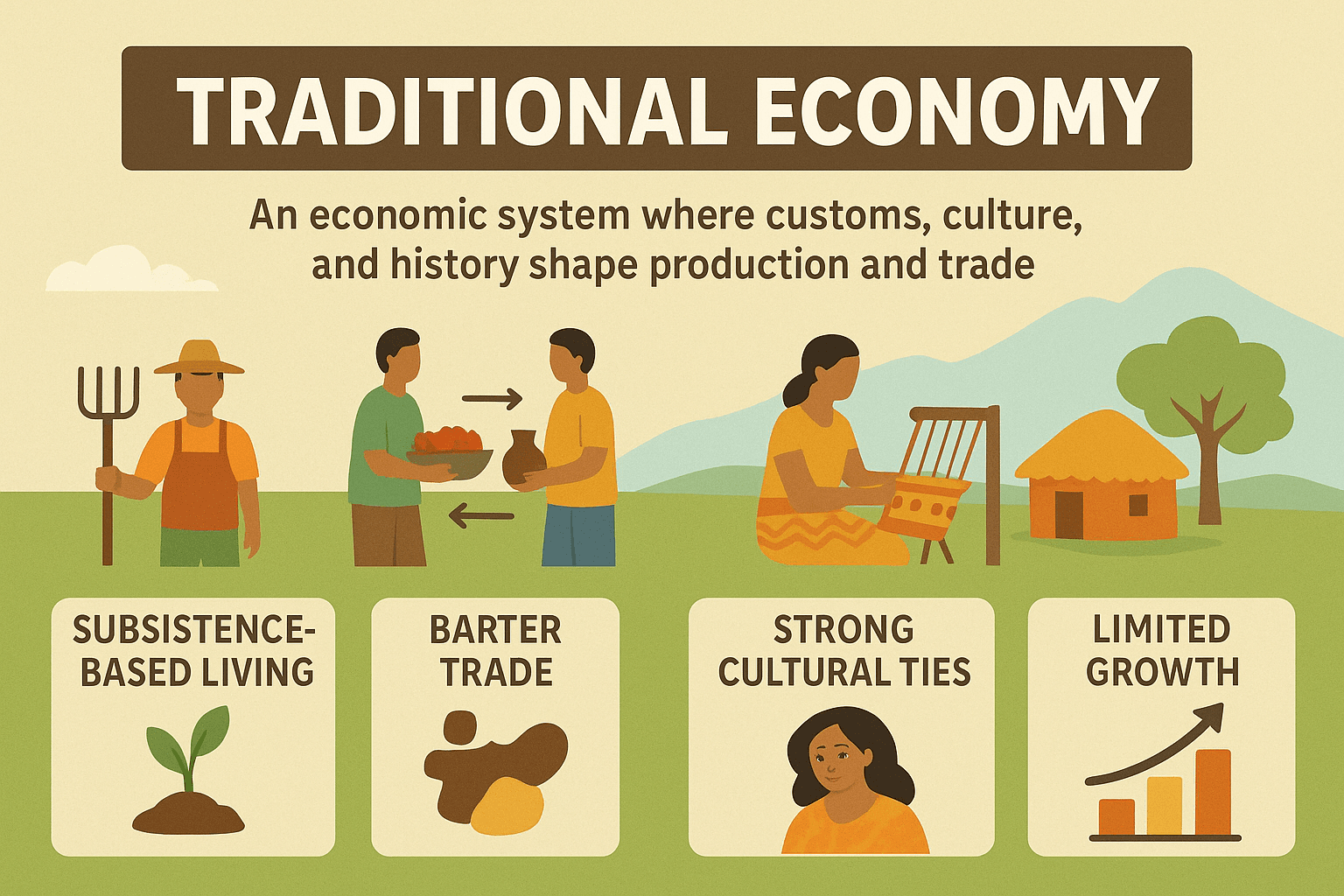
A Traditional Economy is an economic system where customs, traditions, and beliefs shape how goods and services are produced and exchanged. It does not depend on modern technologies or complex financial systems. Instead, it is built on survival and community.
Key Features
- Farming and hunting: Most families grow crops, fish, or raise animals for their own needs.
- Barter system: Instead of money, goods are exchanged directly. A farmer may trade rice for fish, or milk for tools.
- Role of family and tribe: Skills and trades are passed down from parents to children.
- Sustainability: People use only what they need, keeping waste to a minimum.
Advantages
- Strong community ties.
- Little or no pollution.
- Simplicity and self-reliance.
Disadvantages
- Very slow growth.
- Vulnerable to droughts, floods, or other natural problems.
- Limited access to healthcare, education, and modern comforts.
This mix of strengths and weaknesses shows why the Traditional Economy is still important in some regions, but not suitable everywhere.
Where can we see examples of a traditional economy today?
Even in 2025, there are many communities that live by the principles of the Traditional Economy.
Case Study: Rural India
In several Indian villages, families still depend on subsistence farming. They grow rice, wheat, or vegetables mainly for their own use. Surplus is sometimes sold in local markets, but barter between neighbours still exists.
Case Study: Sub-Saharan Africa
According to the World Bank, around 60% of people in Sub-Saharan Africa work in agriculture. Many live in rural areas with limited access to banking or the internet. Families rely on cattle, crops, and trade within the village.
Indigenous Communities
- The Inuit tribes in Canada and Greenland still practice hunting and fishing, relying on traditions that are centuries old.
- In the Amazon rainforest, tribal groups depend on farming, hunting, and natural resources, with little contact with modern markets.
These examples prove that the Traditional Economy is not just history; it is part of present-day life for millions.
Why do people still rely on the traditional economy?
If modern life offers faster growth and comfort, why do so many still depend on older systems?
- Limited Access to Technology- In many parts of the world, internet, mobile banking, or machinery are not available. Villages may not even have reliable electricity.
- Cultural and Social Values- People often prefer to live the way their ancestors did. Farming, fishing, or handicrafts are seen as not just survival but identity.
- Economic Barriers- Many rural families cannot afford modern equipment, education, or transport. They depend on what they can make or grow themselves.
- Food Security and Self-Reliance- In uncertain times, growing your own food gives stability. For example, when global markets face price shocks, traditional farmers can still rely on their crops.
What challenges does the traditional economy face in 2025?
Life in a Traditional Economy is not easy. The modern world puts pressure on such systems from many directions.
- Globalisation and Digital Trade- Modern economies create cheaper products at a faster pace. Traditional goods may struggle to compete.
- Climate Change- According to the United Nations, extreme weather events are increasing. Droughts, floods, and storms directly harm communities that depend on farming and fishing.
- Poverty and Inequality- Families in Traditional Economies often earn less than those in modern ones. They may lack healthcare, education, and housing.
- Migration of Youth- Many young people leave villages for cities, searching for jobs. This weakens the role of traditional systems, as fewer people remain to continue them.
- Lack of Skills for Modern Economy- Without digital literacy or technical training, traditional workers may find it hard to adapt.
These challenges raise the question of how long the Traditional Economy can survive without change.
Is the traditional economy still relevant in the modern world?
Despite its limits, the Traditional Economy still plays a vital role.
Cultural Identity
Traditional systems preserve culture and heritage. Whether it is farming festivals in India, craft traditions in Africa, or rituals linked to harvests, they hold deep meaning for communities.
Sustainability Lessons
Modern economies often focus on speed and profit, which can cause waste. Traditional systems, by contrast, are usually eco-friendly and resource-conscious. For example, small farmers often use organic methods without chemicals, which is now popular again.
Food Supply
The Food and Agriculture Organisation reports that small-scale farmers produce about one-third of the world’s food. This contribution is essential for global security.
Hybrid Models
Many governments and NGOs now support mixing old and new systems. For example, mobile phones allow farmers to check market prices while still farming traditionally. This hybrid model protects culture while offering better income.
What is the future of the traditional economy in 2025 and beyond?
Looking ahead, the Traditional Economy will not disappear, but it will change.
- Technology Integration: Mobile banking and digital marketplaces already help farmers sell products directly.
- Support from NGOs: Programmes that provide training, tools, and microfinance help communities grow without losing their traditions.
- Tourism and Crafts: Many communities earn income by sharing their culture with visitors or selling handmade products online.
- Sustainability Value: As the world faces climate challenges, traditional eco-friendly methods are gaining respect.
It is likely that by 2030, many communities will use a blended system, keeping traditions alive while adopting small parts of modern trade.
Conclusion: Does the traditional economy still matter?
The question was simple: Is the Traditional Economy still relevant in 2025?
The answer is yes, though in new ways.
While digital economies and global trade dominate headlines, the Traditional Economy remains the backbone of life for millions. It provides food, preserves culture, and teaches sustainability. At the same time, it faces real struggles—climate change, poverty, and migration.
The future lies in balance. By respecting traditions while using technology wisely, societies can make sure the Traditional Economy continues to add value. It may not drive global markets, but it still carries lessons for a fairer and greener world.


