
citiesabc, first_page
Two Countries. One Food Future: I Thought Agriculture Had a Technology Problem. I Was Wrong.
19 Oct 2026

The beginning of a new journey: from India's food chain to a possible UK & India agricultural future
For a long time, I viewed agriculture's challenges primarily as technology-related. As a technologist, I have dedicated much of my career to exploring systems, platforms, data, digital transformation, and the potential of artificial intelligence. Naturally, when I immersed myself in agriculture, my initial thought was straightforward:
Better data could improve farming practices.
Innovative platforms could expand access for farmers.
AI could support more informed decision-making.
Digital marketplaces could enhance price discovery.
Technology could help streamline operations and eliminate inefficiencies.
While these points still hold, my deeper exploration of the agricultural chain has revealed valuable insights. Instead of focusing solely on technological solutions, a more holistic approach is needed to address agriculture's complex, multifaceted challenges.
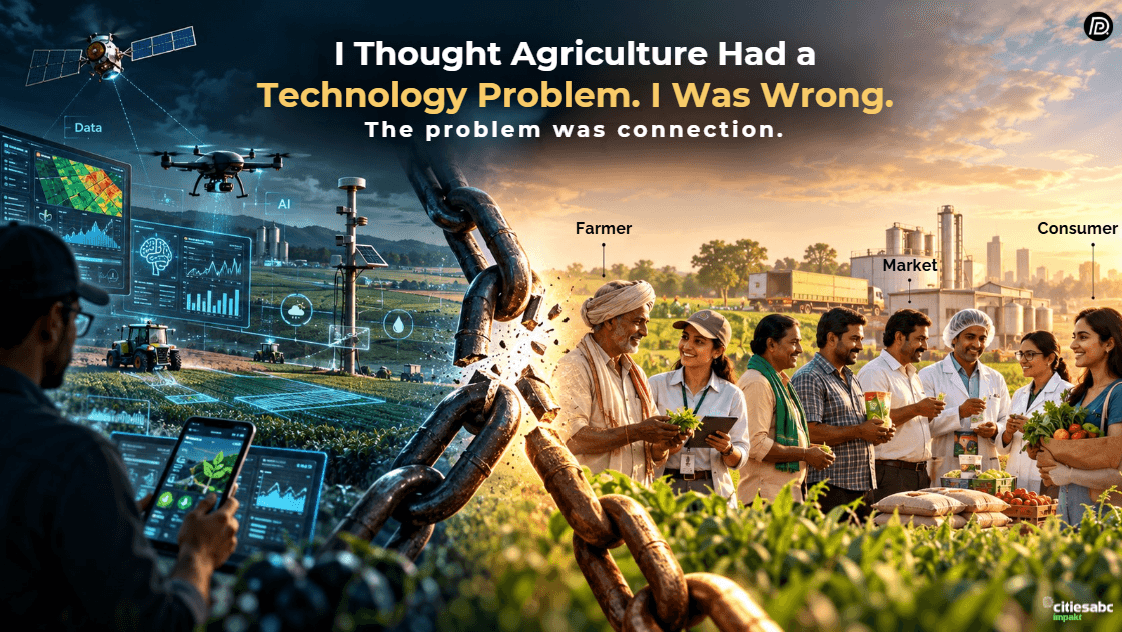
Technology was not the first problem.
Connection was.
This has likely been the most significant lesson I've learned from our work in Indian agriculture.
The People Were Not Failing
In my earlier Voices from the Chain series, I tried to understand agriculture differently.
Rather than beginning with a solution, I began with the people.
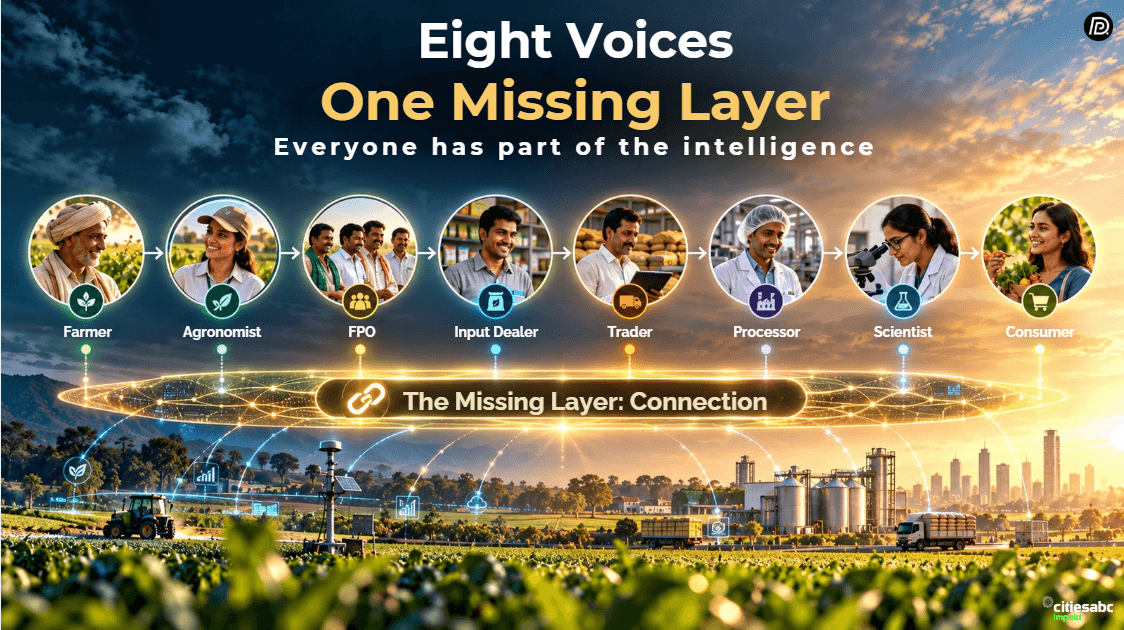
The farmer.
The agronomist.
The FPO leader.
The input dealer.
The mandi trader.
The food processor.
The agricultural scientist.
And finally, the consumer.
Eight actors.
One food chain.
What struck me was not how weak they were.
It was how much each one actually knew.
The farmer knew his land in a way no satellite ever could.
The agronomist understood soil, disease and crop science.
The FPO leader recognised both the challenges and the importance of organising farmers.
The input dealer often knew the farmer personally, sometimes better than any digital platform ever would.
The trader understood market movement.
The processor knew exactly what quality the market wanted.
The scientist had years of validated knowledge.
And the consumer ultimately decided what the entire chain was worth.
Yet each of them was operating with only part of the picture.
That became the central conclusion of the previous series:
India does not lack agricultural capability. It suffers from a crisis of connection.
The original Voices from the Chain conclusion described it as eight strong links without an effective connector between them.
That idea has stayed with me.
Because once you see agriculture this way, many apparently separate problems begin to look like the same problem.
The Farmer Knows the Crop. The Buyer Knows the Market. Why Don't They Know Each Other?
Consider something very simple.
A food processor may know months in advance that it needs a particular:
Size, quality, variety, moisture level, residue profile, or production standard.
But does the farmer know that before planting? Often, no.
The requirement travels backwards through the chain too slowly.
By the time the farmer discovers what the market really wanted, the crop has already been grown.
The decision is over.
Now consider agricultural science.
India has enormous agricultural research capability.
Scientists may spend years understanding a crop disease or improving a farming practice.
But how much of that knowledge reaches the farmer at the moment he has to decide whether to spray tomorrow morning?
Again, that is not necessarily a research problem.
It is a connection problem. Or take the consumer.
The person eating the food may increasingly care about: safety, nutrition, pesticide usage, origin, sustainability, and traceability.
But how much of that demand reaches all the way back to the farm? Very little.
We have built an agricultural chain.
But information still struggles to travel through it.
That Changed the Question for Me
Initially, I asked, "How can technology improve agriculture?"
Now I think that question is too narrow.
The better question is:
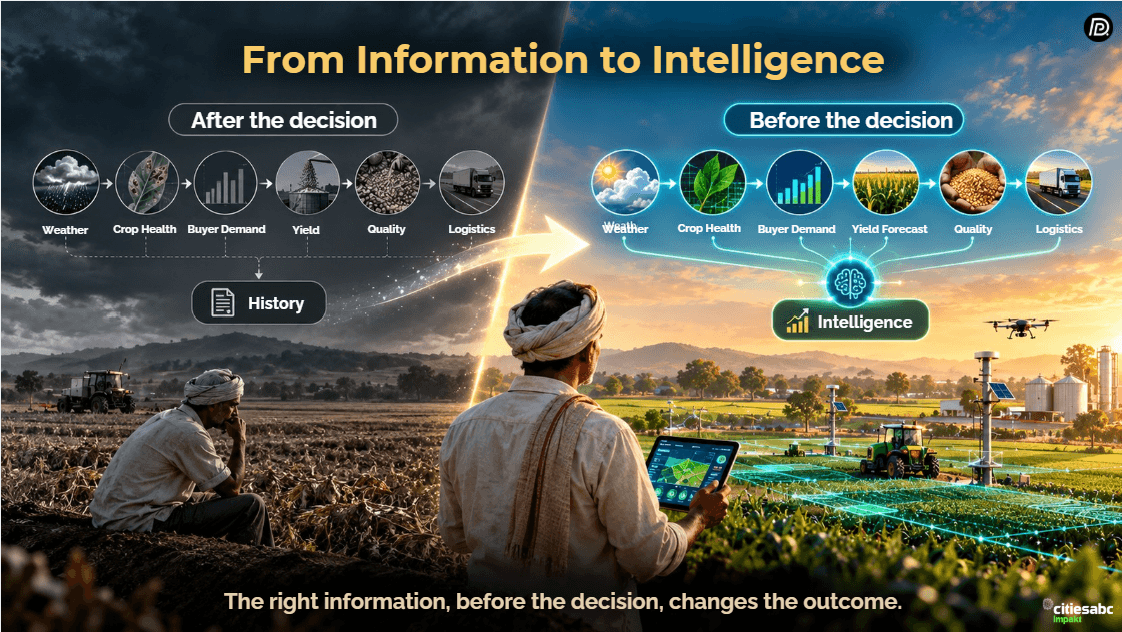
How can we ensure the right information reaches the right person before a decision is made?
That sounds subtle.
It is not. It changes everything.
Because once information arrives after the decision, it becomes history.
If it arrives before the decision, it becomes intelligence.
And agriculture increasingly needs intelligence.
Not dashboards.
Not another application.
Not another portal.
Then I Started Looking Outside India
Something else began to interest me.
The problems I was seeing in India felt enormous.
Millions of farmers.
Small holdings.
Weather uncertainty.
Water pressure.
Input costs.
Market fragmentation.
Traceability.
Farmer income.
At first, it is easy to assume these are largely Indian problems.
Then I started paying closer attention to what was happening in British agriculture.
The farms looked completely different.
The economics were different.
The scale was different.
The technology was different.
Yet the questions sounded strangely familiar.
How do we predict yield better?
How do we reduce labour dependency?
How do we respond to changing weather?
How do we use fewer inputs?
How do we improve productivity?
How do we reduce waste?
How do we make farming economically sustainable?
Different agriculture.
Same uncertainty.
That was important for me.
Because perhaps agriculture does not need one country to teach another.
Perhaps different agricultural systems need to learn from each other.
A British Strawberry Changed the Question Again
Recently, I came across the example of AI being used in British horticulture to analyse crops and improve harvest forecasting.
What fascinated me was not that a camera could count fruit.
That is technically interesting.
But it is not the breakthrough.
The breakthrough is what happens after the prediction.
If you know more accurately when fruit will be ready:
labour can be planned,
packhouses can prepare,
buyers can forecast supply,
logistics can be organised,
waste can fall,
and commercial decisions can be made earlier.
The AI didn't just understand the strawberry.
It changed the chain around the strawberry.
That is the part I find exciting.
Because suddenly the relevance to India becomes much bigger.
Now Imagine Nashik
Take grapes.
A grower in Nashik understands his vineyard.
A British buyer understands the market.
A logistics company understands the route.
A scientist understands crop health.
A weather system understands emerging risk.
An exporter understands compliance.
An insurer understands risk.
All of them possess intelligence.
But imagine if those pieces could begin interacting before the grape is harvested.
Could a buyer know expected quality earlier?
Could logistics capacity be planned earlier?
Could residue compliance be verified earlier?
Could insurance become more dynamic?
Could the farmer understand likely demand before making some production decisions?
At that point, we are no longer talking about a farm app.
We are talking about the beginnings of an intelligent food system.
Note: India exported about 280,000 tonnes of fresh grapes worth $375million in 2025.Of this,around 17,700tonnes,worth $35.3 million were exported to the UK.
And that brings me to the next question.
Why Should India Solve This Alone?
India has one of the world's most extraordinary agricultural environments.
Scale.
Crop diversity.
Climate diversity.
Smallholder complexity.
Scientific institutions.
A huge technology workforce.
Digital public infrastructure.
Entrepreneurship.
And increasingly, AI capability.
Britain brings a different set of strengths.
Precision agriculture.
Agricultural robotics.
Advanced horticulture.
Research.
Commercial validation.
Standards.
Food-processing systems.
Sophisticated retail.
Neither side has all the answers.
That is exactly why the opportunity interests me.
The interesting model is not:
Britain develops technology. India buys it.
Nor:
India develops low-cost technology. Britain imports it.
That is old thinking.
The more interesting possibility is:
What could India and Britain discover together that neither could discover as quickly alone?
And Now There Is a Bridge
On 15 July 2026, the UK–India Free Trade Agreement entered into force. UK government figures put bilateral trade at about £48 billion in 2025, and the agreement is designed to expand trade and investment further.
Most conversations about the agreement will understandably focus on:
tariffs,
cars,
whisky,
textiles,
services,
exports,
and investment.
But I keep wondering whether we are thinking too narrowly.
What if the most valuable things crossing this new bridge aren’t just products?
What if they are:
agricultural science,
AI models,
robotics,
farmer knowledge,
research,
skills,
data standards,
traceability systems,
climate intelligence,
investment,
and real-world learning?
Then the FTA becomes more than a trade agreement.
It becomes an opportunity to build an agricultural innovation relationship.
Possibly even an:
UK–India Agricultural Innovation Corridor.
That is one of the ideas I want to explore through this series.
Not promoted.
Explore.
Because there are difficult questions, too.
Technology Can Also Make Agriculture Worse
We should not assume digitisation automatically helps farmers.
Who owns the farm data?
Who benefits if the farmer's data improves an AI model?
Could more transparency give buyers even greater bargaining power?
Could AI advice be wrong?
Could an expensive British farming technology ever make economic sense for an Indian smallholder?
Could Indian low-cost solutions satisfy demanding British standards?
Would another digital platform simplify agriculture, or would it just add another login?
And perhaps the most uncomfortable question:
Are we building technology around the farmer, or are we building technology because agriculture has become an attractive technology market?
These questions matter.
I do not want this series to become another celebration of AI.
There are enough of those already.
The Farmer Does Not Need More AI
One lesson from the ground has become increasingly clear to me.
The farmer does not wake up thinking:
I need artificial intelligence today.
He thinks:
Will it rain?
Why is this leaf changing colour?
Should I spray?
How much fertiliser do I need?
Will the price rise?
Who will buy my crop?
When will I be paid?
Can I make enough money this season?
Technology matters only if it helps answer those questions better.
That is why I have increasingly started thinking in terms of Agriculture as a Service rather than agriculture as another collection of apps.
The farmer should not have to become a technology expert.
Technology should become better at understanding the farmer.
Maharashtra Has Become an Important Learning Ground
Much of this thinking has developed through our work and conversations in Maharashtra.
It is an extraordinary environment in which to learn.
Grapes.
Onions.
Cotton.
Sugarcane.
Soybean.
Horticulture.
FPOs.
Universities.
Research institutions.
Export markets.
Different farm sizes.
Different climatic pressures.
And increasingly, a serious conversation around artificial intelligence and agricultural transformation.
But I no longer see Maharashtra as the destination.
I increasingly see it as a laboratory.
India is the larger canvas.
And potentially, the UK becomes another laboratory of a very different kind.
One provides scale and complexity.
The other provides precision and a different innovation environment.
The real opportunity may lie between them.
This Series Is Therefore an Experiment
I do not want to start with a conclusion.
I want to start with questions.
Can British precision agriculture intelligence work in Indian conditions?
Can India's experience at scale teach British agriculture something?
Can research travel between the two countries faster?
Can farmers participate in the value created from their data?
Can an international buyer see a crop before harvest?
Can trade become predictive rather than reactive?
Can trusted actors such as FPOs, agronomists and input dealers become stronger through AI rather than being replaced by it?
Can agriculture move from fragmented digital tools toward an intelligent service layer?
And ultimately:
Can two very different agricultural systems help each other build a more resilient food future?
I do not yet know the full answer.
That is precisely why I want to make this journey.
From Voices to Connection
My previous series started by listening to eight voices.
That journey taught me that agriculture's biggest opportunity may not come from replacing people.
It may come from connecting them.
This series takes that learning one step further.
From connecting:
farmer to agronomist,
scientist to field,
buyer to producer,
consumer to food,
we will now ask whether we can also connect:
India to Britain.
Not simply through trade.
But through ideas.
Science.
Technology.
Experience.
Investment.
And perhaps most importantly: learning.
Because the next agricultural revolution may not begin with a new machine.
It may begin when information finally reaches the person who needs it.
before they have to make the decision.
That is the journey I want to explore.
And perhaps somewhere between an Indian field and a British farm, we may find part of the answer to a much larger question:
Who will feed the future & how?
Two countries.
Two very different agricultural systems.
One increasingly shared challenge.
One food future.
Follow the series for the next set of articles to explore the growing capabilities and markets of the two countries.
Share

Dilip Pungliya
Industry Expert & Contributor
Dilip Pungliya is a business leader, Artificial Intelligence consultant, blockchain advisor, metaverse solution expert, data leader, technologist, and business, process, & technology architect. As a board member and significant shareholder of ztudium, Dilip brings a wealth of experience in business leadership and data technology. In his role as the Managing Partner of the ztudium Group, he benchmarks his strategic acumen in steering effective strategy and framework development for the company. Dilip also plays a pivotal role in his family's limited company in India, VPRPL, where he oversees operations and strategic planning. His professional journey includes impactful collaborations with esteemed organisations such as Shell, the Department for Environment Food and Rural Affairs, Deutsche Bank, ICBC Standard Bank Plc, BNP Paribas, and HSBC Investments. Beyond his professional endeavours, Dilip is deeply committed to philanthropy and charitable work, particularly during the global challenges presented by the COVID-19 pandemic.


