
resources-impakt
Two Countries. One Food Future: The Farmer Who Knows Everything, Except What Happens Next
26 Oct 2026

There is something I have started to believe very strongly after spending more time understanding agriculture:
We underestimate how intelligent farmers already are.
A farmer may not use the language of algorithms, predictive models or decision intelligence.
But ask him about his land.
He knows where water sits after heavy rain.
He knows which corner dries first.
He recognises a change in a leaf's colour before most outsiders would notice anything.
He remembers which variety performed well three seasons ago.
He knows which neighbour's field usually catches disease first.
He knows when the soil does not feel right.
He can sometimes look at the sky, feel the wind and make a judgement that no dashboard has yet learned to make.
This knowledge has been accumulated over years.
Sometimes generations.
And yet, despite knowing so much about his farm, the farmer often has remarkably little visibility of what happens next.
That contradiction has stayed with me.
The Farmer Knows the Field. But the Future Sits Somewhere Else.
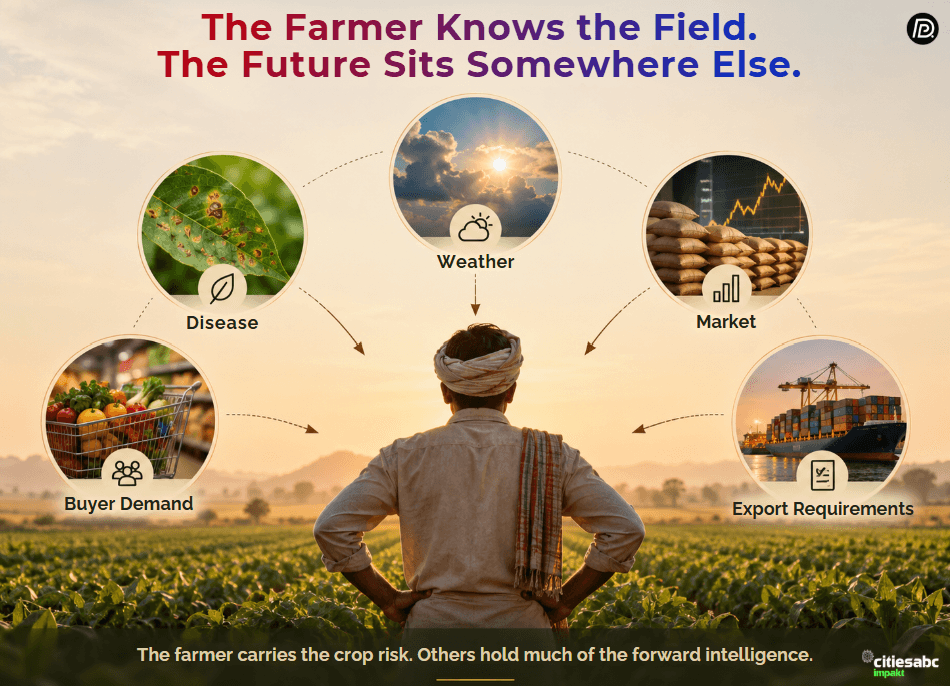
During my earlier Voices from the Chain work, I used a representative farmer named Raju to understand this problem.
Raju knew how to grow.
That was never his weakness.
His problem began when decisions moved beyond his farm's boundaries.
What will the weather do next week?
Will this pest spread?
What are farmers in neighbouring districts planting?
Will the market be flooded by the time his crop is harvested?
What quality will the processor require?
What price will the trader offer?
Is demand rising or falling?
Should he sell immediately?
Should he store?
Should he change the variety next season?
These are not small questions.
They determine whether months of work end in profit or disappointment.
And this is where I began to see a fundamental imbalance in agriculture.
The farmer carries much of the production risk.
But much of the forward-looking information sits elsewhere.
The trader sees market movement.
The processor understands future demand.
The scientist understands disease.
The weather agency sees incoming conditions.
The exporter knows international specifications.
The retailer sees consumer behaviour.
The bank knows credit.
The insurer understands historical risk.
The farmer has the crop.
But rarely the whole picture.
That is the paradox.
We Keep Giving Farmers More Information
For years, the answer has been: give the farmer information. Weather information. Mandi prices. Crop advisories. Input recommendations. Government schemes. Videos. WhatsApp groups. Mobile applications. Portals. Call centres.
All useful.
But I have started to question whether more information is actually the answer.
Because information by itself can create another problem.
Noise.
If a farmer receives five weather forecasts, six crop recommendations, three market prices and advice from ten different people, has the decision become easier?
Not necessarily.
Sometimes it becomes harder.
Technology people, including people like me, can easily misunderstand this.
We assume that once information becomes digitally available, the problem is solved.
It has not.
The actual challenge is:
Which information matters to this farmer, on this field, for this crop, at this moment?
That is a very different problem.
Agriculture Has a Timing Problem
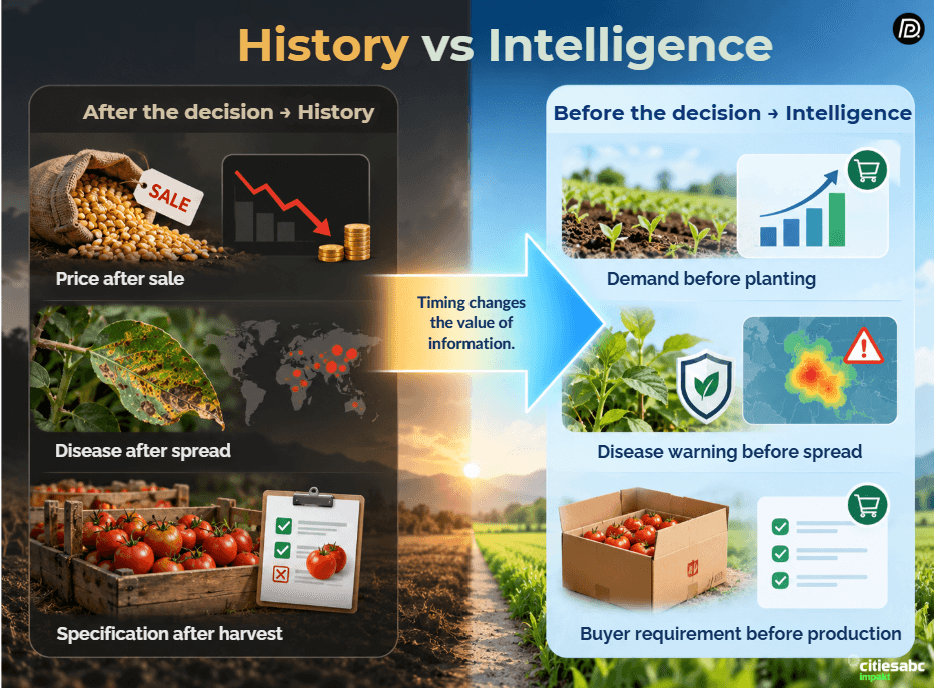
One of the most important lessons I carried forward from Voices from the Chain is that agricultural information often arrives too late.
A farmer learns after harvest that the market wants a different quality.
A processor tells the farmer the residue level is unacceptable after production.
A disease advisory reaches the village after the disease has spread.
A price spike becomes obvious after the farmer has sold.
A consumer trend becomes visible after the crop has already been planted.
A scientific finding is published
but may take years before it becomes normal farm practice.
That led me to a very simple distinction:
Information after the decision is history.
Information before the decision is intelligence.
And that, to me, is where the future of agriculture becomes very interesting.
Imagine the Same Farmer With Visibility
Imagine Raju again.
But this time, before planting, he can see that a food processor is looking for a particular crop variety.
He knows the expected quality specification.
He knows the likely procurement window.
He assesses his soil and water conditions against that crop.
The weather outlook is incorporated.
The agronomist can validate the recommendation.
The FPO can aggregate demand from multiple farmers.
Finance can align with the crop plan.
And the buyer can see expected production months before harvest.
Suddenly, the farmer is not simply producing and hoping.
He is making a forward decision.
That is a completely different agricultural model.
This Is Already Beginning to Become Possible
India is quietly building infrastructure that could support such a model.
The Government's Digital Agriculture Mission is developing AgriStack around three foundational components:
Farmer Registry
Geo-referenced village maps
Crop Sown Registry
The wider architecture also includes the Krishi Decision Support System, intended to bring together information including satellite imagery, weather, soil, water and crop data.
By July 2026, more than 10.18 crore Farmer IDs had already been created. Government systems are also increasingly using satellite information for crop insurance and yield estimation.
This is significant.
But a digital identity is not yet intelligent.
A database is not yet a decision.
The real value comes when these pieces start working together around the farmer.
Maharashtra Makes This Very Real for Me
My own thinking keeps returning to Maharashtra because the state brings the issue into sharp focus.
Take grapes.
Maharashtra accounted for more than 69% of India's grape production in 2024–25, according to APEDA. India exported about 224,401 tonnes of fresh grapes worth US$368 million in FY2025–26, with the UK among the major destinations.
Now think about what sits behind one box of grapes exported from Nashik.
The grower.
The agronomist.
The input programme.
The weather.
Residue management.
The packhouse.
Quality inspection.
Traceability.
Cold storage.
Exporter.
Shipping.
Importer.
Retailer.
Consumer.
That one box is already a data system.
We simply do not always treat it that way.
And this creates a question I find increasingly difficult to ignore:
Why should the buyer understand the market better than the farmer who carries the production risk?
I am not suggesting the farmer needs every piece of commercial information.
But surely he should see enough of the future to make a better decision.
The Most Dangerous Decision Happens Before the Crop Exists
We often think agricultural risk begins after planting.
I increasingly think some of the biggest risks begin before planting.
The farmer decides:
what to grow,
which variety,
how much land to allocate,
what inputs to purchase,
how much credit to take,
and which market he expects to sell into.
At that moment, the crop does not exist.
But much of the season's economics is already set.
That means one of the most valuable agricultural technologies may not be a harvesting robot.
It may be a system that helps answer a question before sowing:
What should I grow, for whom, under what conditions, and with what expected risk?
That is not a weather app.
It is not a mandi-price app.
It is not simply AI.
It is decision intelligence.
What I Learned
My earlier instinct was that farmers needed more expert advice.
I now think that is only partly true.
In many cases, farmers already have considerable expertise.
What he often lacks is visibility into information beyond his own field.
The most valuable technology may therefore not be technology that tells the farmer:
You don't know. I do.
It may be technology that says:
You know your farm. Here is what you cannot currently see.
That is a fundamentally different relationship between farmers and technology.
The farmer remains the decision-maker.
Technology expands his field of vision.
And This Is Where AI Could Either Help or Fail Completely
Enormous excitement surrounds AI advisory systems.
But there is also a danger.
If we take a generic AI model and ask it to tell a farmer what to do, we could create a more sophisticated form of bad advice.
Agriculture is local.
Soil is local.
The weather is local.
Variety is local.
Water availability is local.
Disease pressure is local.
Market economics can be local.
A recommendation that works 200 kilometres away may be wrong for a particular farm.
So AI should not arrive as an oracle.
It needs context.
Farmer knowledge.
Scientific knowledge.
Local weather.
Soil.
Crop history.
Market demand.
And ideally human validation where the decision carries meaningful risk.
In other words:
AI should not replace the farmer's intelligence. It should connect the intelligence surrounding the farmer.
That is much closer to what I now believe.
A Farmer Should Be Able to See Around the Corner
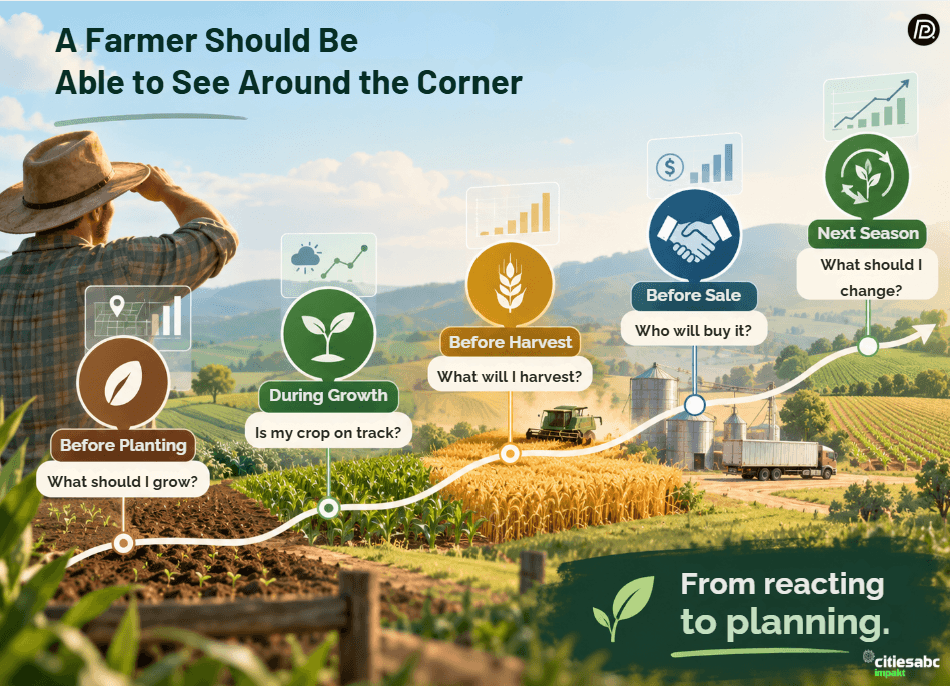
Imagine agricultural decision-making in five simple stages:
Before planting
What crop?
Which variety?
For which market?
During growth
Is the crop healthy?
Is the weather changing?
Before harvest
What yield is expected?
What quality is likely?
Before sale
Who needs it?
At what price?
Should I sell now?
After sale
What worked?
What should change next season?
Today, these decisions often operate almost independently.
The future opportunity is to connect them.
And if we can do that, the farmer moves from being the last person to receive market intelligence to becoming one of the first.
That changes bargaining power.
That changes risk.
That changes planning.
And potentially, it changes income.
But There Is a Bigger Question
If India can build this kind of forward visibility for millions of farmers, the implications extend well beyond India.
India offers something unusual.
Huge scale.
Crop diversity.
Climate diversity.
Smallholder farming.
Sophisticated commercial agriculture.
Export agriculture.
Digital infrastructure.
AI talent.
Scientific institutions.
All inside one agricultural system.
That makes India more than a market for agricultural technology.
It makes India a laboratory for whether agricultural intelligence can actually work at scale.
But this story has another side.
While I was thinking about how an Indian farmer might see further into the future, I came across something happening thousands of miles away.
In Britain, AI already predicts when strawberries will be ready for harvest.
At first, that sounds like a completely different story.
It isn't.
Because the important part is not the strawberry.
The important part is what happens when a farm can see the future before it arrives.
That's where our journey goes next.
What Could Change Tomorrow?
I would start with five practical principles:
1. Start before planting.
Connect crop choice to expected market demand, climate and agronomic suitability.
2. Combine farmer knowledge with external intelligence.
Do not design systems that assume the farmer is the least informed participant.
3. Convert data into decisions.
A farmer does not need twenty dashboards. He needs clarity at the decision moment.
4. Connect buyers earlier.
Quality requirements should reach farmers before production—not after rejection.
5. Measure outcomes, not app downloads.
The test of technology is whether risk falls, quality improves, input use becomes smarter, and farmer economics improve.
The Question I Am Carrying Forward
The farmer already knows an extraordinary amount about what is happening in his field.
The problem is that he cannot see beyond it.
So the next question is:
What happens when technology starts predicting what comes next?
And to explore that, we have to leave India for a moment.
We are going to a British strawberry farm.
Because what is happening there may tell us something surprisingly important about the future of an Indian farmer.
Next:
Then I Found a British Strawberry Farm Predicting the Future
Share

Dilip Pungliya
Industry Expert & Contributor
Dilip Pungliya is a business leader, Artificial Intelligence consultant, blockchain advisor, metaverse solution expert, data leader, technologist, and business, process, & technology architect. As a board member and significant shareholder of ztudium, Dilip brings a wealth of experience in business leadership and data technology. In his role as the Managing Partner of the ztudium Group, he benchmarks his strategic acumen in steering effective strategy and framework development for the company. Dilip also plays a pivotal role in his family's limited company in India, VPRPL, where he oversees operations and strategic planning. His professional journey includes impactful collaborations with esteemed organisations such as Shell, the Department for Environment Food and Rural Affairs, Deutsche Bank, ICBC Standard Bank Plc, BNP Paribas, and HSBC Investments. Beyond his professional endeavours, Dilip is deeply committed to philanthropy and charitable work, particularly during the global challenges presented by the COVID-19 pandemic.


