
resources-impakt, first_page
Two Countries. One Food Future: The Maharashtra Experiment, Can One State Connect the Chain?
16 Nov 2026

One question keeps coming back to me.
We already know the farmer isn't lacking knowledge.
We know the chain does not lack capability.
We know technology is becoming more predictive.
And we know India and Britain have complementary strengths.
So why is agriculture still so fragmented?
I increasingly believe the answer is not that we lack solutions.
It is that we have built too many solutions that do not talk to each other.
One system for weather.
Another for soil.
Another for crop advisory.
Another for finance.
Another for insurance.
Another for government schemes.
Another for markets.
Another for exports.
Another for traceability.
We are digitising agriculture.
But are we actually connecting it?
That is why Maharashtra interests me so much.
Not because Maharashtra has solved the problem.
It has not.
But because it is trying something unusually ambitious:
Can one state create the connective infrastructure that allows agricultural intelligence to flow across the chain?
That is a much more interesting experiment than simply launching another agritech platform.
Maharashtra Is Not Starting From Zero
Maharashtra has already set out a clear direction through its MahaAgri-AI Policy 2025–2029.
The policy is not limited to AI advisory.
It includes:
MahaAgX: a consent-based agricultural data exchange.
MahaVISTAAR: bilingual AI-powered advisory in Marathi and English.
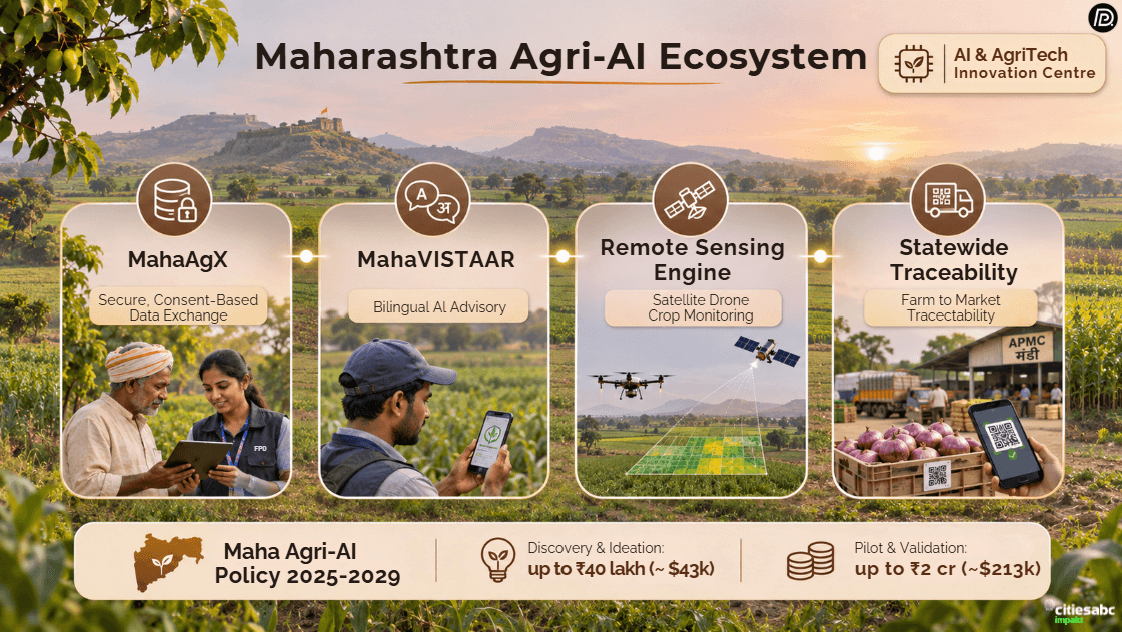
A shared remote-sensing and geospatial intelligence engine.
An AI-enabled agri-food traceability and quality-certification platform.
Funding for innovation.
Capacity building.
And an institutional platform to connect government, research, startups, FPOs and technology companies.
The state has also established the AI & AgriTech Innovation Centre as a nodal platform intended to bridge policy, research, technology and field implementation.
That is important.
Because the difficult part of agricultural transformation is rarely the idea.
It is the coordination.
My Learning From the Previous Series Was Simple
In Voices from the Chain, one lesson kept repeating itself.
Every participant knew something valuable.
The farmer knew the field.
The agronomist knew science.
The FPO knew aggregation.
The dealer knew local behaviour.
The trader knew the market.
The processor knew quality.
The scientist knew what should work.
The consumer knew what they wanted.
The problem was that these forms of intelligence rarely travelled through the chain quickly enough.
That is why I became increasingly sceptical of point solutions.
A weather app can help.
A crop advisory can help.
A marketplace can help.
A drone can help.
An AI model can help.
But if each remains isolated, we may simply be creating digital fragmentation.
And digital fragmentation is still fragmentation.
The Real Test Is Not Whether Maharashtra Can Build AI
It can.
The harder question is:
Can Maharashtra connect the decision chain?
Imagine one farmer.
Not an abstract farmer.
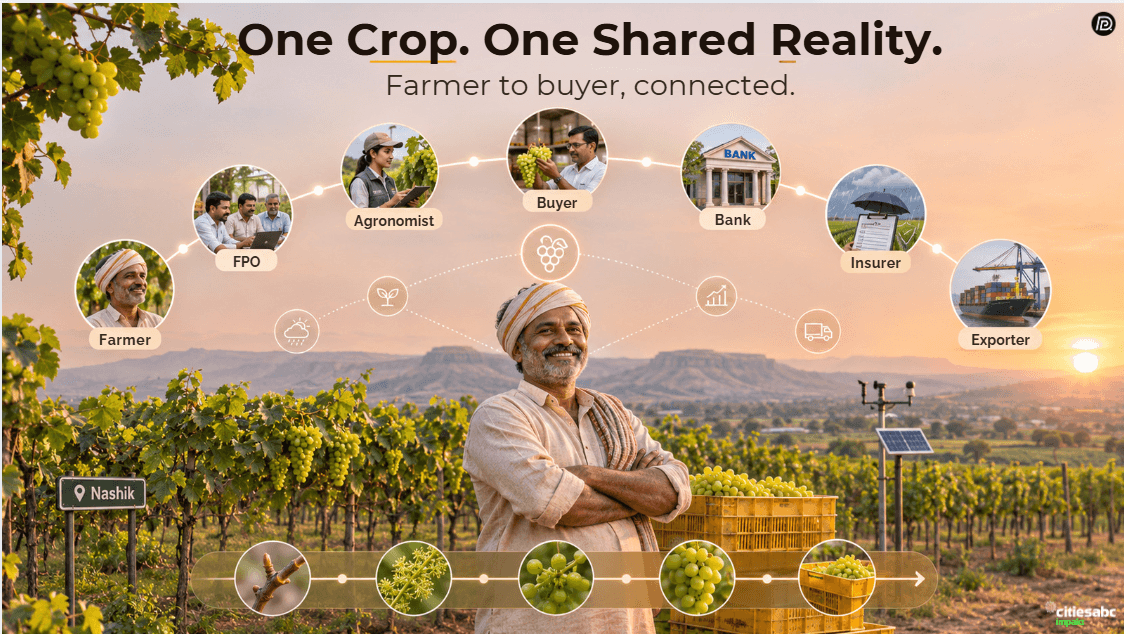
A real grape grower in Nashik.
He has a digital identity.
His farm is registered.
The crop is known.
Weather data is flowing.
Satellite imagery is available.
Input usage is recorded.
The agronomist can see crop risk.
The FPO can see expected production.
The exporter can see quality and compliance.
The buyer can see likely volume.
The insurer can see risk.
The bank can see the crop cycle.
Now the system starts to become interesting.
Because each participant is no longer operating from a different version of reality.
They begin working around the same crop, the same farm and the same decision timeline.
That is what connection should mean.
This Is Where MahaAgX Becomes Important
MahaAgX is being positioned as a secure, consent-based agricultural data exchange.
In simple terms, it is intended to allow agricultural datasets to move between stakeholders while maintaining permission and governance.
That sounds technical.
But the practical implication is much bigger.
If weather data, crop data, satellite data, farmer information, market intelligence and advisory systems can begin working from a common data foundation, then we can move from:
isolated applications
to:
connected services.
The state describes MahaAgX as a foundational digital-public-infrastructure layer for AI, analytics, and innovation across the agricultural ecosystem.
In my view, that's one of the most important ideas in the policy.
Because AI without connected data is limited.
But Data Exchange Alone Will Not Change Agriculture
This is where I think we have to remain pragmatic.
A farmer doesn't benefit just because two databases can talk to each other.
He benefits if that connection changes a decision.
For example:
The weather forecast says heavy rain is likely.
Remote sensing confirms crop stress.
The AI model adjusts the risk.
The agronomist validates the recommendation.
The FPO coordinates input or service support.
The insurer understands the exposure.
The farmer receives one clear action.
That is useful.
But if the system produces five dashboards and three notifications, we have failed.
So the test for MahaAgX, MahaVISTAAR and every other digital layer should be:
Did the connection make the next decision better?
That is the standard that matters.
MahaVISTAAR Could Be the Interface But Not the Whole System
MahaVISTAAR is a bilingual, AI-powered advisory platform that provides crop- and location-specific guidance through voice and text.
That is valuable.
Especially in a state where language, literacy and digital familiarity vary enormously.
But advisory alone cannot solve agriculture.
A farmer may receive the correct recommendation and still be unable to act because:
the input is unavailable,
the labour is unavailable,
finance is delayed,
the FPO is not organised,
the buyer is missing,
or the market price makes the intervention uneconomic.
This is a crucial distinction.
Advice is not action.
A genuinely connected system needs to link advice to the institutions that can act on it.
This Is Where FPOs Become Critical
In the previous article, I argued that prediction becomes valuable for smallholders only when an institution can act on it.
In Maharashtra, that institution is often the FPO.
Suppose a system forecasts that 800 farmers will collectively harvest 6,000 tonnes of onions over a particular window.
The forecast itself is useful.
But the real value begins when the FPO can use it to: find buyers, book transport, arrange storage, coordinate grading, organise packaging, negotiate finance, and plan market timing.
Now prediction becomes commercial intelligence.
The chain becomes:
Farm prediction
- FPO aggregation
- Buyer commitment
- Packaging
- Transport
- Finance
- Insurance
- Market
That is far more powerful than simply sending each farmer an alert.
Maharashtra Has a Structural Advantage
One reason Maharashtra is a useful laboratory is its agricultural diversity.
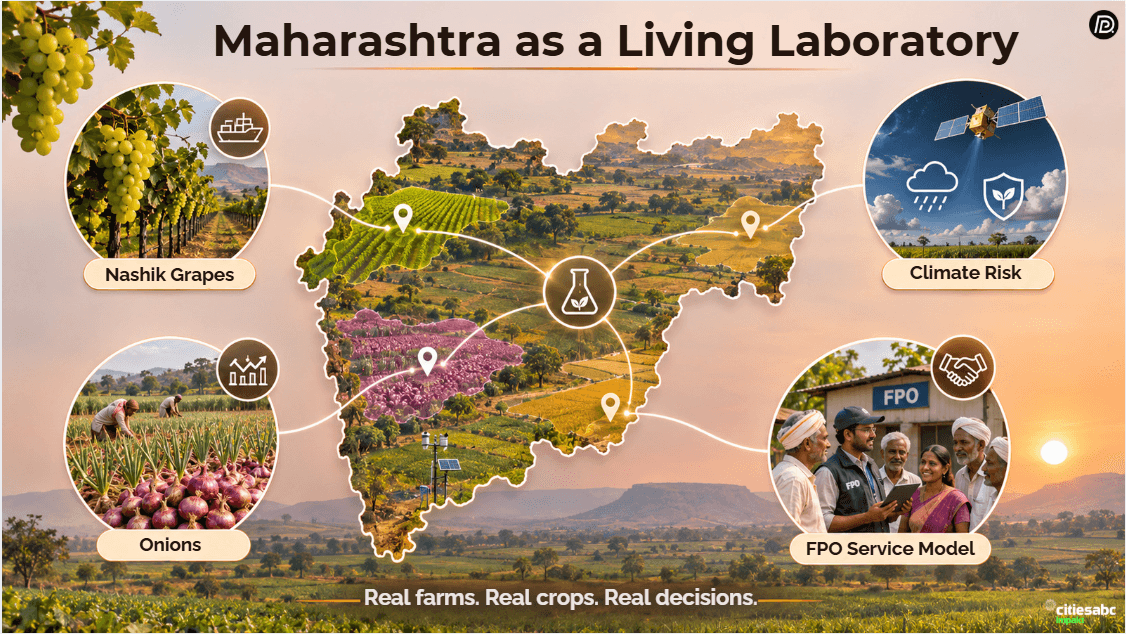
It has grapes, onions, cotton, sugarcane, soybean, pomegranates, vegetables, horticulture, dairy, export-linked agriculture, and large domestic supply chains.
That allows different technologies to be tested against very different commercial realities.
A grape export model is not the same as an onion market model.
The sugarcane supply chain is different again.
Cotton has another set of economics.
That diversity matters.
Because if the state can build a common intelligence layer across different crops and markets, it becomes a much more credible model for wider replication.
The State Is Also Trying to Build a Real Innovation Pipeline
Another important element is the structure being built around pilots.
Under the MahaAgri-AI programme, the state has created one track for early-stage discovery and another for field validation and scaling.
The current framework offers support of up to ₹40 lakh for discovery and ideation, and up to ₹2 crore for pilot and validation projects.
That is a useful structure.
Because one of the biggest weaknesses in agritech is the gap between:
prototype
and
real adoption.
The technology works in a controlled setting.
Then it reaches the field and fails because:
the data is incomplete,
the farmer does not trust it,
the economics do not work,
the interface is too complex,
or no institution is responsible for acting on the recommendation.
A serious pilot should expose those weaknesses.
That is what field validation is for.
What I Would Test First
If I were designing a Maharashtra-wide experiment, I would not start with 50 use cases.
I would start with four.
One export crop
For example:
Nashik grapes.
Connect: farmer, FPO, agronomist, weather, AI yield forecast, residue records, packhouse, exporter, UK buyer.
Measure: rejection rates, forecast accuracy, quality consistency, farmer realisation, and logistics efficiency.
One volatile domestic crop
For example:
onions.
Connect: production forecast, FPO aggregation, storage, market demand, transport, mandi intelligence, and price movement.
Ask: Can earlier visibility reduce distress selling?
That would be a powerful test.
One climate-risk crop
Take a crop where weather variation creates significant risk.
Combine: satellite data, local weather, soil information, crop stage, insurance, and advisory.
Ask:Can we identify risk earlier and reduce loss?
One farmer-service model
Instead of giving every farmer technology, give the technology to:
FPOs, agronomists, KVKs, extension workers, or trusted local intermediaries.
Then measure whether farmer adoption improves.
This matters especially because technology doesn't always need to be farmer-facing.
Sometimes the best route to the farmer is through the person they already trust.
This Is Where Our Agriculture-as-a-Service Thinking Fits
The more I have worked through this chain, the less convinced I am that agriculture needs more standalone products.
What it needs is a service architecture.
- One identity.
- One farm record.
- Many services.
- Weather.
- Soil.
- Advisory.
- Inputs.
- Finance.
- Insurance.
- Market access.
- Traceability.
- Logistics.
Not necessarily one company providing everything.
But one system allows them to work together.
That is how I increasingly think about Agriculture as a Service.
Not as another app.
Not as another portal.
But as an intelligence and service layer around the farmer.
And Maharashtra is one place where that idea could be tested at a meaningful scale.
But There Is a Risk
Large digital systems can look impressive on paper but disappoint in the field.
The risk is that success gets measured by: the number of farmers registered, the number of datasets integrated, the number of apps launched, the number of advisories sent, the number of pilots announced.
Those are useful operational metrics.
But they are not farmer outcomes.
The real measures should be:
Did yield improve?
Did input cost fall?
Did the risk fall?
Did rejection fall?
Did the farmer receive a better price?
Did payment happen faster?
Did the FPO become stronger?
Did the buyer gain confidence?
Did the farmer come back and use the service again?
If those answers are weak, the technology has not yet succeeded.
The UK Connection Makes Maharashtra Even More Interesting
This brings us back to the broader series.
If Maharashtra becomes a strong test environment, Britain can play a practical role.
British companies and research institutions can bring: computer vision, precision horticulture, robotics, forecasting, quality systems, traceability, and commercial validation.
Maharashtra can bring: real farms, crop diversity, FPO networks, scale, local institutions, digital infrastructure, and complexity.
Then the goal is not merely:
UK technology deployed in India.
It becomes:
technology co-developed in Maharashtra, validated in real conditions, and then potentially used in both markets.
That is a much more valuable relationship.
And the UK–India trade framework gives that type of collaboration a stronger commercial context.
What I Learned
My earlier work made me think agriculture had too many disconnected actors.
The Maharashtra experiment has made me realise something else.
We may also have too many disconnected technologies.
The next phase is not simply to digitise every actor.
It is to connect their decisions.
The farmer should not have to understand the architecture.
The system should disappear into the service.
And if we get this right, the technology becomes almost invisible.
The farmer experiences: better timing, better advice, better access, lower risk, and better outcomes.
That is when digital agriculture becomes real agriculture.
What Could Change Tomorrow?
I would keep the Maharashtra experiment focused on seven practical principles:
1. Connect around a crop, not around a technology.
2. Use FPOs and trusted intermediaries as operating institutions.
3. Make MahaAgX the data layer, not the farmer interface.
4. Use MahaVISTAAR to support decisions, not overwhelm farmers with advice.
5. Bring buyers, banks, insurers and logistics into pilots early.
6. Measure commercial outcomes, not digital activity.
7. Build every successful model with replication beyond Maharashtra in mind.
That last point matters.
Maharashtra should not become a closed experiment.
It should become a learning environment for India.
The Question I Am Carrying Forward
If Maharashtra can connect the farmer, the FPO, the agronomist, the scientist, the buyer, the bank, the insurer, the exporter, and the consumer,
then something fundamental changes.
The chain stops being a chain of separate transactions.
It begins becoming an intelligent network.
But one difficult question remains.
Even if all the technology exists…
even if all the data exists…
even if science exists…
How does the right knowledge reach the farmer at exactly the right moment?
That takes me to the next article.
Next:
The Scientist Had the Answer. The Farmer Never Saw It.


