
resources-impakt
Voice Of Agriculture Market (Mandi) Trader: I Know the Price, you don't, that Is Not an Accident
25 May 2026

Previously, in Voices From The Chain
Part of the Agriculture Gap Series, Building on 'The Price of Ignorance' and followed by the series of Article 1: 'Voice of Farmer: He Grows It. Others Price It' Article 2: Voice of Agronomist: I Know Your Soil, But I Can't Reach You, Article 3: Voice Of An FPO Leader: We Are Stronger Together, The System Does Not Believe That Yet, and Article 4: Voice Of Input Deal: I Sell You the Seed & Advice, Only One of Those Is in Your Interest which explore the journey of Raju, a cotton farmer from Vidarbha, Dr Priya, an agricultural scientist from Pune, Meena the chairperson of FPO, and Vijay an input dealer to sell product with better margin. All face challenges due to a lack of vital information, the inability to translate research into practical applications in the field, and the inability to agree on a joint hand to grow and sell, or to create an advisory role independent of the selling margin.
These challenges highlight a common issue: talented individuals often cannot reach their full potential without a robust support system and the power of collaboration.
Attempt to disintermediate
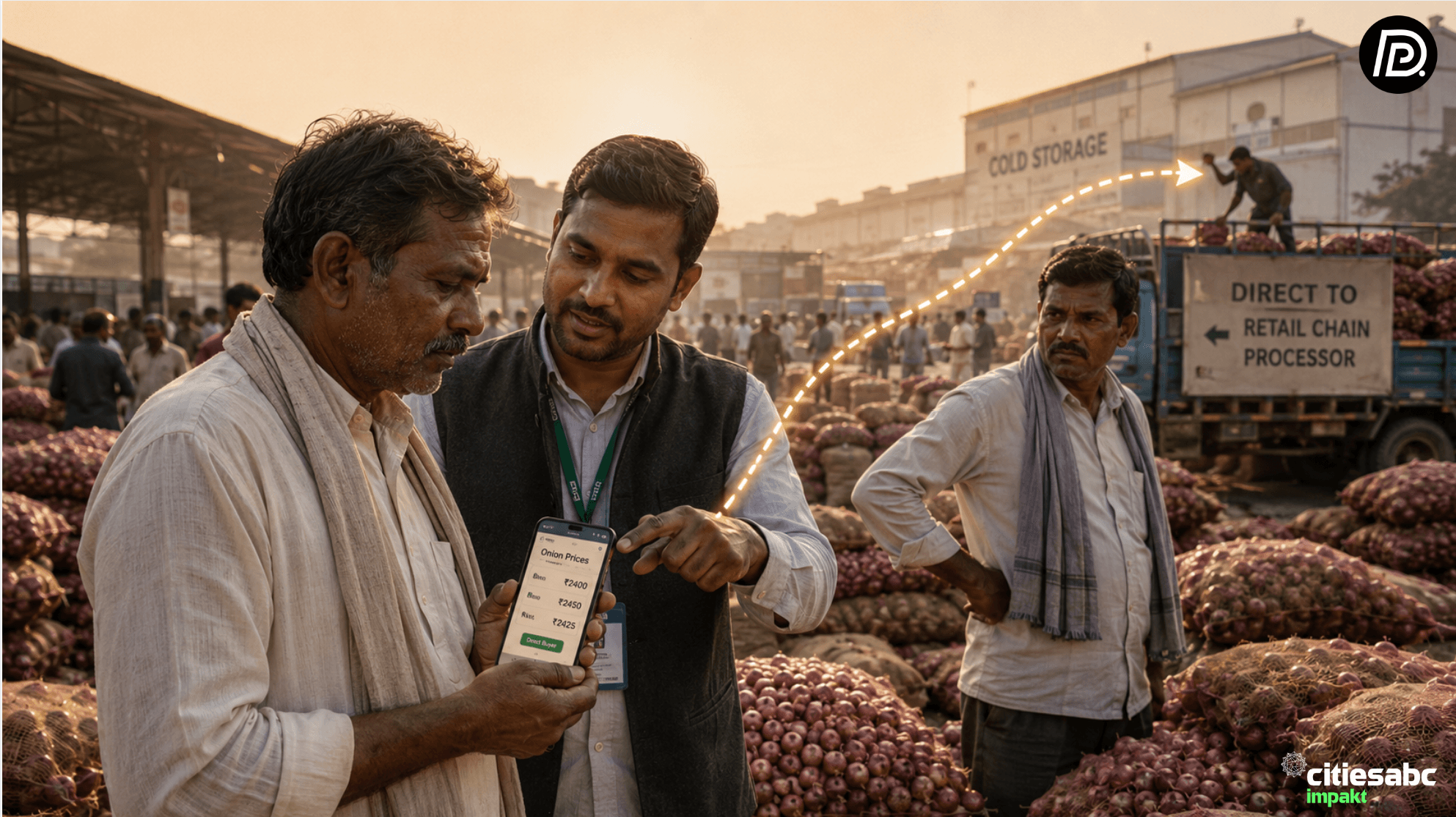
While much of India is still waking up, Ramesh has already been at the mandi for two hours. Asia's largest onion wholesale market in Lasalgaon operates early in the morning, not by choice, but because the produce arrives overnight and buyers aim to complete their transactions before the afternoon heat sets in. As an arhatiya, or commission agent, Ramesh has dedicated 19 years to this mandi, playing a crucial role in the supply chain.
His mobile phone rings twice before six o'clock, both calls from buyers in Pune, one from a processing company and another from a wholesale distributor. They are inquiring about prices. Ramesh informs them of the current rates: ₹18 to ₹22 per kilogram for good-quality onions and ₹12 to ₹14 for seconds. However, he doesn't mention that the farmer whose produce is up for auction is just twenty meters away, unaware of the prices being discussed.
This knowledge gap between Ramesh and the farmer highlights a significant issue in agricultural markets. To fully understand the dynamics at play, it's essential to recognise Ramesh's role, the valuable services he provides, and the reasons why attempts to bypass him without offering adequate alternatives have not succeeded.
Not a Market. A Service Bundle.
The Agricultural Produce Market Committee (APMC) is a statutory body established by state governments in India. It was created in the post-independence era with the important purpose of regulating the marketing of agricultural and horticultural produce and protecting farmers from exploitation by unregulated local buyers. The APMC aimed to establish licensed, regulated wholesale markets that facilitate transparent price discovery, positioning the mandi as a supportive ally for farmers.
However, over more than six decades, the mandi has transformed into an institution that serves a dual role. While it continues to provide valuable services to farmers, it has also developed mechanisms that can inadvertently extract value from them in complex, challenging ways that need to be addressed without significant changes. This intricate balance has allowed the role of the arhatiya (commission agent) to endure through numerous attempts at reform.
To fully appreciate this situation, it's essential to consider the genuine services that Ramesh, the arhatiya(commission agent), offers. Instead of viewing his role solely through the lens of a supposed information advantage, we should recognise what he actually contributes to farmers, especially for those arriving at Lasalgaon at 5 AM with twelve quintals of onions and no clear buyer in sight.
| Service Provided By Arhatiya | What The Farmer Gets | What The Arhatiya Extracts |
| Market Access | Entry into a licensed wholesale market with multiple competing buyers | Commission of 2–6% on the total transaction value, paid by the farmer |
| Storage & Handling | Short-term storage, weighing, grading, loading until the lot is sold | Storage fees, weighment charges, loading charges additional to commission |
| Price Discovery | Access to multiple buyers bidding in a single auction event | Information asymmetry Ramesh knows buyer intent before auction opens |
| Credit Extension | Cash advance against produce before the lot is sold often same day | Implicit interest 18–36% annualised; debt creates selling dependency |
| Buyer Relationships | Established contacts with processors, wholesalers, exporters nationally | Relational advantage, farmer cannot replicate this independently |
| Risk Absorption | Ramesh bears short-term price risk while the lot awaits the right buyer | Spread between buy and sell price; price timing advantage |
| Payment Guarantee | Farmer receives payment from Ramesh, not from buyer Ramesh absorbs default risk | Ramesh's financial exposure gives him negotiating leverage with both parties |
It's important to examine the table closely. Each service listed on the left corresponds to a legitimate extraction on the right. These services and extractions are interconnected and constitute a single transaction. This connection explains why reform efforts that focus solely on eliminating Ramesh can be ineffective. They inadvertently eliminate both the service and the extraction simultaneously, leaving the farmer without essential support. A more comprehensive approach is needed to ensure that farmers retain access to both services and extractions, fostering a healthier system overall.
The arhatiya serves as a vital pillar of the agricultural value chain, recognised as a legitimate service provider. While his pricing model may seem opaque and his information advantage deeply rooted, the many unsuccessful attempts to replace him highlight the need for a more honest approach in acknowledging his role.
When you use a professional service, like in banking, legal, or real estate, you're often paying for a mix of valuable and less valuable services. How do you determine if the price is fair? What would make you consider switching to a service that separates and individually prices each service?
The Price Ramesh Knows and the Price You Don't
It's important to clarify the nuances of information asymmetry, as it provides a clearer understanding than the general statement 'traders exploit farmers' suggests. Ramesh possesses three distinct categories of information that the farmer in the mandi lacks, and each category offers a unique structural advantage. Understanding these differences can lead to more effective solutions to bridge the knowledge gap and promote fairness in the marketplace.
Category One: Real-Time Price Information Across Multiple Markets
At 6 AM in Lasalgaon, Ramesh draws on his extensive network of contacts, mandi management software, and active WhatsApp groups with fellow commission agents to gather valuable insights into onion prices in major cities such as Pune, Mumbai, Ahmedabad, Delhi, Hyderabad, and Kolkata. With nineteen years of market experience, he understands the dynamics of supply and demand, knowing precisely which markets are facing surpluses and which are experiencing shortages. He is also well-informed about the purchasing targets of processing companies and the current trends in export demand.
In contrast, the farmer has limited access to this information. He relies on roughly what onions sold for at his local mandi last week, heavily influenced by discussions with other farmers, whose insights may not always be accurate. This difference in market knowledge and access to information creates an information asymmetry. However, this gap presents an opportunity to improve communication and information-sharing practices. We can empower farmers with the insights they need to make informed decisions, ultimately benefiting their livelihoods. Ramesh's years of relationship-building and market engagement can serve as a model for creating collaborative networks that include farmers' voices, thereby narrowing the information gap and fostering a more equitable marketplace.
Category Two: Buyer Intent Before the Auction
Ramesh's early-morning phone calls, made before 6 AM, play a crucial role in the price discovery process. These calls provide insights into buyer preferences, enabling Ramesh to gauge the price range that dominant buyers are willing to pay before the public auction starts. It means that by the time the auction opens, Ramesh has a solid understanding of the market dynamics, while the farmers may not be fully aware of these price indicators.
This approach to pre-auction consultations is common practice in many agricultural commodity markets worldwide and is not illegal. While it may create a situation in which the intermediary's knowledge somewhat influences the auction's competitive bidding process, it also underscores the importance of clear communication and transparency in market transactions. Ensuring that farmers have access to similar market insights could enhance the competitive bidding environment, ultimately benefiting all parties involved.
Category Three: Seasonal and Quality-Linked Price Patterns
Ramesh has amassed nineteen years of valuable data, providing him with insights into the onion market in Lasalgaon. He has observed that onion prices typically peak between the 18th and 24th of each month. His understanding extends to the nuances of different onion varieties and their appeal to various buyer types, as well as the impact of moisture content on prices. For instance, he knows that moisture levels exceeding 12 per cent can result in penalties from processing buyers, although wholesale distributors are less affected by this factor. Furthermore, Ramesh has identified specific exporters who consistently offer above-market rates for certified low-residue produce.
Farmers, while aware that prices fluctuate, often lack the deeper market insights that Ramesh possesses. This disparity in understanding represents a key information asymmetry, significantly influencing a farmer's decisions on harvest timing, grading practices, and sales strategies. By bridging this gap, farmers can make more informed choices that enhance their profitability and market positioning.
Structural Information Asymmetry: A scenario in which one party to a transaction consistently holds greater information about the transaction's price can arise from their institutional role, established relationships, and long-term engagement with the market. In the context of a mandi, the information advantage held by the arhatiya is a natural outcome of the system's design. Addressing this issue effectively involves reforming the system's underlying architecture rather than focusing solely on penalising individuals.
Reflect on the last significant purchase or sale you made where the other party had more market knowledge than you did. How did you address that knowledge gap? Did you seek independent advice? Did you conduct research? Did you trust that the process would be fair?
Now, consider a farmer facing a perishable crop, a debt due at harvest, and a lack of access to a smartphone for market data. What realistic options were available to them?
The Disintermediation Graveyard: Five Attempts That Did Not Work
Over the past thirty years, the Indian agricultural market has undergone various reforms aimed at redefining the role of the arhatiya. Each initiative has been well-intentioned and supported by significant policy efforts and public investment. While these attempts have not yet achieved their intended outcomes on a large scale, analysing the reasons behind this can provide valuable insights for future efforts. Understanding the challenges faced can guide us toward more effective solutions moving forward.
Attempt One: Direct Marketing Reforms
Many state governments have made significant amendments to their APMC Acts, allowing farmers to sell directly to processors, retailers, and exporters without going through the mandi system. This reform is based on sound reasoning, as there is no agronomic justification for requiring farmers with verified quality certificates to utilise auction markets. However, the practical impact of this change has been somewhat limited. A majority of farmers continue to rely on the mandi because the anticipated direct buyers have not yet emerged in their regions, or they are not available in sufficient volumes or with favourable payment terms that align with farmers' needs. Addressing these challenges could enhance the success of this reform and provide more opportunities for farmers to benefit from direct sales.
Attempt Two: e-NAM, The Electronic National Agriculture Market
e-NAM, launched in 2016, represents a significant step towards modernising agricultural market infrastructure in India. This unified online trading portal connects mandis across the country, empowering farmers with access to national-level price discovery through a digital platform. While the initiative has made strides, there is potential for further adoption and enhancement. The integration of large institutional buyers is still a work in progress, and expanding the quality assaying infrastructure would greatly benefit both buyers and sellers by enabling transactions without the need for physical inspections in more mandis. Additionally, while the role of the arhatiya remains vital in facilitating transactions, exploring ways to innovate this interaction could enhance the value brought to farmers and buyers alike, creating a more efficient and effective marketplace.
Attempt Three: Farmer Producer Organisations as Alternate Channels
As Article 3 of this series examined, FPOs can, in principle, aggregate volume and negotiate directly with large buyers, bypassing the mandi. In practice, as that article documented, fewer than 30 percent of FPOs are genuinely active. Among those that are active, most continue to sell through the mandi for at least some of their produce because they lack the cold storage, working capital, and buyer relationships to operate as a fully independent channel. The mandi persists because the services it bundles, which the FPO would need to replicate, are genuinely difficult and expensive to replace.
Attempt Four: Private Markets and Contract Farming
The contract farming model, where processors or retailers engage directly with farmers to purchase produce at a pre-agreed price, has been successfully implemented across various crops and regions. This system offers several benefits to participating farmers, including price certainty, access to inputs, and technical advisory support. However, it's important to acknowledge some challenges associated with this model. Farmers commit to a single buyer, which can create complications, especially if their interests differ at harvest time. Contract renegotiation is common when market prices fall below agreed contract rates. In such situations, farmers, who may have limited legal and financial resources compared to corporate buyers, can face significant hurdles. By addressing these challenges and fostering a more balanced relationship between farmers and buyers, the contract farming model can continue to evolve and provide even greater benefits to stakeholders in the agricultural sector.
Attempt Five: Regulatory Commission Rate Caps
Several state governments have implemented caps on the arhatiya's commission rate, limiting it to 2 or 3 percent of the transaction value. This policy change has prompted some adjustments in the market, as arhatiyas have shifted their revenue streams from regulated commissions to unregulated ancillary charges such as weighment fees, storage charges, loading fees, and quality-related price adjustments. While the commission cap aims to reduce overall costs, total revenue extraction has not decreased accordingly. Understanding that arhatiyas are rational economic actors, it's important to recognise their ability to adapt and maximise revenue within the existing regulatory framework. Their institutional knowledge enables them to navigate these changes effectively, underscoring the need for ongoing dialogue to create a more transparent and equitable pricing structure in the industry.
Every reform aimed at eliminating the arhatiya without addressing the essential services they provide has faltered. It is not due to the overwhelming power of the arhatiya, but because those services are truly indispensable. The way forward lies not in elimination but in disaggregating services, making valuable support accessible without the burdens of information asymmetry.
The five efforts mentioned earlier each aimed to solve a genuine issue but ultimately fell short of their objectives. If you were to come up with a sixth approach, what changes would you make? What are the essential services that farmers need from the market, and what basic changes could be made to level the playing field for buyers and sellers, ultimately leading to better results for everyone involved?
Nobody Is Lying. The System Is Unfair. Both Are True.
We explored the idea of structural exploitation in our article on the input dealer. This concept arises when individual actors may not engage in unethical behaviour, yet the overall outcome is systematically unjust. The mandi system in Indian agriculture serves as a prominent illustration of this phenomenon.
Take Ramesh, for example. He operates transparently with the farmers, maintaining accurate auction records and honestly managing produce. His actions are aligned with his institutional role, which guides and motivates him. He adeptly leverages his access to information to create transactions that benefit both his buyers, who receive a reliable supply, and himself, as he earns commission and additional income. However, this dynamic often leaves the farmer in a challenging position, as they must accept prices determined by a system that is difficult to understand or navigate fully.
When farmers sell their produce through the mandi, they do not have the luxury of making entirely independent decisions. Various pressures shape their choices: the perishability of their goods, debts owed to the arhatiya or input dealer (who may often be the same individual), limited access to cold storage, and the lack of alternative buyers. While the mandi is not a legal monopoly, it operates as a structural monopoly, being the only viable buyer for farmers given their current constraints.
By recognising these dynamics, we can begin to address the challenges farmers face and work towards more equitable solutions in the agricultural market.
The Perishability Leverage: The true strength of the arhatiya's information advantage lies not just in their price knowledge, but also in their understanding of the urgency farmers face. For instance, a tomato farmer whose crop started ripening just three days ago has a very limited negotiating window measured in hours. In contrast, a buyer who can source from multiple farmers and has access to cold storage enjoys a more extended negotiating period, often weeks. This difference in time horizons highlights a significant challenge within the mandi system. While access to price information is valuable, it does not fully address this issue. To truly empower farmers and balance this disparity, investing in cold chain infrastructure is essential. Such investments would provide farmers with the time they need and create a more equitable system that benefits all stakeholders involved.
Understanding the relationship between a farmer's information challenges and their infrastructure needs is crucial for designing effective solutions to address the mandi's information asymmetry. Providing real-time price data to a farmer who must sell immediately may offer limited benefits. However, for a farmer with access to cold storage who can hold their crop for an additional two weeks, this same data can have a significant impact. The Impakt Platform's market intelligence layer is thoughtfully developed with this in mind, combining price intelligence with FPO's collective cold storage infrastructure. This integration ensures that farmers have the time necessary to make informed decisions that can enhance their market outcomes.
The Arhatiya Has a Problem Too & Nobody Is Asking
The reform narrative often portrays the arhatiya as a comfortable beneficiary of the status quo, which holds some truth but also misses important nuances. Ramesh operates within genuine constraints that influence his actions, many of which are not fully appreciated by the reformers working to modernise the system.
Ramesh's commission is directly tied to the prices farmers receive for their produce; for instance, a 4 per cent commission on ₹20 per kilogram yields significantly more than on ₹14 per kilogram. In theory, his interests align with securing the best price for the farmers. However, in practice, this alignment is only partial. If Ramesh has already extended substantial credit to a farmer, a marginally lower price today may be more advantageous for him than a potentially higher price next week, given his immediate cash flow needs.
Moreover, Ramesh faces considerable financial risks. He often provides farmers with upfront cash before their produce is sold. Should prices drop during this selling period, Ramesh incurs the loss, as the farmer has already received payment. Additionally, if a buyer defaults, Ramesh also bears that burden. These risks are significant and help explain why the current commission structure is in place.
Ramesh is also feeling the pressure as large corporate procurement teams and modern retail chains increasingly bypass traditional mandis, pulling higher-value transactions out of the existing system. E-commerce grocery platforms are now sourcing directly from Farmer-Producer Organisations (FPOs) for premium produce, leaving Ramesh with thinner margins on the less differentiated commodities that remain.
This situation does not excuse the existing information asymmetry, but it does provide important context. The arhatiya who actively bridges the price information gap by informing farmers about market conditions, such as current prices in Delhi, can foster better long-term outcomes. This approach helps farmers produce more, build reliable returns, and encourages referrals to others. Nevertheless, the mandi system has not yet created an environment conducive to prioritising long-term success for farmers.
By addressing these challenges and fostering a more supportive system, we can improve outcomes for both arhatiyas and the farmers they serve, ultimately benefiting the agricultural community as a whole.
Ramesh understands the price because he has dedicated nineteen years to building relationships to gain that insight. Instead of focusing on how to take away his knowledge, we should seek to empower farmers by providing them with the same level of market intelligence without requiring nineteen years of personal engagement to attain it.
Four Directions That Address the Structure, Not the Symptom
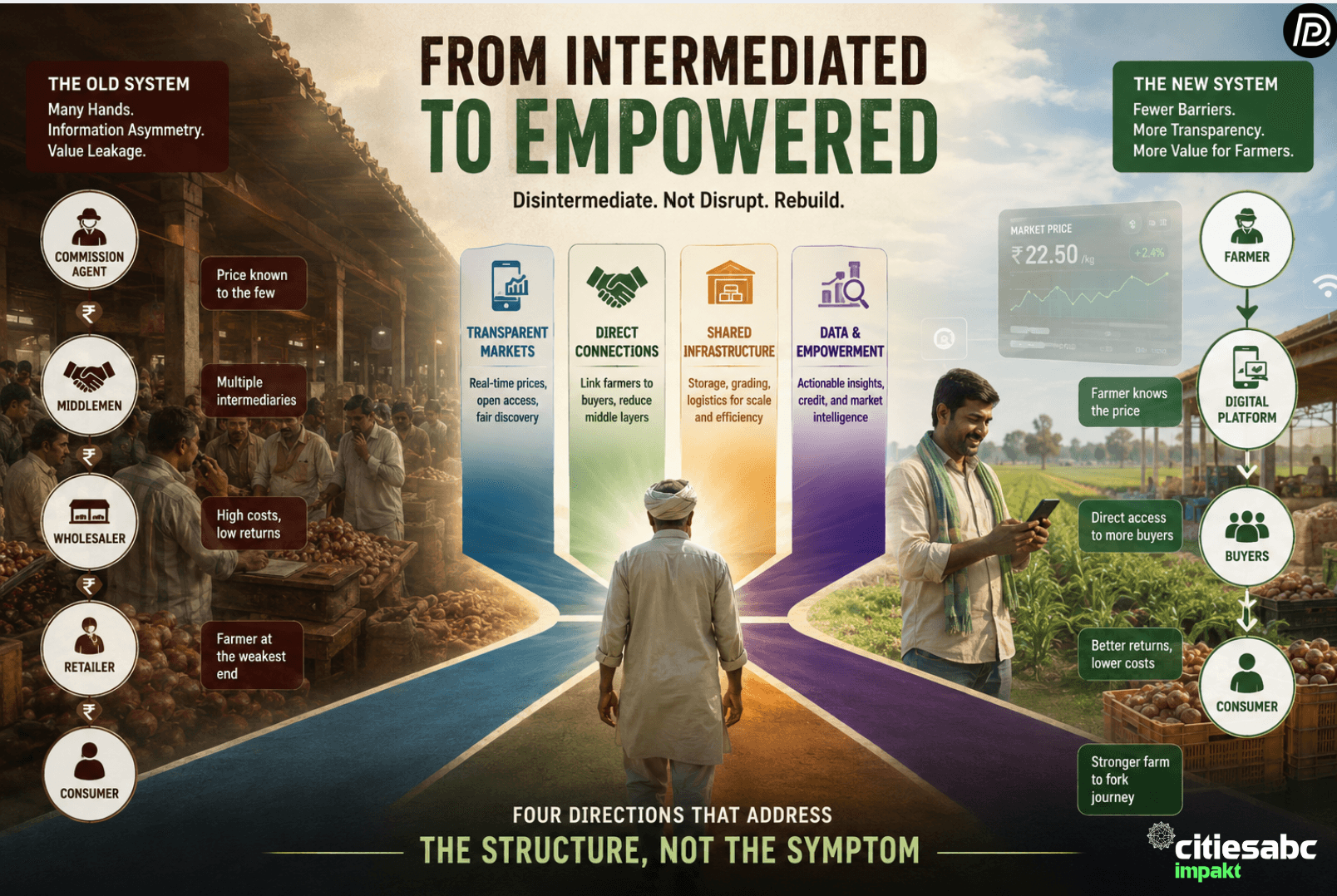
The information advantage held by mandi traders highlights an important aspect of our agricultural market system. It stems from a historical lack of infrastructure that has denied farmers equal access to markets. To bridge this gap, we need to invest in building the necessary infrastructure. It's essential to recognise that this process requires time, financial resources, and a strong commitment from institutions, elements that have often been overlooked in discussions around reform. By addressing these challenges, we can create a more equitable market environment for farmers.
Direction 1: Real-Time Price Intelligence at the Farm Level
The Impakt Platform's Market Intelligence layer provides valuable mandi prices across local, national, and export markets, delivering personalised alerts to farmers via convenient communication tools such as SMS or WhatsApp, as well as through the field agent interface. Additionally, the Agri LLM's Market Price Agent enhances this experience by analysing each farmer's specific crop, quality grade, and harvest timeline in relation to current demand patterns. It allows the agent to recommend the optimal selling window, offering insights beyond just the current price. While the technology itself is not new, its thoughtful application of existing data infrastructure ensures that it reaches the individuals who need it most at the right moment, benefiting both farmers and the agricultural sector as a whole.
Outcome
Research shows that farmer-producer organisations (FPOs) that have adopted market intelligence practices enable their members to achieve prices that are consistently 8–15% higher than those received by non-members selling similar produce in the same week. It illustrates the effective impact of market intelligence on members' earnings.
Direction 2: Cold Chain as the Foundation of Market Power
Price intelligence becomes truly valuable when farmers have the flexibility to act on it, which is made possible by the ability to delay sales. For instance, farmers connected to a cold storage facility through a Farmer-Producer Organisation (FPO) can preserve their perishable products for 5 to 14 days. This time frame transforms market insights from mere observations into powerful negotiation tools. Investing in cold chain infrastructure at the FPO aggregation point significantly enhances farmers' price realisation, offering benefits that surpass what information technology alone can achieve.
Outcome
Sahyadri Farms' investment in cold chain logistics plays a pivotal role in driving their impressive ₹1,548 revenue for FY24. With a robust cold chain in place, farmers are empowered to sell their produce at optimal market prices rather than merely at harvest prices. This approach not only benefits farmers but also enhances the overall efficiency of the agricultural supply chain.
Direction 3: Blockchain Quality Certificates as Market Credentials
The relationships between an arhatiya and their buyers are fundamentally rooted in trust. Buyers have confidence in Ramesh's produce, as their longstanding transactions have established a solid rapport. However, a farmer or Farmer Producer Organisation (FPO) can achieve similar levels of trust with new buyers by utilising a blockchain-verified quality certificate. This document provides a detailed account of input logs, grading results, and nutritional profiles, allowing farmers to showcase their produce's quality without needing the extensive history of personal connections. By leveraging this certificate as a credential, farmers gain direct access to buyers, streamlining market entry and expanding their opportunities.
Outcome
Export houses and premium food processors have expressed a strong interest in paying premiums of 15–25% for produce that is verified and traceable. This certification significantly streamlines the trust-building process, transforming it from a lengthy process into a single, efficient transaction.
Direction 4: Working with the Arhatiya, Not Against Him
Engaging the arhatiya as an active participant in the platform presents a constructive near-term opportunity. By reforming the role of the arhatiya, we can implement a model in which they earn an outcome-linked fee, aligning their income with the prices farmers receive relative to market benchmarks. This alignment creates mutually beneficial incentives. Furthermore, providing arhatiyas with access to the platform's market intelligence enables them to deliver enhanced services to their farmers, enabling transparent pricing. A pilot program in Maharashtra has demonstrated measurable improvements in farmers' prices while preserving the integrity of the mandi system, showcasing the potential for positive change.
Outcome
In instances where outcome-linked arhatiya models have been implemented, farmers have experienced a 6–12% improvement in price realisation. This approach offers a valuable alternative by minimising transaction costs and addressing market access challenges, unlike complete disintermediation.
What Changes If the Farmer Knows the Price
It's 6:15 AM in Lasalgaon, and a farmer named Govind, 48, from a nearby village about 40 kilometres away, is watching the auction of his onions. He is unaware that earlier, at 5:50 AM, Ramesh received a phone call informing him that a Pune processor is willing to buy at ₹21 today. Govind also doesn't know that competing farmers have delivered better-graded onions, which the processing buyer is likely to prefer. Additionally, prices in Lasalgaon are currently 12 percent lower than in Mahabaleshwar, where a different buyer pool is active.
As a result, Govind's onions sell for ₹17.50. After accounting for a 4 per cent commission, a weighment charge of ₹180, and a loading charge of ₹220, his net earnings amount to ₹15,080 for 12 quintals. Satisfied, he takes the cash and drives home.
Now, let's envision the same morning but with two positive changes. First, Govind's Field Producer Organisation (FPO) field agent sends him a WhatsApp message at 5 AM detailing the current price ranges at Lasalgaon, Mahabaleshwar, and the Pune direct market. The message highlights that the FPO's block booking with a direct buyer offers ₹19.50 this week, with payment the following day. Second, Govind's FPO has cold storage at the aggregation centre, allowing him to hold his onions for up to 4 days while the agent assesses the possibility of selling his lot to a direct buyer.
In this scenario, Govind may still decide to sell to Ramesh today for ₹17.50. The certainty of a quick sale might appeal to him. However, now he has the advantage of being well-informed, with options and time to make the best decision. It exemplifies how closing the information gap can empower farmers.
For Ramesh, this new setup might mean earning less commission per transaction, but he will be working with more knowledgeable, confident farmers. Over time, this shift could lead to a new market equilibrium. Ramesh's services will be more transparently priced, his information advantage will lessen but not disappear, and farmers will receive a greater share of the value chain. This isn't about upheaval; it represents a gradual correction of a long-standing structural injustice that can thrive in a well-built infrastructure, benefiting everyone involved.
The arhatiya has demonstrated resilience in the face of evolving information technology, successfully enduring various reform attempts over the past thirty years. However, the landscape is changing as farmers gain access to cold storage, verified quality certifications, direct buyer relationships, and real-time market price information on their phones. Rather than completely displacing the arhatiya, these advancements reduce his leverage and create a more equitable trading environment. This shift has the potential to benefit both farmers and markets alike.
If Govind had access to all the information Ramesh possesses, such as the buyer's pricing intentions, the rates from competing mandis, the optimal selling timeframe for his specific lot, and the cold storage required to wait for 4 days. What price do you think he could achieve for his onions? Additionally, what does the difference between that price and ₹17.50 reveal about the impact of a broken market information system, especially when considered across 140 million farming households?
Next In Voices From The Chain: Article 6 Of 8
We are striving for improved food quality, but we currently face verification challenges that can leave stakeholders feeling responsible and motivated to find solutions. This is the narrative surrounding the food processing industry. On the demand side of the quality premium gap, food companies and organised retailers genuinely desire to invest in better produce but find themselves hindered by the same information gaps that farmers experience, albeit from a different perspective. It's crucial to recognise that traceability is not merely an ethical initiative; it is a fundamental procurement challenge that must be addressed for the benefit of all stakeholders.
About This Series
“Voices from the Chain is an important addition to the Agriculture Gap Series, building on the insights from 'The Price of Ignorance: Mapping the Gaps That Cost Indian Agriculture Trillions,' which can be found at impakt.citiesabc.com. Over the past year, I have engaged deeply with the agricultural community by visiting farms, attending agri-sector seminars, and connecting with FPO leaders, agronomists, and input dealers throughout Maharashtra and beyond.
The Citiesabc Impakt Platform has emerged as a pivotal initiative to address gaps identified in recent agricultural research. The project is informed by insights from "Voices from the Chain," a publication in The Capital Signal, part of the Agriculture Gap Series. This publication builds on a foundational report titled "The Price of Ignorance: Mapping the Gaps That Cost Indian Agriculture Trillions," which can be accessed at impakt.citiesabc.com.
The author dedicated a year to visiting various agricultural settings, including farms, mandis, farmers' producer organisations (FPOs), and agri-businesses throughout Maharashtra. The findings from these explorations directly guided the development of the Citiesabc Impakt Platform, which aims to enhance the agricultural landscape by addressing documented issues. The tags associated with this initiative highlight critical topics such as APMC reform, price discovery, and information asymmetry in agricultural markets.


