
resources-impakt
Voice Of Agronomist: I Know Your Soil, But I Can’t Reach You
23 Apr 2026

Part of the Agriculture Gap Series, Building on 'The Price of Ignorance' and 'Voice of Farmer: He Grows It. Others Price It'
Article 1, 'Voice of Farmer: He Grows It. Others Price It'' follows Raju, a cotton farmer in Vidarbha, as he navigates a single farming season. The piece highlights the choices he faces and the information gaps that affect those decisions. It introduces the concept of decision poverty, the challenge of making significant, irreversible choices without adequate data or guidance. This article shifts its focus to an important question: why is the valuable knowledge that could assist Raju not reaching him?
The Disconnect
Dr Priya has been up since five, a routine she cherishes after over twenty-two years of teaching and field research. She's discovered that the early morning hours, before the day's hustle and bustle, are when her best ideas emerge. This morning, she's immersed in her latest soil health study, which highlights a critical issue: the black cotton soils of Vidarbha are losing organic carbon at an alarming rate. If this trend continues unchecked, crop productivity could decline by fifteen to twenty per cent in just two growing seasons.
Fortunately, Dr Priya's research is robust. It has undergone peer review and has been published in the Journal of Soil and Tillage Research. Importantly, the study offers actionable recommendations: reduce urea application by thirty percent, introduce green manure crops during the fallow season, and apply compost at a specific rate per acre. These interventions not only cost less than current input expenditures but also ensure neutral yields in the first year and positive impacts from the second year onward.
By eight AM, when her students arrive, Dr Priya will be onto her next project. However, the crucial findings of her research will remain in the journal, which is likely to see only about forty visitors this month, none of whom might be Raju.
This scenario illustrates a significant opportunity for improvement in the agricultural sector rather than a failure in research. The disconnect between Dr Priya's valuable insights and Raju represents a critical challenge in Indian agriculture. It's not that the knowledge isn't out there; rather, it underscores the need to strengthen the channels connecting researchers and practitioners. For the past thirty years, this pipeline has struggled, and it's time to focus on building effective pathways to ensure that essential agricultural knowledge reaches those who need it most.
India has strong agricultural research, but weak last-mile delivery
Let’s focus on the strengths of India’s agricultural research system. It stands out as one of the most substantial in the world. The Indian Council of Agricultural Research (ICAR) operates over 100 institutes and national research centres, supported by 63 state agricultural universities. Additionally, the network of over 700 Krishi Vigyan Kendras serves as vital farm science centres, connecting research with practical application across nearly every district in the country.
The outcomes generated by this robust system are impressive, including thousands of peer-reviewed papers each year, new crop varieties, pest-resistant hybrids, soil health protocols, innovative water management techniques, integrated nutrient management guidelines, validation studies in natural farming, and precision application models. Clearly, India possesses a wealth of agricultural science.
However, there is an opportunity to enhance the connection between research findings and farmers’ decisions. Over the past thirty years, the mechanisms designed to facilitate this link have faced challenges and diminished support. By revitalising and strengthening these communication pathways, we can ensure that the extensive knowledge and innovations produced by our agricultural research reach farmers efficiently, empowering them to make informed decisions that enhance their productivity and sustainability.
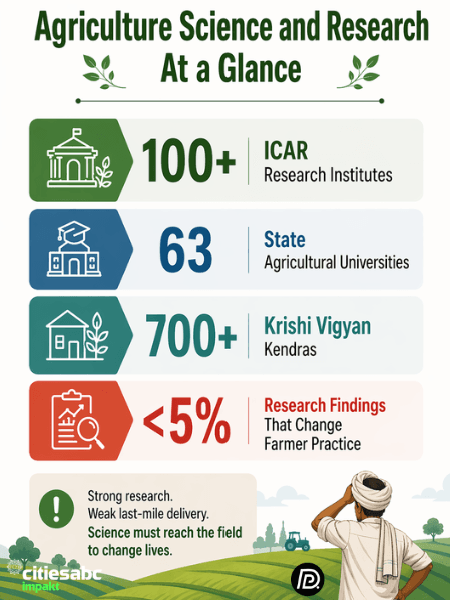
India's agricultural knowledge system offers opportunities for improvement in both production and distribution. We have a wealth of information available, but we can enhance our efforts to ensure that vital knowledge reaches the farmers in the field when they need it most. By focusing on effective communication and delivery methods, we can empower those who play a crucial role in feeding the nation.
The Arithmetic That Makes the Gap Inevitable
The tech industry has grasped a critical concept that agricultural policymakers have yet to address fully: the ratio of knowledge providers to knowledge recipients.
In India, there are around 140 million farming households, supported by an estimated 65,000 to 80,000 trained agronomists working across universities, government extension services, private agri-input companies, and NGO advisory programs. This results in a ratio of about 1 agronomist per 1,750 to 2,000 farming households.
However, this ratio does not capture the full picture. A trained agronomist can engage with approximately 80 to 100 farming households in a season, provided they have dedicated time, reliable transport, and accessible farm clusters. Unfortunately, many agronomists face challenges that limit their effectiveness. For instance, the actual active caseload for a government extension officer, after accounting for administrative responsibilities, travel constraints, and the geographical scope of their work, is typically 40 to 60 households per season.
By understanding and addressing these dynamics, we can enhance support for farmers and improve agricultural productivity in the region.
Let us do that arithmetic clearly.
Scaling Problem: India currently has around 80,000 active agronomists, each effectively advising about 60 farming households per season. This results in coverage for approximately 4.8 million households out of a total of 140 million. While this signifies valuable support for households, it also highlights a significant opportunity: over 135 million Indian farming households make critical agronomic decisions each season without the guidance of a trained agronomist. This gap presents a chance to enhance access to expert advice and improve agricultural practices for the majority of farmers in the country.
Addressing this gap requires an approach beyond simply training more agronomists. Even if India were to increase its agronomist workforce significantly, the overall impact might still be limited. Instead of focusing on the number of professionals, we should focus on improving the scalability of the advice and strategies provided in the field.
By innovating in how we deliver agronomic solutions, we can effectively bridge the gap and make a meaningful difference.
Reflect on the most valuable professional advice you’ve ever received from a doctor, lawyer, financial advisor, or mentor. Now imagine a scenario where you didn’t have access to that level of guidance for your most significant career decisions. Consider how this absence of advice might influence your decision-making process. What strategies or approaches would you adopt in its place? How could you develop your own framework for making these crucial choices?
The Quiet Collapse of India's Extension System
To fully understand our current agricultural landscape, it's essential to consider its historical context and the changes that have shaped it.
India's agricultural extension system was developed in the 1960s and 1970s, based on the Training and Visit model, which the World Bank supported. This approach established a network of Village Level Workers who received regular training from specialists and subsequently visited farmers on a set schedule to provide them with updated recommendations. At its peak, this system effectively reached millions of farmers. While it faced challenges such as a top-down structure and slow adaptation to local needs, it provided a crucial link between agricultural knowledge and practice through on-the-ground human support.
Unfortunately, over time, this human connection has diminished. The extension system was not formally dismantled but rather unintentionally weakened. Since the 1990s, funding for extension services has steadily declined as a proportion of the agricultural budget, leading to unfilled vacancies in Village Level Worker positions and the gradual phase-out of the Training and Visit model. Although Krishi Vigyan Kendras were introduced as replacements, they have not been adequately funded or staffed to fill the vacancies left by the traditional system.
As a result, the gap left in agricultural knowledge delivery has largely been filled by market-driven forces. While this has provided some solutions, it often places farmers at the mercy of those who might prioritise profit over genuine guidance.
Moving forward, there is an opportunity to revitalise the agricultural extension system by investing in community-based approaches, building capacity in local institutions, and ensuring that farmers receive impartial advice that focuses on their needs. By re-engaging with the principles of the original model and adapting them to today's context, we can create a more effective and responsive agricultural support system.
When government extension officers ceased their visits, input dealers filled the gap. Though not malicious, their role as primary agronomic advisors for many farmers arose from their presence, product knowledge, and credit offerings. The problem lies not in dishonesty but in misaligned incentives; input dealers benefit from selling more inputs, while optimal agronomy often calls for fewer, cheaper inputs.
The Input Dealer as Agronomist: A Structural Conflict of Interest
To address the persistence of the knowledge gap in states with functional KVK networks, it is essential to analyse the input dealer's business model with attention to its structural dynamics rather than viewing it as a moral issue.
In rural India, the typical agri-input dealer sells a variety of products, including seeds, fertilisers, pesticides, and micronutrient solutions. The profit margins on generic or government-recommended products tend to be low, typically 5-10 per cent. In contrast, margins on branded, premium, or newly launched products can be significantly higher, often between 20 and 30 per cent. Additionally, dealers may receive manufacturer incentives for achieving volume targets on certain products.
When a farmer presents a concern, such as yellowing leaves on their cotton crop, the input dealer faces a critical decision. The best agronomic recommendation might be to apply a foliar spray of micronutrients at a specific dose, costing ₹180 per acre, to resolve the issue effectively. Alternatively, the dealer might steer the farmer toward a premium fungicide-micronutrient combination product priced at ₹850 per acre, which would yield a much higher profit margin. Unfortunately, farmers typically lack the resources necessary to assess which option is actually best for their crops, which is where the dealer's knowledge of these economic pressures comes into play.
It's important to recognise that the majority of input dealers have good intentions and a strong desire to support their farmer clients, as their businesses rely on these longstanding relationships. However, the existing structural incentives often lead to a preference for the more profitable recommendation over the agronomically optimal one. By focusing on these systemic pressures, we can work towards solutions that align economic viability with the best agronomic practices, ultimately benefiting both farmers and dealers alike.
What The Agronomist Would Recommend ▸ Soil test before every input application ▸ Minimum effective dose not maximum ▸ Generic or off-patent products where available ▸ Integrated pest management biological first ▸ Crop rotation to break pest and disease cycles ▸ Green manure to reduce fertiliser dependence ▸ Harvest timing based on actual maturity data | What The Input Dealer Typically Recommends ▸ Same products as last season, proven sellers ▸ Slightly higher dose 'insurance' framing ▸ Branded premium products better margin ▸ Pesticide-first response to any visible symptom ▸ Repeat application as default fallback ▸ No fallow or rotation, reduce next season's sale ▸ Standard timing, not crop-specific |
The effects of this substitution are evident in the soil data. Research on Indian cotton, wheat, and rice farming indicates that fertiliser application rates often exceed the agronomically recommended doses by two to three times. Similarly, pesticide use in Indian vegetable farming ranks among the highest globally, especially given the relatively low pest pressure that would warrant such levels. Additionally, the decline in post-harvest soil organic matter, which threatens to undermine India's most productive agricultural lands, can be attributed to both the overuse of inputs and climate variability.
It's important to understand that Raju is making informed decisions based on the information available to him. However, this information often comes from sources with commercial interests that can distort the data. The challenge here is not solely a farmer's issue; it is a broader systemic design problem that warrants attention and reform. By addressing this knowledge gap, we can empower farmers like Raju to make more sustainable decisions for their land and livelihoods.
The issue of agrochemical overuse in India stems not just from farmers' lack of knowledge, but also from the interests of those selling these products. To tackle this, we need to reform the advice delivery system and focus on sustainability rather than just training. This will help empower farmers with reliable information and promote healthier agricultural practices.
Lost in Translation: The Language Gap Within the Knowledge Gap
There exists an important yet often overlooked aspect of the knowledge gap, which we can refer to as the language gap. The majority of Indian agricultural research is published in English, reviewed by English-speaking peers, and presented at English-language conferences. Consequently, much of this research is stored in libraries and databases that English readers primarily access. For example, Dr Priya composes her papers in English, as it is the standard language for academic publication, citation, and professional credibility in her field.
However, many farmers, like Raju, who read Marathi or may struggle with literacy, are missing out on these valuable insights. Across India, the farmer who could benefit the most from these research findings often speaks a language other than English, such as Hindi, Telugu, Marathi, Tamil, Kannada, Bengali, Odia, or Punjabi. This creates a complex journey for translating English research findings into actionable recommendations for farmers. The process often goes through multiple layers: from English academic articles to policy documents in regional languages, then to simplified advisory pamphlets, and finally into spoken conversations at the farm gate.
Unfortunately, at each step of this translation process, important nuances such as specific soil types, moisture conditions, and crop varieties can be lost. By the time a recommendation reaches the farmer, it may become too generalised, often blending with the farmer's own intuition.
The Krishi Vigyan Kendra (KVK) network was established to bridge this gap. Ideally, a KVK in Vidarbha would conduct demonstrations in Marathi, run trials on local soil types, and provide recommendations tailored to the specific conditions faced by farmers like Raju. While some KVKs are successfully implementing these practices, many face resource and staffing challenges that hinder their effectiveness in disseminating agricultural knowledge.
Addressing the discrepancy between the KVK network's potential and its actual delivery is essential. By enhancing communication and support structures, we can empower farmers with the precise and relevant information they need to thrive. This initiative could mark a significant step toward reducing the knowledge gap in agriculture and ultimately improving the livelihoods of farmers across India.
The translation of agricultural knowledge from English research to localised advice and farm-gate recommendations highlights an area for improvement. Each step can diminish the precision and actionable relevance of the information. To better support farmers who need accurate guidance, we should refine these communication channels to ensure they receive reliable, relevant advice.
Remember the last time you got advice that felt generic or overly formal? It was hard to relate to and use effectively, right? Now imagine if all the professional advice you received was like that. Who would you trust then? Who would you turn to for help?
The Weight of Knowing Without Reaching
Let's revisit Dr Priya for a moment. She plays a pivotal role in this narrative as a key figure, facing significant challenges. Over the past twenty-two years, she has dedicated herself to generating vital knowledge for Indian agriculture. She understands which soil amendments can enhance the productivity of 50,000 farms in Vidarbha, the pest management protocols that could cut cotton pesticide use by 40 per cent without affecting yields, and the winter crops that can improve soil carbon retention while boosting the following year's cotton yields. Her findings are backed by rigorous testing, validation, and publication.
However, she also recognises, with an honesty that her academic papers may not fully convey, that farmers have not widely adopted her groundbreaking insights on a large scale. Although she has directly influenced between 2,000 and 3,000 farmers through interactions, demonstration plots, and training programs, 180,000 farming households in her district remain outside her reach.
Dr Priya is not falling short; she is maximising her impact within the constraints of the current agricultural system. The challenge lies not in her knowledge or dedication but in the existing delivery mechanisms for that knowledge. Currently, her efforts to conduct farm visits, lead demonstrations, and participate in village meetings are fundamentally limited in their scalability.
This highlights the crucial insight behind the Impakt Platform's approach: Dr Priya's expertise requires a robust distribution system. Rather than replacing the invaluable work she does, the goal is to amplify her knowledge, enabling it to reach farmers more efficiently and effectively, all while minimising the need for her physical presence at every single farm.
The agronomist is not the last-mile failure. The last-mile failure is the absence of infrastructure that connects the agronomist's knowledge to the farmer's decision when it needs to be made. The agronomist is willing. The channel does not exist.
Three Models That Have Not Closed the Gap & Why
It's essential to acknowledge past challenges as we explore potential solutions. In India, three models have been developed to address the agronomic knowledge gap on a larger scale. While each has seen some localised success, there's still an opportunity to bridge this gap through growth and improvement fully. Let's build on these experiences to create more effective strategies moving forward.
Model One: The Government Extension System
The Training and Visit system, along with its successors through the National Agricultural Extension Project, was built on a strong foundation of regular, scheduled, field-level interactions between trained knowledge providers and farming households. While the concept was solid, challenges arose due to resource constraints and institutional commitment. In many states, extension services in India receive less than 0.5 per cent of the total agricultural budget, resulting in unfilled positions that hinder effectiveness. Additionally, training programs need to be continuously updated to reflect the latest scientific advancements.
Rather than suggesting that the government should withdraw from the advisory space, the key takeaway from the challenges faced in government extension is the need for sustained investment, robust outcome measurement, and enhanced accountability. Creating an advisory system that operates at scale requires a commitment to genuinely assessing its impact, ensuring that efforts focus on meaningful change rather than merely meeting superficial targets. This approach will foster a more effective extension service that truly benefits farmers and the agricultural sector as a whole.
Model Two: The Krishi Vigyan Kendra Network
The KVK network represents a significant effort in India toward localised, district-level knowledge translation. When functioning at its best, some KVKs excel in delivering critically needed resources: locally validated, vernacular-language, demonstration-based recommendations that farmers can observe and replicate. However, there are growth opportunities, as some KVKs may primarily focus on generating activity reports that don’t always translate into behavioural changes among farmers.
One key area for improvement in the KVK model, as in the broader extension system, is coverage. With only one KVK per district and teams of eight to twelve scientists serving districts that encompass 100,000 to 500,000 farming households, the reach can be quite limited. While the demonstration plot approach is highly effective for those who can attend, there is a need to explore ways to extend this knowledge further, as insights gained by farmers visiting KVKs often do not spread beyond a couple of villages. By addressing these challenges, the KVK network can become an even more powerful tool for disseminating agricultural knowledge and practices across wider communities.
Model Three: Digital Advisory Platforms
The last decade has produced a wave of agri-advisory apps, Kisan Suvidha, mKisan, AgroStar, DeHaat, Farmart, and others that attempt to deliver advisory at scale through digital channels. These platforms have achieved genuine reach: millions of registered users, meaningful engagement in some crop-geography combinations. However, they often overlook the digital literacy and trust issues faced by farmers who most need advisory support, making it difficult for these users to navigate or trust the apps effectively.
The digital advisory platforms have also largely failed to solve the personalisation problem. An app that sends the same pest management notification to all cotton farmers in Maharashtra on the same day offers generic advice rather than tailored, contextualised, or relationship-based advice. Addressing this gap can reinforce the importance of tailored support in digital advisory efforts. It is the pamphlet problem in new clothes.
Consider the information that has had the greatest impact on your job. Was it from a publication, training program, digital resource, or an individual? Why did it resonate more than other information? What does this reveal about the best ways to deliver agricultural knowledge?
The Human-Technology Stack: The Only Architecture That Scales
The three models discussed above each have a notable opportunity for improvement. They all strive to address a fundamental aspect of effective agronomic advice: the essential relationship between a knowledgeable advisor and the farmer making critical decisions. The government extension system aimed to institutionalise this relationship but faced challenges in securing adequate resources. Meanwhile, the KVK sought to localise the approach, yet struggled to achieve sufficient coverage. The digital platforms, in their pursuit to eliminate the need for human interaction, inadvertently lost the trust and context that are vital for making actionable recommendations.
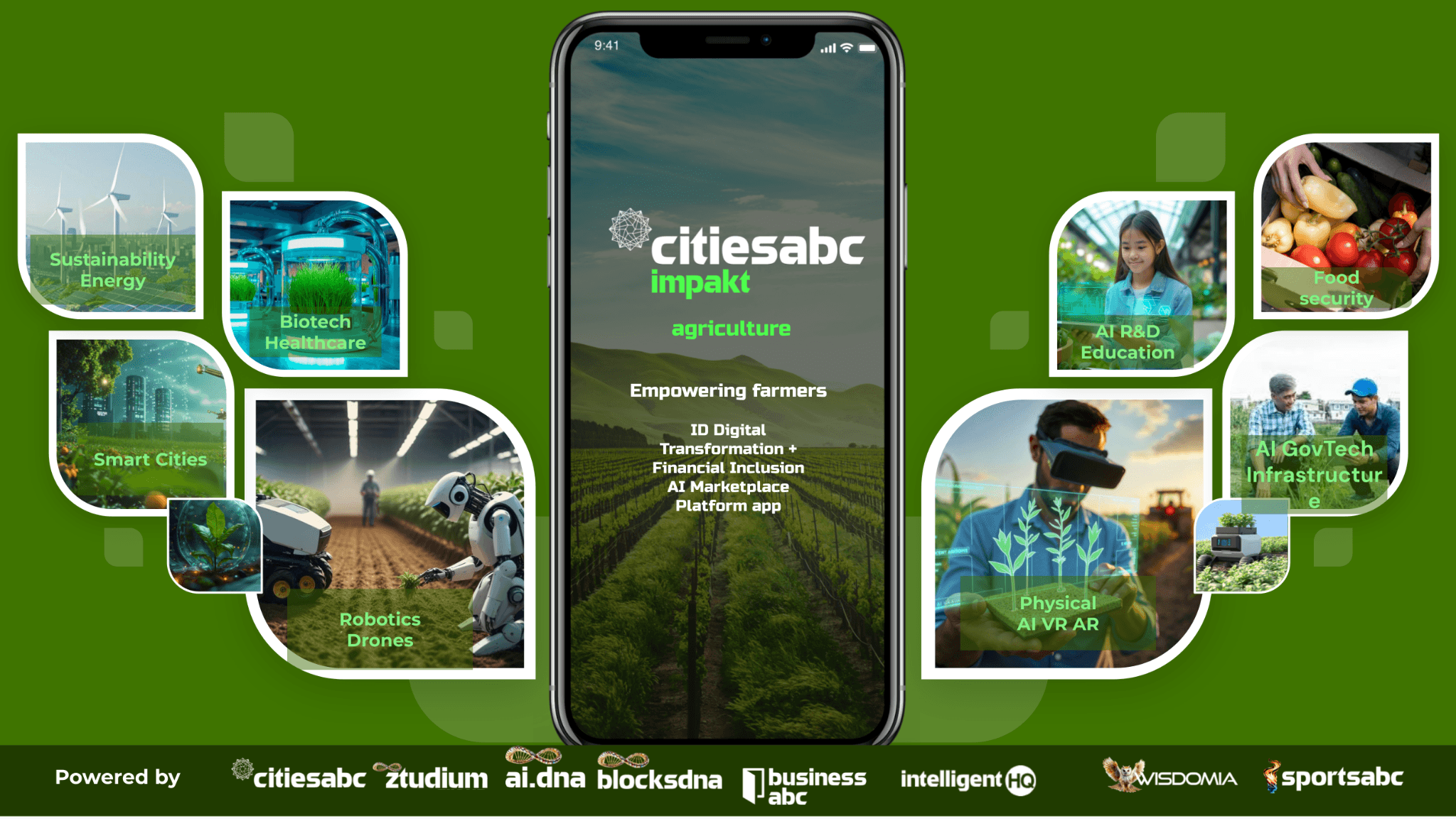
The solution lies in an innovative architecture that the Citiesabc Impakt Platform is developing, which focuses on creating a synergistic stack rather than mere substitution. This stack effectively integrates technology and human interaction, enhancing the effectiveness of both elements.
At the foundation of this stack is the AI and data layer. The Agri LLM, trained on verified knowledge from experts such as Dr Priya, can generate personalised recommendations tailored to specific soil, crops, and seasons at no additional cost to farmers. With the ability to operate in multiple & regional languages and analyse sensor data from individual farms, it delivers recommendations that are far more precise than generic guides. This model can scale indefinitely, providing broad access to personalised insights. However, it does not possess the ability to build trust, interpret a farmer's body language, or make nuanced judgments based on an individual's financial circumstances or risk tolerance.
The human layer of this model features the Impakt Field Agent, a local representative from the farming community who is trained in both agronomic science and the platform's technology. This individual plays a vital role in fostering relationships, providing context, and ensuring accountability facets that the AI layer alone cannot deliver. Farmers trust these agents because they are familiar with them and their specific situations. Notably, their advice is supported by the extensive insights of the Agri LLM, sensor data, and the valuable expertise of Dr Priya.
This model effectively bridges the scale gap while preserving essential relationships. The field agent enhances the reach of agronomic expertise, while the AI bolsters the effectiveness of the field agent's support. As a result, farmers receive trustworthy, personalised, and actionable advice at a cost that makes comprehensive coverage a practical reality.
Every recommendation produced by the Agri LLM carries the name and institutional affiliation of the scientist or agronomist whose research informed it. When the platform advises Raju to reduce his urea application by 30% and introduce a fallow-season green manure crop, it emphasises that this guidance is rooted in the work of Dr Priya at Pune Agricultural University, published in 2023, and has been validated across three consecutive seasons on black cotton soils in Vidarbha. This approach transcends mere transparency; it establishes a trust architecture. The farmer who knows that a named expert with credible credentials crafted this recommendation embraces it with confidence, unlike those who receive generic push notifications. Moreover, the scientist whose work is cited and honoured feels inspired to continue their vital contributions to a system that truly appreciates their dedication.
Not Replaced: Amplified
It's essential to clarify a common misconception before concluding this discussion: technology-driven advisory systems are not designed to replace agronomists. Rather, they transform and enhance the agronomist's role, enabling their contributions to be even more impactful.
For instance, Dr Priya, with her 22 years of research experience, currently reaches 3,000 farmers through direct interactions. In a model like Citiesabc Impakt, however, her research is structured and integrated into the Agri LLM's knowledge base, meaning it can benefit every farmer on the platform. Each recommendation derived from her work not only cites her but also ensures that her expertise is at the forefront, rather than being obscured by algorithms.
In this new framework, Dr Priya's role evolves significantly. Instead of focusing solely on the direct delivery of knowledge, an area handled by field agents, she becomes responsible for ensuring the quality and accuracy of the knowledge base. She reviews and updates recommendations seasonally, investigates any discrepancies arising from field agent reports, and contributes to research questions that emerge from the rich data generated by the platform. These inquiries can address critical issues such as soil health patterns, input effectiveness, and climate adaptation, which can only be explored with real-time data from a large number of farms.
This evolution enhances the value of agronomists' expertise. Freed from the limitations of personal reach, the constraints of how many farmers one can physically visit, they gain access to a distribution channel that dramatically amplifies their impact.
Ultimately, the model that Indian agriculture needs isn't a choice between human expertise and technological advancement; rather, it's a collaborative system that harnesses the strengths of both. Closing the knowledge gap won't come from simply increasing the number of scientists publishing papers or sending more extension officers to meet farmers. It will require a system that takes the insights Dr Priya offers, translates them into accessible language for farmers like Raju, delivers this information precisely when it's needed, and recognises Dr Priya's invaluable contributions in the process.
What Separates Dr Priya from Raju
Dr Priya and Raju are approximately 350 kilometres apart, with Dr Priya in Pune and him in a village outside Yavatmal. While they may never meet in person, there's an opportunity to bridge the knowledge gap between them. Dr Priya offers valuable insights that can significantly improve Raju's farming practices. This knowledge is documented in written, validated, and peer-reviewed formats, yet it struggles to reach Raju in a timely and contextually relevant manner.
For the past 75 years of independent India, the infrastructure needed to share this knowledge effectively has been lacking, not because it is impossible, but because it hasn't been prioritised at the policy level. The 140 million farming households that would benefit the most from this information often have little political and economic power to advocate for their needs.
Addressing this gap is not merely a technological challenge. While technology can be a powerful ally, its effectiveness hinges on the intentions driving its development. The goal must be clear: every farmer, including Raju, deserves access to the highest-quality knowledge when it's needed to make informed decisions about their crops and livelihoods.
Dr Priya should have the opportunity to see her research translated into actionable insights that truly benefit farmers on the ground. Raju deserves access to the same calibre of information that influences the buyers of his crops.
The divide between them is a construct of our systems and policies; it can be dismantled through intentional action and commitment to equitable knowledge transfer. Together, we can build the pathways that connect expert research to the fields it was meant to serve.
India has ample knowledge for better farming; what’s needed is stronger communication to connect agronomists with farmers. Bridging this gap will empower agricultural success.
Who taught you what you know in whatever field you work in? And how did that knowledge reach you? Through a person, a system, a document, a technology? What made it land and change what you did? And what does your answer suggest about how 140 million Indian farmers should be getting the knowledge they need to grow the food you eat?
Next In Voices From The Chain: Article 3 Of 8
We Are Stronger Together. There is significant potential for progress that has yet to be fully recognised. The story of the FPO leader highlights how Farmer-Producer Organisations represent a promising structural intervention in Indian agriculture. Yet, they often face challenges related to funding and understanding within the sector. By addressing issues such as the collective action paradox, governance challenges, and market access barriers, we can learn from the strategies employed by successful FPOs that have navigated these obstacles effectively. Let's focus on fostering greater support and recognition for these vital institutions to unlock their transformative potential in agriculture.
About This Series
“Voices from the Chain is an important addition to the Agriculture Gap Series, building on the insights from 'The Price of Ignorance: Mapping the Gaps That Cost Indian Agriculture Trillions,' which can be found at impakt.citiesabc.com. Over the past year, I have engaged deeply with the agricultural community by visiting farms, attending agri-sector seminars, and connecting with FPO leaders, agronomists, and input dealers throughout Maharashtra and beyond. This experience has been instrumental in shaping the Citiesabc Impakt Platform, which aims to address the gaps identified in our findings and enhance the agricultural landscape.”


