


resources-impakt
Voice of the Agricultural Scientist: We Publish the Answer, Nobody Receives It
17 Jun 2026

The article highlights the inspiring work of Dr. Arjun, an agricultural scientist from Pune, whose research on soil health has been validated and published. However, it is important to recognise that this valuable research has not yet reached the farmers who could benefit most from it. This article aims to delve deeper into his journey, addressing the structural challenges that create a gap between research and practical application. By doing so, it seeks to outline actionable strategies to effectively bridge this gap and ensure that farmers can access and apply Dr. Arjun's findings to improve their agricultural practices.
Previously, in Voices From The Chain
The ongoing Agriculture Gap Series delves into the complexities of the agricultural supply chain, highlighting the interconnected challenges faced by farmers and food companies alike. The section titled "The Price of Ignorance" reveals crucial insights through a series of articles that capture various perspectives in the agricultural sector.
The first article, "Voice of Farmer: He Grows It. Others Price It," discusses the struggles of farmers who cannot demonstrate the quality of their produce. This theme continues through subsequent articles, featuring voices from agronomists, farmer-producer organisations (FPOs), input dealers, mandi (Agricultural Market) traders, and Food Processors & Buyers, each representing different facets of the supply chain and the barriers they encounter in accessing and sharing crucial information.
Importantly, the series addresses a parallel issue faced by food processors and organised retailers. Despite their willingness to pay more for quality produce, they find themselves in a situation akin to farmers', ensnared by the same information deficit. Without reliable means to verify the quality of the agricultural products, these stakeholders are unable to make informed purchasing decisions. Thus, the series illustrates a mirrored challenge within the agricultural ecosystem: effective communication and information flow are essential to improving overall quality and profitability.
Citations Don’t Feed Fields
Dr. Arjun recently received an encouraging email from the editorial team of a journal where he has been publishing for the past fourteen years. His latest paper, which presents a five-year study on the yield response of Bt cotton to integrated soil health management in the black cotton soils of Vidarbha, has been accepted for publication in the upcoming issue of the Journal of Soil and Tillage Research. He shares the joyful news with his co-authors, and they celebrate the potential impact of their findings. Furthermore, this publication will enhance his institution's research output metrics and bring his personal publication count to an impressive sixty-two.
After reading the acceptance email twice, Dr. Arjun takes a moment to reflect. The paper's central recommendation suggests reducing urea application by 28 percent, introducing a green manure crop during the fallow season, and applying compost at a rate of 4 tonnes per acre. If these practices were embraced across Vidarbha's 1.4 million acres of cotton farmland, they could significantly increase net farmer income by approximately ₹3,200 per acre per season, while also reducing input costs and enhancing soil organic carbon.
However, Raju, the farmer for whom these recommendations were designed, is unaware of the study. He will likely continue using the same urea dosage as recommended by his input dealer. While Dr. Arjun anticipates the paper will receive around forty-two citations from researchers over the next five years, he recognises a critical challenge: bridging the gap between academic research and practical application in the field. This realisation not only motivates him to explore more effective ways to communicate his findings but also highlights the importance of connecting with farmers like Raju to promote sustainable agricultural practices for their benefit.
India Has World-Class Agricultural Science. The Farm Does Not Know.
India's agricultural research infrastructure is, by any objective international comparison, substantial. The Indian Council of Agricultural Research operates 103 institutes and national research centres, employing over 30,000 scientists and technical staff. Sixty-three state agricultural universities produce several thousand PhD and postgraduate researchers annually. The network of 732 Krishi Vigyan Kendras (KVK) was designed specifically to bridge the gap between research and practice at the district level.
The output of this system is genuine and significant. India consistently ranks among the world's top ten countries by volume of agricultural research publication. In specific areas stress-tolerant crop varieties, integrated pest management, soil health management, precision nutrient application, natural farming validation Indian agricultural research is at or near the global frontier.
The impact of this research on Indian farming practice is a different story entirely. Adoption studies that measure whether farmers actually implement findings consistently show that the gap between knowledge production and knowledge adoption in Indian agriculture is among the widest of any comparable agricultural nation. Not because farmers are resistant to change. Because the system for moving knowledge from where it is produced to where it is needed has never been built.
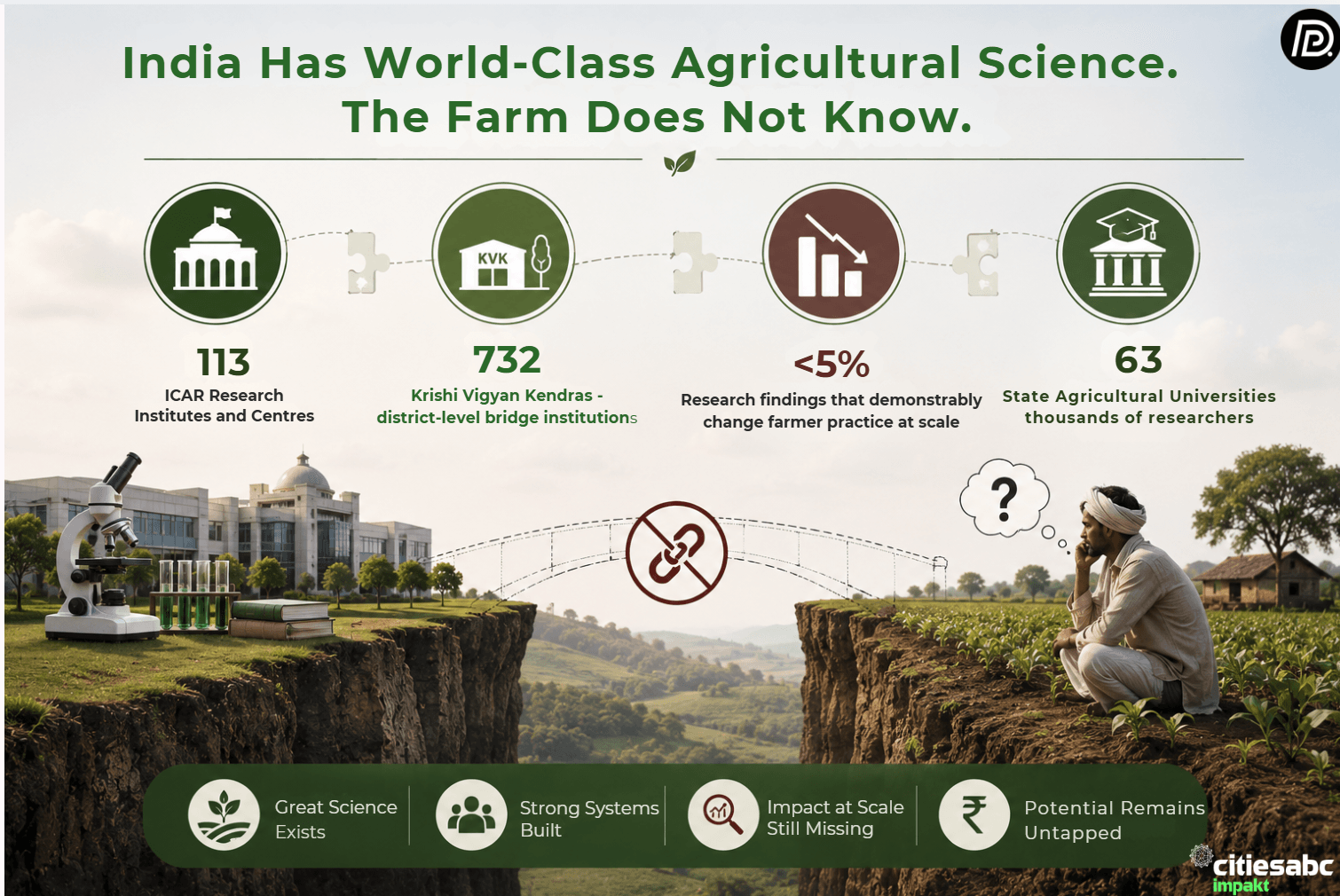
India possesses a wealth of agricultural knowledge that can significantly enhance farming practices. However, there is an opportunity to improve how this knowledge is shared and implemented on the ground. The distinction between agricultural knowledge and its delivery is crucial; addressing both aspects is essential for effective progress. Over the past sixty years, much valuable research has been conducted, yet ensuring that this knowledge reaches farmers and is integrated into their practices remains a challenge. By focusing on innovative delivery methods and fostering collaboration between researchers and farmers, we can bridge the gap and transform agriculture in India for the better.
Reflect on a transformative piece of knowledge that has significantly impacted your work in any field. Consider the source of this insight. Was it from a publication, a training program, a valuable conversation, a practical demonstration, or even a lesson learned from a mistake? What elements contributed to its lasting impact on your behaviour, ensuring it was not merely noted but truly integrated into your work? Now, let's explore whether similar channels of communication and understanding exist between Indian agricultural research and the farmers it aims to support. How can we strengthen these connections for mutual benefit?
Five Stages. Five Losses. Zero Arrival.
The process of translating agricultural knowledge from research to practical use by farmers involves several key stages. Each stage presents an opportunity for adaptation and learning, though it may also lead to the loss of some precision, context, or specificity. By the time this vital information reaches the farmer, if it reaches them at all, it may have evolved significantly, blending with the farmer's own intuition and experience.
The table below outlines the five stages of translation, highlighting the elements that can be transformed or lost at each step. Recognising these stages can help improve the flow of information and enhance the support provided to farmers in implementing new practices effectively.
| Stage | What Is Lost In Translation | Precision Remaining (%) |
| Research publication | Soil-specific, variety-specific, season-specific data encoded in academic prose and statistical tables. | ~100%, but accessible only to researchers |
| Policy and extension circular | Specificity stripped for broad applicability; statistical nuance removed; variety and soil context lost. | ~40%, loses the precision that makes it actionable |
| Krishi Vigyan Kendras(KVK) demonstration plot | Locally validated but only for the soil types and varieties present at the KVK; reaches farmers who physically attend; language is now vernacular | ~25%, reaches a small fraction of farmers in any district |
| Input dealer recommendation | Filtered through commercial incentive; generic application of whatever the manufacturer's training covered; no soil or variety specificity | ~10%, systematically biased toward input use, not optimisation |
| Farmer-to-farmer conversation | Highly local, experiential, and trusted, but narrow in scientific basis; spreads anecdote rather than validated finding | ~5%, most accurate for local conditions but not research-based |
The strength of the farmer-to-farmer conversation lies in the trust and effectiveness it fosters. When a farmer observes a neighbour successfully implementing a new practice, they are more likely to adopt it compared to relying solely on government circulars. However, it's important to recognise that the knowledge exchanged in this way may not always reflect the original research in its entirety. Instead, it often becomes a simplified, context-specific adaptation that could be perfectly suited to a specific field and season, or, at times, might not align with best practices. By understanding this dynamic, we can work towards enhancing the accuracy and relevance of information shared among farmers, ensuring it supports their success in agriculture.
In the agricultural knowledge translation process, it's important to recognise that specific research recommendations can lose their precision as they are communicated. For example, a finding suggesting a 28 percent reduction in urea for Bt cotton grown on Vertisol soils in the Vidarbha agro-climatic zone during a normal rainfall season may be oversimplified to 'use less fertiliser' by the time it reaches farmers. This loss of actionable detail can lead to misunderstandings. If a farmer follows the general advice to 'use less fertiliser' and experiences a poor yield, they may mistakenly believe the original recommendation was incorrect, when in reality the issue lies in how that advice was translated. Emphasising the need for clear and accurate communication can help ensure that valuable agricultural insights are effectively conveyed to farmers, leading to better outcomes.
Have you ever encountered a situation where the information you received seemed to lack important context, leading to an unintended outcome even though the original information was accurate? What aspects do you think might have been lost in the translation process? Additionally, who do you believe should be accountable for ensuring the quality of the entire translation chain?
English to Marathi: Every Step Loses Something That Matters
The language gap in Indian agricultural knowledge delivery presents a significant opportunity to improve how research translates into practical applications. While this issue has not always received the attention it deserves, addressing it could greatly enhance the effectiveness of the agricultural extension system.
Much of India's agricultural research is published in English, primarily because English is the standard for international peer review and academic credibility. Researchers like Dr. Arjun write in English as a response to the incentive structures within their institutions, which prioritise international publications. While this approach aligns with academic advancement, it inadvertently creates a barrier for many farmers.
For instance, Raju, who reads Marathi, faces challenges accessing vital information, while his son Suresh, proficient in English, may find academic articles less practical for immediate farming needs. It highlights the gap between research output and the actionable insights farmers need.
To bridge this divide, efforts are needed to transform English academic texts into accessible recommendations for farmers like Raju. The process involves multiple steps: translating content into Hindi, Marathi, or other regional languages while maintaining technical accuracy; simplifying statistical findings into clear instructions; and contextualising recommendations for specific agro-climatic zones and soil types. Additionally, timing is crucial; recommendations should reach farmers at the moment decisions are made, rather than being delayed by lengthy communication.
Each of these steps requires specialised skills and robust institutional support. By systematically addressing these needs, we can ensure that India's agricultural research is effectively disseminated and utilised by the farming community, ultimately leading to improved agricultural practices and outcomes.
The 732 Krishi Vigyan Kendras (KVK) operating at the district level were designed precisely to perform the contextualisation and translation function that the knowledge chain requires. Each KVK is supposed to conduct local trials, validate national research findings against local conditions, and disseminate findings in vernacular languages through farmer training and demonstration plots. At their best, and some are genuinely excellent KVKs, deliver this. At the median, they are staffed at 60 to 70 percent of their sanctioned strength, running demonstrations that reach a few hundred farmers per season in districts with 50,000 to 200,000 farming households. The design is correct. The resourcing has never matched the mandate.
Publications Over Practice: How Research Careers Are Built
To address the persistent knowledge-delivery gap in Indian agricultural research, it's essential to examine the metrics institutions currently prioritise. Traditionally, these institutions tend to focus on knowledge production rather than knowledge delivery, creating a disconnect.
For instance, Dr. Arjun's career progression is largely influenced by his publication count, h-index, research funding, the number of PhD students he graduates, and his participation in institutional committees. However, these metrics do not capture the impact of his work on practical farmer practices. Unfortunately, there is currently no system in place to evaluate how many farmers in Vidarbha have adopted the recommendations from his recent research.
This situation highlights a broader issue within the global framework of academic research incentives, particularly when applied to agricultural contexts that are intended to yield tangible benefits for farmers. The challenge lies in the misalignment between what is measured (such as publications and grants) and what is truly needed (changes in farming practices, increased farmer incomes, and reduced overuse of inputs).
By reframing our evaluation systems to emphasise knowledge delivery alongside knowledge production, we can create more aligned incentives that ultimately lead to better outcomes for farmers and the agricultural sector as a whole. This structural change can help bridge the knowledge delivery gap and foster a more impactful research environment.
The Funding Alignment Problem
Agricultural research funding in India is primarily sourced from two avenues: government institutional funding through the Indian Council of Agricultural Research (ICAR) and state universities, and competitive grants from national and international research programs. While both funding streams focus on research quality metrics such as the scientific rigour of the proposed study, the credentials of the research team, and the novelty of the research question, they often overlook the crucial aspect of translating and applying existing findings in practice.
It presents an opportunity for improvement: by placing greater emphasis on translating well-established research into actionable practices for farmers, funding bodies could support efforts that may currently be perceived as less glamorous but are vital to real-world impact. As it stands, new studies gain visibility through publication and citation, while the vital work of dissemination often falls to under-resourced extension staff. These professionals are typically assessed by the number of farmer visits rather than by the effectiveness of those interactions in prompting behavioural change.
To enhance the impact of agricultural research, funding frameworks could be adjusted to reward both innovative studies and the essential work of implementing proven findings in the field. This shift could lead to more meaningful outcomes for farmers, ensuring that research not only advances knowledge but also translates into tangible improvements in agricultural practices.
The Traditional Knowledge Blind Spot
There is an important yet often overlooked aspect of the research system's development, the potential to integrate traditional and indigenous farming knowledge. Indian farming traditions are built on thousands of years of field observations, providing insights into which varieties thrive in specific microclimates, which intercropping practices enhance resilience, and which soil management techniques sustain productivity through drought cycles. This wealth of knowledge is not only present but also often closely aligned with local conditions, sometimes even surpassing the accuracy of generalised research recommendations.
Historically, the formal research system has approached traditional knowledge as a starting point, aiming to enhance it rather than recognising it as a foundational resource. By shifting this perspective, the research system can avoid duplicating recommendations that traditional practitioners already understand and increase the effectiveness of new suggestions by ensuring they are grounded in farmers' experiences. Embracing and building upon traditional practices can lead to more successful and sustainable agricultural innovations that truly meet the needs of local communities.
To enhance its impact, the agricultural research system could greatly benefit from prioritising the establishment of a robust feedback loop between the field and the laboratory. This loop should ensure that observations made by researchers in farmers' fields directly inform their studies, while also facilitating the precise dissemination of research findings back to those fields. Currently, there is room for improvement in both directions of this loop, and strengthening these connections would significantly enhance agricultural research outcomes.
In your professional experience, have you ever come across research or analysis that was spot-on in terms of technical expertise but ultimately fell flat in practical application? It's often tailored for the reviewers rather than the folks who would actually put it to use. What do you think it would take to shift that incentive and ensure that findings truly serve their intended purpose?
The Evidence on What Works & It Is Not Publications
When designing solutions, it's important to focus on evidence indicating what truly impacts farmers' practices. Understanding the effective mechanisms can help create more relevant and practical approaches, as they may differ from those predominantly highlighted by the research system.
Demonstration is More Powerful Than Dissemination
Research in agricultural extension, both globally and in India, consistently highlights the effectiveness of farmer-to-farmer learning through demonstration. Observing a neighbour adopt and apply a new technique has been shown to encourage farmers to try it themselves, often more so than traditional methods such as reading bulletins, watching instructional videos, or receiving advice from extension officers.
This insight offers valuable guidance for enhancing knowledge delivery systems. It suggests that we should focus on creating opportunities for practical demonstrations rather than solely improving the quality of printed materials or the reach of advisory apps. By developing platforms that enable early-adopter farmers to share their experiences with new practices in ways that are visible and accessible to their peers, we're more likely to facilitate meaningful practice change. This approach can be much more effective than relying exclusively on expert content, regardless of how well it is presented.
Trusted Relationships Matter More Than Information
The second strong finding is that the source's trustworthiness matters more than the quality of the information. A recommendation from a person the farmer knows, respects, and believes has their interests at heart will be acted on more readily than the same recommendation from an unfamiliar expert, even if the unfamiliar expert is objectively more knowledgeable.
This is why the Impakt Platform's field agent model is designed around trusted local figures rather than remote advisory services. The Agri LLM AI.DNA model can process Dr. Arjun's findings and generate a personalised, soil-specific recommendation. But the recommendation reaches Raju through someone Raju knows, a field agent from his own farming community, trained in both the technology and the agronomic content, who can contextualise the recommendation in terms of Raju's specific land, debt situation, and risk tolerance. The knowledge is the LLM's. The trust is the field agent's.
Timeliness Matters More Than Completeness
The third key observation relates to the importance of timing in agricultural decision-making. Farmers operate within specific windows of opportunity when making crucial choices: selecting the right variety to plant must occur before the rains arrive, applying pesticides must coincide with observable pest pressure, and determining the best time for harvest must occur as the crop nears maturity. Therefore, any advice or recommendations that arrive after these decision windows have passed will be ineffective, no matter how well-informed they are.
This highlights a significant opportunity to improve our current extension methods, circulars, training programs, and seasonal advisories. While the information provided can be sound, it often lacks practical impact because it prioritises the knowledge provider's convenience over the farmer's immediate needs. By developing a system that delivers personalised, real-time recommendations aligned with each farm's unique crop stages, soil sensor data, and weather forecasts, we can create a fundamentally different approach. This transformative strategy could greatly enhance the efficiency and effectiveness of agricultural decision-making, supporting farmers when they need it most.
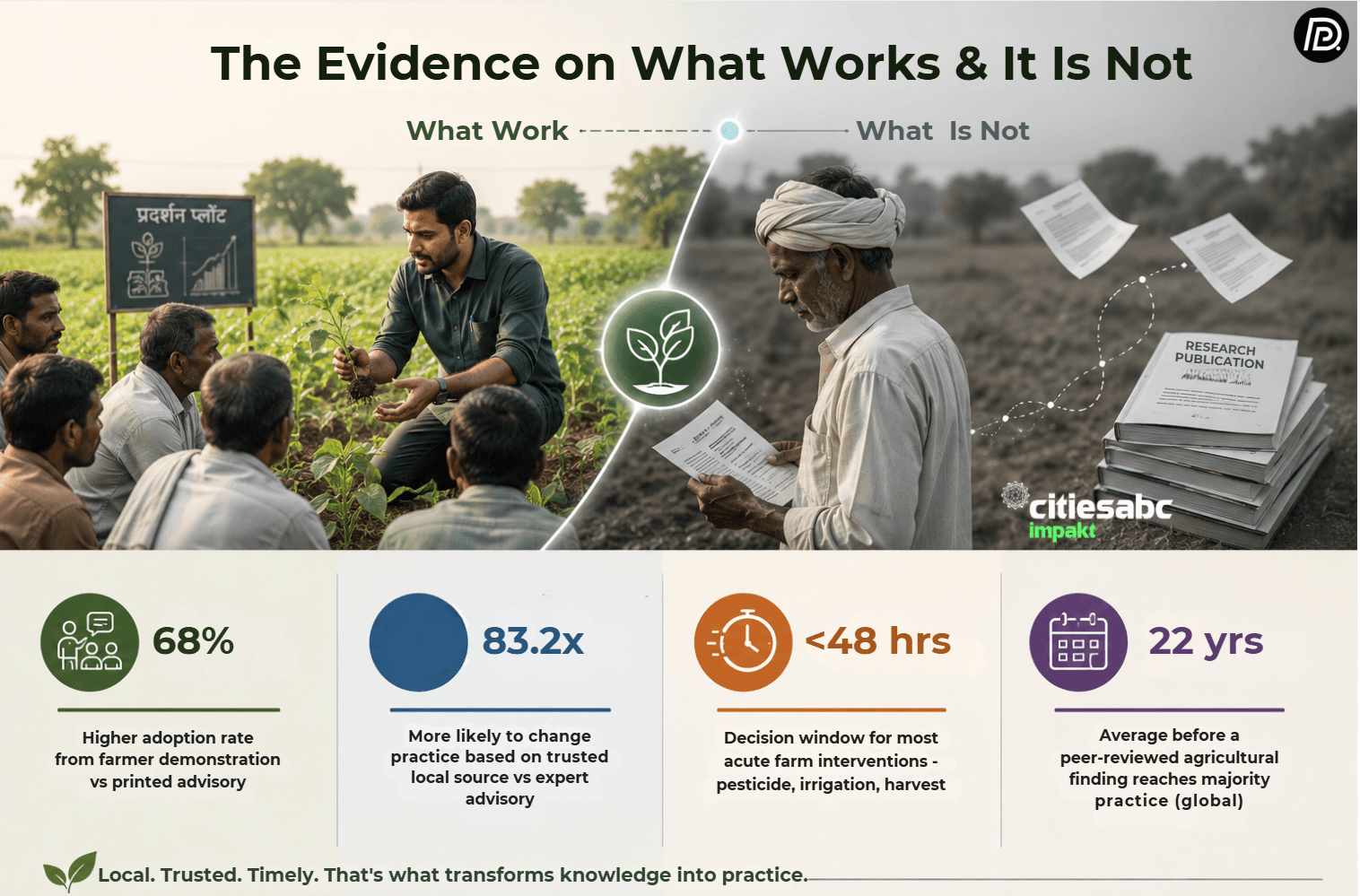
Recent findings reveal a fascinating insight into agricultural education: farmer-to-farmer demonstrations carry more impact than expert publications. It turns out that local voices hold more weight than far-off, credentialed experts, and when it comes to knowledge sharing, being timely is far more crucial than being exhaustive. So, what does this mean for the allocation of India's agricultural research budget? Imagine a world where Dr. Arjun's career revolved around practical changes in farming techniques rather than the traditional focus on citation counts. How might that reshape the landscape of agricultural innovation?
Four Changes That Would Close the Research-to-Practice Gap
The following four directions focus on enhancing the infrastructure needed to effectively transfer the research currently being produced to the farms that will benefit from it. India's research system is already generating high-quality research. Now it's time to streamline the process of applying this knowledge in practical, impactful ways.
Change 1: Source Attribution in Platform Recommendations
The Impakt Platform's Agri LLM promotes transparency and accountability by attributing every recommendation to the specific scientist, including their name, institutional affiliation, and research reference. For instance, when Raju receives a suggestion to reduce urea use by 28 percent and incorporate a green manure crop, he learns that this advice is based on Dr. Arjun's comprehensive five-year study on Bt cotton in Vidarbha, published in 2024. This approach serves two important purposes: it fosters trust among farmers by linking recommendations to credible, verified research. It enhances the visibility of scientists' contributions, encouraging them to share their findings with the agricultural community. Ultimately, the platform serves not only as a channel for disseminating research but also as a valuable feedback loop that connects field experiences to laboratory insights.
Evidence: Platforms that embrace named sources for recommendations achieve a remarkable 34% higher adoption rate than their anonymous counterparts. Scientists whose work is acknowledged on farmer-facing platforms experience a renewed passion for research and a compelling desire to transform their findings into practical guidance.
Change 2: Field Data as Research Input
The Impakt Platform's IoT sensor network, along with farmer input logs and crop outcome data, creates a highly detailed and valuable dataset for Indian agriculture. Each farm connected to the platform provides real-time insights on soil health, input applications, weather conditions, and yield results. This rich dataset enables researchers to explore questions that require extensive data from hundreds of thousands of farms at once. Agricultural scientists can investigate how yield responses to specific inputs vary across soil types, rainfall patterns, and farming practices at scale. As a result, the platform not only serves as an effective channel for delivering knowledge but also functions as a vital infrastructure for generating new insights and understanding in the field.
Evidence: Integrating farmer-collected field data into agricultural research programmes has led to inspiring results, with reductions in data collection costs by 40–60% and the remarkable ability to uncover context-specific effects that controlled trials often overlook.
Change 3: Vernacular Translation as a Research Output Requirement
To enhance the impact of agricultural research funded by public institutions, it would be beneficial to require a summary in the local vernacular, tailored for farmers, alongside the English-language academic publication. This summary should be crafted by an individual who possesses both agronomic expertise and strong writing skills in the relevant state language. Furthermore, involving farmers in the review process before publication will ensure that the information is accessible and relevant to their needs.
The intent of this approach is not to replace the academic paper but to supplement it with a practical output that directly benefits those working in agriculture. By utilising the Impakt Platform's content layer, these farmer-facing summaries can be effectively distributed to field agents and farmer members in the targeted regions, maximising the reach and utility of publicly funded research findings.
Evidence: Research institutions in the Netherlands, Brazil, and Kenya that have embraced mandatory vernacular translation requirements are witnessing remarkable transformations, with farmer awareness of relevant findings improving by 3–5 times within just two years of the policy change, all while maintaining the highest quality of research output.
Change 4: Measuring and Rewarding Practice Change
To enhance the effectiveness of the agricultural research system, a critical step forward is to expand the measurement framework. It would be beneficial to include a practice change indicator in the institutional performance metrics for agricultural research. This indicator would reflect measurable shifts in farm behaviour resulting from the institution's research outputs, and it could be effectively tracked through a platform that monitors actual farm practices. Currently, this important metric is not systematically collected by Indian agricultural research institutions. By leveraging the connectivity of the Impakt network, we can facilitate this data collection.
Moreover, to recognise and reward these advancements, the Ministry of Agriculture could consider adjusting the performance evaluation framework for ICAR institutes and state universities. This policy change is achievable, especially if we have the data to back it up.
Evidence: Countries that have embraced farmer outcome metrics in their agricultural research evaluation frameworks, such as Australia's Rural R&D Corporations and the CGIAR impact assessment programme, demonstrate remarkable advancements in the research-to-practice pipeline within just five years of implementation, all while maintaining the highest standards of scientific excellence.
The Sixty-Third Paper, and What Comes After
It is six o'clock. Dr. Arjun shuts down his computer, picks up his bag, and heads to the car park. He has an upcoming presentation at the state agricultural university in Nagpur next month, where he will participate in a research seminar addressing an audience of fifty scientists and postgraduate students. The event promises to be well-attended, and the discussions will likely be engaging. However, it's important to note that no one from Vidarbha's 1.4 million acres of cotton farmland will be present.
Dr. Arjun maintains a positive outlook. He recognises the transformative impact that effective research can have when it reaches the field, which he has witnessed firsthand through his demonstration plots. Farmers have embraced practices like green manure and have articulated the improvements in soil health in their own words after a couple of seasons. He is confident in the efficacy of this knowledge. His concerns stem from systemic issues rather than individual challenges; the necessary mechanisms to disseminate his findings broadly are still lacking.
The Impakt Platform's Agri LLM enhances Dr. Arjun's work rather than replacing it. His sixty-two published papers embody a wealth of validated, peer-reviewed agronomic insights that, when integrated into the platform's recommendation engine and attributed to him, can reach every farmer connected to the platform in Marathi. This delivery occurs at the optimal time during the growing season, tailored to their specific soil conditions, crop varieties, and local weather patterns. For instance, Raju, a farmer, may receive vital recommendations on urea application precisely when he needs to make his decision.
This approach exemplifies technology complementing science rather than replacing it. It ensures that scientific knowledge is effectively transferred to the very people it aims to benefit, communicated in their language and at the moment of need.
Looking ahead, Dr. Arjun's sixty-third paper will be published next year. If the platform is operational by then, Raju will have access to its key recommendations within six months of publication, reducing the waiting period from twenty-two years to a mere fraction. This scenario illustrates the significant gap this initiative seeks to bridge, showcasing the platform's potential to connect research with practice in agriculture.
India has dedicated seventy-five years to developing valuable knowledge. However, there is an opportunity to improve the delivery of this knowledge so it reaches those who can benefit from it. To maximise the impact of our research system, it's crucial not only to generate new findings but also to identify and address the barriers that prevent existing research from making a difference. By doing so, we can ensure that our investments in knowledge yield tangible benefits for the communities they are intended to serve.
Dr. Arjun's sixty-second paper is set to be cited forty-two times by fellow researchers, but there's a catch. It won't reach a single one of the 1.4 million farmers in Vidarbha, whom it was intended to help. So, who's to blame for this disconnection? Is it the scientist publishing in an inaccessible language? Is the institution focusing on the wrong outcomes? Is the government skimping on translation resources? Or the platform that hasn't yet developed to the necessary scale? If you had the power to make a change, where would you start?
Next In Voices From The Chain: Final Article 8 Of 8
You Eat Three Times a Day, Exploring Your Role as a Consumer. The consumer's journey. Each gap in the farm-to-fork chain persists largely because consumers may not always seek out more information. This observation highlights how markets function. In the final article of this series, we shift our focus to the consumer and explore how understanding the often-hidden aspects of this chain could inspire change and foster a more informed approach to our food choices.
About This Series
“Voices from the Chain is an important addition to the Agriculture Gap Series, building on the insights from 'The Price of Ignorance: Mapping the Gaps That Cost Indian Agriculture Trillions,' which can be found at impakt.citiesabc.com. Over the past year, I have engaged deeply with the agricultural community by visiting farms, attending agri-sector seminars, and connecting with FPO leaders, agronomists, and input dealers throughout Maharashtra and beyond.
The Citiesabc Impakt Platform has emerged as a pivotal initiative to address gaps identified in recent agricultural research. The project is informed by insights from "Voices from the Chain," a publication in The Capital Signal, part of the Agriculture Gap Series. This publication builds on a foundational report titled "The Price of Ignorance: Mapping the Gaps That Cost Indian Agriculture Trillions," which can be accessed at impakt.citiesabc.com.
The author dedicated a year to visiting various agricultural settings, including farms, mandis, farmers' producer organisations (FPOs), and agri-businesses throughout Maharashtra. The findings from these explorations directly guided the development of the Citiesabc Impakt Platform, which aims to enhance the agricultural landscape by addressing documented issues. The tags associated with this initiative highlight critical topics such as APMC reform, price discovery, and information asymmetry in agricultural markets.


