
resources-impakt
Voices from the Chain: The Final,The Chain and Its Links
04 Aug 2026

Eight Actors. One Chain. India's Food Future.
A concluding reflection on what this series was really about not the failures of individuals but the dysfunction of a disconnected system and the extraordinary future available to India when its agricultural chain begins to run as one.
A Note On What This Series Was Not Trying To Do
Voices from the Chain emphasises understanding rather than blame. The eight individuals featured, ranging from farmers and agronomists to FPO leaders, input dealers, mandi traders, food processors, agricultural scientists, and consumers, all represent dedicated professionals navigating a challenging system. Each is committed to doing their best, even when faced with systemic obstacles that highlight the need for collective change. This series aims to shed light on these complexities and, ultimately, concludes by focusing on reimagining the system for a better future.
A Chain With Eight Links and No connector
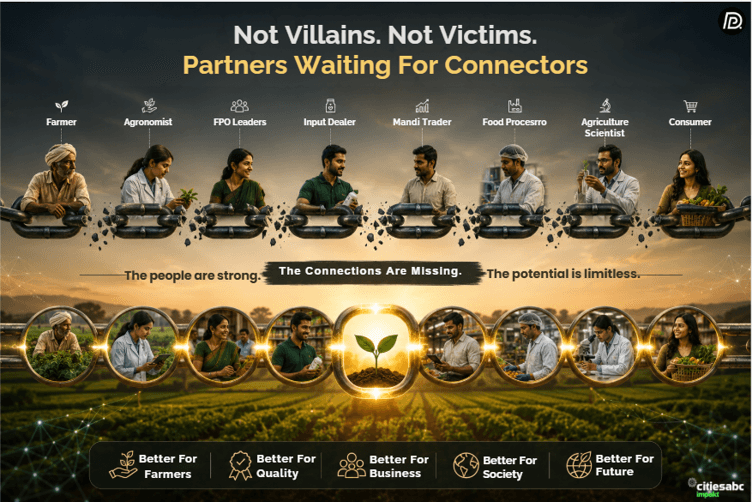
Envision India's agricultural supply chain as a robust iron chain composed of interconnected links: the farmer, agronomist, FPO, input dealer, mandi trader, food processor, agricultural scientist, and consumer. Each of these links is strong, stable, and filled with dedicated individuals, yet they remain isolated, lacking the crucial connectors and an engine to drive progress.
This situation, highlighted in eight insightful articles, reveals not broken individuals but rather disconnected links in a chain. Each participant brings valuable expertise: the farmer understands his land but may not have access to current market prices; the agronomist possesses soil knowledge but lacks direct access to farmers; the FPO leader recognizes the potential of collective action but struggles to penetrate market channels; the input dealer knows the products but may not fully realize optimal agronomic outcomes; the mandi trader is aware of market fluctuations but is hesitant to share this information; the food processor has specific production needs but cannot verify their availability; the agricultural scientist holds crucial insights but faces barriers in implementation; and the consumer engages daily with food yet remains largely unaware of the complexities beneath the surface.
Every link in this chain offers resources that others can benefit from. The farmer's harvest is what processors seek, while the agronomist's expertise is essential to the farmer's success. The FPO's collective strength can provide opportunities that individual traders can't offer, and the input dealer's reach complements the agronomist's understanding. The processor's premium pricing reflects the value the farmer truly deserves, while the agricultural scientist's validated knowledge can empower agricultural advancements. The consumer's demand serves as a vital cue for the entire supply chain.
To enhance this system, we must develop the necessary connective infrastructure that allows resources to flow seamlessly between these links. The abundance of people, knowledge, and determination is already present; what is needed is the establishment of connections that facilitate these exchanges. By building this network of collaboration, we can empower each participant in the agricultural landscape and amplify the support provided to farmers and stakeholders throughout the supply chain.
A lack of skill does not define India's agricultural landscape. Each player in this chain possesses valuable expertise. Instead, it is a crisis of connection. The farmer's skill awaits alignment with the buyer's needs. The scientist's discoveries are eager to inform the farmer's choices. The consumer's desires long to inspire farm practices. Strengthening these connections holds the promise of transformation.
Not Villains. Not Victims. Partners Waiting for Connectors.
The conclusion should emphasise a positive perspective: each actor discussed in this series plays an important and valuable role. Currently, these actors face challenges that hinder their optimal performance, not due to personal shortcomings but because of structural conditions that complicate their efforts. However, a more effective version of each role is both visible and attainable, providing a commercially viable path forward. Here's what that could look like.
Link 1 - The Farmer: Raju & 140 million like him
|
Link 2 - The Agronomist: Dr Priya, Dr Arjun & 80,000+ trained advisors
|
Link 3 - The Fpo Leader: Meena & Thousands Of Collective-Builders
|
Link 4 - The Input Dealer: Vijay & 270,000 Rural Agri-Retail Operators
|
Link 5 - The Mandi Trader: Ramesh & The Commission Agent Network
|
Link 6 - The Food Processor: Prabhav & The Organised Food Industry
|
Link 7 - The Agricultural Scientist: India's 30,000+ Icar & State University Researchers
|
Link 8 - The Consumer: Meghna And 300 Million Urban Food Buyers
|
Examine those eight cards, and you'll notice a common theme in each row. It's not about having a broken person, but rather a blocked one. By providing each actor with the necessary information, market access, verification infrastructure, and accountability mechanisms, we can facilitate progress. The resources are already in place. They need the right momentum to get moving. Let's work together to activate this potential and set the wheels in motion.
Food Will Be the Next Crisis. India Can Be the Answer
This series has examined the structural challenges within India's agricultural supply chain, and now it's important to broaden our perspective and consider these issues and potential solutions within a global framework.
We are currently navigating a food security crisis that will significantly impact the next fifty years. Factors such as population growth, climate change, water scarcity, soil degradation, geopolitical disruptions to supply chains, and the consolidation of food production by a small number of mega-producers are converging to place unprecedented pressure on the global food system. The conflicts likely to have a lasting influence on the twenty-first century will be centred on water, arable land, and food supply. Countries that can provide abundant, authentic, and verified food will possess a strategic advantage that extends beyond mere financial power.
India is uniquely positioned to leverage these advantages. It boasts the largest arable land area in the world, 179 million hectares, which is surpassed only by the United States, and it exceeds that of China. Additionally, India is home to the most diverse agro-climatic zones, ranging from the cold deserts of Ladakh to the tropical spice gardens of Kerala, and from the wheat plains of Punjab to the cotton fields of Vidarbha. The nation has a farming population of 140 million households, whose accumulated traditional knowledge reflects a rich heritage of refined agricultural practices. Furthermore, India's young population, if equipped with the right skills and infrastructure, has the potential to emerge as the most productive workforce in the global food sector.
Lastly, India possesses a rich agricultural history that, though often overlooked by the world, holds invaluable lessons for the future. By recognising and harnessing these strengths, India can play a pivotal role in addressing global food security challenges.
India's Agricultural Legacy: For centuries, India stood as a pivotal player in the global food market, particularly in terms of value rather than sheer volume. The spice trade, which significantly influenced the early modern world, attracted European powers to explore uncharted oceans and reshaped global commerce. Indian spices such as black pepper from Malabar, cardamom from the Western Ghats, turmeric from Tamil Nadu, and ginger from Kerala were among the earliest premium agricultural exports. These products not only carried a distinctive geographic identity but also commanded high value due to their exceptional quality, making them highly sought after by some of the wealthiest markets around the globe. India was not just a food producer; it established the benchmark for premium food quality.
The foundational knowledge and practices of Indian agriculture have not been lost; rather, the supply chain that linked them to global markets has diminished. For three centuries, colonial agricultural policies prioritised the extraction of raw materials over the development of India's rich agricultural heritage, resulting in a decline in the institutional infrastructure that once positioned Indian food as a premium product on the global stage. Today, we have a unique opportunity not just to create something from scratch, but to revitalise and restore this heritage. By leveraging modern technology, effective governance structures, and updated market infrastructure, India can reclaim its status not as the world's cheapest food producer, but as the world's most trusted source of quality food.
The spice traders who laid the foundations of ancient Indian commerce thrived not simply by increasing their output but by enhancing the quality of their products. They developed systems that made their superior offerings verifiable, traceable, and trusted across vast trade routes. This approach serves as a valuable model for today's commerce. With technology more accessible than ever for implementing these practices on a larger scale, the opportunity is here for India to embrace this approach and drive its trade success.
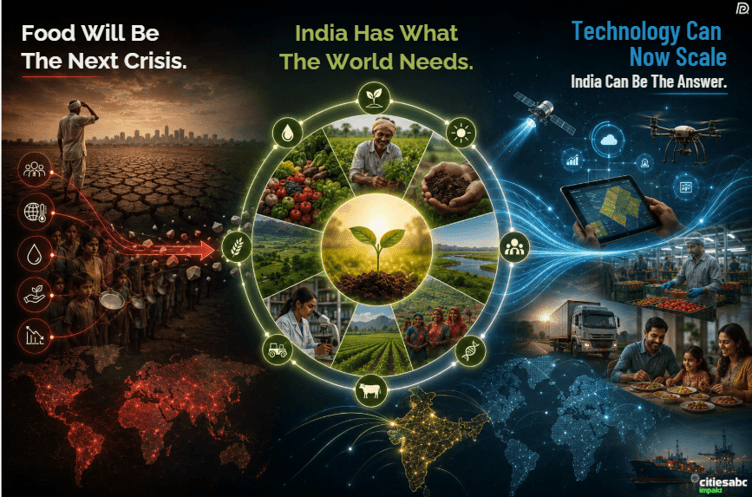
What India Already Knows & Technology Can Now Scale
India's traditional agricultural knowledge system is among the most sophisticated and empirically validated globally. The challenge lies not in its age but rather in the perception that it is outdated and should be replaced with modern inputs. Instead, a more constructive approach involves integrating these ancient practices with contemporary tools.
By addressing this perspective, India can enhance soil health, biodiversity, and agricultural resilience, moving forward in a meaningful way. The goal is not to revert to the past but to create a synthesis that combines ancient knowledge with modern science, optimises traditional practices with precision technology, and scales community-based farming through digital connectivity. This synthesis can be explored across five key dimensions of traditional agricultural wisdom, paving the way for a sustainable and thriving agricultural future.
Integrated Crop Management
Ancient insight: Traditional Indian farming practices recognised the importance of maintaining soil health and managing pest populations. Techniques such as intercropping, crop rotation, and incorporating fallow periods have been effectively utilised over millennia across various agro-climatic zones in the subcontinent. These methods not only enhance soil fertility but also promote biodiversity, showcasing the wisdom embedded in these sustainable farming systems.
Modern application: The Agri LLM models provide valuable insights into optimal intercropping combinations by analysing soil sensor data alongside market price signals. This approach transforms traditional farming knowledge into data-driven, economically viable strategies, bridging the gap between heritage practices and modern agricultural efficiency. By leveraging technology, farmers can enhance productivity while staying connected to market demands.
Soil as a Living System
Ancient insight: Vedic and Ayurvedic texts recognise soil (Bhoomi) as a dynamic and living entity, emphasising its health characteristics that can be nurtured or harmed. Traditional practices such as composting, using green manure, applying ash, and incorporating crop residues highlight an understanding that aligns with modern scientific findings: the biology of soil, alongside its chemistry, forms the essential foundation of agricultural productivity. Embracing these insights can lead to more sustainable farming practices and healthier ecosystems.
Modern application: IoT soil sensors provide valuable insights by measuring organic carbon, microbial activity, and nutrient availability in real time. This innovative platform transforms sensor data into a soil health score, effectively quantifying aspects of soil health that traditional farmers understood qualitatively. Additionally, carbon credit mechanisms offer financial incentives for farmers to rejuvenate degraded land, encouraging a return to sustainable soil management practices that have supported Indian agriculture for centuries. This approach not only promotes environmental restoration but also enhances the economic viability of farming.
Community as Infrastructure
Ancient insight: Traditional Indian farming communities, whether organised as jajmani systems, water user groups, or grain storage collectives, have effectively recognised the importance of collective infrastructure in achieving agricultural resilience. These communities understand that no individual smallholder farm can thrive alone in terms of knowledge, capital, or market access. By working together, they create a supportive environment that addresses the challenges each faces, fostering a more sustainable and successful agricultural landscape.
Modern application: The FPO model represents an innovative evolution of the traditional farming collective, enhanced by the integration of digital governance tools. These tools help protect against the capture and manipulation that have historically undermined community institutions. With features like a transparent payment ledger, a blockchain voting record, and real-time market price access for every member, this modern collective fosters greater trust and accountability compared to its predecessors.
Seed as Heritage
Ancient insight: Traditional Indian seed systems have effectively preserved a remarkable range of biodiversity, featuring thousands of locally adapted varieties that have been carefully selected over generations to thrive in specific soil types, rainfall patterns, and taste profiles. While the Green Revolution introduced high-yielding varieties that significantly increased production, it also shifted the focus away from this rich diversity. Recognising the value of both traditional and modern agricultural practices can help us develop sustainable solutions that harness the strengths of both approaches.
Modern application: The Impakt Platform's variety documentation feature effectively tracks the seed used for each registered lot, enhancing transparency in the agricultural sector. As the market for natural farming and heritage varieties expands, driven by consumer demand for authentic, nutritionally rich produce, this platform establishes a robust verification system. This not only supports the commercial viability of heritage variety premiums but also transforms traditional biodiversity into a valuable market asset, fostering sustainable practices and preserving our agricultural heritage.
Seasonality and Ecological Timing
Ancient insight: Traditional Indian agriculture demonstrates a profound understanding of seasonal rhythms, encompassing not only the broader monsoon and rabi cycles but also intricate micro-seasonal signals derived from ecology, astronomy, and the wealth of local observation. The principle of Ritu, or seasonal awareness, plays a crucial role in guiding practices such as planting, harvesting, soil treatment, and even the timing of market transactions. This holistic approach fosters a deeper connection between agricultural practices and the natural environment, promoting sustainable and efficient farming methods.
Modern application: Satellite-based crop monitoring, combined with weather forecast integration and market price prediction algorithms, enhances the traditional practices of seasonal farmers. These technologies interpret the landscape to determine optimal timing, much like farmers have done for generations. Rather than replacing traditional knowledge, they validate and extend it, enabling farmers to make informed decisions with a level of precision that individual observation alone cannot achieve. This synergy between technology and traditional expertise creates a more effective farming approach.
The future of Indian agriculture embodies a harmonious blend of ancient wisdom and modern innovation. Traditional knowledge serves as our foundation, technology amplifies our potential, and the market ensures quality is valued. India has always been able to cultivate extraordinary food. Now, we have the tools to showcase it, connect it, and expand its reach.
From Commodity Exporter to Verified Premium Supplier
Let's focus on the tangible benefits for India when the agricultural supply chain is effectively connected and a robust quality verification infrastructure is established. It's essential to discuss these in measurable and achievable terms, highlighting the concrete steps we can take to make this vision a reality.
The Premium Market India Is Not Yet Capturing
India stands out as one of the world's largest agricultural exporters, with significant contributions in rice, wheat, cotton, spices, fruits, and vegetables. However, it has room to grow as a leader in value per unit in the global agricultural market. The premium segment, which includes verified organic, GI-certified, traceable, nutritionally dense, and sustainably grown products, is currently dominated by European and American producers. While their farming practices may not necessarily surpass those of Indian producers, the difference lies in their robust documentation infrastructure.
For instance, a certified organic tomato from a Spanish cooperative can fetch three to four times the price of a similar Indian tomato in European markets. This price disparity is not due to a significant difference in quality but rather to verified supply chain documentation for the Spanish tomato, contrasted with the more generalised assertions surrounding the Indian tomato. Thus, the key issue here is not the quality of the produce itself, but the systems in place for verification.
India's spice sector exemplifies the potential of verifying and protecting geographic origins. Products like GI-certified Darjeeling tea, Alphonso mangoes, Malabar black pepper, and Coorg coffee enjoy strong demand and command significant premiums in international markets compared to their non-GI counterparts.
To further enhance the value of its agricultural exports, India can leverage blockchain technology, such as the Impakt Platform's traceability infrastructure. This platform aims to provide a GI certificate equivalent for every farm, not just a select few premium products, ensuring that every lot of verified produce leaving the farm is accompanied by a documented chain of custody. By focusing on improving verification processes, India can strengthen its position in the global food market and achieve better outcomes for its farmers and producers.
The Scale of the Opportunity
The global organic food market is projected to exceed USD 564 billion by 2030. India's current share is not significant despite having the largest area under certified organic farming of any country in the world, concentrated in states like Sikkim, Madhya Pradesh, and Rajasthan. The gap between India's certified organic area and its organic export revenue is a documentation gap, a cold chain gap, and a market access gap all of which the connected agricultural chain addresses.
The global functional food and nutraceutical market premium food products valued for their nutritional and health properties is a market that India's traditional variety biodiversity and traditional farming knowledge uniquely positions it to serve. The moringa from Tamil Nadu, the ashwagandha from Rajasthan, the turmeric from Erode, the amla from Uttar Pradesh these are not niche curiosities. They are documented in the world's oldest nutritional science tradition and validated by a rapidly growing body of modern clinical research. The market for verified, authenticated, traditionally produced Indian superfoods is one of the fastest-growing segments in global premium food retail.
The global halal food market $911 billion to $2.6 trillion (depending on specific sector scopes) annually, serving 1.9 billion Muslim consumers worldwide requires exactly the kind of supply chain documentation and quality verification that the Impakt Platform provides. India has the agricultural diversity to serve this market across dozens of crop categories. It has not captured it at the scale it could because the documentation infrastructure has not existed.
The Spice Trade Reborn: Five centuries ago, a kilogram of Indian black pepper held greater value than a kilogram of gold in European markets, illustrating the immense demand for this spice. The trade routes that carried pepper to cities like Venice, Lisbon, and Amsterdam not only transformed these regions but also reshaped global commerce. The spice traders were not merely dealing in a commodity; they were offering a unique story of provenance, showcasing the distinct taste and potency of Malabar pepper, a quality that any substitute could not easily match.
This historical perspective serves as a valuable lesson for today. With today's technology, we can verify and authenticate India's rich agricultural heritage on a large scale. There is a significant market willing to pay a premium for this authenticity, one that is vastly larger than before. Therefore, the future of Indian agriculture lies not in simply increasing production but in demonstrating the quality and authenticity of what is already being produced. By embracing this approach, India can leverage its strengths and secure a prominent place in the global market.
When All Eight Coaches Connect, This Is What Moves
The final question this series must answer is a profound one: what does the connected system truly look like in human terms? As the engine runs, how does it transform the experience for each individual in the chain?
Raju's Season, Transformed
Raju has successfully followed the recommendations of the Agri LLM, choosing a crop variety suited to his soil type and aligned with the current season's rainfall forecast. This guidance, rooted in Dr Arjun's extensive research, was effectively communicated in Marathi by Suresh, who is now a certified Impakt Field Agent. To demonstrate scalability, other FPOs can adopt similar models, showing the system's potential for widespread impact and encouraging stakeholder confidence.
Raju's use of technology is particularly impressive, as his input log is automatically recorded, detailing what he applied, the dosage, and the application dates. When yellowing symptoms emerged in week seven, the field agent swiftly reviewed the soil sensor data, consulted the LLM, and recommended a targeted micronutrient spray. This precise approach fostered trust in the system and demonstrated how technology supports effective decision-making, avoiding costly mistakes.
As harvest time approached, Raju received an automatic blockchain quality certificate generated from his input log, lab test results, and cold chain records from the FPO aggregation point. This secure certification linked his four acres of Vidarbha cotton to a specific buyer, a clean-label textile brand in Mumbai identified by the FPO's market intelligence system as willing to pay ₹850 per quintal above the mandi rate for verified low-residue cotton. This process reassures stakeholders of product authenticity and traceability.
Meena's FPO facilitated the transaction, ensuring that Raju received payment within forty-eight hours through the platform's efficient escrow mechanism. As a result, Raju's credit score improved, enabling him to retire his debt to the input dealer and set the stage for future agricultural success.
Suresh looked at the numbers and decided to stay.
Dr Priya's Finding, Delivered
In February, Dr Priya published her insightful study on soil health. By March, the knowledge team at the Impakt Platform successfully transformed her key recommendations into personalised advice within the Agri LLM's advisory layer, ensuring they were properly attributed to her name and institutional affiliation. As the Kharif planning season began in April, 12,000 farmers connected to the Vidarbha FPO network received tailored recommendations derived from her research, specifically adapted to their soil types and crops, all presented in Marathi. By September, the platform had gathered aggregate yield and input data, revealing a statistically significant improvement in yield-per-input-rupee for farms that adopted her recommendations.
This valuable data has provided Dr Priya with a solid foundation for her next research inquiry. Although she has authored thirty-five papers, this marks the first time she has witnessed her work being applied in the field.
Meghna's Breakfast, Verified
Meghna opened her grocery app at 7:20 AM, excited to explore her options. This time, she selected tomatoes with a QR code, a habit she had developed over the past three months after reading an enlightening article about food traceability. When she scanned the code, the information provided was impressive: the tomatoes were sourced from Govind Kumar in Nashik district, met the FSSAI MRL standards, were harvested six days ago, and had maintained the cold chain throughout. Moreover, the pesticide residue was below the detection threshold, and Govind received ₹21 per kilogram for his produce. Meghna paid ₹88, which transparently reflected the costs associated with processing, logistics, and retail margins.
As she made her purchase, Meghna felt a sense of empowerment and connection to her food that she hadn't experienced in years. At dinner, she enthusiastically shared her experience with two friends, and one of them was inspired enough to download the grocery app herself.
This is not a utopia. It is a thriving market in perfect harmony. The farmer who cultivates excellence is rewarded abundantly. The buyer seeking quality can discover it. Knowledge that enhances growth finds its way to the fields. Trust that fuels trade is founded on verified data, not mere hope. None of this is out of reach. All it takes is the infrastructure to unite the resources each participant already possesses, inspiring confidence in our capacity to grow together.
The Series Has Ended, The Work Has Not
Eight articles. Eight voices. One interconnected vision. Ending not with a conclusion but with a call to action.
This series aims to clearly outline the challenges within our agricultural system, the gaps, their underlying mechanisms, the costs they incur, and the viable solutions. It is crafted not merely for reflection but as a guide for action. Each gap identified is real and currently impacts farmers, consumers, and the nation, costing us trillions of rupees annually that a connected system could easily mitigate. The series prompts us to consider whether we can create such a connected system. It is clear that we can but rather who will take the initiative to build it.
Farmers are eager to engage at fairer prices, but they need clear pathways to participate. FPO leaders seek ways to strengthen their collectives with essential governance and working capital. Agronomists aspire for their research to have a meaningful impact beyond academic journals. Input dealers recognise the potential for improved advisory services. Mandi traders are keen to adapt to a changing landscape, and food processors are ready to invest in quality assurance rather than suffer financial losses. Scientists want their findings to translate into real-world practices, and consumers are becoming increasingly interested in the sources of their food.
This is a rallying call to all stakeholders not to adopt a technology platform, but to embrace a collaborative approach. Initiatives like shared data platforms, joint training programs, and integrated supply chains can create an ecosystem where farmers' insights, scientists' research, market intelligence, and consumer preferences interact fluidly and effectively.
India has a rich legacy as a trusted source of food, a status that predates the industrial commodity system and the Green Revolution. Our agricultural heritage, rooted in sustainable practices and biodiversity, is still very much alive. The essential knowledge and community systems that support extraordinary food production remain intact, alongside some of the world's most fertile land. Together, we can build on this strong foundation to realise our full potential.
The real question is not whether India can reclaim its position as a leader in global food production; it already possesses the resources and potential to achieve this. The challenge lies in establishing support mechanisms, capacity-building programs, and shared infrastructure that empower diverse actors within the agricultural chain to adopt a collaborative approach over isolation.
The foundation is set. The components are ready. Those eager to join this journey are waiting. Now, it is our collective moment to act and connect the core elements of our agricultural engine.
Now is the time to connect the core elements of our agricultural engine.
India stands at a pivotal moment, poised to leverage its vast resources and capabilities to lead the global food future. By recognising and harnessing what it already has, the country can build the necessary infrastructure to unlock its potential and help feed a hungry world once again. This transformative journey is currently taking shape through discussions in policy rooms, decision-making in procurement offices, conversations in village meetings, and in every kitchen where consumers thoughtfully consider the sources of their food. The choices made today will define India's role in global food security for years to come.
Voices From The Chain: A Complete Body of Work
The Agriculture Gap Series, consisting of nine articles, highlights the importance of understanding the challenges and opportunities of Indian agriculture. Published in The Capital Signal, this series is the result of a year of dedicated research and aims to inform and inspire stakeholders across the sector. The insights gathered reveal structural challenges that, if addressed, could lead to substantial economic improvements and positively impact the agricultural chain.
This series will serve as a meaningful foundation for the Citiesabc Impakt Platform's upcoming white paper, which will be unveiled alongside the platform's official launch. The platform aims to connect stakeholders and promote constructive change, emphasising the role each reader can play. The full series can be accessed at impakt.citiesabc.com, inviting readers to engage with innovative solutions and shared goals.
The Beginning On The Ground
We extend our heartfelt appreciation to every farmer, agronomist, FPO leader, input dealer, trader, processor, scientist, and consumer who contributed their experiences, insights, and aspirations to this series. Your stories of challenges and optimism are invaluable in shaping a better future for all.
The chain needs all of you. Connected.


