
resources-impakt
We Can Forecast El Niño. Can We Protect the World's Food?
16 Oct 2026

Drought, floods, heat and storms are testing more than harvests. They are testing whether warnings turn into action before farmers and consumers pay the price.
My report is based on news and forecasts available as of 16 October 2026.
Ten days can change what a farmer is able to do.
In Cambodia, farmer Sokhom Kha received advance notice that rain would not arrive. The warning came with practical advice: close the field dikes and retain water. A recent FAO account describes how climate information, delivered through a local advisory programme, helped her change water-management and harvesting decisions. It was not simply a forecast on a screen. It was information connected to a choice she could make. Click here for more information about the Cambodia Early Warning System.
That distinction is where the next chapter of climate resilience begins.
In my first article, AI-Driven Resilience: El Niño's Impact on Global Agriculture, Commodity Markets, and Logistics, I explored how a disturbance in the Pacific can ripple through farms, trade routes, energy systems, and financial markets.
The question now is more practical:
When we can see danger approaching, what prevents that knowledge from becoming protection?
Recent developments across Asia, Africa, Europe and the Americas make this question urgent. They also show why we must look beyond one weather pattern, one crop or one dramatic headline.
The challenge is not only to forecast El Niño. It is to protect food systems from different hazards, sometimes arriving together, sometimes one after another.
The Warning Is Global. The Damage Is Local.
On 8 October, the World Meteorological Organisation reported that El Niño was strengthening, with its seasonal outlook pointing to intensification towards the end of 2026. NOAA's October assessment likewise indicated that strong-to-very-strong conditions were likely to continue into early 2027. These are climate-system forecasts, not guarantees of a particular disaster in every country.
That qualification matters.
El Niño isn't a label for every drought, flood, fire, or failed harvest. Other ocean patterns, background warming and local conditions also influence the weather. NOAA explicitly notes that even a very strong event does not guarantee all the impacts normally associated with El Niño.
We should therefore distinguish between damage already observed, production losses currently estimated, and risks forecast for the coming season.
The World Food Programme's 13 October assessment illustrates the scale of the concern: its analysis projects that El Niño could push at least 49 million additional people into acute food insecurity by the end of 2027. That is a risk projection, not a count of people who have already become hungry because of this event.
The warning deserves attention. Understanding the local pathways deserves just as much attention.
What the Latest Global Reports Are Telling Us
India: A National Rainfall Number Can Hide Several Different Farming Realities
India's 2026 southwest monsoon ended at 87% of its long-period average, a 13% national shortfall. But the regional picture was uneven: Central India received 97% of average rainfall, while the South Peninsula received 76% and East and Northeast India received 74%, according to the India Meteorological Department.
For agriculture, those differences are more useful than the national headline alone.
FAO's October cereal assessment connects reduced and poorly distributed monsoon rainfall to weaker rice-production prospects in India. It also highlights tighter irrigation supplies in southern producing states, which matter for production beyond the main monsoon crop.
The practical questions now are district-specific. Which reservoirs can support the next crop? Where is soil moisture insufficient? Which planting decisions remain flexible? Where would financial support arrive early enough to make a difference?
The monsoon may be over. The decisions shaped by it are not.
Europe: Heat and Drought Are Reaching Beyond the Grain Harvest
Europe's recent experience shows why food risk cannot be reduced to rainfall totals.
In its 28 September assessment, the European Commission's Joint Research Centre described how exceptional heat and dryness accelerated crop development, leaving less time for grains, tubers and cobs to form properly. Its September forecasts placed EU grain-maize yields 8% below the five-year average, potatoes 7% below and sugar beet 11% below. These were yield forecasts, not final harvest totals.
The pressure extended to livestock. Deteriorating grassland and reduced forage availability left farmers with less grazing and less feed to store for winter; some reduced their herds. Winter crops, however, had largely completed development before the worst summer conditions and performed closer to average.
The lesson is important: the same heatwave can have very different consequences depending on which crop is growing, at what stage, and what feed or water reserves remain.
Nepal and the Philippines: Floodwater Can Take More Than the Crop
Floods expose another weakness: producing food is only one part of keeping people fed.
Following Nepal's August floods, a WFP assessment in Rasuwa, Nuwakot and Dhading documented damage to agricultural land, stored food, livestock, roads, bridges and markets. Its September household survey found that 91.6% of surveyed households had acceptable food consumption, yet 90.9% depended on assistance for cereals, pulses, and cooking oil.
Those findings are not contradictory. They show that emergency assistance worked, but families had not necessarily regained the ability to produce or buy food independently.
A full plate today does not always mean a recovered livelihood tomorrow.
In the Philippines, the Department of Agriculture's 6 September assessment estimated PHP 4.13 billion in agricultural damage following typhoons and enhanced monsoon rainfall. Yet it also noted that damaged rice represented less than 1% of projected annual national production, helping limit the expected national supply impact.
This is a distinction that global food discussions often miss:
A loss can be manageable for a national balance sheet and devastating for the farmer who bears it.
Assessments must examine both.
Africa: The Next Shock May Arrive Before Recovery Is Complete
Africa's risk picture is not one uniform drought map.
The Joint Research Centre's September global assessment reported that Southern Africa's aggregate 2026 cereal production was above its five-year average. At the same time, forecasts for the coming planting period raised concerns about drier-than-average conditions across several countries, including South Africa, Zimbabwe, Botswana and Madagascar. A relatively good regional harvest and serious next-season risk can exist together.
In Somalia, the concern is different. A joint government-UN warning issued on 23 September projected that 5.4 million people would face crisis-level hunger or worse during October-December, amid existing food insecurity and the threat of further flooding. The assessment described communities weakened by poor seasons, insecurity and high food costs, with anticipated floods threatening crops, livestock, market access and aid delivery.
That hunger projection reflects overlapping pressures, not weather alone.
For these communities, more rain does not automatically mean recovery. Its timing, intensity, and impact on roads, fields, and settlements determine whether it replenishes resources or triggers another emergency.
The Americas: Drought Can Remove Both Food and the Income to Buy It
In Central America's Dry Corridor, recent assessments describe drought damage to maize and bean harvests. WFP's October reporting also highlights a less visible consequence: when farmers cut planting and investment, agricultural labour opportunities shrink.
For households that depend on farm wages, this creates double pressure. Local food production may decline, while the income used to buy food also falls.
Brazil adds another reminder that large countries cannot be assigned a single weather label. FAO's October market assessment identified heavy rain in Brazil's Centre-South as a factor affecting sugar-supply expectations, alongside rainfall concerns in India and lower expected output in Thailand.
Meanwhile, October reporting describes serious Amazon fires and smoke disruption, with human land-clearing practices contributing alongside fire-favourable conditions. Those headlines matter, but they don't, by themselves, measure Brazil's national grain harvest. Crop location and verified production assessments remain essential.
Peru: Some of the Food Shock Is Beneath the Water
Food-security analysis often begins with rice, wheat and maize. It should not stop there.
FAO's latest GLOBEFISH update reports that El Niño conditions off Peru have tightened supplies of fishmeal and fish oil, with low reserves and reduced catches or quotas among other producers adding pressure. Recent reporting has also renewed attention to disruptions in Peru's anchoveta fishery.
These products feed aquaculture and animal feed. A disruption to small pelagic fisheries can therefore affect the cost of producing other foods far from the original fishing grounds.
We must watch not only the food people eat, but also the food used to produce it.
Heat Is a Food Risk Even Without a Flood or a Fire
The less dramatic hazards also deserve attention.
The FAO-WMO report on extreme heat, released earlier this year, examines risks to crops, livestock, fisheries and agricultural workers. Heat can damage production, make outdoor work more dangerous, and reduce the capacity of people and animals to function normally.
A crop-loss assessment that overlooks farmworkers, grazing conditions, animal health or water access may therefore miss part of the problem.
Resilience is not only about keeping plants alive. It is about keeping the whole production system functioning.
Does This Mean the World Is Running Out of Food?
No. That would be the wrong conclusion from the available evidence.
FAO's October assessment still forecasts the second-largest global cereal harvest on record, although below the previous year's exceptional level. It projected a global cereal stocks-to-use ratio of 31.7% - the relationship between inventories and annual consumption, not the disappearance of the world's food reserves.
But global totals can conceal serious local shortages, inaccessible supplies and unaffordable diets.
Prices are also moving unevenly. FAO's September Food Price Index rose 1.5% from August and 5.8% from a year earlier. Sugar, cereals, and vegetable oils rose, while meat prices fell. The index tracks internationally traded commodities; it does not reflect the same change in every household's shopping bill.
Nor should we attribute every increase to El Niño. FAO identifies transport constraints, trade disruptions, demand and production expectations, and weather-related pressures.
The more useful questions are therefore:
Is food available? Can it reach the market? Can households afford it? And can producers finance the next season?
A global harvest estimate answers only part of that challenge.
Nepal's flood assessment offers a clear example: assistance maintained adequate food consumption, while households' independent access to food remained fragile.
The Most Dangerous Loss May Be the Next Harvest
A failed season does not necessarily end when the weather improves.
WFP's account of Central America shows how an unsuccessful early growing season can lead farmers to plant less, invest less, and hire fewer workers. That means one shock can affect the next production cycle.
This changes how we should think about recovery.
Emergency food assistance protects immediate consumption. Restoring seeds, working capital, equipment, market access, and confidence is a different task and both matter.
The timing is critical. The Philippine Department of Agriculture has explicitly highlighted the need to speed up insurance and credit support so farmers can return to production. Assistance that arrives after a viable planting window may not restore the opportunity that has already been lost.
For me, this raises a practical test for every response programme:
Does it help a household survive this week and remain able to produce or earn next season?
The Gap Is Not Only in the Forecast
In my Voices from the Chain series, I explored how farmers, advisers, producer organisations, input dealers, traders, scientists, and consumers can each hold something valuable yet remain poorly connected. My central concern was not simply a lack of knowledge. It was whether useful knowledge, services and incentives reached the right person at the right moment.
Climate resilience brings that same issue into sharper focus.
Consider the difference between these two messages:
There is an elevated risk of below-average rainfall.
And
Given the latest forecast and local water assessment, here are the planting options to review with your adviser, along with the support available before the decision deadline.
The second is an illustrative model of what useful communication should aim for. It connects a warning to a decision, a person, and a way to act.
I would judge an advisory system against that standard.
Could the farmer understand the message? Was it relevant to the crop and location? Could the farmer question it? Was the recommended response affordable? Did anyone check what happened afterwards?
A warning without a practical response may increase anxiety without reducing exposure.
Where AI Helps & Where It Cannot
Forecasting technology is advancing rapidly.
ECMWF upgraded both its conventional forecasting system and its Artificial Intelligence Forecasting System in May 2026. India also launched an AI-enabled monsoon-advance forecasting product designed to support agricultural planning across 16 states and more than 3,000 sub-districts.
These developments are significant. But launching a forecasting product isn't the same as showing it prevented a crop loss.
Different tools also answer different questions. ECMWF's operational AI weather forecasts extend to 15 days; seasonal ENSO outlooks address a different time horizon and require different interpretation. A capable short-range weather model alone does not validate a year-ahead crop or commodity-price prediction.
The opportunity, in my view, is to connect four functions.
- See the risk earlier. Combine forecasts with crop stage, soil moisture, satellite observations and local reports.
- Translate it into relevant choices. Help qualified advisers and farmer organisations explain what a changing forecast could mean locally, including uncertainty and alternatives.
- Connect the choice to support. Link advice with available water, seed, finance, storage, transport or emergency assistance - not just another notification.
- Check the outcome. Record whether the message arrived, whether action was possible and whether the intervention actually helped.
This is a proposed operating model, not a claim that every part is already working at scale.
It also does not require every useful component to be AI. Satellite monitoring, sound agronomy, farmer field schools, local institutions and basic communications can be just as important. The Cambodian example combines several of these elements; it is not evidence that an AI system alone protected a harvest.
AI can help organise and interpret information. It cannot manufacture missing water, replace lost assets, or release an unapproved budget.
From Early Warning to Early Action
The most useful decision process remains:
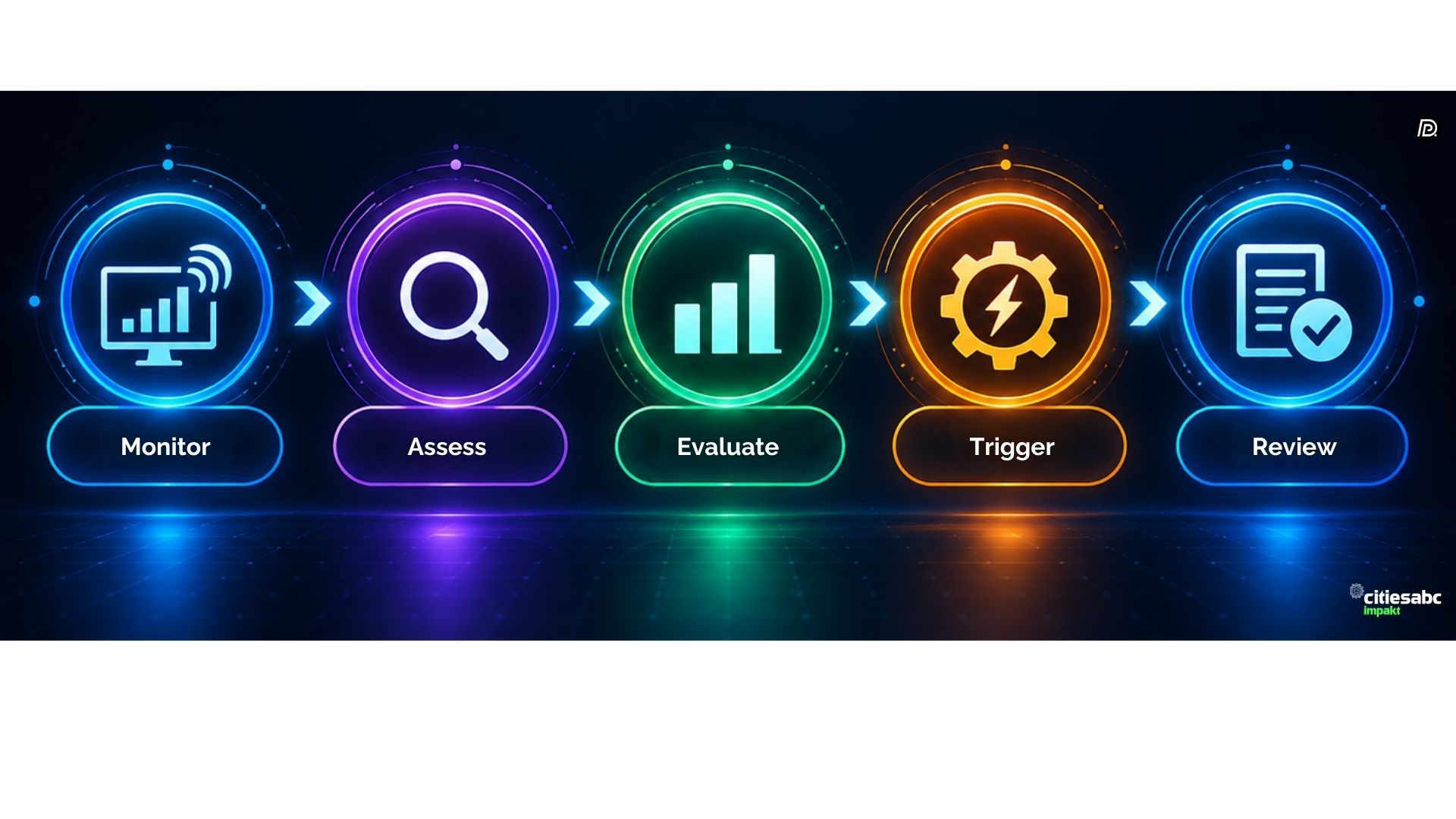
But each stage needs an owner. Trigger must mean more than changing the colour of a risk indicator.
WFP's current response describes anticipatory measures such as early-warning messages, cash assistance, food support, water-system improvements and pre-arranged disaster financing. These approaches aim to provide help before losses become harder and more expensive to manage.
For governments, farmer organisations and food businesses, a practical framework could look like this:
| Emerging Risk | Decision to Prepare Before Damage Escalates |
| Persistent dryness before planting | Review crop and planting options with local advisers, assess realistic water availability, and arrange suitable inputs and finance before the planting window closes. |
| Flood risk threatening farms and access routes | Protect stored seed and food, identify safer storage and transport alternatives, and pre-position assistance where routes may become inaccessible. |
| Extreme heat during a vulnerable period | Prepare worker-protection measures, water and shade arrangements, and locally appropriate crop and livestock management responses. |
| Production losses coinciding with market disruption | Verify inventories and delivery capacity, review procurement alternatives, and target support towards households losing purchasing power. |
These are planning examples, not universal instructions. Local forecasts, farming conditions, and response capacity must shape the final decision. The underlying approach that links early information to funded preparedness aligns with the measures described by FAO, WMO, and WFP.
The essential discipline is straightforward: name the decision-maker, identify the budget, establish the deadline and check whether action happened.
A forecast should not have to travel through several institutions while the opportunity to act disappears.
Protect the Farmer, the Food & the Ability to Recover
Reports from around the world do not describe a single, identical crisis.
They describe different hazards meeting different vulnerabilities: insufficient rain, excessive rain, extreme heat, damaged infrastructure, strained fisheries and households with little room to absorb another loss.
My conclusion is not that every harvest will fail or that technology offers an easy rescue.
We need to change what we reward.
Alongside forecast accuracy, I would ask resilience programmes to report how many people received support before the critical deadline, whether advice was usable, how quickly productive assets were restored, and what evidence shows that losses were reduced. Those outcomes should be independently assessed, not inferred from the number of alerts sent or users registered.
For technology providers, the challenge is to support trusted local institutions rather than assume another app will replace them.
For governments and funders, the challenge is to enable preparation before the photographs of destruction arrive.
For food businesses, it is to understand exposure beyond their immediate suppliers and consider producers' capacity to recover.
And for all of us, it is to remember that food security is not only about tonnes produced. It is about people retaining the ability to grow, earn, buy and eat.
We can see more of the risk than before.
The next measure of progress is what we do with that knowledge while there is still time to protect the next harvest.
Share

Dilip Pungliya
Industry Expert & Contributor
Dilip Pungliya is a business leader, Artificial Intelligence consultant, blockchain advisor, metaverse solution expert, data leader, technologist, and business, process, & technology architect. As a board member and significant shareholder of ztudium, Dilip brings a wealth of experience in business leadership and data technology. In his role as the Managing Partner of the ztudium Group, he benchmarks his strategic acumen in steering effective strategy and framework development for the company. Dilip also plays a pivotal role in his family's limited company in India, VPRPL, where he oversees operations and strategic planning. His professional journey includes impactful collaborations with esteemed organisations such as Shell, the Department for Environment Food and Rural Affairs, Deutsche Bank, ICBC Standard Bank Plc, BNP Paribas, and HSBC Investments. Beyond his professional endeavours, Dilip is deeply committed to philanthropy and charitable work, particularly during the global challenges presented by the COVID-19 pandemic.


