
business resources
What Americans Really Think of Streaming Brands: Netflix Brand Health in 2026
25 Nov 2026

Ask Americans to name a streaming service and half of them name Netflix unprompted. Ask which one they pay for, and the gap between Netflix and Amazon Prime Video almost disappears.
In August 2026, Behavio surveyed 1,500 Americans (a nationally representative sample) about six streaming brands: Netflix, Amazon Prime Video, Disney+, Apple TV+, Crunchyroll, and Shudder. The study measured how many people know each brand, how many think of it unprompted, how many pay for it, and what they feel when they hear its name.
Netflix tops almost every metric. But the brand tracking data from Behavio also shows where its lead is thin, where Prime Video is level with it, and where Disney+ holds an association Netflix doesn't. Here are the three findings that matter most if you run a brand.
1. Everyone knows the streamers. Netflix is the one that comes to their mind.
On awareness, the four biggest streaming brands are relatively close. When prompted, 90% of Americans recognize Netflix, compared with 83% for Prime Video, 78% for Disney+, and 71% for Apple TV+.
But ask people to name streaming services without prompting, and the picture changes. Netflix comes to mind for 50% of Americans, more than twice as many as its nearest rival, Prime Video (23%). Disney+ follows at 14%, and Apple TV+ at just 5%. Crunchyroll and Shudder round to 0%.
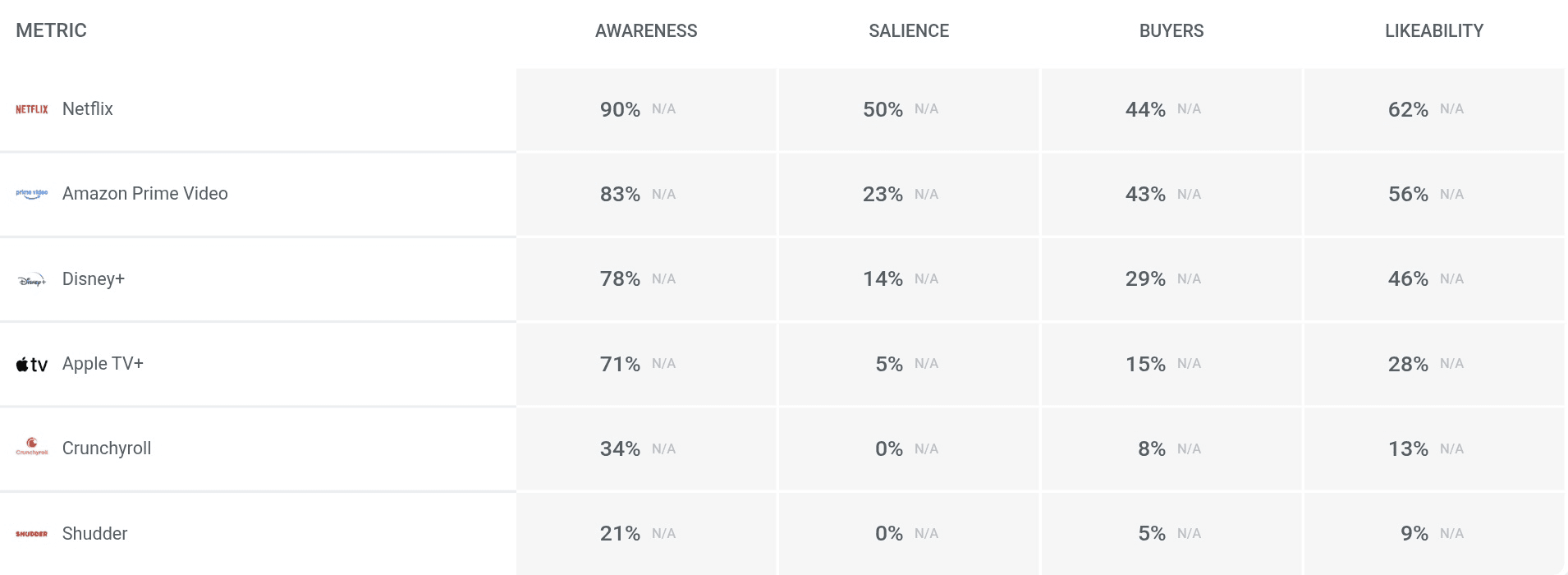
US population, August 2026. Awareness: recognize the brand when prompted. Salience: name the brand unprompted when asked about streaming. Buyers: paid for the brand in the past year. Likeability: feel positive emotion toward the brand.
Apple TV+ shows why awareness alone is a weak KPI. Seven in ten Americans recognize the brand, but only one in twenty thinks of it when asked about streaming. It has achieved recognition, but that doesn’t mean it comes to mind.
In this category, once brands reach roughly 70% awareness, the differences between them become less meaningful. Salience is what separates them. Netflix is the clear leader, with more than twice the salience of its nearest competitor.
2. Among streaming subscribers, Prime Video matches Netflix on buyers, but not on mindshare.
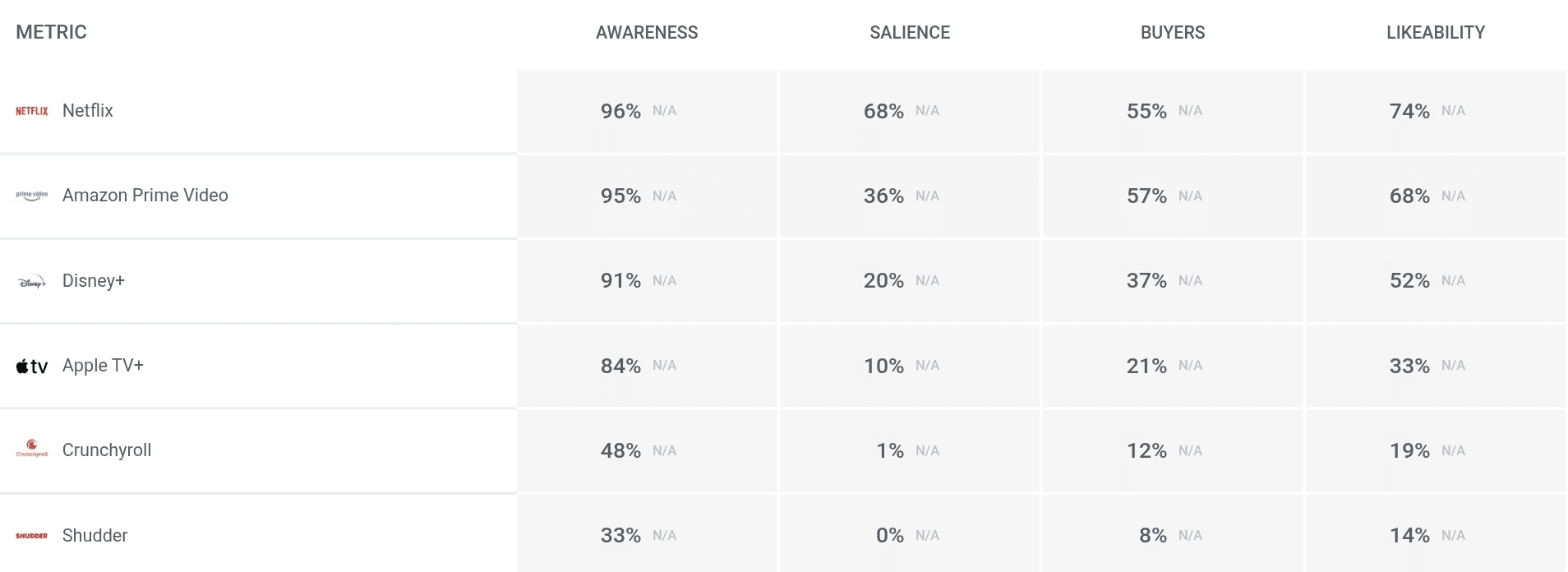
Now narrow the focus to category buyers: the 39% of Americans who pay for streaming services. These are the people streaming brands compete for most directly, and the picture changes.
Key metrics among category buyers, August 2026.
Among category buyers, Netflix and Prime Video are effectively level on purchase. 55% have paid for Netflix in the past year, compared with 57% for Prime Video, a difference within the margin of error. Awareness is almost identical too, at 96% and 95%.
But when it comes to mindshare, the gap is much wider. 68% name Netflix unprompted when asked about streaming, compared with just 36% for Prime Video. Netflix also leads on likeability, at 74% versus 68%.
One plausible explanation is distribution. Prime Video comes bundled with an Amazon Prime membership, so some of its buyers may never have chosen it as a streaming service. The survey can't confirm this, but the pattern is consistent with a simple distinction: Prime Video is in many homes, but less often on people’s minds.
If that’s the case, Prime Video’s bigger opportunity may not be to attract more subscribers, but to become a service people actively value and would miss. A subscription people pay for but rarely think about may be more vulnerable when households decide what to keep.
3. Netflix leads on emotion, but its image reflects the category as a whole.
Behavio asked respondents how they feel about each brand, offering five options: love, a smile, neutrality, boredom, or anger.
Netflix has the strongest emotional connection. 29% of Americans say they love the brand, and another 33% select a smile. That’s 62% positive overall. Prime Video follows at 56%, Disney+ at 46%, and Apple TV+ at 28%.
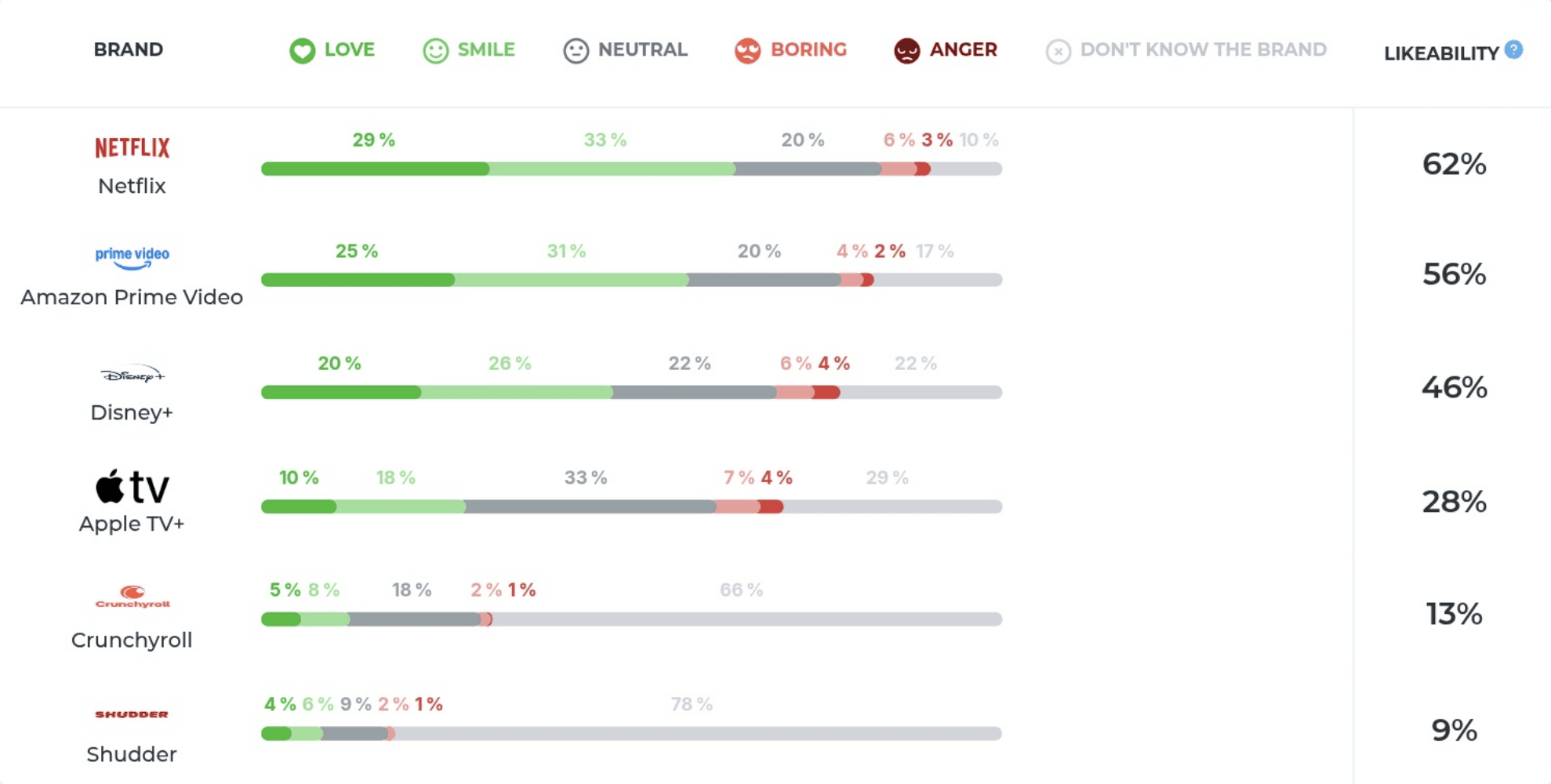
% of people who feel the specified emotion towards the brand. US population, August 2026. Likeability = love + smile.
Negative feelings are low across the board: no brand is seen as boring or met with anger by more than 11% of Americans.
The bigger gap is indifference. 33% are neutral toward Apple TV+, the highest share of any brand tested. That’s a different challenge from being disliked: people know the brand, but it hasn’t given them much reason to feel anything about it.
The catch: Netflix leads on almost everything, but stands out on little
On raw numbers, Netflix leads eight of the ten product associations Behavior tested. 60% of Americans link it to "great for evening relaxation," 58% to "wide selection of content," and 58% to "high-quality original shows."
Two associations belong to rivals. 49% associate Disney+ with the “kids profile option,” compared with 45% for Netflix. And 40% associate Prime Video with “to watch sports events,” compared with 35% for Netflix.
But raw numbers tend to favor bigger brands. If more people think about a brand, they’re naturally more likely to associate it with almost any attribute. That’s why Behavio also measures relative association strength: how strongly a brand is linked to an attribute compared with what’s expected given its size.
And this changes the picture. Netflix is almost entirely average, sitting within two percentage points of expectation on every attribute except “pre-installed TV app,” where it scores four points above. Its competitors, by contrast, are the ones with more distinctive profiles.
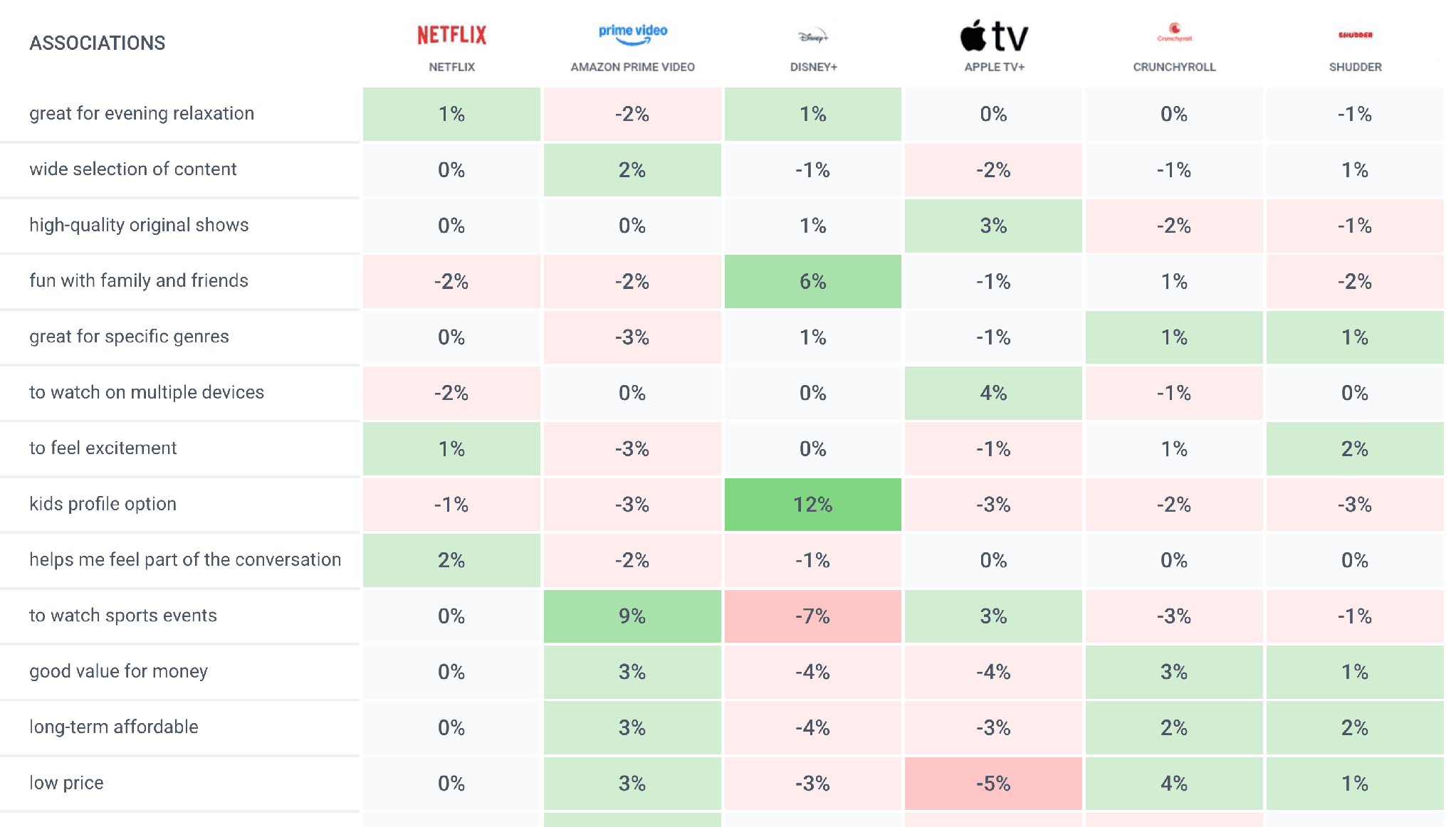
Percentage points above or below what each brand's size would predict. US population, August 2026.
This is what being the category default looks like: Netflix’s associations largely reflect what people associate with streaming services in general. That’s a strong position to hold, but it doesn’t make the brand distinctive.
Disney+ has a 12-point relative lead on kids profiles, with no close competitor. Prime Video stands out for sports, and to a lesser extent, price. Netflix’s clearest relative advantage is being pre-installed on TVs, an association it shares with Apple TV+.
What this means for brand marketers
Vojtech Prokes, Research Director at Behavio, on what he'd take from the streaming numbers:
"The first thing I’d stop doing is treating awareness as a win on its own. In streaming, four brands have between 71% and 90% awareness, but those numbers hide how differently they perform. Salience reveals the real gap. If your tracker shows awareness rising while salience stays flat, you may be increasing recognition without making the brand any more likely to come to mind.
The second lesson comes from the challengers. Disney+ and Prime Video don’t beat Netflix across the board. They stand out in specific situations: Disney+ when kids are watching, and Prime Video when there’s a game on. Both are more strongly associated with these moments than their size alone would predict. If you’re not the category leader, find a moment you can own, then build your brand around it.
And if you are the leader, your job is to defend that position. Netflix’s advantage goes beyond salience: 62% of Americans feel positively about the brand. Competitors can often match a feature, but emotional connections take much longer to build.”
About the data
Behavior surveyed 1,500 US adults, nationally representative, between August 6 and 14, 2026. The study covered six streaming brands: Netflix, Amazon Prime Video, Disney+, Apple TV+, Crunchyroll, and Shudder. Category buyers (39% of the sample) are respondents who buy in the streaming category.
Metrics: awareness (recognizes the brand when prompted), salience (names the brand unprompted when asked about streaming services), buyers (paid for the brand in the past year), likeability (feels love or a smile toward the brand), and brand associations across product, price, place, and promotion attributes. Relative association strength adjusts each brand's association scores for its overall size, so a small brand with a sharp image shows up as clearly as a large one.
Share

Ricardo Tomaz
Ricardo Tomaz is VP of Finance & Operations at Ztudium, the 4IR technology company behind Businessabc, Citiesabc, and IntelligentHQ. He owns the group's finance and operations function, spanning financial strategy, budgeting, reporting, and multi-entity operations, and works directly with leadership to align commercial goals with data-driven insight.
Working at the core of a technology group operating across AI and blockchain, Ricardo writes on the practical intersection of finance and emerging technology: how automation and digital transformation are reshaping business operations, what data-driven decision-making looks like in practice, and the questions of governance and ethics that come with AI-led systems.


