
business resources
What an NSC Calculator Reveals About Risk Free Saving Preferences
09 Sept 2026

Investment behaviour often reveals more about an investor’s priorities than the final returns generated from a financial product. Some investors willingly accept volatility for higher growth potential, while others prefer predictability, stability, and disciplined accumulation over uncertain outcomes.
This distinction becomes especially visible when investors actively use a National Savings Certificate (NSC) calculator before making fixed-income investment decisions. The tool does more than estimate maturity values. It reflects how investors think about guaranteed returns, capital protection, tax efficiency, and long-term financial comfort during uncertain economic cycles.
Let’s understand how the NSC calculator works and what it reveals about risk-free savings preferences.
An NSC calculator is an online financial tool that estimates the maturity value of investments made under the National Savings Certificate (NSC) scheme. The calculation usually considers the investment amount, prevailing interest rate, annual compounding structure, and the five-year maturity period.
The calculator helps investors estimate:
- Total maturity amount
- Interest earned during the tenure
- Annual compounding effect
- Long-term savings growth
- Expected fixed-income accumulation
Unlike equity-oriented calculators, the NSC calculator does not model volatility scenarios or multiple market outcomes. Instead, it focuses entirely on guaranteed projections supported by sovereign-backed returns.
This fixed-return visibility often attracts investors seeking greater financial predictability during uncertain market conditions.
The NSC calculator uses the standard compound interest formula to estimate maturity value over the investment tenure. Since NSC interest compounds annually, the accumulated interest gets added back to the principal every year.
A = P × (1 + r)^t
Where:
A = Maturity amount
P = Principal invested
r = Annual interest rate (in decimal)
t = Number of years
At present, the NSC interest rate remains around 7.7% annually for the applicable quarter, although the Government of India reviews these rates periodically.
For example, if an investor allocates ₹10 lakh through the scheme, the calculator estimates the maturity corpus using fixed annual compounding assumptions.
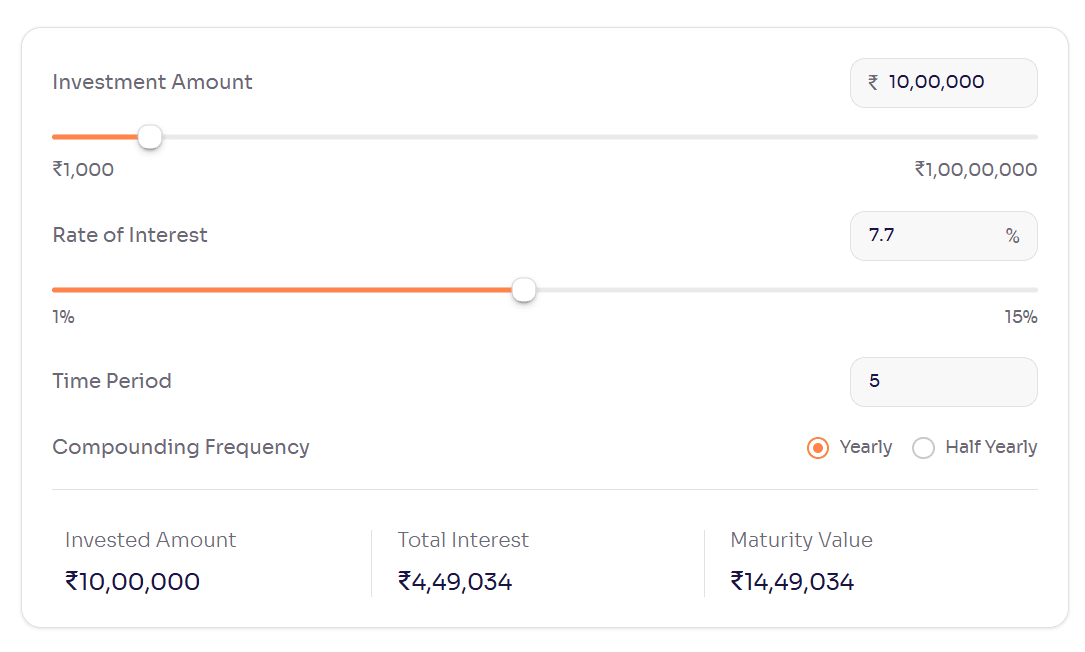
This straightforward structure is one reason conservative investors frequently prefer the NSC calculator while evaluating fixed-income allocation decisions.
Why conservative investors rely heavily on NSC calculations
Risk-averse investors usually focus on certainty instead of return maximisation. The NSC calculator supports this mindset because it removes estimation ambiguity from the investment process.
Unlike market-linked products, the calculator provides a clearly defined maturity projection from the beginning. Investors know the approximate maturity amount before committing capital for five years.
This predictability becomes psychologically valuable during:
- Equity market corrections
- High inflation cycles
- Interest-rate uncertainty
- Global economic disruptions
- Retirement planning phases
For many investors, the calculator acts as a reassurance mechanism rather than merely a mathematical tool.
It converts abstract savings behaviour into visible financial outcomes with minimal uncertainty attached to the process.
What the popularity of NSC calculators says about investor behaviour
The increasing use of an NSC calculator reflects broader behavioural trends among Indian savers. It highlights how many investors still prioritise capital preservation over aggressive wealth creation strategies.
This preference often emerges from:
- Fear of market volatility
- Desire for sovereign-backed security
- Stable income expectations
- Structured financial discipline
- Lower tolerance for investment fluctuations
Interestingly, this does not always indicate poor financial understanding. Many experienced investors deliberately allocate part of their portfolio towards stable fixed-income instruments to reduce overall portfolio risk.
Even sophisticated investors sometimes prefer guaranteed accumulation for specific goals such as:
- Child education planning
- Retirement income stability
- Emergency reserve allocation
- Capital preservation strategies
In such cases, the NSC calculator becomes part of a broader asset-allocation framework rather than a standalone savings exercise.
How the calculator reflects long-term savings discipline
One overlooked aspect of the NSC calculator is its role in encouraging disciplined investing behaviour.
Since the scheme carries a five-year lock-in period, investors cannot access funds freely during the tenure except under specific circumstances. This restriction reduces impulsive withdrawals and supports long-term accumulation habits.
The calculator reinforces this behavioural discipline by visually demonstrating how compounding strengthens savings over time.
For many households, this creates an emotional shift:
- Savings become goal-oriented
- Financial planning feels structured
- Future cash flow appears more tangible
- Investment discipline improves gradually
This explains why fixed-income planning tools remain highly popular despite the growing availability of equity-based wealth creation products on every major trading website.
Tax efficiency and the role of the NSC calculator
The NSC calculator also helps investors understand the tax-adjusted impact of fixed-income savings decisions.
Investments made under the scheme qualify for deductions under Section 80C of the Income Tax Act, subject to applicable limits. Additionally, the accrued interest during the initial years is considered reinvested and may also qualify for deduction treatment under certain conditions.
This creates a dual advantage:
- Guaranteed fixed-income growth
- Partial tax optimisation opportunity
However, many investors misunderstand one important aspect.
Although the scheme does not deduct Tax Deducted at Source (TDS), the interest earned remains taxable according to the applicable income-tax slab.
A professional evaluation should therefore compare:
- Nominal return
- Post-tax return
- Inflation-adjusted return
- Opportunity cost versus other investments
The NSC calculator helps simplify this assessment process for conservative investors seeking stable outcomes.
The signals it gives about risk-free savings preferences
The widespread usage of the NSC calculator reveals several deeper financial preferences among investors.
- Preference for guaranteed visibility
Many investors value return visibility more than return potential. A guaranteed maturity estimate often feels more reassuring than uncertain market-linked growth projections.
- Lower emotional tolerance for volatility
Investors who frequently use fixed-income calculators generally prefer smoother financial journeys without daily portfolio fluctuations or valuation stress.
- Structured goal-based allocation
The calculator appeals strongly to investors planning for defined future objectives where capital certainty matters more than aggressive growth assumptions.
- Conservative asset-allocation thinking
An investor repeatedly evaluating NSC maturity values often demonstrates a preference for balanced risk exposure rather than fully equity-driven investing behaviour.
- Stronger behavioural discipline
Fixed lock-in structures usually attract investors who recognise that unrestricted liquidity sometimes weakens long-term savings consistency.
These behavioural patterns are important because investing decisions are rarely driven purely by mathematics. Emotional comfort significantly influences financial behaviour across all income groups.
Where NSC fits within a modern investment portfolio
The NSC calculator should not encourage investors to view fixed-income products as complete wealth-creation substitutes. Instead, the scheme works more effectively as one component within a diversified portfolio.
A balanced allocation may include:
- Equity mutual funds for long-term growth
- Debt instruments for stability
- Gold for diversification
- Fixed-income schemes for predictable accumulation
- Emergency reserves for liquidity management
Within this structure, NSC supports capital stability while reducing overall portfolio volatility.
Many experienced investors now compare NSC projections alongside retirement tools, debt allocation models, and calculators available across modern trading platforms before finalising their investment decisions.
Build a savings strategy aligned with your risk comfort
An NSC Calculator does far more than estimate future maturity value. It highlights how investors emotionally define safety, certainty, and financial discipline within their broader wealth-building journey.
For conservative investors, the calculator offers reassurance through predictable projections and sovereign-backed stability. For experienced investors, it becomes a useful fixed-income planning tool supporting balanced portfolio construction and long-term allocation discipline.
The real value lies in understanding what these projections represent. Guaranteed returns can support financial confidence, but sustainable wealth creation still depends on diversification, inflation awareness, tax planning, and a realistic long-term investment strategy.
As investors gradually expand from fixed-income planning towards broader portfolio participation, many also begin comparing how different platforms, research tools, and digital investing ecosystems support their financial goals.
Modern investment platforms such as Ventura allow investors to evaluate multiple asset classes alongside traditional savings instruments, helping create a more balanced and informed long-term financial approach.


