
resources-impakt, first_page
Two Countries. One Food Future: What Britain Has That India Needs & What India Has That Britain Cannot Replicate
05 Nov 2026

In the previous article, I wrote about British strawberry farms using AI to forecast yield and harvest timing.
It raised an obvious question.
Could the same thinking work in India?
My first instinct was yes.
Then I realised that was probably the wrong question.
Because taking a technology that works on a British farm and simply transferring it to India is unlikely to be enough.
The farm is different.
The economics are different.
The climate is different.
The crop is different.
The farmer is different.
And the scale is completely different.
That led me to a more useful question:
What does Britain have that India genuinely needs, and what does India have that Britain cannot recreate?
I believe the answer is where the real opportunity lies.
And with the UK–India Free Trade Agreement now in force, this is no longer just an interesting discussion.
It can become a practical collaboration.
Britain Has Something India Needs: Precision
Britain has spent decades building agricultural capability around precision.
Precision in machinery.
Precision in horticulture.
Precision in food standards.
Precision in research.
Precision in data.
Precision in controlled trials.
And increasingly, precision in AI, robotics and automation.
The UK government is continuing to invest in this direction.
In August 2026, £20 million was made available for agricultural automation and robotics, bringing farmers, researchers and technology companies together to develop systems that can plant, manage and harvest crops.
A further £13 million programme announced in September was specifically designed to move promising agricultural research closer to practical farm deployment.
This is important.
Not because India lacks agricultural research.
It does not.
India has a huge agricultural research and university ecosystem.
But Britain has built a strong environment for taking certain technologies through:
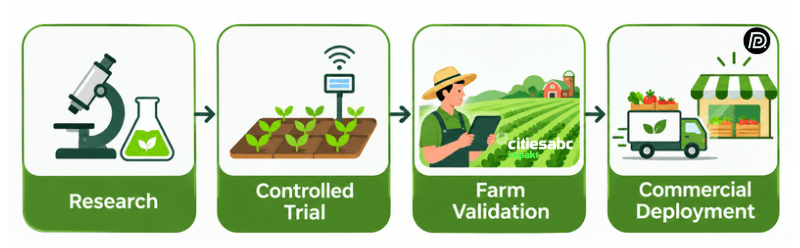
India can learn from that process.
But India Has Something Britain Cannot Manufacture: Scale
India's agricultural advantage is very different.
It is not only the number of farmers.
It is the diversity within those numbers.
Different soils.
Different rainfall.
Different irrigation systems.
Different farm sizes.
Different languages.
Different crops.
Different supply chains.
Different levels of mechanisation.
Different levels of digital adoption.
That complexity is often described as India's weakness.
I increasingly think it could be one of India's greatest agricultural assets.
Because if a technology can work across Indian conditions, it has been tested in one of the world's most demanding agricultural environments.
Britain can create a sophisticated pilot.
India can test whether that sophistication holds up in reality.
India Is Also Building the Digital Infrastructure for Scale
This is where India's position is becoming particularly interesting.
AgriStack is being built as agricultural digital public infrastructure around three foundational registries:
- Farmer Registry
- Geo-referenced Village Maps
- Crop Sown Registry
By February 2026, more than 8.48 crore Farmer IDs had already been generated.
The objective is to create a more connected foundation for services such as crop insurance, procurement, credit, input distribution and disaster relief.
Britain can't easily replicate that.
Britain may be able to develop highly advanced intelligence at farm level.
India can connect agricultural intelligence to millions of individual farmers.
These are different capabilities.
And they are potentially complementary.
Britain Has Precision. India Has Complexity.
But I want to avoid oversimplifying this.
It would be wrong to say:
Britain innovates. India scales.
India itself is one of the world's largest technology ecosystems.
It has AI engineers.
Agricultural scientists.
Startups.
Universities.
Remote-sensing capabilities.
Digital infrastructure.
And increasingly sophisticated agricultural technology.
Likewise, Britain is not simply a laboratory.
It has real farming challenges:
labour shortages,
weather volatility,
farm profitability,
input costs,
food security,
and pressure to improve sustainability.
So the opportunity is not a one-way technology transfer.
It is two-way learning.
What Britain Can Bring
There are several areas where British capability could be highly valuable in India.
Precision horticulture
Yield forecasting.
Computer vision.
Automated crop monitoring.
Robotic harvesting.
Protected cultivation.
These technologies could be highly relevant for high-value Indian crops.
Grapes.
Berries.
Pomegranates.
Tomatoes.
Mangoes.
Apples.
Flowers.
Robotics and automation
India faces a very different labour environment today, but agriculture is already experiencing labour shortages in certain crops and regions.
Small-scale, affordable versions of robotic and automated systems could become increasingly relevant.
The challenge is not importing expensive machinery.
The challenge is:
Can British engineering be redesigned around Indian farm economics?
That is where collaboration becomes meaningful.
Commercial validation
India does not need more demonstration projects that disappear after funding ends.
One useful lesson from the British innovation environment is the focus on moving technology toward commercial deployment.
The question should always be:
Who pays?
Why do they pay?
How quickly does the investment return?
That discipline is valuable.
Food standards and traceability
If India wants to expand higher-value food exports into Britain and Europe, traceability and compliance will become increasingly important.
Residue limits.
Quality standards.
Food safety.
Certification.
Farm records.
Supply-chain visibility.
These should not be treated as border obstacles.
They should be designed into the production system from the beginning.
What India Can Bring
The collaboration becomes much more interesting when we reverse the direction.
India has capabilities Britain can learn from too.
Scale
British agricultural technology may prove itself across dozens of farms.
India can expose it to thousands.
That creates enormous learning.
Cost innovation
India is exceptionally good at making technology affordable.
A £50,000 agricultural system may work commercially in Britain.
That does not mean it works in India.
Indian deployment forces a different question:
Can we deliver 80% of the value at 20% of the cost?
That thinking can create technologies relevant not only to India, but also to Africa, Southeast Asia and other emerging agricultural markets.
Digital service delivery
India has extensive experience building digital systems for very large populations.
The agricultural opportunity is similar.
How do you provide advisory, insurance, finance, identity and market access to millions of farmers?
Britain does not face that challenge at the same scale.
India does.
Smallholder operating models
Many agricultural technologies assume one farmer owns:
the land,
the machinery,
the data,
and the purchasing power.
That is not the reality for millions of Indian farmers.
This forces alternative models:
FPO ownership.
Shared machinery.
Drone-as-a-service.
AI advisory-as-a-service.
Pay-per-use sensors.
Collective procurement.
Collective market access.
These models may become increasingly useful elsewhere too.
The FTA Changes the Context
This discussion would have remained largely academic a few years ago.
Now there is a commercial framework around it.
The UK–India Comprehensive Economic and Trade Agreement entered into force on 15 July 2026.
UK government modelling estimates that the agreement could increase bilateral trade by around £25.5 billion annually in the long run.
But for agriculture, I think the more interesting part goes beyond tariffs.
The agreement contains provisions on:
trade in goods,
customs and trade facilitation,
rules of origin,
sanitary and phytosanitary measures,
and broader economic cooperation.
The SPS chapter is particularly important.
It is designed to facilitate agri-food trade while maintaining food safety and plant and animal health protections.
Importantly, it does not remove UK food-safety requirements.
Indian products entering Britain still have to meet UK standards.
That should not be seen negatively.
It creates an opportunity.
Because instead of asking:
How do we pass the UK inspection?
we can ask:
How do we build UK compliance into the Indian farm-to-market system from the beginning?
That is a much more powerful model.
Imagine a UK–India Grape Corridor
Let us make this practical.
Take grapes from Maharashtra.
India already exports fresh grapes to the UK.
Now imagine building a dedicated UK–India technology and trade pilot around that existing corridor.
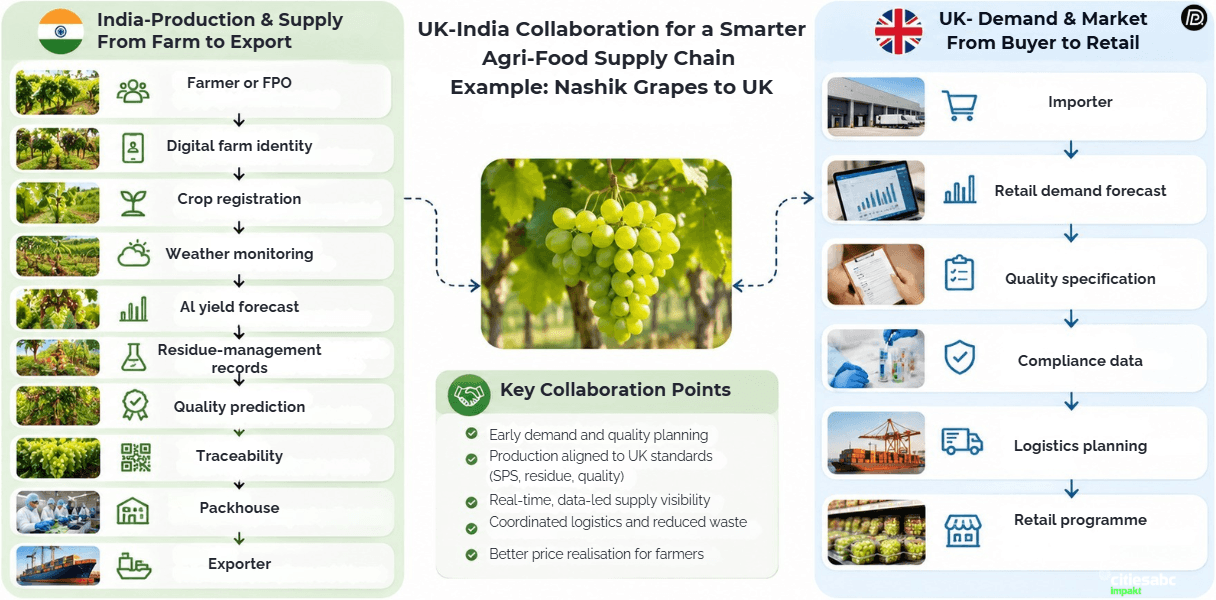
Now connect both sides.
The British buyer communicates requirements before production decisions are complete.
The Indian farmer or FPO receives those requirements early.
Technology monitors whether production remains within specification.
Yield forecasting gives buyers better visibility into the future.
Traceability follows the crop.
Logistics are planned earlier.
This is what I mean by practical collaboration.
Not a conference.
Not an MoU.
Not another demonstration.
A real crop.
A real buyer.
A real farmer group.
A real commercial transaction.
The FPO Could Become the Missing Institution
Another lesson became clearer to me after Article 2.
Prediction alone is not enough for a small farmer.
Suppose AI predicts that 500 farmers will collectively harvest 4,000 tonnes of produce next month.
What happens then?
An individual farmer may not be able to negotiate a buyer.
Book logistics.
Arrange packaging.
Access a cold chain.
Manage certification.
Or hedge commercial risk.
That is where the FPO becomes extremely important.
The forecast should not stop with the farmer.
It should feed into an institution that can act on behalf of multiple farmers.
The model could become:
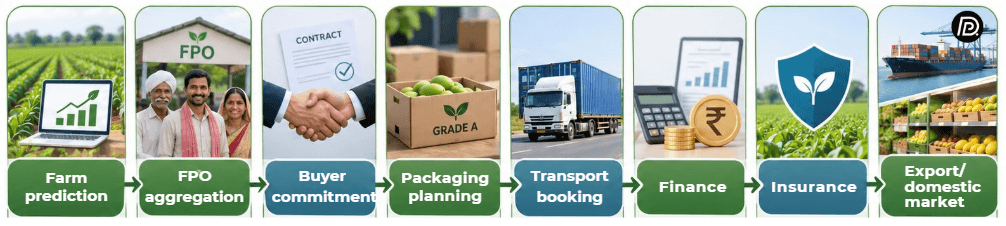
Prediction becomes useful only when somebody can act on it.
That is a practical lesson we should not ignore.
A Collaboration Model I Would Actually Test
Instead of trying to build a huge UK–India agriculture programme immediately, I would start with three focused pilots.
Pilot 1: Predictive horticulture
Choose one crop.
For example:
Nashik grapes.
Bring together: Indian farmers/FPOs, an Indian agricultural university, a British computer-vision or forecasting company, a UK importer or retailer, and a logistics partner.
Measure: forecast accuracy, waste reduction, labour planning, rejections, farmer realisation, and buyer reliability.
Pilot 2: AI + agronomist
Do not replace agronomists.
Give them better tools.
Combine: Indian field knowledge, British predictive technology, local weather, soil, crop images, and Indian agricultural research.
Measure: how many recommendations farmers actually follow, whether input use changes, whether disease is detected earlier, and whether economics improve.
Pilot 3: Traceability for UK trade
Take an existing export crop.
Digitise: farm origin, input usage, quality, residue compliance, packhouse movement, shipment, and importer acceptance.
Then ask one commercial question:
Does better traceability increase market access, reduce rejection or improve price?
If the answer is no, redesign it.
Technology should earn its place.
The Collaboration Should Work Both Ways
The strongest UK–India agricultural partnership should not end with deployment in India.
If a British technology is redesigned for Indian conditions and becomes cheaper, more robust, simpler, multilingual, and able to work across smaller farms, Britain may benefit from the redesigned version too.
This is often how innovation works.
Constraint improves design.
India can become more than an end market.
It can become a co-development environment.
And Britain can become more than a technology supplier.
It can become a validation and market-access partner.
That is a fundamentally different relationship.
What I Learned
I started this part of the journey by asking whether British agricultural technology could help India.
I now think that question is still too small.
The bigger opportunity is:
Can Britain and India build agricultural technologies, commercial models and food systems together that neither would build as effectively alone?
Britain brings precision.
India brings scale.
Britain brings structured commercial validation.
India brings real-world complexity.
Britain brings advanced agricultural engineering.
India brings cost innovation.
India brings digital infrastructure.
Britain brings sophisticated food markets and standards.
The FTA now gives the relationship a stronger economic framework.
But the agreement alone will not create collaboration.
People have to build it.
What Could Change Tomorrow?
I would start with six practical actions.
1. Choose crops, not concepts.
Start with grapes, berries, onions, apples or another commercially meaningful crop.
2. Pair one UK technology company with one Indian deployment partner.
Avoid large consortiums at the beginning.
3. Work through FPOs.
They can aggregate farmers, forecasts, demand and commercial action.
4. Bring the buyer in from day one.
Do not build technology first and search for a market later.
5. Design UK compliance into production.
Use SPS and quality requirements as production intelligence, not border paperwork.
6. Measure farmer economics.
Every pilot should answer one question:
Did the farmer become better off?
If not, the collaboration has failed.
The Question I Am Carrying Forward
The UK has capabilities India can use.
India has capabilities Britain cannot recreate.
The FTA provides a new bridge.
But a bridge matters only if something valuable crosses it.
So the next question is:
Can we move beyond pilots and create a real operating model where research, technology, farmers, buyers and markets are connected?
That brings me back to Maharashtra.
Because if India is the canvas, Maharashtra may be one of the best places to test whether this idea actually works.
Next:
The Maharashtra Experiment: Can One State Connect the Chain?
Share

Dilip Pungliya
Industry Expert & Contributor
Dilip Pungliya is a business leader, Artificial Intelligence consultant, blockchain advisor, metaverse solution expert, data leader, technologist, and business, process, & technology architect. As a board member and significant shareholder of ztudium, Dilip brings a wealth of experience in business leadership and data technology. In his role as the Managing Partner of the ztudium Group, he benchmarks his strategic acumen in steering effective strategy and framework development for the company. Dilip also plays a pivotal role in his family's limited company in India, VPRPL, where he oversees operations and strategic planning. His professional journey includes impactful collaborations with esteemed organisations such as Shell, the Department for Environment Food and Rural Affairs, Deutsche Bank, ICBC Standard Bank Plc, BNP Paribas, and HSBC Investments. Beyond his professional endeavours, Dilip is deeply committed to philanthropy and charitable work, particularly during the global challenges presented by the COVID-19 pandemic.


