
business resources
What Changes in Tire-Wear Diagnosis When Heavier EVs Enter the Workshop?
12 Nov 2026

Electric vehicles do not require workshops to abandon the fundamentals of tire diagnosis. They require technicians to apply those fundamentals with tighter control over load, pressure, geometry and vehicle history.
That distinction matters. Some battery-electric vehicles are heavier than comparable combustion models, and electric motors can deliver high torque from very low speed. Both can increase the forces passing through the contact patch. But rapid or uneven EV tire wear should not automatically be blamed on the battery or the powertrain. Vehicle mass is one factor among many, including inflation pressure, alignment, suspension condition, tire specification, road use and driver input.
The practical change is therefore not a new list of wear patterns. It is a more disciplined diagnostic process, one that starts with the vehicle’s approved specification and records enough evidence to separate normal service wear from a correctable fault.
Start with the vehicle, not the EV label
Before interpreting the tread, confirm the exact vehicle, derivative, wheel and tire combination. Two versions of the same model can have different kerb weights, axle loads, tire sizes and cold-pressure requirements. Optional wheels, towing use and frequent heavy loading can change the picture again.
The workshop baseline should come from current manufacturer information, the tire placard, owner information and applicable service data. Record the specified size, load index, speed rating and cold pressures before deciding whether the fitted tire is suitable or the observed wear is abnormal.
An XL marking, a high load index or an ‘EV’ description should not be treated as a substitute for checking the vehicle’s approved fitment. Nor should a technician assume that any tire matching the nominal size will deliver the same load capacity, rolling resistance, noise behaviour or durability.
Measure the wear before explaining it
A quick glance at the outer shoulder is not enough. Measure each tire at repeatable points across the tread and record the position on the vehicle. Comparing front to rear and left to right often reveals more than looking at one tire in isolation.
A useful inspection record should include:
- tread depth at the inner, centre and outer zones of each tire.
- cold pressure, where possible, compared with the vehicle specification.
- odometer reading and, if known, mileage since fitment or rotation.
- tire make, pattern, size, load and speed rating, and production identification.
- signs of feathering, cupping, localised scuffing, cracking, impact damage or repair.
- which axle and corner each tire occupied and
- the customer’s typical use, including urban acceleration, motorway mileage, towing and repeated heavy loads.
- Record the DOT tire code as part of the inspection, but do not treat the manufacturing date alone as proof of a tire’s condition. Storage history, environmental exposure and physical condition also matter.
Photographs and numeric measurements make a later comparison possible. They also help the workshop explain why an alignment check, pressure correction or earlier follow-up inspection is being recommended.
Treat the pattern as a clue, not a verdict
Traditional pattern recognition still helps, but it should guide the next test rather than close the job.
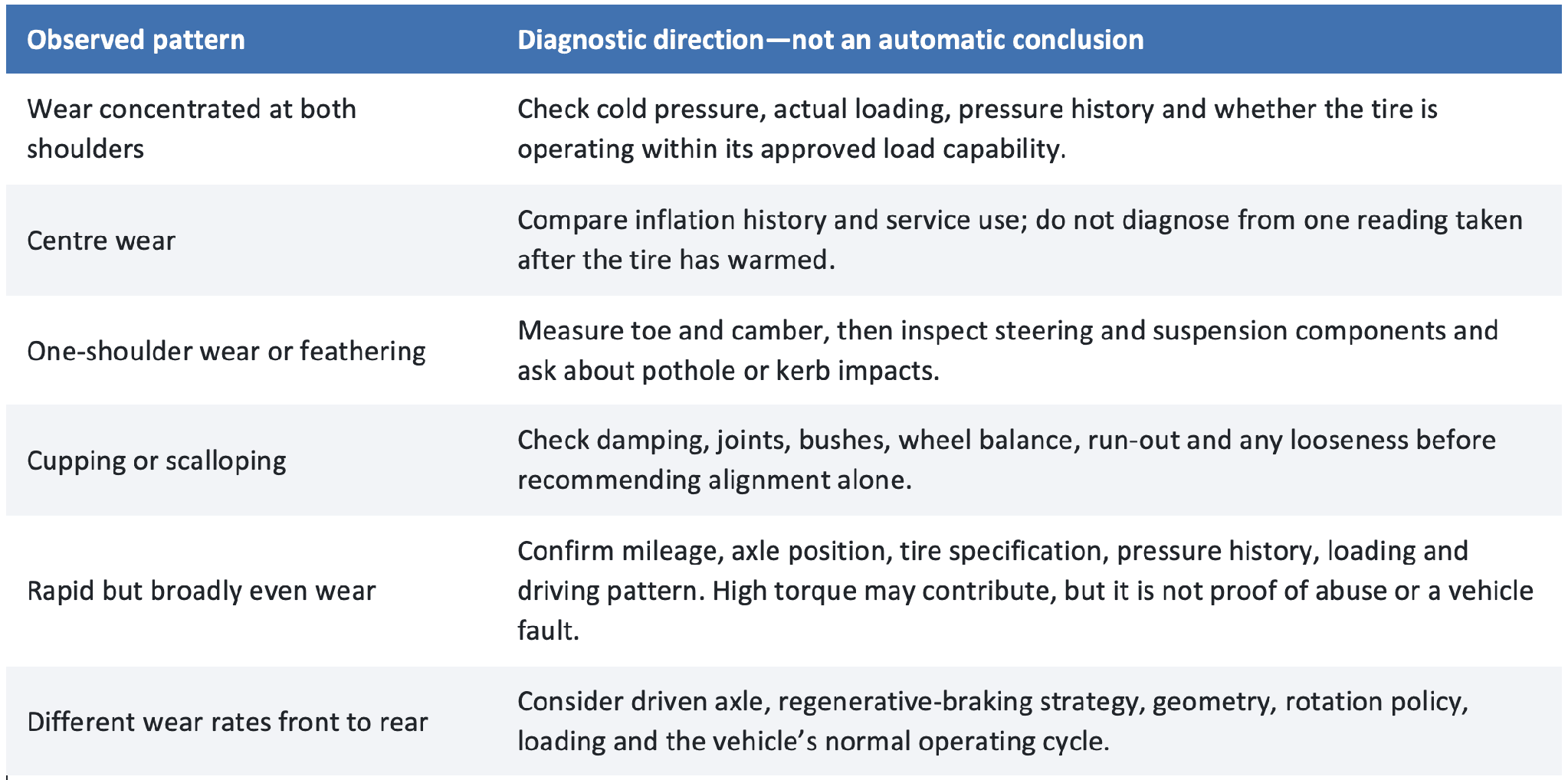
This is particularly important with EV tire wear because several influences can overlap. A heavier vehicle running slightly below its specified pressure can increase carcass deflection and shoulder loading. Add misalignment or repeated high-torque acceleration and the visible result may have more than one cause.
Pressure errors become more expensive
Inflation pressure affects the tire’s load-carrying behaviour, footprint, heat generation and rolling resistance. On a heavier vehicle, a pressure error can consume the available operating margin more quickly, so the accuracy of the measurement matters.
Use a calibrated gauge and compare like with like. A warm tire reading cannot be judged as though it were a specified cold pressure. If the customer has just arrived, record the condition and avoid releasing or adding pressure on the basis of an invalid comparison. Check for seasonal temperature change, slow punctures, valve leakage and damage where pressure loss is reported.
If the vehicle offers different pressures for normal and fully laden use, the workshop should establish how the vehicle is actually being used. The correct answer comes from the manufacturer’s specification for that vehicle and load condition, not from a generic ‘EV pressure’ figure.
Alignment deserves evidence, not guesswork
The combination of high vehicle mass, wide tires and low-profile fitments can make geometry errors costly. A pothole strike or worn suspension component may place toe or camber outside tolerance, but replacing the tires without identifying the cause simply resets the clock.
Inspect for play and damage before relying on alignment readings. Confirm wheel and tire condition, ride height and any manufacturer requirements for loading, calibration or driver-assistance systems. Then produce before-and-after measurements. A green screen is not enough if the equipment used the wrong vehicle variant or a worn component allowed the setting to move under load.
Where the wear is mild or the cause remains uncertain, a documented recheck after a defined mileage can be more defensible than a confident diagnosis based on one visit.
Account for torque and regenerative braking, carefully
Instant torque can increase tread stress when the driver repeatedly asks for strong acceleration, especially from low speed. Regenerative braking can also change how deceleration work is distributed through the driven wheels. Neither feature creates one universal EV wear pattern, because control software, drive layout, suspension geometry, tire design and driver behaviour vary widely.
Ask specific questions instead of telling the customer that ‘EVs eat tires’. Is most use short urban journeys? Is the vehicle driven in a high-performance mode? Has the wear appeared on the driven axle, one corner or all four tires? Has the rotation procedure permitted by the manufacturer been followed? The answers help separate operating pattern from a pressure, geometry or component fault.
Replacement choice is part of the diagnosis
A replacement tire must satisfy the vehicle manufacturer’s size, load and speed requirements and any other applicable specification. Beyond basic fitment, the workshop may also need to discuss durability, wet grip, rolling resistance and noise according to the customer’s use.
Tire manufacturers are addressing these competing requirements through compounds, constructions and pattern designs intended to work across modern powertrains. Giti Tire’s EV-ready tire development is one example of how weight, torque, efficiency, noise and durability are considered together rather than as isolated features.
That does not mean an ‘EV’ label alone proves suitability. The workshop still has to check the approved fitment for the exact vehicle and explain the trade-offs relevant to the customer.
A repeatable EV tire-wear workflow
- Identify the exact vehicle variant, tire specification and manufacturer pressure requirements.
- Measure and record all four tires by tread zone and vehicle position.
- Check pressure accurately and establish the vehicle’s usual load and operating pattern.
- Inspect wheels, steering and suspension before interpreting alignment readings.
- Compare wear across axles and consider drive layout, torque delivery, regenerative braking and permitted rotation practice.
- Correct the verified cause, select an approved replacement where required and document the advice.
- Set a follow-up mileage when the diagnosis depends on whether wear continues after correction.
The real change is diagnostic discipline
Heavier EVs can increase the consequences of poor pressure control, unsuitable fitment and small geometry errors. They can also expose weak workshop habits: visual-only inspection, no baseline measurements and an assumption that the powertrain explains everything.
A defensible diagnosis does the opposite. It verifies the vehicle specification, measures every tire, checks the mechanical causes and accounts for how the vehicle is used. That approach is more useful than blaming EV weight and it gives the customer a clear reason for every recommendation.


