
Trading Strategies & Tech, Markets & Investing, Crypto & Digital Assets
What Is a Prop Firm? How Funded Trading Accounts, Challenges and Payouts Work
05 Aug 2026

A practical guide to proprietary trading firms, evaluation programmes, simulated funded accounts, drawdown rules, profit splits and trader payouts.
A prop firm, short for proprietary trading firm, is a company that seeks to earn money by trading financial markets using the firm’s own capital. Its traders may be owners, employees or contractors, depending on the organisation and market.
The term is now also widely used for retail funded-trader programmes. In this model, an individual pays for an evaluation—often called a challenge and attempts to meet a profit target without breaking risk rules. Passing can lead to a funded account or reward account, but that account may be simulated rather than connected directly to live capital.
That distinction matters. A large advertised account size does not necessarily represent cash placed in the trader’s name, and a trader who passes is not automatically an employee, portfolio manager or licensed financial professional.
This guide explains how prop firm trading works, what challenges measure, how drawdown and payout rules interact and what traders should verify before paying an evaluation fee.
RISK WARNING: Trading futures, forex, options and other leveraged products can produce rapid losses. Passing a prop-firm evaluation does not guarantee a payout, continued account access or future profitability. Firm terms can change, so verify every rule on the provider’s official website before purchase.
What is a prop firm?
In the traditional institutional sense, a proprietary trading firm trades exclusively with its own capital rather than managing customer money. FINRA’s description of a proprietary trading firm, in a specific regulatory context, includes a firm that trades its own capital, has no customers and conducts trading through firm accounts using owners, employees or contractors.
Traditional prop firms may operate as market makers, quantitative trading businesses, arbitrage firms or specialist trading desks. They normally recruit traders based on experience, technical ability or research skills and may provide salary, bonuses, technology and risk limits.
Retail funded-account providers use a different structure. They sell access to an evaluation and apply predefined objectives and loss limits. Traders who qualify may receive a simulated reward account, a live account or a pathway that can move from simulation to live trading. The exact model depends on the provider.
| Traditional proprietary firm | Retail funded-trader programme |
|---|---|
| Capital | Firm capital is traded in firm accounts; retail programmes may begin or remain simulated. |
| Entry | Recruitment and employment or contractor selection versus a paid public evaluation. |
| Trader status | Employee, owner or contractor versus programme participant or independent contractor. |
| Compensation | Salary/bonus or profit participation versus performance-based rewards or payouts. |
| Risk controls | Internal desk limits versus published challenge and funded-account rules. |
| Account size | Allocated risk capital versus a nominal or simulated account balance. |
How a retail prop firm challenge works
Most retail prop firm programmes follow a sequence similar to the one below, although terminology varies.
Account structure and drawdown rules can shape every later decision. Our latest guide on The Choice You Make Before Your First Trade at a Prop Firm explains why the programme selected before the first order matters.
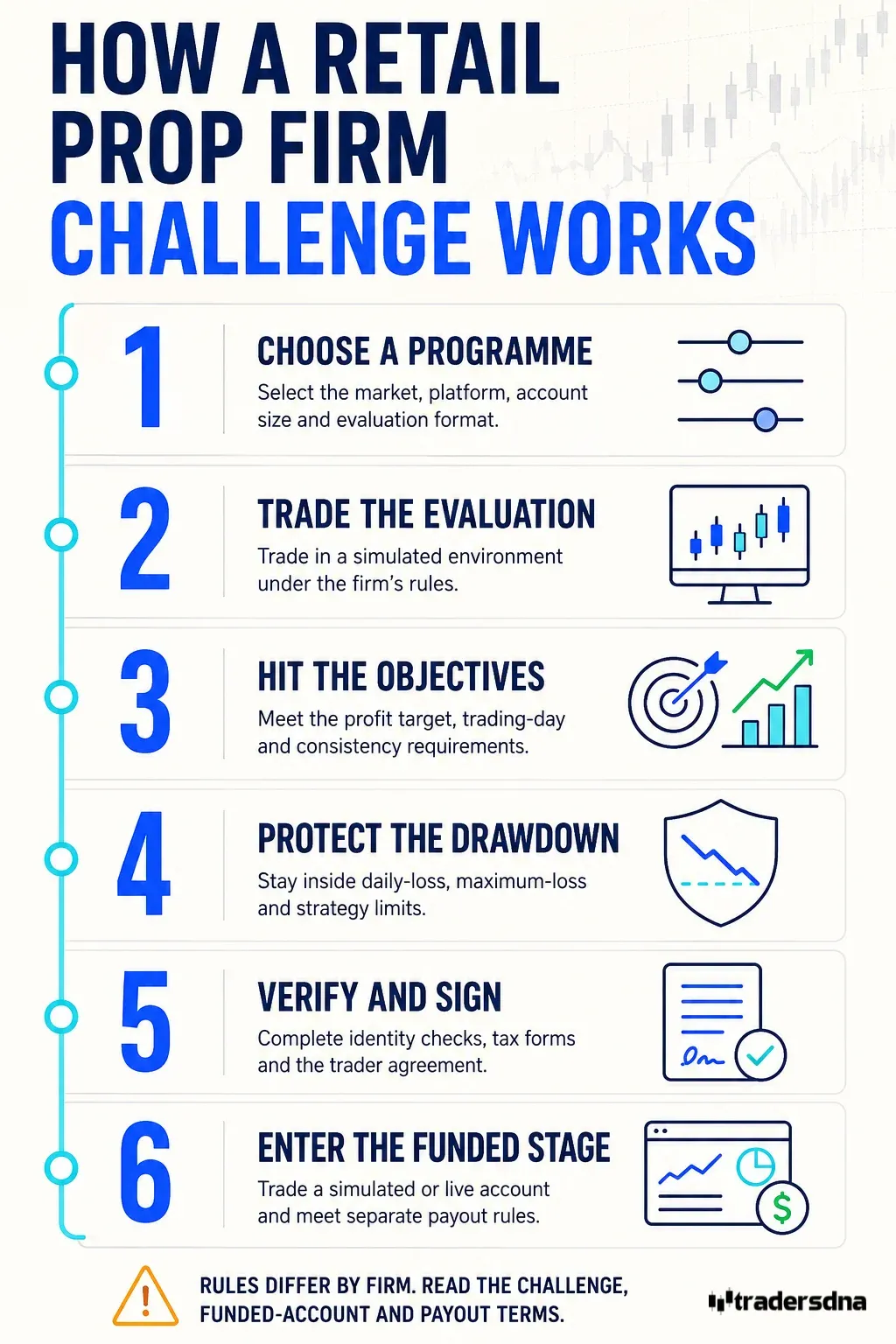
- Choose an account and programme. The trader selects a market, platform, account size and evaluation format, then pays the stated fee.
- Trade the evaluation account. Orders are usually placed in a simulated environment using market data and the firm’s rule set.
- Reach the performance objective. The trader may need to achieve a profit target, minimum number of trading days or consistency requirement.
- Stay within risk limits. Breaching a maximum loss, daily loss or prohibited-practice rule can fail or close the account—even if the trader was previously profitable.
- Complete verification and agreements. A successful participant may need identity checks, tax forms and a trader agreement before receiving the next account stage.
- Trade the funded or reward account. The account may be simulated, live or subject to later risk review. Payout eligibility remains governed by separate rules.
Passing the evaluation is therefore not the end of the process. Challenge rules, funded-account rules and payout rules can be different documents with different thresholds.
What does a ‘funded trading account’ mean?
The phrase funded trading account can create the impression that a firm deposits the advertised balance into a brokerage account controlled by the trader. That is not always how retail prop firm trading works.
Some providers use simulated accounts throughout the evaluation and reward stages. FTMO, for example, states that its platform accounts use fictitious capital and that clients do not execute trades in live markets; the company may separately use client trading data when deciding whether to trade its own capital.
Other providers use a progression model. A trader may begin in a simulated evaluation, move to a simulated funded account and later become eligible for a live account at the firm’s discretion.
The practical economic exposure is usually defined less by the headline balance and more by the loss limit. A ‘$100,000 account’ with a $3,000 maximum-loss limit gives the trader approximately $3,000 of permitted downside before failure—not $100,000 of freely riskable capital.
KEY IDEA: Treat the maximum permitted loss as the account’s effective risk budget. The headline balance mainly determines buying power, position limits and marketing presentation.
The rules that determine whether a challenge is passed
Profit target
The profit target is the amount the trader must gain during the evaluation. It should be considered alongside the maximum permitted loss. A high target combined with a narrow drawdown can encourage excessive risk if the trader has no tested plan.
Maximum loss or drawdown
Maximum loss is the lowest permitted account equity or balance. Some limits are static; others trail upward as profits increase. A trailing threshold can reduce usable room after a profitable period because the loss floor rises and may not move back down.
Daily loss limit
A daily loss limit caps how much can be lost in one trading session. The calculation may include realised losses, unrealised losses, commissions and fees. Traders must also confirm when the firm’s trading day resets and which time zone applies.
Minimum trading days
Some evaluations require activity on a minimum number of days. The purpose is to prevent a single lucky trade from being treated as sufficient evidence of consistency.
Consistency rules
A consistency rule limits how much of total profit may come from the trader’s best day. For example, if the largest day cannot exceed 40% of total profit, one unusually large win can delay eligibility until the trader earns additional profit on other days.
Position and strategy restrictions
Rules may cover maximum position size, news trading, overnight positions, weekend holding, copy trading, multiple accounts, latency arbitrage, account sharing, automated systems and prohibited attempts to exploit a simulated environment. Never assume a strategy is permitted because the platform technically accepts the order.
A simple challenge example
| Term | Illustrative condition |
|---|---|
| Nominal account | $100,000 simulated balance |
| Profit target | $6,000 |
| Maximum loss | $3,000 |
| Daily loss | $1,500 |
| Minimum days | Five trading days |
| Consistency | Best day no more than 40% of total profit |
This example requires the trader to earn twice the permitted total loss before failing. If the trader risks $600 per trade, only five full-risk losses would consume the entire maximum-loss allowance. A more conservative $150 risk would allow more observations, but the profit target would require a larger number of net winning trades.
The important comparison is therefore not account size versus fee. It is target versus drawdown, drawdown method, allowable risk per trade, expected number of trades and payout conditions.
How prop firm payouts work
A payout is the amount a firm distributes to an eligible trader under its agreement. It is not automatically equal to the account’s displayed profit.
A payout policy may include:
- A profit split determining the trader’s and firm’s shares
- A minimum payout amount
- A waiting period or minimum number of qualifying days
- A consistency requirement
- A cap per payout or per account size
- A requirement to remain above a minimum balance
- A reduction or reset in the account’s loss buffer after withdrawal
- Identity, compliance and payment-method checks
Current provider terms illustrate why the complete policy matters. Topstep’s published rules, for example, describe a 90/10 profit split, qualification conditions and payout caps for certain simulated funded-account paths. Those terms can change and should be treated as a live example, not an industry standard.
Why taking a payout can change account risk
Suppose a funded account shows $5,000 of reward balance above its loss threshold. If the trader withdraws $2,500, the remaining cushion may fall to $2,500 or less depending on how the firm resets the threshold. The same position size that appeared reasonable before the payout may then represent twice the percentage risk relative to the remaining buffer.
Before requesting money, calculate the post-payout balance, new loss threshold, remaining drawdown and maximum safe position size.
How prop firms make money
The revenue model varies. Traditional prop firms aim to earn trading profits. Retail funded-account businesses may earn revenue from evaluation fees, subscriptions, resets, activation charges, platform services and their share of profitable trader performance. A provider may also use selected trading data or move selected traders into live execution.
The existence of evaluation fees does not by itself prove that a programme is illegitimate. However, traders should understand whether the business appears designed to identify sustainable trading performance or primarily to generate repeated fees from failed challenges.
How much does prop firm trading cost?
The advertised evaluation fee is only the starting point. Calculate the complete expected cost of participation:
- Initial evaluation or subscription fee
- Recurring monthly charges while the evaluation remains active
- Reset or retry fees
- Activation or onboarding fees after passing
- Market-data and platform charges
- Trading commissions and simulated fees
- Withdrawal, currency-conversion or payment-processing charges
- Taxes on payouts in the trader’s jurisdiction
A low entry price can become expensive when the programme requires repeated attempts. Set a fixed annual evaluation budget and do not fund retries with money needed for living costs, debt payments or emergency savings.
Are prop firm traders employees?
Usually not in retail challenge programmes. Participants may be classified as independent contractors or counterparties under a trader agreement, but status varies by provider and jurisdiction. A passed challenge should not be represented as salaried employment unless a genuine employment contract exists.
Tax treatment also differs. One provider may issue contractor income documentation in a particular country, while another may pay from an overseas entity. Traders should keep records of fees and payouts and obtain jurisdiction-specific tax advice.
Potential advantages of a funded trading programme
- A predefined loss limit can impose risk discipline.
- The trader may pursue performance-based payouts without depositing the advertised account balance.
- Evaluation metrics can expose inconsistency, overtrading and poor position sizing.
- Some programmes provide analytics, education, community or a pathway toward live capital.
- The maximum personal cash outlay can be limited to fees if the trader does not add outside leverage or debt.
Risks and disadvantages
- Most participants may fail before receiving a payout.
- Rules can be complex, change over time or differ between evaluation and funded stages.
- Trailing drawdown can make a nominally large account fragile.
- A simulated account is not the same as being entrusted with live investment capital.
- Fees can accumulate through subscriptions, resets and repeated challenges.
- Payouts may be delayed, capped, reviewed or refused under the agreement.
- The programme may be unavailable or treated differently in certain jurisdictions.
- Trading to pass quickly can reinforce risk-taking habits that are unsuitable for long-term performance.
How to evaluate a prop firm before paying
- Identify the legal entity. Confirm the company name, jurisdiction, address and the entity named in the trader agreement.
- Understand the account model. Determine whether evaluation, funded and payout-stage trading are simulated or live.
- Read every rule source. Compare the marketing page, rulebook, FAQ, payout policy and contract for inconsistencies.
- Reconstruct the effective risk budget. Focus on drawdown, daily loss and how thresholds move after profits and payouts.
- Calculate the full cost. Include subscriptions, resets, activation, data, commissions and payment charges.
- Review payout mechanics. Check eligibility days, consistency, caps, minimums, profit splits and post-withdrawal drawdown.
- Check strategy restrictions. Confirm rules for news, overnight trades, automation, copy trading, IP addresses and multiple accounts.
- Verify relevant registrations and claims. For U.S. futures, forex or derivatives activity, the CFTC recommends checking NFA BASIC and asking why an entity is absent if registration might be expected.
- Search for operational warning signs. Look for unresolved payout complaints, frequent rule changes, unclear ownership and pressure-based promotions.
- Test before paying. Trade the intended rules in a personal simulator long enough to see whether the strategy fits the drawdown structure.
Common prop firm misconceptions
‘A $100,000 account means I can lose $100,000.’ No. The maximum-loss limit normally defines the usable downside and may be only a small fraction of the advertised balance.
‘Passing proves I am consistently profitable.’ Passing demonstrates performance under one rule set over a limited period. It does not establish long-term profitability.
‘Funded always means live capital.’ Many programmes use simulated accounts. Read the provider’s execution and account-model disclosures.
‘A 90% split means I receive 90% immediately.’ Eligibility days, caps, minimum balances and reviews may apply before the split is calculated and paid.
‘No daily loss limit means there is little risk.’ A maximum-loss rule can still close the account, and trailing drawdown may be more restrictive than a daily limit.
Frequently asked questions
What is prop firm trading?
Prop firm trading is trading conducted for a firm’s own account. In retail usage, it commonly refers to challenge-based programmes in which traders follow defined objectives and may qualify for performance payouts.
Do prop firms give traders real money?
Traditional firms allocate firm capital. Retail programmes may provide simulated accounts, live accounts or a progression between them. Verify the provider’s disclosure rather than relying on the word ‘funded’.
What happens if I fail a prop firm challenge?
The evaluation normally ends or becomes ineligible. The provider may offer a reset or new evaluation for an additional fee. Previously paid fees may be non-refundable.
How do prop firm payouts work?
Eligible profits are distributed according to a profit split and payout policy. Minimum days, consistency, balance requirements, caps and compliance reviews may apply.
Can beginners use prop firms?
They can purchase evaluations, but a paid challenge should not replace basic market education and simulator practice. Beginners are especially vulnerable to repeated-fee cycles.
Are prop firms regulated?
The answer depends on the firm’s activities, instruments, structure and jurisdiction. A simulated evaluation provider is not automatically regulated like a broker. Verify specific claims with the relevant authority.
Is prop firm trading profitable?
Some traders receive payouts, but individual results vary and fees, failed evaluations and account closures reduce net returns. There is no guaranteed income.
How long does it take to become a funded trader?
It depends on the evaluation format, minimum trading days, strategy and performance. Passing quickly should not be prioritised over remaining within a tested risk plan.
Final thoughts
A prop firm can provide a structured route from simulated evaluation to performance-based payouts, but the headline account size tells only a small part of the story.
The decisive terms are the effective drawdown, daily-loss calculation, payout conditions, fee structure, account model and legal agreement. Traders should understand those terms before attempting to optimise a strategy around them.
Approach a challenge as a paid risk-management test—not as a shortcut to guaranteed income. If the rules cannot be explained clearly on one page, do not pay until they can.
Sources
- FINRA, Regulatory Notice 23-16: https://www.finra.org/rules-guidance/notices/23-16
- CFTC, Check Registration & Backgrounds Before You Trade: https://www.cftc.gov/check
- CFTC, Customer Advisory on fee scams and unrealistic trading claims: https://www.cftc.gov/LearnAndProtect/AdvisoriesAndArticles/CustomerAdvisory_CoronaFees.htm
- FTMO, How an FTMO Account works from the technical side: https://ftmo.com/en/faq/how-does-an-ftmo-account-work-from-the-technical-side/
- Topstep, Express Funded Account Rules: https://www.topstep.com/express-funded-account-rules
- Topstep, Payout Policy: https://help.topstep.com/en/articles/8284233-topstep-payout-policy
- Topstep, Maximum Loss Limit: https://help.topstep.com/en/articles/8284204-what-is-the-maximum-loss-limit


