
business resources
What Most Startups Get Wrong About Product Launch GTM
22 Apr 2026

GTM mistakes don’t always show up on launch day. Here’s a quick breakdown of where most startup product launch strategies go wrong and what to do about it.
There’s a pattern behind most underwhelming product launches. The team does everything right by its own measure. They build anticipation, announce the launch, push it across every channel, maybe even line up some PR.
And then, not much happens. In many cases, the problem is that teams treat attention as the ultimate goal when it’s only the starting point. They optimize for visibility alone instead of building a system that turns that visibility into demand.
And when that system isn’t there, even a strong product struggles to land. CB Insights found that 35% of startups fail because there’s no market need for what they built. But even when the need is there, a weak GTM strategy can bury it.
A strong product doesn’t win by default. It needs positioning, timing, and distribution to work in sync. Without those pieces, it doesn’t matter how good the product is. This article breaks down exactly where startup GTM goes wrong, and what to do instead.
A Product Launch GTM Is Not What Most Teams Think It Is
Before getting into the mistakes, it helps to clear something up. A product launch is not a demand generation event. It doesn’t create demand out of thin air. What it does is capture and accelerate demand that already exists in the market.
That distinction matters because it changes what you need to build. Attention spikes are temporary by nature, whereas a steady pipeline requires continuity.
Thankfully, a few software solutions exist to address this issue. The Conigma GTM community, for instance, is a platform purpose-built to help teams maintain momentum and coherence long after the product launch.
If nothing carries your product launch forward after the announcement fades, the momentum fades with it. A launch without a data-backed GTM strategy behind it is just a very expensive moment. On that note, let’s go over the most common product launch GTM mistakes startups often make.
#1 Treating the Launch Like a One-Time Event
Weeks of buildup, a coordinated announcement, a spike in traffic and engagement, and then silence. The campaign wraps up, and the sales team is left to follow up however they see fit. Three weeks later, the pipeline looks exactly like it did before.
This is the most common GTM failure mode, and the most preventable. The problem is that there’s nothing designed to come after it. No structured path for warm interest to travel down. No continuation motion to keep the conversation alive once the announcement noise fades.
Interest fades especially fast in B2B. A prospect who was genuinely curious on launch day has a full inbox and three competing priorities by the end of the week. Without a deliberate follow-through system, that interest eventually disappears.
#2 Leading With the Product Instead of the Problem
“We built something great” is not a good enough reason to buy. Neither is “faster, simpler, better.” You’ll see these types of taglines appear in roughly 80% of B2B launch copy. And, of course, they’re immediately forgotten by almost everyone who reads them.
The problem here is you’re positioning your business from the inside out. Founders and teams know their product intimately, so their messaging can inadvertently reflect what that product does rather than the problem it solves for customers.
It’s the classic “features vs benefits” concept. Here’s how one founder describes this concept on LinkedIn:
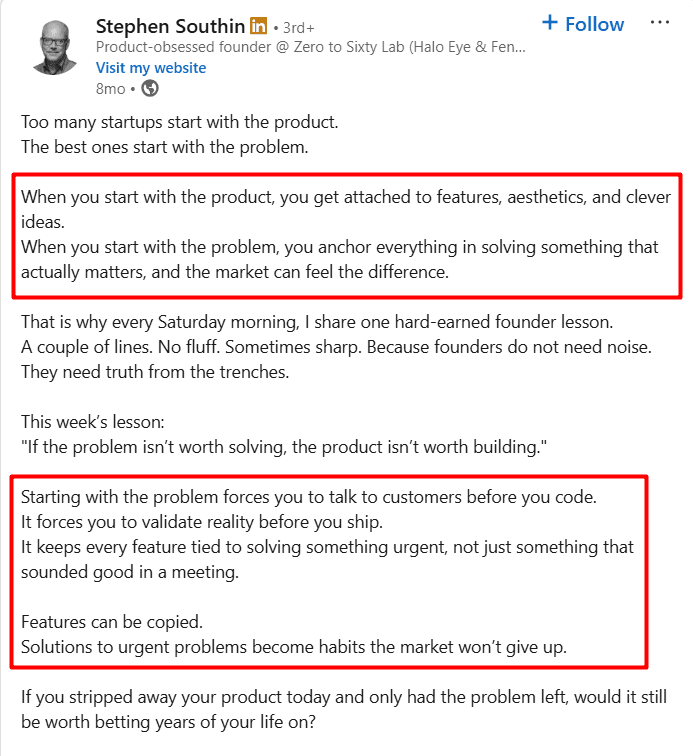
When it comes to the GTM product launch, this mistake shows up as feature-heavy announcements that praise the product with no sharp problem framing or urgency for the buyer.
If your message doesn’t immediately reflect the pain point your buyers are actively trying to solve, they’ll move on long before the conversation starts. Get that part right, and your product is one step closer to selling itself.
#3 Confusing Attention With Demand
Having high traffic and strong engagement numbers means little without a qualified pipeline to show for any of it. This typically happens when attention is mistaken for demand.
Attention is someone noticing you exist. Demand is someone actively looking to fix a problem you solve. The difference between those two states is where too many product launch strategies break apart.
Without some mechanism to separate genuine buyers from curious observers, your team is bound to chase the wrong signals. You end up celebrating vanity metrics internally while the pipeline remains thin. The product launch looks successful, but revenue doesn’t reflect it.
#4 Having a Weak Distribution Strategy
“If you build it, they will come” is not a credible GTM strategy. In B2B, it’s barely even an optimistic take. Startups notoriously under-invest in distribution.
They often pick one channel, usually LinkedIn or email, push the launch message once or twice, and move on when the response is underwhelming. And it’s understandable given the number of priorities they juggle.
That said, B2B buying decisions are slow and committee-driven. A single touchpoint won’t move them. You need repetition, and the data on this is pretty consistent. A RAIN Group study confirms that it takes an average of 8 touchpoints to get an initial meeting (or other meaningful action) with a new prospect.
In other words, you’ll need campaign sequencing, channel variety, and coordinated outreach across the places your specific buyer spends time. Reach without repetition doesn’t stick. And distribution without depth doesn't build a pipeline.
#5 Letting Marketing and Sales Operate in Separate Worlds
When marketing and sales don’t share a definition of a qualified lead, follow-up timing becomes inconsistent, and messaging between teams drifts. The launch ends up producing a spike in interest that fades in the handoff between teams.
B2B research consistently finds that strong sales and marketing alignment correlates with higher win rates and revenue growth. Aligned teams move faster, speak consistently, and don’t let warm leads go cold while they figure out whose job it is to follow up. A launch succeeds or fails in the handoff.
So What Does a Good Product Launch GTM Look Like?
It starts before the launch, not on the day of it. Map the buyer problem first, precisely and specifically. Build the follow-through system before you write the announcement. Align sales and marketing around a single motion with shared definitions and sequenced handoffs.
Treat launch day as the opening of a conversation rather than the conclusion of a campaign. The startups that figure out GTM aren’t necessarily better resourced. They just build for what comes after the spike.


