
About UsMembershipMarketplaceResourcesGlobal Business Atlas
Top AI CompaniesTop Blockchain Influencers & AuthorsTop Global Digital AgenciesBusinessabc Country IndexesTop Accelerators and Chambers of CommerceTop Public Companies by MarketcapBusinessabc Education IndexesTop Malaysian Companies
DirectoryCompaniesLeadersInvestorsUniversitiesOrganisations
Loading article…
Logo

Businessabc provides digital business directory, digital blockchain AI certification, resources, and marketplace for businesses, organisations, and professionals.

Contacts

Email
Contact

Follow Us

Created Produced

Partner logo
Partner logo

Tech AI Media Platforms

Partner logo
Partner logo
Partner logo
Partner logo
Partner logo
Partner logo
Partner logo
Partner logo
Partner logo
Partner logo
Partner logo
Partner logo

Copyright 2026 © Businessabc powered by

Powered by ztudium group

DisclaimerPrivacy PolicyTerms of Service

Markets & Investing

What Would a Battle of Inflationary Pressures (and Disinflation) Mean For Markets?

Peyman Khosravani

31 Jan 2019

What Would a Battle of Inflationary Pressures (and Disinflation) Mean For Markets?

Chinese ‘factory gate’ price inflation has been slowing over the past two years. Recently released producer price inflation was markedly lower in year-on-year terms, driven down further by a very weak monthly reading in December. These lower ‘factory gate’ prices are likely to be imported into developed markets via trade with China, creating a disinflationary (slower inflation) impulse for developed economies. This would be good news for bond markets, which are notoriously unnerved by too much inflation.

It is important to note that disinflation is a term commonly used by the Federal Reserve to describe a period of slowing inflation. Unlike inflation and deflation, which refer to the direction of prices, disinflation refers to the rate of change in the rate of inflation. Although sometimes confused with deflation, disinflation is not considered as problematic because prices do not actually drop, and disinflation does not usually signal the onset of a slowing economy. Deflation is represented as a negative growth rate, such as -1%, while disinflation is shown as a change in the inflation rate from 3% one year to 2% the next.

“As such, the developed world has a potential counterbalance to these disinflationary pressures: strong domestic labour markets. US unemployment levels are currently at their lowest point since the 1970s, and even in Europe (where unemployment is structurally higher) employment levels are relatively robust,” said Graham Bishop, Investment Director at Heartwood Investment Management, the asset management arm of Handelsbanken in the UK.
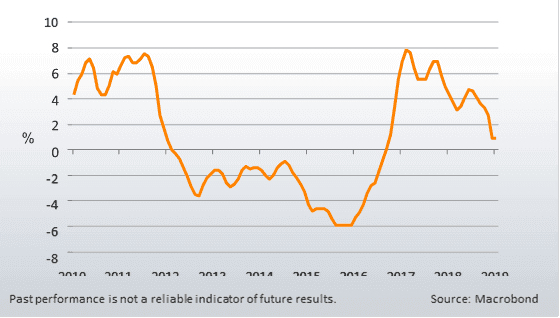
China PPI (year on year)
China PPI (year on year). Source: Macrobond

In fact, as the US Federal Reserve has pointed out, the inflation remains on track for now, amidst signals of being slowed down, prior their next meeting. In it, it is due that policymakers discuss about the current rates of inflation and make efforts in tracking the control of the prices to reach their target of 2 per cent, as long as the American Jobs market and the unemployment rate keep steady at a 4 per cent rate.

“This in turn should feed through into wage inflation, which could work to offset the disinflationary impulses imported from China. While we expect these two factors to offset one another to a degree, we believe that for developed world economies the inflationary effects of strong labour markets at home will outweigh the disinflationary impulses from abroad, for now. As a result, we maintain our preference for short-duration fixed income assets, which are less likely to be impacted by changes in inflation,” concluded Graham Bishop.


Read More:

What is crypto day trading?

stock market veterans day

how long is trade school

sell to open vs sell to close

What is emotionless option trading?

Previous

Currencies: Victory For May But Not For The Pound As Exchange Rate Slips, Expert Warns

Next

This Is How Hardware Wallets Work To Keep Safe Your Crypto

Share

Peyman Khosravani

Peyman Khosravani

Industry Expert & Contributor

Peyman Khosravani is a global blockchain and digital transformation expert with a passion for marketing, futuristic ideas, analytics insights, startup businesses, and effective communications. He has extensive experience in blockchain and DeFi projects and is committed to using technology to bring justice and fairness to society and promote freedom. Peyman has worked with international organisations to improve digital transformation strategies and data-gathering strategies that help identify customer touchpoints and sources of data that tell the story of what is happening. With his expertise in blockchain, digital transformation, marketing, analytics insights, startup businesses, and effective communications, Peyman is dedicated to helping businesses succeed in the digital age. He believes that technology can be used as a tool for positive change in the world.

Read more

More Articles

article cover

$1.1 Billion In Crypto Stolen Since 1.1.18

article cover

1.9 Million UK Buildings Require Urgent Energy Efficiency Overhaul

article cover

#1 Cosmetic Dentist in New York City – Dr. Pia Lieb from Cosmetic Dentistry Center NYC (2026)

article cover

1 in 3 Big Business Audits Fail to Meet UK Standards - FRC Reveals as KPMG is Fined £13 Million

article cover

10,000 Garments Later: How The Massing Group Answered the Palisades and Altadena Fires

article cover

10 Benefits of Using Church Accounting Software