


business resources
When Meetings End, Business Knowledge Shouldn’t Disappear
21 Sept 2026

Meetings contain more than conversation. They capture decisions, customer feedback, project risks, strategic reasoning and commitments that shape what a business does next. Yet much of this information can disappear as soon as the call ends.
Some participants rely on memory. Others keep personal notes that colleagues cannot access. Important details may remain buried in a recording that nobody has time to replay. When the next meeting begins, the team may spend valuable time reconstructing what was already discussed.
For growing businesses, this is more than an administrative inconvenience. It creates an information gap between the people who attended a meeting and everyone who must act on its outcome.
The Hidden Cost of Information Lost in Meetings
A single forgotten detail may appear insignificant. Across multiple departments and recurring meetings, however, those gaps can create larger operational problems.
A sales representative may remember a customer request differently from the product team. A project manager may know that a deadline changed without understanding why. A colleague returning from leave may see the final decision but not the alternatives that were considered.
This loss of context can lead to duplicated work, inconsistent communication and delayed decisions. It can also make businesses overly dependent on individual employees who hold important knowledge in their private notes or memory.
Preserving meeting knowledge does not mean documenting every sentence indefinitely. It means creating a reliable way to find the decisions, explanations and next steps that matter.
Why Manual Notes Become Less Reliable at Scale
Manual note-taking works reasonably well in small, simple meetings. It becomes more difficult when discussions are fast, technical or multilingual.
The person taking notes must decide what is important while continuing to participate in the conversation. This divided attention can result in missing a question, shortening a nuanced explanation or recording a conclusion without its supporting context.
Different employees also use different note-taking styles. One person may document decisions, while another focuses on ideas or tasks. Their notes may be stored in separate documents with inconsistent names and access settings.
As an organisation grows, the problem is not simply whether notes exist. The problem is whether people can locate, understand and verify them when they are needed.
Capture Is the First Layer
Recording and transcription provide a more complete starting point than memory alone. An AI meeting assistant such as Owll can record, transcribe and summarise conversations from platforms including Zoom, Google Meet and Microsoft Teams. It can also process uploaded recordings, interviews and voice memos.
Transcripts make spoken information searchable. Instead of replaying an entire meeting to find one detail, a team member can search for a customer name, project milestone or specific topic.
Speaker identification and timestamps provide additional context by showing who said something and when it appeared in the discussion. This can be useful when confirming the origin of a suggestion or reviewing the conversation around a decision.
However, capturing a meeting is not the same as understanding it. The value appears when teams turn the record into information that supports real work.
From Conversation to Searchable Business Knowledge
A useful meeting record usually has several layers:
- The original recording for source verification
- A transcript for searching and detailed review
- A summary for quick understanding
- Action items for follow-up
- Links or exports that connect the information to existing workflows
Each layer serves a different purpose. A manager may only need the summary, while a researcher may want to examine a participant’s exact response. A sales team might focus on commitments and objections, while a project team needs decisions, dependencies and deadlines.
Businesses should therefore avoid treating automated summaries as universal replacements for full records. Summaries reduce reading time, but they may leave out details that become important later. Keeping access to the transcript and source recording makes verification possible.
Turning Summaries Into Accountability
Meeting summaries become more useful when they clearly separate discussion from action.
A strong follow-up record should identify:
- What was decided
- Which questions remain unresolved
- What action is required
- Who is responsible
- When the action should be completed
AI can help extract possible action items, but the team should confirm them before treating them as final. A statement such as “we could review the proposal next week” may be an idea rather than a firm commitment.
Responsibility remains human. Participants should verify task ownership, deadlines, financial figures and promises made to customers. The technology reduces the effort required to organise information; it does not make business decisions on behalf of the team.
Supporting International and Distributed Teams
Remote teams face an additional challenge: the people who need meeting information may be working in different locations, languages and time zones.
Owll’s AI transcription software supports more than 99 languages and is designed to handle code-switching within conversations. This can help international teams create a common written record when participants move between languages or speak with different accents.
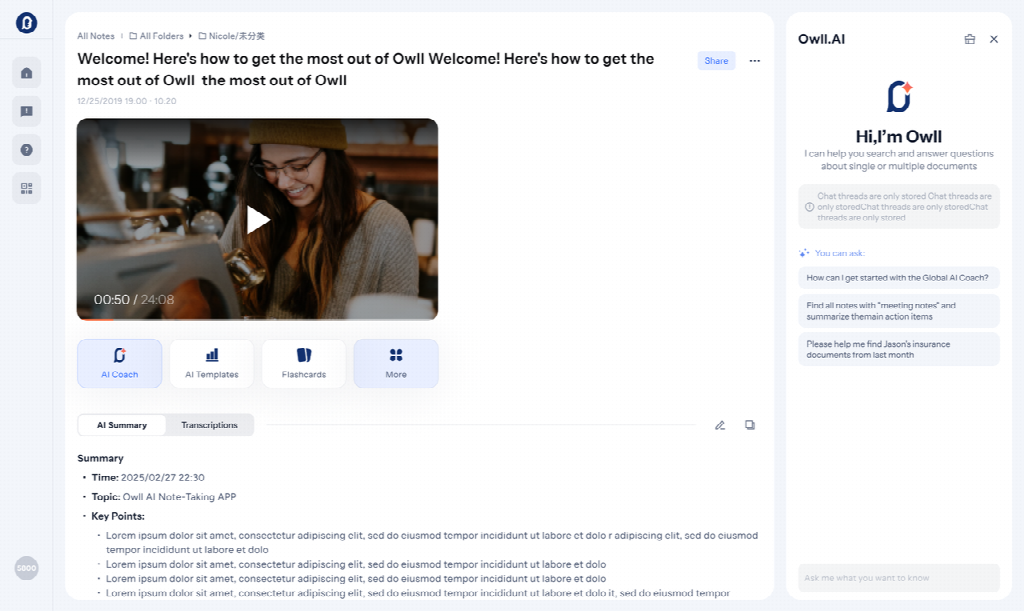
A searchable transcript also supports asynchronous work. Colleagues who could not attend can review the summary first, then consult the relevant section of the transcript if they need more detail.
This does not remove the need to clarify ambiguous language. Names, technical terms, figures and industry-specific vocabulary should still be checked, particularly when they affect contracts, budgets or customer commitments.
Meeting Records Need Governance
Meetings may contain personal information, confidential strategies, financial details or customer data. Businesses should establish rules for recording and storing them before introducing any meeting assistant.
A practical policy should address:
- When meetings may be recorded
- How participants are notified
- Who can access recordings and transcripts
- How long information is retained
- Which meetings should not be recorded
- How employees can report an error or request a correction
Owll states that recordings and transcripts are encrypted, that customer content is not used to train its AI, and that it maintains ISO 27001 and ISO 27701 certifications. Businesses should still review their own legal, contractual and industry requirements before adoption.
Permission is especially important. The assistant joins supported online meetings as a visible participant and may require host approval, but organisations remain responsible for following applicable consent rules.
What Business Leaders Should Evaluate
The right meeting technology should fit the organisation’s actual communication habits. Leaders should examine whether a tool works with existing meeting platforms, supports the required languages and makes information easy to search or export.
They should also test it with realistic scenarios rather than relying only on a short demonstration. A useful pilot might include a multilingual meeting, a technical discussion, a customer call and a project review with several speakers.
The evaluation should ask whether the resulting record helps employees answer practical questions:
- Can they find an earlier decision?
- Can they understand why it was made?
- Can they identify the agreed next step?
- Can they verify important wording against the source?
- Can the right people access the information without exposing it too broadly?
Knowledge Must Remain Usable
Meetings will always involve imperfect language, changing ideas and unfinished decisions. Technology cannot remove that complexity. It can, however, make the conversation easier to revisit.
When recordings, transcripts, summaries and confirmed action items are managed together, meeting knowledge becomes less dependent on memory and scattered personal notes. Teams can spend less time reconstructing previous discussions and more time acting on them.
The objective is not to create a permanent archive of every word. It is to preserve the business context that people need to make informed decisions after the meeting ends.


