
business resources
Why 4K Camera Glasses Are Becoming a Must-Have Business Tool in 2026
21 Aug 2026

Smart glasses are moving beyond consumer entertainment and social media. In 2026, businesses are increasingly looking at camera-equipped eyewear as a practical hands-free tool for field work, training, inspections, remote assistance, and documentation. The ability to capture what an employee sees without stopping work to hold a phone can make many everyday processes faster and easier.
The rise of 4k camera glasses is adding another layer to that trend. Higher-resolution video can make small details easier to review later, which is useful when workers are checking equipment, documenting installations, showing a problem to a remote expert, or creating training material.
However, 4K alone does not make a pair of smart glasses suitable for business. Companies also need to think about battery life, comfort, recording limits, storage, software compatibility, durability, and privacy. The best choice depends heavily on where and how the glasses will be used.
Hands-Free Video Is Changing Remote Collaboration
Remote collaboration is one of the clearest business uses for camera glasses. A technician working at a customer site can show a remote specialist exactly what is happening without holding a phone or positioning a laptop camera. Both hands remain available for tools, equipment, or repairs.
Higher-resolution recording can improve this experience when small components, labels, wiring, or mechanical details need to be reviewed. Even when a live call does not stream at full 4K, capturing high-quality footage gives teams a clearer record that can be examined afterward.
Field Teams Can Bring Experts Into the Job
Businesses often have experienced specialists who cannot physically travel to every site where their knowledge is needed. Smart glasses can help extend that expertise. A worker in the field can capture a first-person view while receiving instructions from someone located elsewhere.
This model is particularly useful for maintenance, manufacturing, utilities, logistics, and technical support. Instead of explaining a problem over the phone, workers can provide visual context and reduce the misunderstandings that happen when complex equipment is described only with words.
Inspections Become Easier to Document
Field inspections often involve taking notes, photographs, and videos while moving through a site. Switching repeatedly between tools and a phone can slow the process, particularly when employees are wearing gloves or working in areas where they need both hands available.
Camera glasses can create a more natural record of the inspection. A worker can look directly at equipment, damage, installation work, or safety conditions while recording the same perspective for later review. High-resolution footage becomes useful when managers need to zoom into details after the inspection has finished.
Training Can Be Recorded From the Worker's View
Traditional training videos are usually recorded from the outside, which means the viewer watches another person complete a task. Smart glasses can instead capture the process from the employee's own point of view.
That perspective can be valuable for step-by-step training. New employees can see where an experienced worker looks, which controls are used, and how tasks are completed in the correct order. Businesses can gradually build libraries of practical training footage without arranging a separate camera crew for every procedure.
First-Person Footage Can Also Support Internal Knowledge
Experienced employees often develop useful techniques that never appear in formal manuals. When those employees leave or change roles, part of that practical knowledge can disappear with them.
First-person recording offers companies another way to preserve it. Rather than relying entirely on written instructions, teams can document real processes and create visual examples that future employees can review. The goal is not to replace formal training but to make practical knowledge easier to share.
What Businesses Should Compare Before Buying
The market now includes everything from lightweight consumer smart glasses to rugged industrial wearables. Businesses should therefore avoid comparing products only by camera resolution.
RayNeo X3 Pro is one of the more feature-rich options. The manufacturer lists a 12MP camera capable of 4K/3K video, while the glasses also include a full-color display and AR functions. That combination can be useful when businesses want more than straightforward video recording.
The disadvantage is that extra capabilities can increase cost and power demand. A company that only needs employees to document jobs or make video calls may not benefit from paying for an advanced AR display. It makes more sense when visual information and on-screen assistance form part of the workflow.
Rokid Style Focuses More on Everyday Wear
Rokid AI Glasses Style takes a lighter, display-free approach. Rokid lists a 12MP Sony camera and markets the glasses with 4K capture, multiple recording formats, and up to 10-minute video clips. The company also states up to 12 hours of typical daily use.
That combination may suit sales teams, supervisors, consultants, trainers, and other employees who want camera functions in something that resembles conventional eyewear. For heavy industrial settings, however, companies may prefer a device designed specifically around rugged field work.
Vuzix Remains Strong for Industrial Work
Vuzix has been developing enterprise smart glasses for years, and its M400-series products illustrate a more specialized approach. Current Vuzix support documentation lists 4K UHD recording at 30 fps for the M400 and M4000, along with autofocus and image stabilization.
These devices are less focused on looking like ordinary fashion eyewear and more focused on hands-free professional tasks. That can make them better suited to manufacturing, maintenance, warehousing, and technical field service where functionality is more important than appearance.
Ray-Ban Meta Shows That 4K Is Not Always Necessary
Ray-Ban Meta Gen 2 is an important comparison because it remains a mainstream smart-glasses option even without true 4K video. Ray-Ban currently lists recording at up to 3K and 30 frames per second, along with open-ear audio, microphones, AI functions, and smartphone connectivity.
For businesses that mainly need short clips, simple documentation, or communication, 3K may already provide sufficient quality. It is a useful reminder that buying decisions should be based on the required workflow rather than assuming every organization needs the highest available resolution.
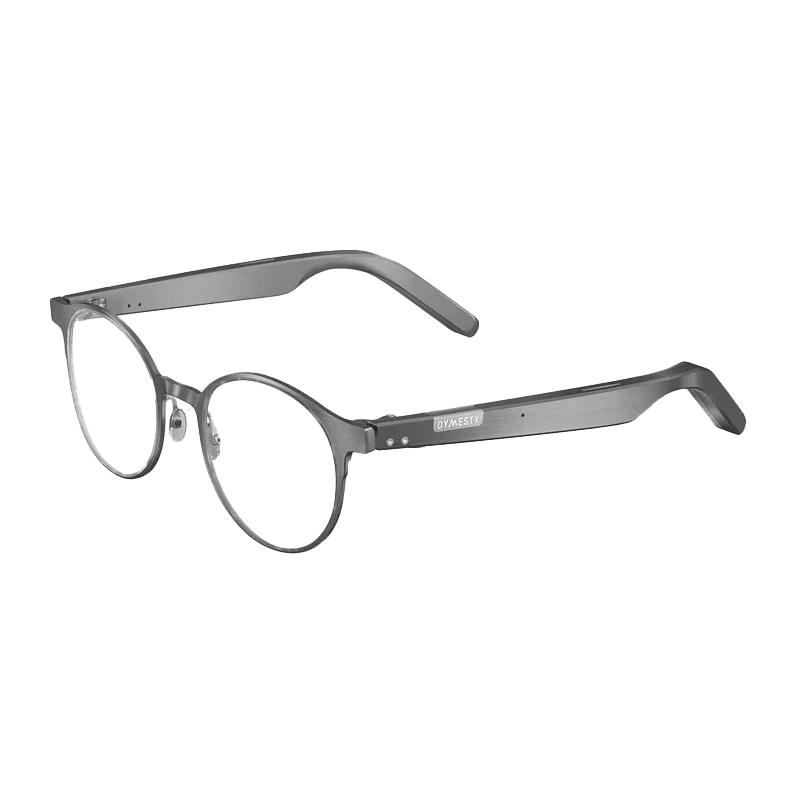
That is why another category of smart eyewear is developing alongside camera-equipped products. Camera-free options such as Dymesty focus on functions including audio communication, meeting transcription, AI assistance, and translation without adding visual recording hardware. Dymesty explicitly positions its camera-free approach for situations where privacy and compliance matter.
Battery Life and Comfort Still Shape Real-World Use
A pair of glasses may have excellent recording quality but provide little value if employees constantly remove them because they are uncomfortable. Weight, fit, charging frequency, and battery performance can determine whether smart eyewear becomes part of a daily workflow or stays unused in a drawer.
Camera systems naturally consume more power because capturing and processing video requires additional energy. Businesses expecting employees to record frequently should check actual recording endurance rather than relying only on advertised typical-use battery figures.
For people who want smart features without making their eyewear feel like another gadget, Dymesty AI Glasses Jobs Circle offers a more understated approach. The round-frame design combines everyday eyewear with open-ear listening, hands-free calls, voice assistance, translation, and tools for capturing and organizing conversations. Its camera-free design also makes it better suited to settings where discretion and privacy matter, while support for prescription lenses allows the glasses to serve as a practical part of a daily routine rather than something worn only when using AI features.
Businesses Need a Clear Policy for Recorded Footage
Introducing camera glasses into a company is not simply an equipment decision. Organizations should establish clear rules covering when employees can record, where recordings are stored, how long they are retained, and who is allowed to access them.
This becomes particularly important when glasses are used in customer locations, offices, factories, healthcare environments, or other places where confidential information may be visible. Higher-resolution footage can capture considerable detail, making responsible data management just as important as image quality.
Visible Cameras Can Create Trust Concerns
Employees and customers may also feel differently about a wearable camera than they do about a smartphone. A phone being used to record is usually obvious. A camera built into eyewear can be less noticeable.
Businesses should therefore prioritize transparency. Recording indicators, consent processes, staff training, and clear workplace policies can reduce uncertainty about when cameras are active. Companies should also review relevant local privacy and workplace rules before deploying camera-equipped eyewear broadly.
The Best Business Glasses Depend on the Job
There is no universal winner in the current smart-glasses market. An industrial technician may benefit from a rugged Vuzix device, while a company experimenting with advanced AR workflows might prefer RayNeo X3 Pro. Rokid Style may appeal to teams that want lighter everyday eyewear, while Ray-Ban Meta can be sufficient for simpler visual communication.
The important step is defining the problem first. Businesses should ask whether employees need high-resolution documentation, live remote assistance, hands-free training, AI support, audio communication, or some combination of these features before choosing hardware.
Not Every Scenario Requires a Camera
Camera glasses can be extremely useful, but businesses should not assume every employee needs visual recording. Boardrooms, legal offices, healthcare environments, research facilities, security-sensitive workplaces, and confidential customer meetings can all create situations where an integrated camera becomes a disadvantage rather than a benefit.
For businesses in 2026, the real opportunity is therefore not simply adopting 4K camera glasses everywhere. It is choosing the right type of wearable for each environment. Camera-equipped glasses can transform inspections, training, field service, and remote support, while camera-free alternatives may be a better fit for sensitive conversations and privacy-conscious workplaces.
As smart eyewear becomes more common, successful companies will treat it the same way they treat laptops, phones, or specialist tools: not every employee needs the same device. The strongest business case comes from matching the technology to the task.


