
business resources
Why DTC Brands Are Rethinking Shopify SEO as Paid Ads Get More Expensive
26 May 2026

Your cost-per-click went up again. Your ROAS went down. And your CFO is asking questions you don't have clean answers to yet.
If that sounds familiar, you're not alone. Across beauty, wellness, pet, and lifestyle verticals, DTC brands are hitting the same wall. Paid advertising still works. But it's getting harder to make it profitable at scale, and the margin pressure is real.
That's where Shopify SEO comes back into the conversation. Not as a backup plan, and not as a slow burn you start today and forget about.
As a genuine revenue channel that compounds over time and doesn't invoice you every time someone clicks.
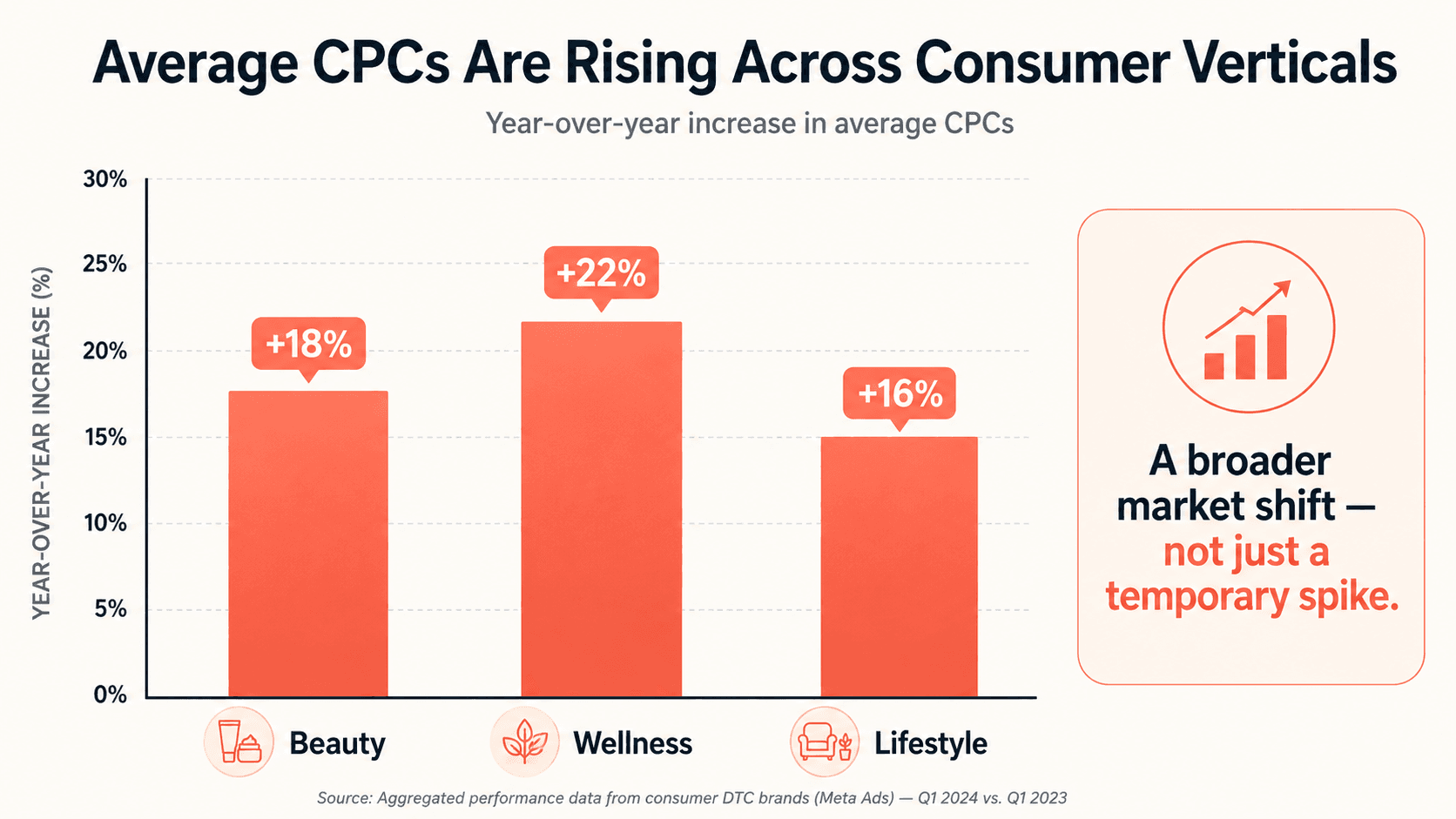
The Paid Ads Problem Is Structural, Not Cyclical
A lot of marketing teams are waiting for ad costs to come back down. That's the wrong frame.
Meta and Google ad costs have been climbing steadily for years. Auction-based inventory means more brands competing for the same eyeballs. And as more DTC brands enter the same verticals, the floor keeps rising. That makes every paid dollar count, so it pays to see what's already converting before you bid. A Facebook & TikTok adspy platform like Winning Hunter surfaces the top-performing ads in your niche, so you can model proven creatives instead of feeding a rising auction blind.
This isn't a bad quarter. It's the new operating environment.
The brands that figure this out early stop trying to fix their ROAS and start building a channel that doesn't depend on winning an auction every single day. Organic search is that channel.
Why Organic Search Converts Differently
Here's something most agencies won't say clearly: organic search traffic doesn't just cost less. It often converts better.
A shopper who types "best magnesium supplement for sleep" into Google and lands on your product page is already halfway sold. They're not being interrupted. They found you because they were looking.
Compare that to a paid impression served to someone scrolling past cat videos. The intent gap between those two visitors is enormous. One costs you money on every visit. The other builds over time.
That's the economic case for Shopify SEO in plain terms.
What Makes Shopify SEO Different from Generic SEO
Shopify is a powerful platform. It's also one that creates specific SEO challenges most generic strategies miss entirely if your Shopify website design services are not at par..
Think of Shopify's structure like a filing cabinet with a well-organized front desk but a complicated back room.
What customers see is clean and navigable.
What search engines see can be a tangle of duplicate URLs, thin collection pages, and crawl paths that waste your indexing budget.
The platform generates duplicate content almost by default. Product pages often appear under multiple URL paths because of how Shopify handles collection-based navigation.
If your Shopify SEO strategy doesn't account for that, you're effectively competing against yourself for rankings.
The crawl budget problem most DTC brands don't know they have
Think of Google's crawl budget like a delivery driver with a fixed number of stops. If your site sends them down dead-end streets and back alleys, they run out of stops before reaching your most important pages.
On large Shopify stores, this shows up as product pages that aren't indexed, collection pages that don't rank, and category-level visibility that never materializes. The store looks fine to a shopper. To Google, it's a maze.
Fixing this means cleaning up URL structure, resolving canonical tag issues, tightening internal linking, and making sure your XML sitemap reflects pages you actually want indexed. It's technical work, but it has direct revenue consequences.
That is also why generic SEO support often falls short for Shopify brands.
The platform needs a more specific process: technical cleanup, collection-page prioritization, internal linking, content gap analysis, and authority building working together.
With proven Shopify SEO services from Break the Web, DTC brands can turn that messy back room into a clearer organic growth system, where search engines can find the right pages and shoppers can move more easily from search intent to purchase.
The goal is not just more traffic. It is making the right pages easier for search engines to understand and easier for qualified shoppers to find.
Collection pages are your biggest organic revenue opportunity
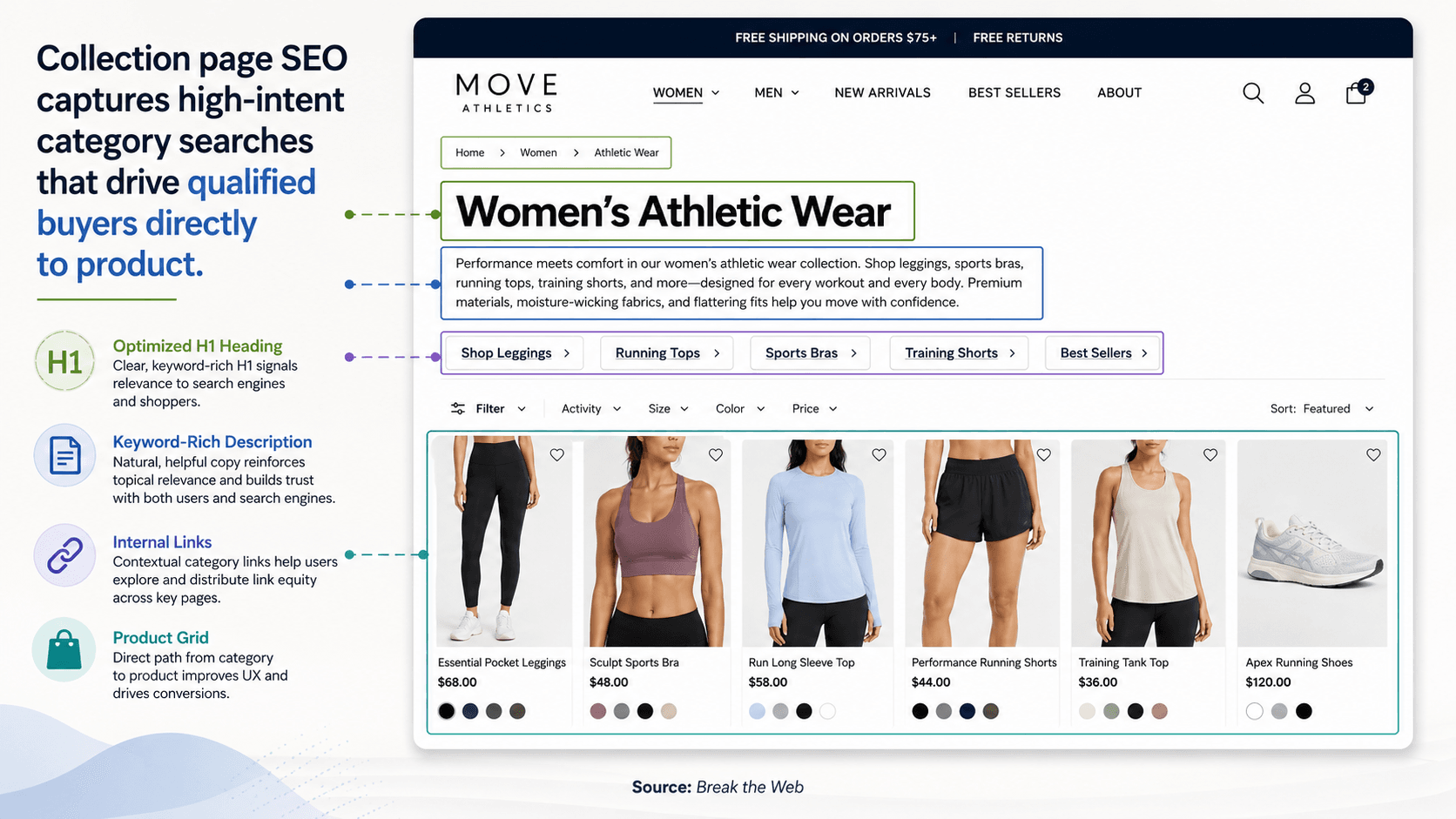
For most Shopify stores, collection pages are the highest-leverage SEO asset. They sit between product pages and the broader search ecosystem, targeting category-level queries with real commercial intent.
A well-optimized collection page for "men's merino wool base layers" doesn't just rank for that phrase. It captures the full range of related searches, guides buyers deeper into your catalog, and supports the product pages beneath it.
Most Shopify stores treat these pages as an afterthought.
That's the gap your competitors are exploiting while you're bidding on keywords.
The Real Cost Comparison: Paid Ads vs. Organic Search
Let's make this concrete. Not abstract math. Real operating reality.
With paid ads, every visitor has a price. Traffic stops the moment you pause the campaign. And as your category gets more competitive, that price climbs.
With organic search, the work you do today keeps producing results months and years later. A well-ranked collection page or buying guide doesn't invoice you each time it brings in a buyer. It compounds.
The honest caveat: SEO takes time to build. You won't see organic traffic replace paid overnight. But that's exactly why the brands winning on organic started six months ago, not last week.
The question isn't whether SEO is worth it. The question is how much longer you can afford to wait.
How Content Drives Organic Revenue for DTC Brands
Organic search isn't just about product and collection pages. Content is a core part of the revenue equation.
Here's how it works. A first-time buyer rarely goes straight to purchase. They research. They compare. They look for reassurance that your product solves their specific problem.
A content strategy built around real search demand puts your brand in front of buyers at every stage of that journey. Educational content earns trust. Comparison content shortens the decision cycle. Buying guides push undecided shoppers toward conversion.
When content and ecommerce SEO services work together, you're not just ranking for keywords. You're building the kind of organic presence that makes your brand the obvious answer before a shopper even reaches a product page.
What good DTC content strategy actually looks like
It's not a blog you update whenever someone has bandwidth. It's a planned, prioritized system tied directly to search demand and buyer behavior.
You're mapping content to the questions your buyers are actually asking. You're connecting those articles back to product and collection pages through deliberate internal linking. And you're updating high-value content regularly so it stays competitive.
The result is a content library that generates qualified traffic consistently. Not a content graveyard of posts that never ranked.
(IMAGE) Caption: Content tied to real search demand brings qualified buyers into the funnel before competitors get a chance. Alt-text: Content strategy flowchart showing educational articles linking to collection pages and product pages on a DTC Shopify store Source: Break the Web
Digital PR Builds the Authority That Makes Rankings Stick
Here's a part of Shopify SEO most agencies skip or tack on at the end. Authority.
Google doesn't just look at what's on your pages. It looks at who trusts your site. Links from relevant, credible publishers signal that your brand is worth ranking. Without them, even perfectly optimized pages hit a ceiling.
Digital PR is how you build that trust at scale. It's not cold-email link schemes. It's earning genuine coverage from publications your buyers already read, creating real brand signals that search engines can verify.
For DTC brands in beauty, wellness, and lifestyle, this often means getting featured in editorial content, contributing expert perspectives to trade publications, and building the kind of third-party credibility that separates market leaders from also-rans.
The SEO benefit is real, but the brand benefit matters too. Every piece of earned coverage reinforces your positioning in a way paid ads can't replicate.
What to Fix First on Your Shopify Store
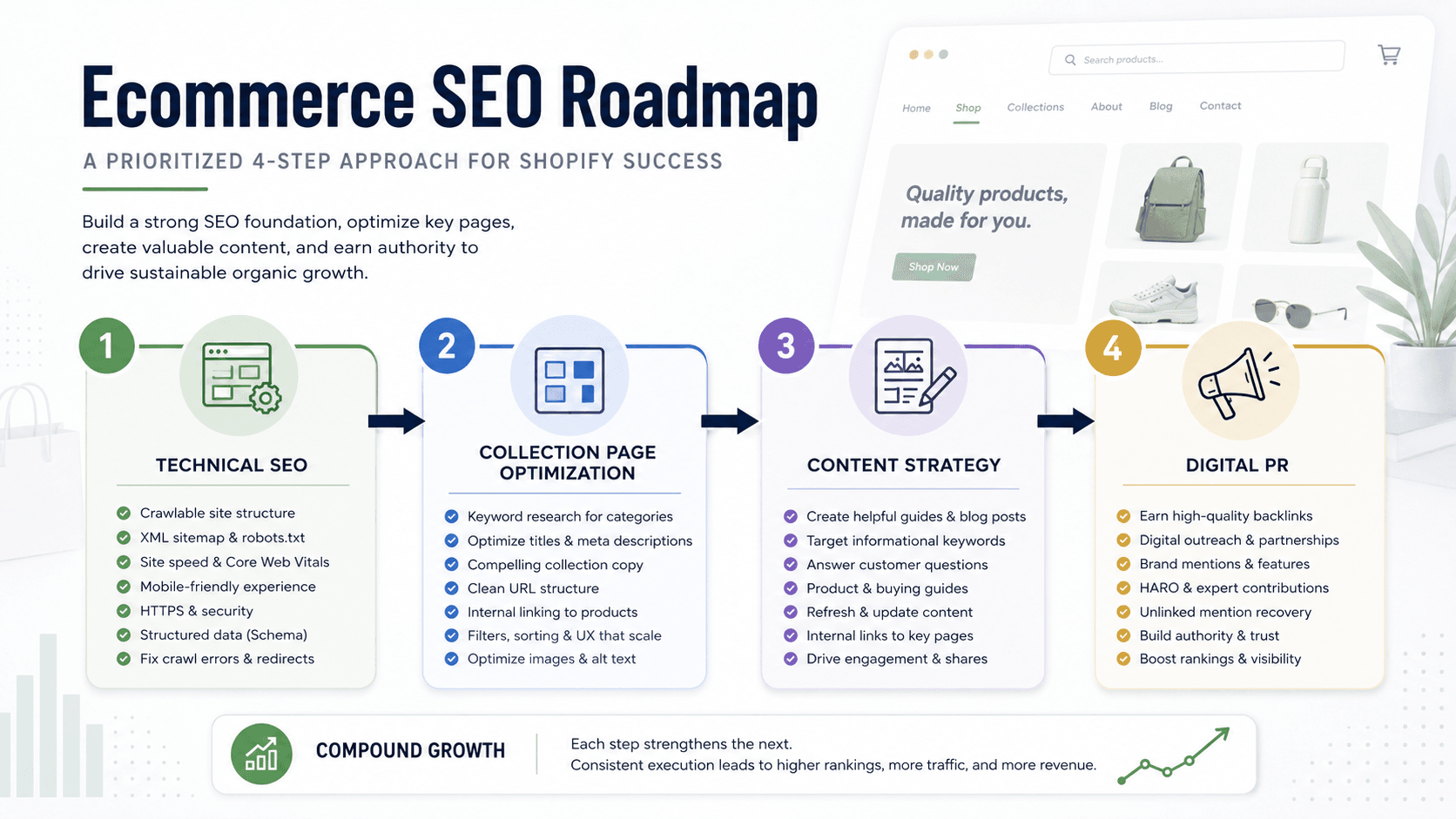
If you're starting from scratch or trying to prioritize, here's a practical order of operations.
Technical foundation first. Before you create a single piece of content, your site needs to be crawlable, indexable, and free of the structural issues that block Google from seeing your pages correctly. This means canonical tags, redirect chains, site speed, and XML sitemaps.
Collection pages second. These are your highest-leverage ranking targets. They capture commercial intent at scale and support everything beneath them in your catalog. Optimize them before you work on individual product pages.
Content third. Build content that maps to real search demand, connects back to commercial pages, and answers the questions your buyers are actually asking. Skip the generic blog content that attracts visitors with no intent to buy.
Authority building alongside all of it. You can't wait until everything else is perfect to start earning links and coverage. Authority-building is a long game. Start now.
The Agency Problem DTC Brands Keep Running Into
You've probably tried an SEO agency before. And if you're reading this, it probably didn't go the way you hoped.
The pattern is familiar. Lots of activity in month one. A thick audit document full of recommendations. Then slower communication, reports that don't connect to revenue, and a contract you can't get out of.
That experience has made a lot of marketing directors skeptical of SEO altogether. That's understandable. But the problem wasn't SEO. It was the agency model.
The right SEO partner works like a member of your team. They're in your Slack. They explain what they're doing and why. They report in plain language, not vanity metrics. And they don't need a six-month contract to feel secure because their results do the talking.
That's the difference between an agency relationship that drains budget and one that builds a real organic growth engine for your brand. It's also what DTC ecommerce SEO looks like when it's done right.
The Compounding Math of Organic Search
Here's the thing about paid ads that's easy to forget when you're in the middle of campaign management. The moment you stop paying, the traffic stops.
Organic search works the opposite way. A well-ranked page keeps driving traffic for months or years after the work is done. New content builds on top of existing authority. Internal links amplify across your catalog. Rankings compound.
This doesn't mean SEO is free. It takes real investment, consistent execution, and someone who knows what they're doing. But the return structure is fundamentally different from paid advertising. You're building an asset, not renting one.
For DTC brands feeling the squeeze on paid margins, that compounding return is exactly what the business model needs.
What Winning DTC Brands Do Differently
The brands that are growing organic revenue on Shopify have a few things in common.
They started before they felt the pressure from paid ads. They treat SEO as a channel, not a project. They don't pause execution when paid campaigns are performing and restart when they're not. And they measure SEO performance against revenue outcomes, not just rankings and sessions.
Most importantly, they have a clear SEO strategy that connects every tactic back to a business result. Not a list of tasks. A system.
If that's not what your SEO looks like right now, it's worth asking why and what it would take to get there.
SOURCES
GOOGLE SEARCH CENTRAL DEVELOPER DOCUMENTATION. (2024). GOOGLE. FOUND ON: https://developers.google.com/search/docs
GOOGLE SEARCH QUALITY EVALUATOR GUIDELINES. (2024). GOOGLE. FOUND ON: https://static.googleusercontent.com/media/guidelines.raterhub.com/en//searchqualityevaluatorguidelines.pdf
META ADVERTISING COST TRENDS. (2024). META FOR BUSINESS. FOUND ON: https://www.facebook.com/business/ads
SHOPIFY HELP CENTER: SEO BEST PRACTICES. (2024). SHOPIFY. FOUND ON: https://help.shopify.com/en/manual/promoting-marketing/seo


