
Businesses
Why SMEs Will Power the Future of Saudi Vision 2030?
20 May 2026

With Dinis Guarda
The Power of SMEs to empower the global economy and Saudi Arabia
Across the global economy, small and medium-sized enterprises (SMEs), a number that reaches over 400 million organisations, are increasingly becoming the foundation of innovation, employment, resilience and sustainable growth. In Saudi Arabia, this transformation is taking on even greater importance through the ambitious Vision 2030 framework — a national strategy designed to diversify the economy, empower entrepreneurship, and create a globally competitive future.
While major corporations and mega-projects often dominate headlines, the long-term success of Saudi Vision 2030 may ultimately depend on the strength, adaptability and innovation of the SME sector.
SMEs represent more than businesses. They are engines of opportunity. They create jobs, encourage local manufacturing, develop skills, empower communities and accelerate technological adoption. Around the world, SMEs account for the majority of private sector employment and are essential contributors to GDP growth. Saudi Arabia recognises this reality and has placed SME development at the centre of its national economic transformation.
Saudi Arabia’s total population in 2026 is estimated at 35.17 million people, driven by steady economic growth and urbanisation. Backed by Saudi Vision 2030, the country stands out for its remarkably young domestic population and a rapidly diversifying ecosystem where over 1.5 to 1.8 million small and medium enterprises (SMEs) are taking centre stage
Vision 2030 aims to significantly increase SMEs' contribution to GDP while supporting innovation, investment and entrepreneurship across sectors such as technology, construction, tourism, logistics, healthcare, manufacturing and renewable energy. This is not simply an economic shift — it is a social and cultural transformation designed to build a knowledge-driven economy for future generations.
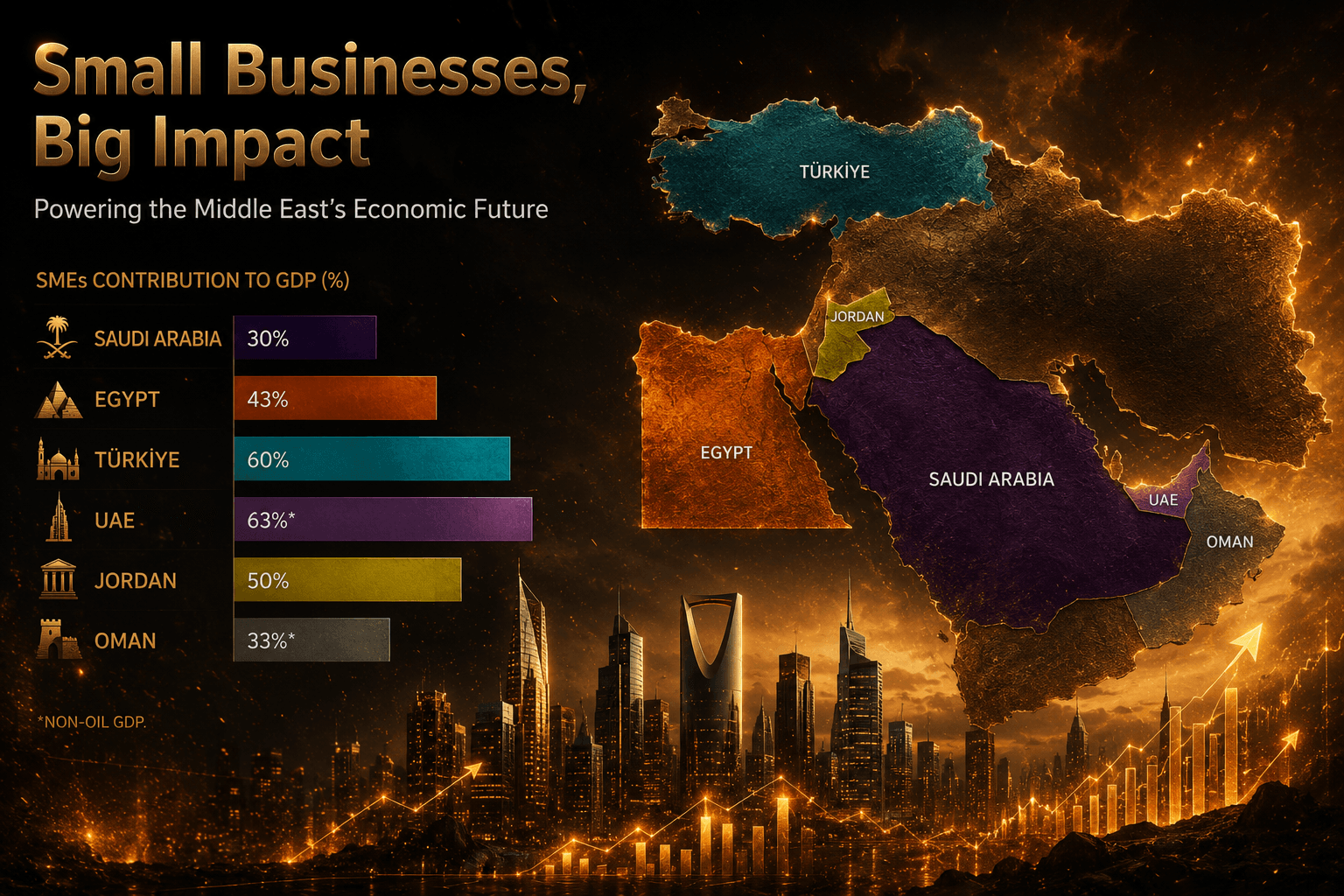
Contextualising SMEs: Small Business - Big Impact in the Middle East
While massive "Giga-projects" like NEOM and the Red Sea development capture global headlines, the true engine of Saudi Arabia’s economic transformation is unfolding at a more granular level. Small and Medium Enterprises (SMEs) across the Middle East—and specifically within the Kingdom—are proving that small businesses wield a massive, disproportionate impact on national resilience.
As Saudi Arabia enters the final, crucial phase of Vision 2030, transitioning from infrastructure building to a self-sustaining private economy, SMEs are no longer just a sector to support; they are the primary vehicle for economic diversification, employment, and localised innovation.
Key Saudi Arabia SMEs Contextual Pillars
- Surpassing Benchmarks: According to the latest 2026 data, the SME sector has experienced exponential growth, now numbering over 1.7 million registered enterprises across the Kingdom.
- The GDP Engine: SMEs have officially scaled their economic output to contribute nearly 23% to Saudi Arabia's GDP, outpacing baseline intermediate projections on their structured march toward the ultimate Vision 2030 target of 35%.
- The Region's Ultimate Job Creator: In the Middle East, employment generation is a crucial metric. In Saudi Arabia, SMEs currently anchor the labour market by supporting over 8.88 million jobs. This massive employment blanket has been instrumental in dragging Saudi unemployment down to a historic low of roughly 7.1%.
- A Catalyst for Inclusivity: The agility of small businesses has uniquely enabled the achievement of social targets. The surge in SME creation directly correlates with the monumental rise of female labour force participation, which has comfortably surpassed 34% by 2026.
Saudi Arabia SMEs data and numbers
Saudi Arabia is home to over 1.7 million registered small and medium-sized enterprises (SMEs). The Kingdom's SME sector represents roughly 99% of all private businesses and contributes around 30% to the national gross domestic product (GDP).
This rapid expansion is driven by the country's Vision 2030 initiatives, which aim to increase the sector's GDP contribution to 35%. To further support the SME ecosystem, the government has launched targeted funding and support platforms, including:
- Monsha'at: The Small and Medium Enterprises General Authority, which oversees business development and monitors SME metrics. http://www.monshaat.gov.sa/en
- SME Bank: Dedicated to providing specialised financial solutions to micro, small, and medium enterprises. https://smebank.gov.sa/en
- Kafalah Program: An initiative that helps smaller firms secure bank financing by providing loan guarantees. https://www.kafalah.gov.sa/ar/Pages/default.aspx
Saudi Arabia SMEs latest Figure source Monsha’at
| Indicator | Latest figure (Monsha'at and government sources) |
|---|---|
| Active SME registrations | 1.68 million (Q1 2025), +6% year-on-year |
| New registrations Q1 2025 | 154,640, +48% year-on-year |
| SME contribution to GDP | 21.9% (2023, exceeding 20.2% target); Vision 2030 target 35% |
| Employment in SMEs | 7.86 million (end-2024) |
| Women-owned active registrations | 45% of total active commercial registrations |
| Active e-commerce SMEs | Over 41,000 active businesses |
| Tomouh programme cumulative | USD 15.7 billion deployed to startups and SMEs to date; 34 Nomu listings (USD 450 million market value) in 2025 |
| Regional venture capital share | 30% of MENA venture capital flows into Saudi SMEs |
Sources: Monsha'at SME Monitor (Q1 2025); Vision 2030 portal; Asharq Al-Awsat reporting on Monsha'at Q1 2025 release; US-Saudi Business Council briefings.
Other important data around SMEs and their Global Recognition & Historic Financing Surge
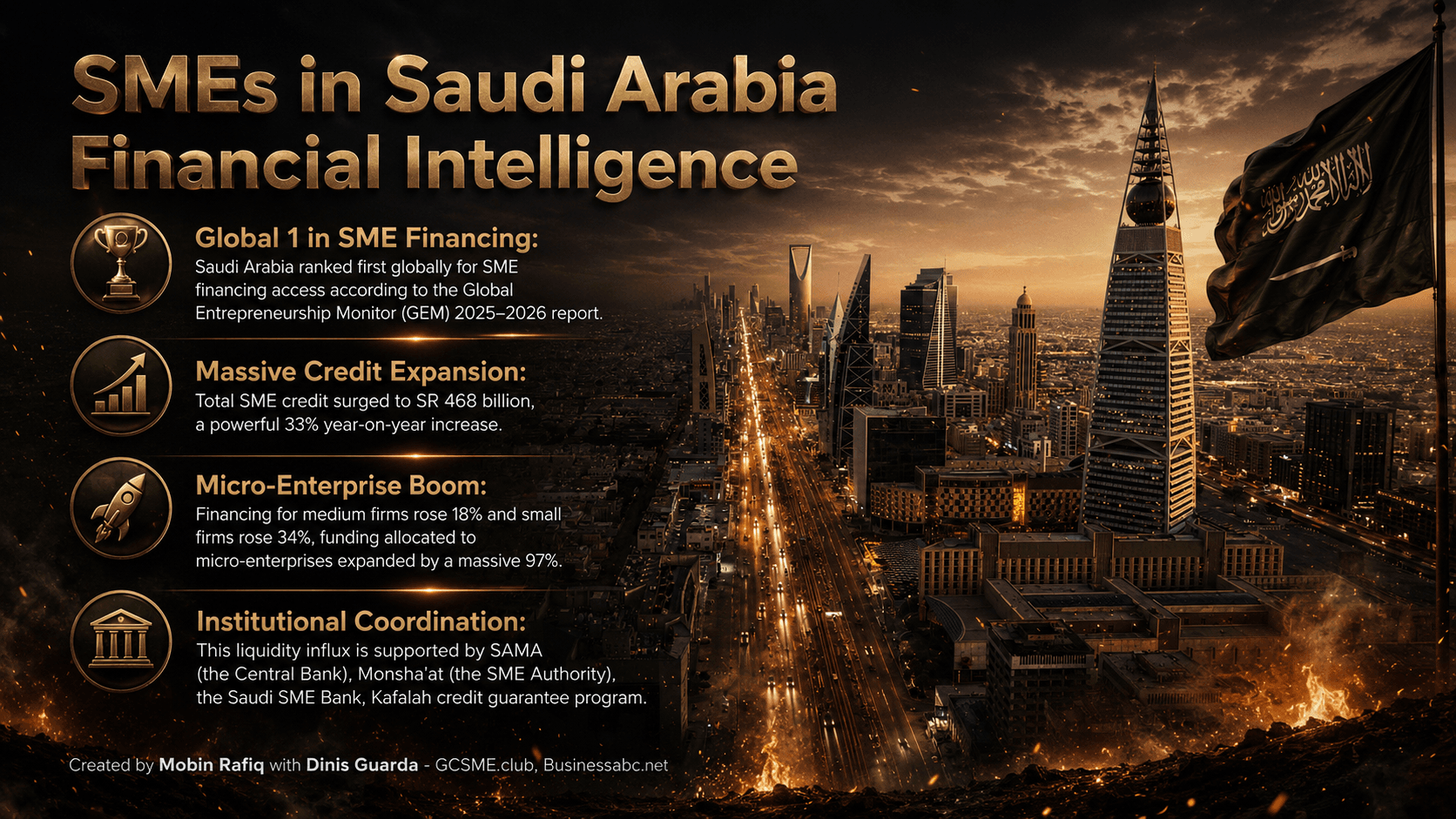
- Global #1 in SME Financing: Saudi Arabia ranked first globally for SME financing access according to the Global Entrepreneurship Monitor (GEM) 2025–2026 report.
- Massive Credit Expansion: Total SME credit surged to SR 468 billion, registering a powerful 33% year-on-year increase.
- Micro-Enterprise Boom: While financing for medium firms rose 18% and small firms rose 34%, funding allocated to micro-enterprises expanded by a massive 97%.
- Institutional Coordination: This liquidity influx is supported by SAMA (the Central Bank), Monsha'at (the SME Authority), the Saudi SME Bank, and the Kafalah credit guarantee program
SMEs are a critical driving force for economic growth in Saudi Arabia.
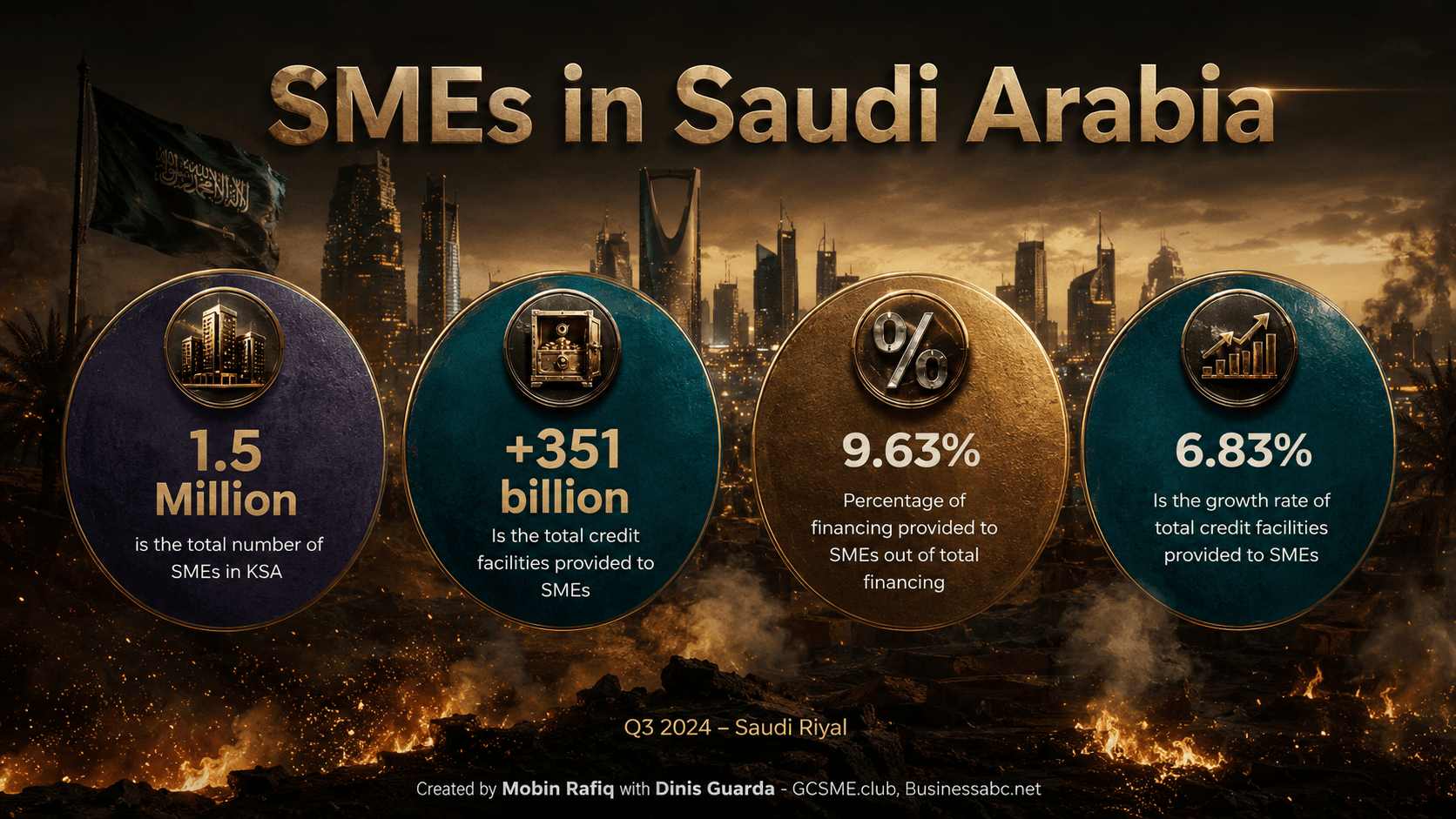
The greatest strengths of SMEs
One of the greatest strengths of SMEs is their flexibility. Unlike large organisations, smaller businesses can adapt quickly to market changes, technological shifts and consumer demands. In a rapidly evolving digital economy, this agility becomes a major competitive advantage.
Saudi Arabia’s young and ambitious population presents enormous opportunities for entrepreneurial growth. A new generation of Saudi innovators is emerging in fintech, artificial intelligence, clean energy, e-commerce, digital media and smart infrastructure. SMEs are becoming the bridge between youthful ambition and economic reality.
According to many global economic studies, countries that successfully invest in entrepreneurship ecosystems tend to create stronger employment opportunities and more resilient economies. Saudi Arabia’s investment in startup incubators, smart cities, innovation hubs and digital transformation programmes demonstrates a serious commitment toward creating one of the most dynamic SME environments in the world.
Mobin Rafiq believes the future global economy will increasingly rely on collaborative SME ecosystems rather than isolated business models.
SMEs as the foundation of economic resilience, innovation and human potential
“SMEs are not small in impact. They are the foundation of economic resilience, innovation and human potential. The countries that empower entrepreneurs today will shape the global economy tomorrow.” — Mobin Rafiq
Saudi Arabia’s transformation is also opening major opportunities for international partnerships. SMEs from the United Kingdom, Europe, Asia and Africa are increasingly looking toward the Kingdom as a strategic destination for investment, collaboration and expansion. This creates the possibility for Saudi Arabia to become not only a regional economic leader but also a global hub connecting continents through entrepreneurship and innovation.
International collaboration is essential in the modern business landscape. SMEs benefit enormously from access to global networks, technology exchange, skills partnerships and international financing opportunities. Organisations such as GCSME.club aim to encourage these global connections by bringing together entrepreneurs, policymakers, educators, investors and innovators from different regions of the world.
Beyond economics, SME development also contributes to social progress. Entrepreneurship encourages self-reliance, creativity and community leadership. It enables young people to build careers, families and futures with confidence. It empowers women entrepreneurs, expands regional development and helps local communities participate directly in national economic growth.
Driven by the Small and Medium Enterprises General Authority (Monsha'at) and unprecedented venture capital inflows, Saudi SMEs are rapidly shifting away from traditional oil-adjacent trades toward high-innovation, service-based fields. The largest and fastest-growing SME sectors include:
1. Tech, FinTech, & AI
Technology is the most heavily supported priority sector. Small businesses are thriving in FinTech (payments, lending apps), SaaS platforms, and localised AI toolkits tailored for corporate automation and smart-city applications.
2. E-Commerce & RetailTech
Propelled by a hyper-connected, mobile-first young demographic, the e-commerce segment is projected to hit $31.29 billion. SMEs heavily dominate consumer retail platforms, digital payment integration services, and hyper-local last-mile delivery services.
3. Tourism, Hospitality, & F&B
With major giga-projects (such as NEOM and the Red Sea Project) entering their operational phases, tourism is booming. SMEs find massive opportunities in boutique travel agencies, cultural-experience apps, premium quick-service restaurants, and cloud kitchens that offer quick capital returns.
4. Smart Logistics & Supply Chain
As Saudi Arabia positions itself to connect Asian, European, and African trade, SMEs are increasingly embedding themselves in B2B digital freight brokerage, temperature-controlled transport (cold chain), and automated warehouse storage management.
5. HealthTech & Digital Wellness
Supported by national digital health integration networks, private tech startups are booming. High-growth sub-sectors include remote diagnostic apps, digital fitness/wellness lifestyle services, and regional specialised clinics.
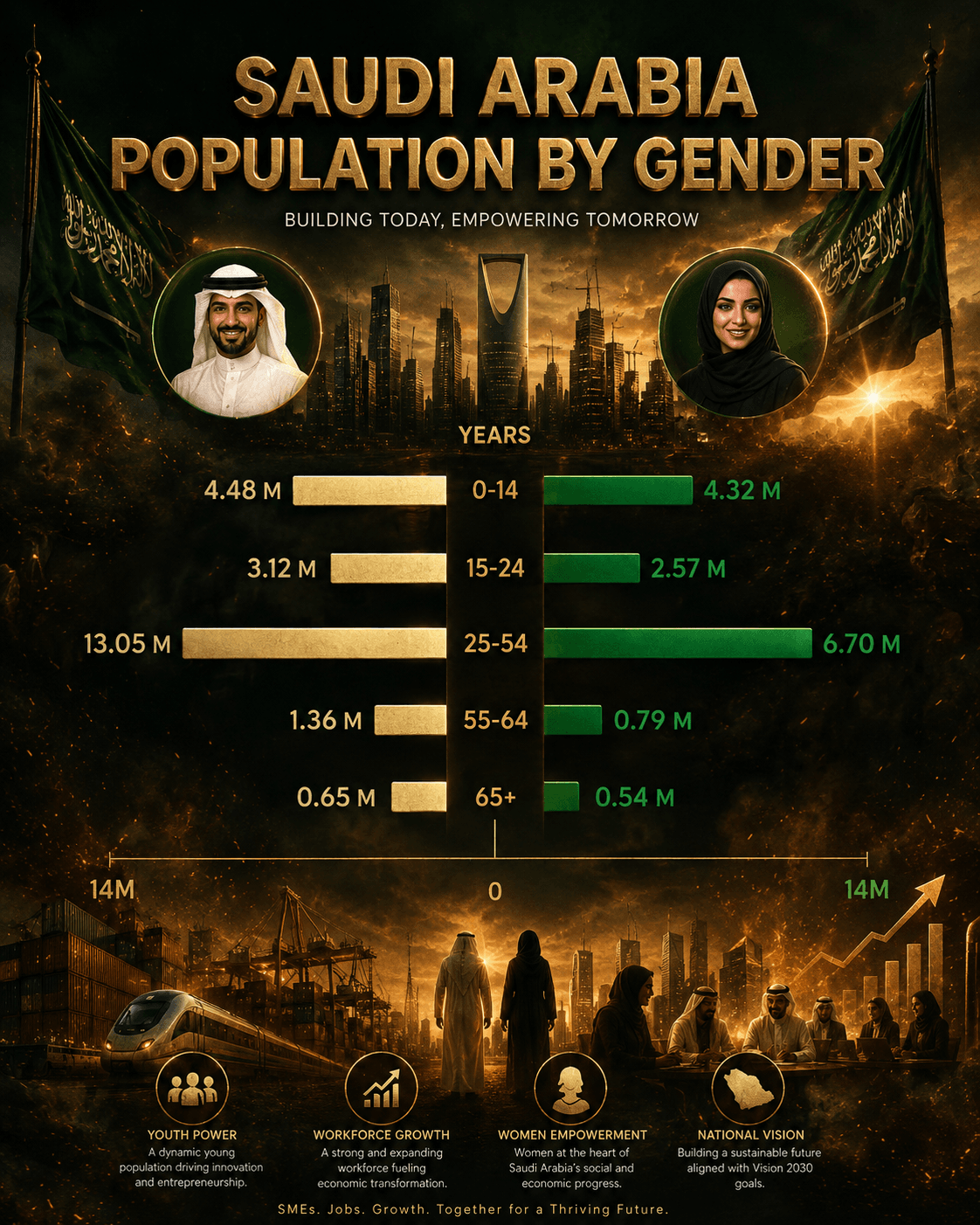
Saudi Arabia’s future and its vocational education and skills development
Saudi Arabia possesses a youth-heavy demographic profile, with a national median age of 29.7 years. Approximately 91.9% of the population resides in urban centres, with Riyadh and Makkah housing the largest shares.
The Saudi Arabian population breaks down into three primary macro age brackets:
- Children & Adolescents (0–14 years): Roughly 24.1% of the population (approx. 8.4 million people).
- Working-Age Population (15–64 years): The vast majority at 73.1%. Notably, over 63% of the native Saudi population is under 30.
- Elderly (65+ years): A tiny fraction at 2.8%, highlighting the country’s massive workforce potential.
A particularly important area for Saudi Arabia’s future is vocational education and skills development. As industries evolve through automation, artificial intelligence and digital technologies, nations must prepare their workforce for the demands of tomorrow. SMEs often play a crucial role in this process because they create practical training environments where innovation and learning happen together.
The engineering, manufacturing, textiles, infrastructure, logistics, and renewable energy sectors all present major opportunities for SME-led growth. The development of smart cities and giga-projects throughout Saudi Arabia will require extensive support from agile and innovative SMEs capable of delivering specialised services, technology and workforce solutions.
“The future of economic growth belongs to nations that successfully combine the best of education with entrepreneurial spirit, with the innovation coming from AI, technology, and empowering human talent. SMEs are central to building that intelligent and inclusive future.” — Dinis Guarda in Businessabc AI and Business publication.
The challenge of AI Digital transformation is no longer optional
Digital transformation is no longer optional. SMEs that embrace AI, blockchain, cybersecurity, smart manufacturing and digital commerce will become major contributors to economic diversification. Saudi Arabia’s increasing investment in innovation ecosystems creates a powerful environment for such transformation.
At the same time, sustainability must remain central to future development. SMEs are uniquely positioned to drive green innovation, circular economies and sustainable business practices. As global industries transition toward environmentally responsible models, Saudi SMEs can become leaders in renewable energy, sustainable construction, clean logistics and responsible manufacturing.
The rise of SMEs across Saudi Arabia also sends an important message to the wider world: economic success is strongest when opportunity is distributed broadly across society. Empowering entrepreneurs creates a more balanced, inclusive and resilient economy capable of adapting to future global challenges.
SMEs: the critical Power for the Future of Saudi Arabia Conclusion
Saudi Vision 2030 is not only about economic diversification. It is about creating confidence, opportunity and long-term prosperity for future generations. SMEs are the mechanism through which much of this transformation can become reality.
The future belongs to nations that invest not only in infrastructure and technology, but also in people, ideas and entrepreneurial ambition. Saudi Arabia’s commitment to SME growth demonstrates a strategic understanding that sustainable development depends on empowering innovators at every level of society.
As the Saudi Arabia Kingdom moves forward with Vision 2030, SMEs will not simply support the journey — they will help lead it.
Together, global collaboration, digital innovation, entrepreneurial leadership and inclusive economic development can position Saudi Arabia as one of the most influential SME-driven economies of the future.
And in that future, partnerships between visionary leaders, global networks and ambitious entrepreneurs will become more important than ever before.
Resources and Sources
https://www.arabnews.jp/en/business/article_87064/
https://www.vms.sa/partners/monshaat


