
business resources
Events Are Becoming Business Infrastructure: Why SMEs Need an Owned Event Hub
22 Sept 2026

An owned event hub is the part of a company's website that gives its events a permanent home and coordinates registration, communication, delivery, commerce, and measurement. The business controls the destination and its core records while connecting specialist services where they make sense. For an SME that runs recurring events, this model can turn separate campaigns into a business capability that improves with each event.
Then the event ends, and nobody is quite sure which system holds the useful history.
That problem becomes expensive as events move from occasional promotion to a regular part of customer education, product launches, community building, recruitment, or partner development. At that point, the business needs more than a page for the next event. It needs a reliable centre for the whole programme.
What is an owned event hub?
An owned event hub is a business-controlled web destination and coordinating data layer for an event programme. It gives events persistent pages, establishes a core attendee record, and connects the systems used before, during, and after attendance.
The word “owned” can be misleading, so the definition matters. It does not require an SME to build its own payment processor, video platform, email service, or CRM. Those services can remain connected. Ownership concerns four practical questions:
- Does the business control the main destination customers visit?
- Can it access and export the records needed to operate the event?
- Can it connect those records to the rest of the customer journey?
- Can it change a supplier without losing its event history?
A marketplace may provide discovery or ticketing, while a video service runs the live session. The hub gives those tools a clear place in a system the business understands.
When do events become business infrastructure?
Events become infrastructure when they repeatedly create something the business needs to retain: customer relationships, useful content, commercial activity, community participation, or operational data.
A company holding one public seminar may be perfectly well served by a hosted event page. Speed matters, the setup is temporary, and there may be little reason to maintain a separate system.
Now consider an SME that runs monthly product demonstrations and quarterly customer workshops. Each event produces pages, registrations, attendance records, recordings, feedback, and possible sales. Treating each one as a fresh campaign means rebuilding the process and scattering another set of records.
The same principle appears in Businessabc's coverage of digital foundations for SMEs: more automation cannot repair unclear records and disconnected systems. Events expose those weaknesses quickly because several tools must work together on a fixed date.
What are the five parts of an owned event hub?
The hub has five parts. They describe business capabilities rather than five mandatory software products. One platform may cover several parts, while a specialist may handle a job that the central platform should not duplicate.
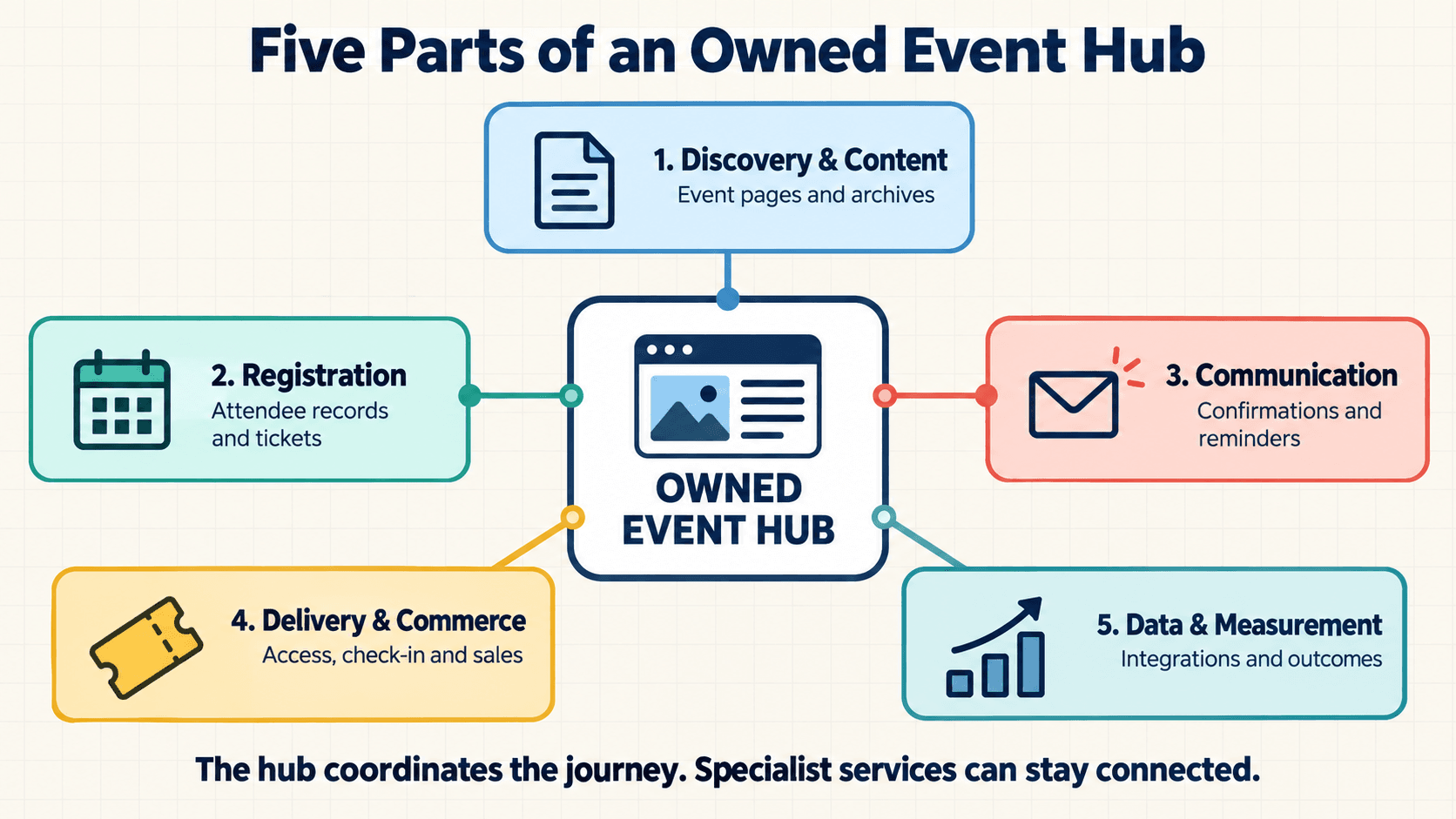
The hub coordinates five business capabilities, even when specialist services provide some of them.
1. Discovery and content
The public event page can contain the schedule, speakers, venue or access details, related resources, and a clear route to register.
Persistent pages also create a useful archive. Someone who finds last year's workshop recording may discover the next session on the same site instead of encountering a closed ticket page without context.
Google's Event structured-data guidance says each event should have a unique page when a publisher wants it considered for Google's event experience. That does not guarantee visibility, but it reinforces the value of accurate, dedicated event pages.
Businessabc has already examined WordPress as digital infrastructure. For SMEs using WordPress, the existing company site can also become the publishing layer for their event programme.
2. Registration and attendee management
Registration creates the core operational record. The system may need to handle tickets, capacity, waiting lists, cancellations, session choices, check-in, and communication preferences.
More fields do not automatically create a better record. A public webinar may need little beyond a name, email address, and appropriate preferences. A paid workshop may also require ticket information, billing details, or dietary requirements. Each field should have an operational reason.
The UK's Information Commissioner's Office explains the roles of organisations that determine how personal data is processed and suppliers that process data on their behalf. An SME should therefore know which provider holds each attendee field, why it is collected, who can access it, and what happens when the relationship with that provider ends. This article is not legal advice, but those are sensible procurement questions.
3. Attendee communication
Operational communication starts with confirmation and continues through reminders, schedule changes, access instructions, cancellation notices, and post-event resources.
These messages should be separated conceptually from broader marketing. An attendee needs to receive a venue change because it affects a booking. Receiving future promotions is a different use of the relationship and may require a different preference or workflow.
The core event platform might send operational messages while an email or customer platform handles segmented campaigns. What matters is knowing which system sends each message and which attendee status triggers it. Otherwise, cancellations can remain in promotional sequences and attendees can receive reminders for sessions they never selected.
4. Delivery and commerce
The delivery layer depends on the event. A webinar needs access control and a live platform. A pop-up needs check-in and in-person selling. A paid workshop needs ticket validation, while a product launch may need a short path from the demonstration to the relevant product page.
The owned hub does not have to run every transaction. It should keep the journey intelligible. Customers need to recognise the company, understand where they are being sent, and know what happens after they register or buy.
Physical technology can also feed this layer. Businessabc's article on NFC wristbands for events illustrates how access and payments may become part of the on-site experience and wider event record.
5. Data, integrations, and measurement
Registration totals tell only one part of the story. A useful event record can include acquisition source, registration status, attendance, ticket or product purchases, session selection, survey responses, and the next agreed action.
That does not mean putting every field into one enormous database. It means deciding which system is authoritative for each record and how approved information moves between systems. An API or webhook may pass a confirmed booking to a CRM. An automation service may create a follow-up task. An analytics platform may connect an event page with a later ecommerce action.
Businessabc's reporting on SME concerns about data control provides useful context here. Event suppliers should be evaluated for exports, connected processors, access controls, retention options, and exit procedures as well as front-end features.
Which event operating model should an SME choose?
The right model depends on event frequency, the value of the resulting relationships, marketplace discovery, internal skills, and the amount of maintenance the business can support.
Operating model | Best fit | Main advantage | Main tradeoff |
| Fully hosted | One-off events, early experiments, or events that depend heavily on marketplace discovery | Fast setup with fewer systems to maintain | Less control over the destination and greater dependence on one provider's rules and exports |
| Owned core with integrations | Recurring workshops, launches, customer education, memberships, and community programmes | The business controls the main event destination and connects specialists as needed | Requires someone to own configuration, data flow, maintenance, and testing |
| Custom infrastructure | High-volume programmes with unusual workflows or strict integration requirements | Precise control over processes and interfaces | Higher development cost and continuing responsibility for edge cases, security, and support |
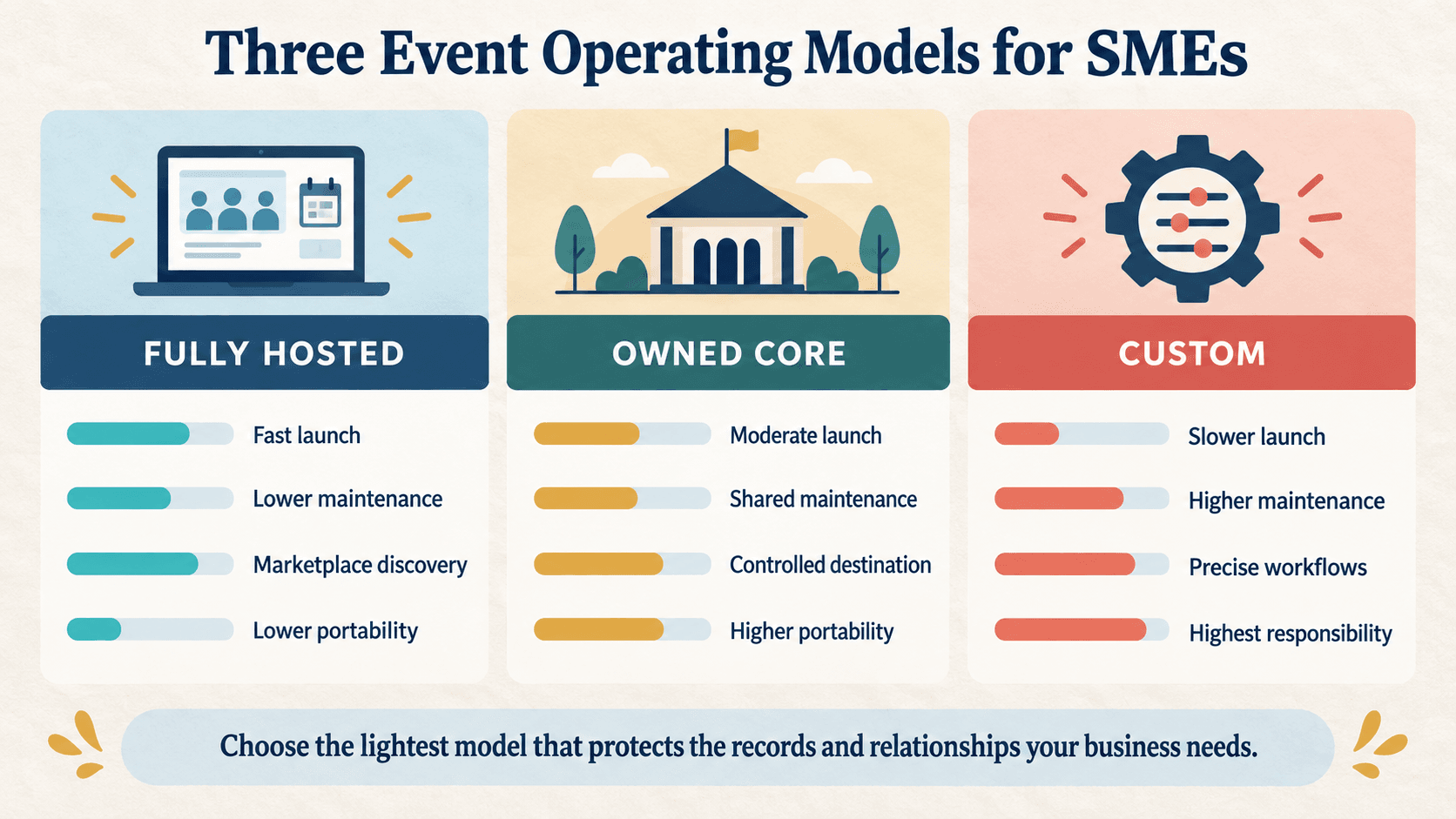
The right model balances control with the maintenance capacity of the business.
For many SMEs with recurring events, the middle model is practical. The company site holds the event pages and central workflow, while proven services handle video, email delivery, payments, or CRM activity. A business that runs one or two simple events a year may gain little from the extra responsibility.
What does an owned WordPress event hub look like?
On WordPress, the event layer can sit inside the company's existing publishing system. Each event receives a dedicated page, related events remain discoverable, and registration connects with the other tools the business already uses.
One implementation option is Modern Events Calendar, developed by Webnus. Depending on the selected configuration, it can connect WordPress event publishing with booking forms, tickets, attendee notifications, WooCommerce or native checkout, REST API access, and webhook-based automation.
That range is useful because a calendar label can hide how much operational work an event platform performs. Still, MEC should occupy a defined place in the wider setup. A specialist CRM may remain the customer system of record. A dedicated email platform may handle promotional segmentation. Zoom or another service may deliver the live session.
WordPress ownership also brings responsibility. Hosting, updates, backups, security, privacy configuration, integration testing, and staff access all need clear owners. Moving an event workflow onto the company website without assigning those responsibilities merely changes where the risk sits.
What should an SME ask before choosing an event platform?
Start with the journey and the records, then evaluate products. These questions usually reveal more than a long feature checklist:
- Where will the permanent event page live?
- Which system owns the registration and attendance record?
- Can the business export its records in a usable format?
- Which operational messages come from the event system?
- How will cancellations and attendance changes reach connected tools?
- What happens when an integration fails on event day?
- Which business outcome will be measured after attendance?
- How difficult would it be to replace one supplier next year?
The answers may point to a hosted platform, an owned core, or a custom setup. That is a healthier result than choosing the product with the longest feature page.
Ownership should reduce dependence, not create more work
An SME has an owned event hub when it can explain the customer journey, identify the authoritative records, move approved data between systems, and change suppliers without erasing the history of its programme.
The next step is simple. Take one recent event and map it against the five parts above. Write down the system responsible for each part, the person accountable for it, and the route the data follows. Any blank or disputed answer is a more useful buying signal than another generic software shortlist.
Frequently asked questions
Does an owned event hub mean every tool must be self-hosted?
No. Ownership means controlling the event destination, essential records, and data connections. An SME can still use specialist services for video, payments, email, or CRM. Replacing one service should not dismantle the entire event operation.
When is a fully hosted event platform the better choice?
A hosted platform can suit a one-off event, an early test, a small team, or a programme that depends on marketplace discovery. Check available exports and integrations, plus what happens to event pages and attendee records if you leave.
Which system should own the attendee record?
Choose one authoritative system for registration status, tickets, cancellations, and attendance. A CRM may remain the main customer record, but both systems need clear field definitions and update rules to prevent conflicts and support reliable follow-up.
Can WordPress serve as an owned event hub?
Yes. With suitable hosting, an event-management plugin, and the required integrations, WordPress can provide the public destination and central workflow. The business must still plan maintenance, backups, security, permissions, and data handling.
Can Modern Events Calendar be the core of this model?
MEC can cover event pages, bookings, tickets, notifications, and connections to other business systems. The exact mix depends on the licence, modules, and integrations. Specialist services may still handle video delivery, advanced marketing automation, payments, or CRM activity.


