
business resources
Why Strategic Execution Fails Without Portfolio-Level Visibility
25 Jul 2026

Strategy rarely collapses because leaders cannot define priorities. It usually weakens during execution, when dozens of initiatives compete for the same people, budgets and management attention without a shared view of how the whole portfolio is performing.
Most organisations can explain their strategic goals in a board presentation. The harder task is translating those goals into a controlled set of projects and then adjusting that set as conditions change. Individual project reports may show schedules, costs and milestones, yet senior leaders still struggle to answer basic questions. Which initiatives make the largest contribution to the strategy? Where are scarce specialists overcommitted? Which projects depend on the same supplier, system or decision? Which business cases have weakened since approval? Without portfolio-level visibility, these questions are answered through partial reports, personal knowledge and negotiation between departments. The result is not simply slower reporting. It is a widening gap between declared priorities and the work the organisation continues to fund.
Strategy Becomes Fragmented During Delivery
A strategic plan establishes direction, but projects consume the resources required to move in that direction. Once delivery begins, responsibility is distributed among sponsors, project managers, business units, finance teams and operational departments. Each group naturally concentrates on its own commitments. A project manager protects scope and deadlines, a sponsor defends the expected benefit, a functional manager manages specialist capacity, while finance monitors expenditure. All of these perspectives are legitimate, although none provides a complete picture of strategic execution.
The fragmentation becomes particularly dangerous when management reviews projects one by one. A digital platform rollout may be on schedule, a customer programme may be within budget and a regulatory initiative may report no major risk. Viewed separately, all three appear healthy. Viewed as a portfolio, they may require the same architects during the same quarter, rely on one overloaded procurement team or compete for a change window that can accommodate only one major release. Local reporting can therefore be accurate while the overall execution plan remains unrealistic.
Project Health Is Not the Same as Portfolio Health
Traditional status reporting is designed to show whether a project is being delivered against an approved baseline. Portfolio management adds a more demanding question: does the project still deserve its place in the investment mix? A project can remain green while its strategic relevance declines. Market conditions may change, expected benefits may no longer justify the cost or a different initiative may offer greater value with less risk. If the organisation lacks a regular portfolio review, approval can become permanent protection from challenge.
The opposite problem also occurs. A strategically essential programme may report a temporary delay because it depends on a regulatory decision or a difficult technology migration. A simplistic ranking could make it appear less attractive than a collection of smaller, easier projects. Portfolio visibility must preserve context. It should expose schedule and budget performance while also showing strategic contribution, risk, dependencies, resource demand and expected benefits. This gives executives a basis for deciding where intervention is required and where a controlled deviation is acceptable.
A portfolio is healthy when the organisation is investing in the right combination of initiatives, not merely when every project reports a green status.
Visibility Must Connect Priorities, Capacity and Benefits
Useful portfolio information is selective rather than exhaustive. Senior leaders need a consistent view of investment, progress, forecast cost, strategic alignment, major risks, resource conflicts and benefit ownership. The data must be comparable across projects and current enough to support action. A large dashboard filled with unrelated indicators may create the appearance of control while obscuring the few issues that require a decision.
The strongest portfolio processes connect three management conversations that are often separated. Prioritisation determines which proposals should enter the portfolio. Capacity planning tests whether the organisation has the people, funding and operational space to deliver them. Benefits management verifies whether completed initiatives are creating the value that justified investment. When these conversations use different data and occur in different forums, the portfolio gradually becomes a historical list of approvals rather than an active instrument of strategy.
The Project Management Institute’s Delivering on Strategy research reported that organisations with mature project portfolio management practices completed 35 per cent more programmes successfully. The report also emphasised the importance of linking execution to strategic goals, keeping portfolio processes sufficiently simple and building decision-making capability around the portfolio. The PMI report remains relevant because it frames visibility as a management discipline rather than a reporting feature.
The PMO Converts Portfolio Data Into Governance
Portfolio visibility creates value only when the organisation has a mechanism for acting on it. This is where a strategic PMO or EPMO becomes important. Its role is not limited to collecting status information. It establishes common definitions, maintains project and portfolio standards, prepares decision forums and ensures that leaders receive comparable information across business units. It can also challenge outdated assumptions, identify duplicated initiatives and recommend when a project should be accelerated, reshaped, paused or closed.
A capable PMO designs the governance behind the dashboard. Project charters need consistent fields, strategic objectives require measurable links to initiatives, scoring criteria should be transparent and periodic reviews must focus on decisions rather than presentation. Modern PMO software can support these controls through configurable project templates, approval paths, scoring models, recurring reviews and reports built from current project data. Technology reduces administrative effort, although the quality of governance still depends on the rules, accountabilities and review habits established by the organisation.
Portfolio-Level Control Still Depends on Project Teams
Executives cannot manage a portfolio with information that project teams do not maintain. Strategic visibility begins with ordinary delivery discipline: owners update tasks, project managers revise forecasts, risk owners describe exposure honestly and sponsors confirm whether expected benefits remain credible. When updates are delayed or designed mainly to protect a favourable status, portfolio reporting becomes less reliable regardless of the sophistication of the platform.
The human side of execution also explains why resource data must be interpreted carefully. A person who appears available on a capacity chart may lack the required specialist knowledge, be committed to operational work or need time to join a new team effectively. Project managers therefore remain responsible for building workable teams, clarifying responsibility and creating conditions in which issues are reported early. Practical guidance on managing a project team is relevant at portfolio level because every strategic dashboard ultimately depends on decisions and updates made inside individual projects.
How FlexiProject Supports Portfolio-Level Execution
FlexiProject combines operational project management with portfolio and PMO capabilities in one environment. Organisations can group projects into different portfolios, place the same project in more than one strategic or operational perspective and configure the information shown in each portfolio. Graphical roadmaps display project timing, milestone status, deviations and dependencies, while aggregated financial views compare planned, incurred and forecast costs. Scoring supports structured project evaluation, and reports can consolidate information on risks, milestones and delayed tasks. Recurring portfolio reviews help management work with a defined reporting cycle instead of rebuilding the same information manually before every meeting.
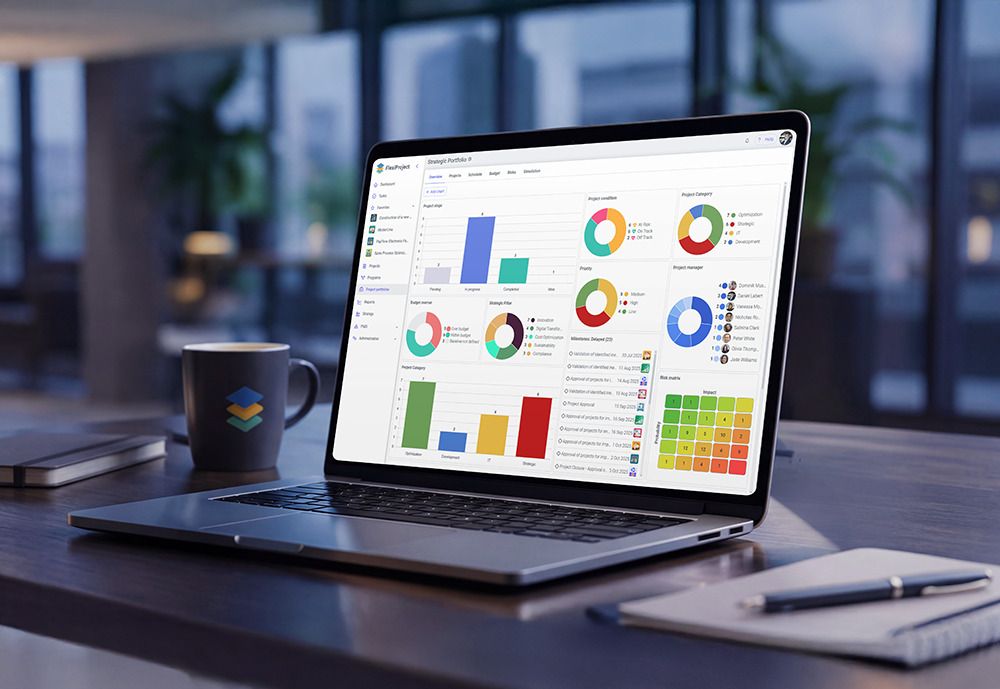
This structure is particularly useful when strategy crosses organisational boundaries. A technology project may belong simultaneously to an IT portfolio, a transformation portfolio and a customer-experience programme. Different executives can examine the same initiative from the perspective relevant to their responsibilities without creating separate, conflicting records. Graphic summaries can present budgets, delays, risks, tasks and milestones through configurable widgets, while portfolio-level risk views allow managers to filter and trace exposures back to their source projects.
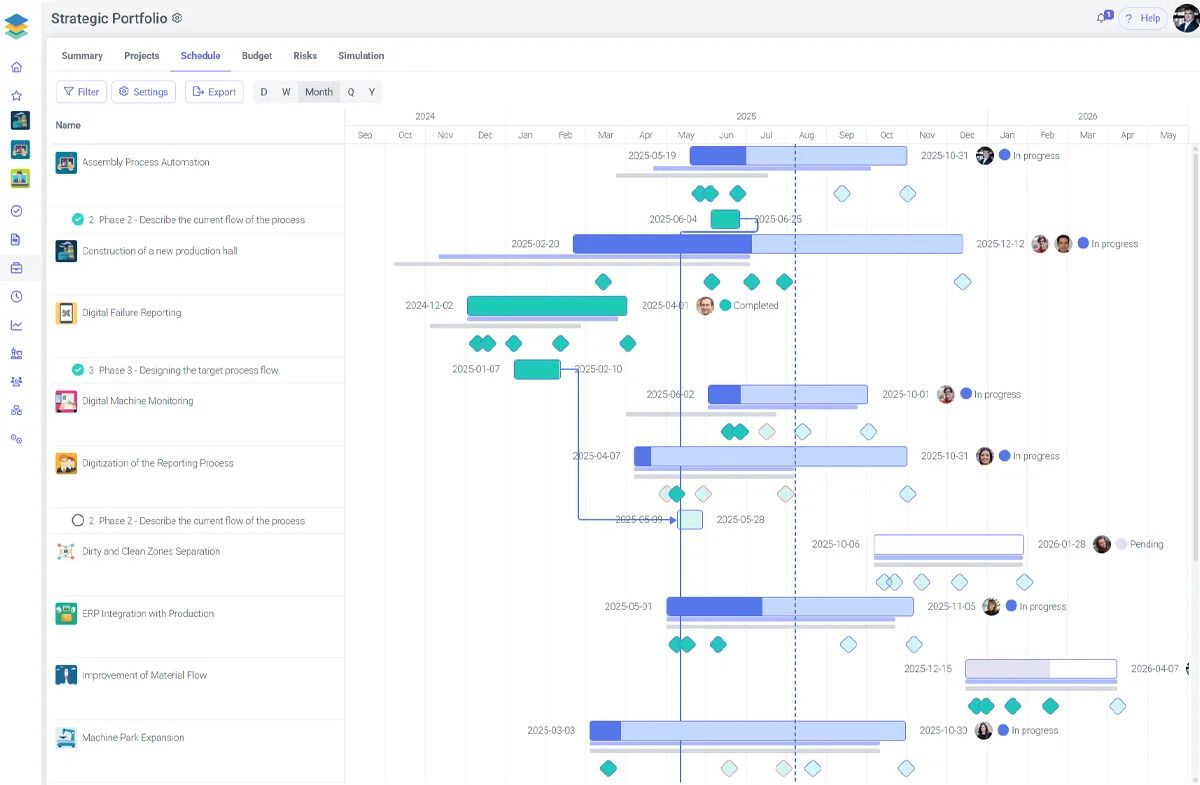
Caption: Configurable portfolio summaries help decision-makers focus on the indicators that materially affect strategic execution.
International adoption also affects data quality. FlexiProject is available in 28 languages, including separate UK and US English versions. User documentation is available in English, Polish, Czech, German, Spanish, French, Hungarian, Italian, Portuguese, Romanian and Ukrainian, while training videos and system presentations are offered in Polish and English.
The FlexiProject mobile application lets users review assigned tasks, change their statuses, add comments and attach photographs or documents. Project information can therefore be updated during site visits, implementation work or customer meetings rather than waiting for the user to return to the office. For international and distributed organisations, multilingual access and mobile updates make it easier to maintain one reporting standard across business units and provide the PMO with current portfolio information.
A Portfolio View Changes the Quality of Executive Decisions
Portfolio-level visibility does not remove uncertainty, and it cannot turn weak strategic choices into strong ones. It gives leadership a more honest picture of what the organisation has committed to deliver and whether those commitments still fit available capacity. That picture makes difficult decisions possible: redirecting specialists, stopping a low-value initiative, protecting a strategically important programme or accepting a delay because the alternative would create greater risk elsewhere. The discipline also changes the tone of executive reviews. Instead of asking why a project manager has moved a milestone, leaders can examine how the change affects benefits, dependencies and the wider investment plan. Instead of approving new initiatives in isolation, they can see what must be postponed or resourced differently to make room. Strategy execution becomes a continuous process of portfolio adjustment, supported by evidence and governed through explicit choices.
Organisations do not fail to execute merely because they lack data. They fail when information remains fragmented and no one can connect project reality with strategic intent. Portfolio-level visibility provides that connection. When supported by a capable PMO, disciplined project teams and a shared management platform, it turns strategy from a collection of priorities into a portfolio that can be governed.


