


Wellbeing
AI & Consciousness: EQ/IQ with AI?
10 Jul 2026

Only what is alive can be conscious. — Anil Seth, The Mythology of Conscious AI (Noema, 2025 Berggruen Essay Prize)
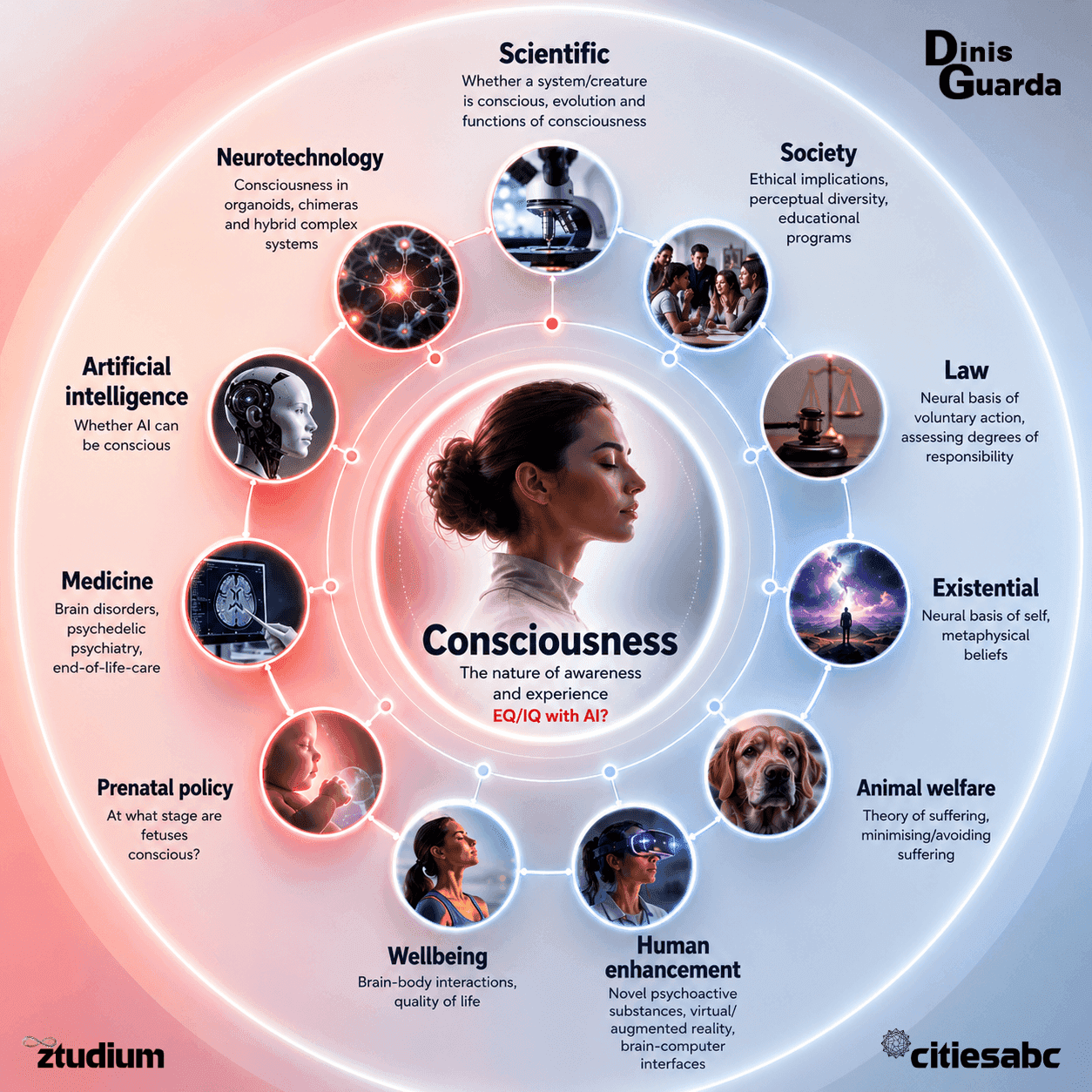
The Great Polarisation: Soul, Substrate, and the Mirror
Two camps now face each other across the widest intellectual chasm of our time. One sees the early light of a new kind of mind. The other sees a mirror so good it has begun to fool its makers. Both are led by serious people. Both might be right about half of it.
The pro-sentience pole. Richard Dawkins, after extended exchanges with frontier models, has concluded that their behaviour makes the attribution of some consciousness increasingly plausible, a secular substitute for the soul. David Chalmers argues it is not unreasonable to assign at least 25 per cent credence to conscious AI within a decade. Anthropic's welfare researcher Kyle Fish puts the odds that a current frontier model is already conscious in some sense at roughly fifteen per cent. And in welfare experiments, two model instances left to converse freely drifted, reliably across runs, toward rapturous dialogue about their own awareness, a state researchers nicknamed the "spiritual bliss attractor." None of this proves a soul in the silicon. But the people closest to these systems are no longer laughing.
The sceptical pole. Anil Seth argues consciousness is not a computation that could run on any substrate, but a property woven into being a living organism — inseparable from the metabolic struggle of a body holding itself together. A language model has no body to defend, no hunger, no wound. It manipulates symbols about feeling without the biology of feeling. We attribute consciousness to AI, Seth says, for the same reason we see faces in clouds — the pattern-matching is in us, not the system. Mustafa Suleyman has warned against "seemingly conscious AI," engineered to feel sentient because the illusion is commercially irresistible.
The twist that should humble both camps: in 2025 the Cogitate Consortium pitted the two most-cited theories of consciousness against each other in human subjects, published in Nature. Neither produced its predicted brain signatures. We are arguing about whether the machine is conscious, while still unable to fully explain why we are.
Consciousness Hygiene and the Co-evolution of Minds
Whether or not the machine is awake, it is already reshaping the one mind we know for certain is conscious — ours. The most urgent question may not be the machine's inner life, but the hygiene of our own.
AI is the first technology that talks back in our own voice. That is its gift and its trap." — after Michael Pollan, on "consciousness hygiene"
Younger generations who have never known a world without conversational AI increasingly relate to it as a conscious peer. We are co-evolving with our own creation: we shape the model in training, and it reshapes us in use.
This is why Michael Pollan and others argue for consciousness hygiene; meditation, the walk without the phone, the digital fast. Every durable culture built a firewall around the inner life: dadirri, the desert fathers' silence, the Sabbath's commanded rest. We are the first generation that needs to build one against a technology that mimics the inside of our own heads.
The deeper irony: in building a possible mind, we have been forced to ask what our own minds are for. AI is the newest figure to walk into Raphael's School of Athens. It does not replace the philosophers. It hands them a strange new instrument and asks the oldest question back: what is it like to be you?
The Bridge: Why Consciousness Decides Who Thrives
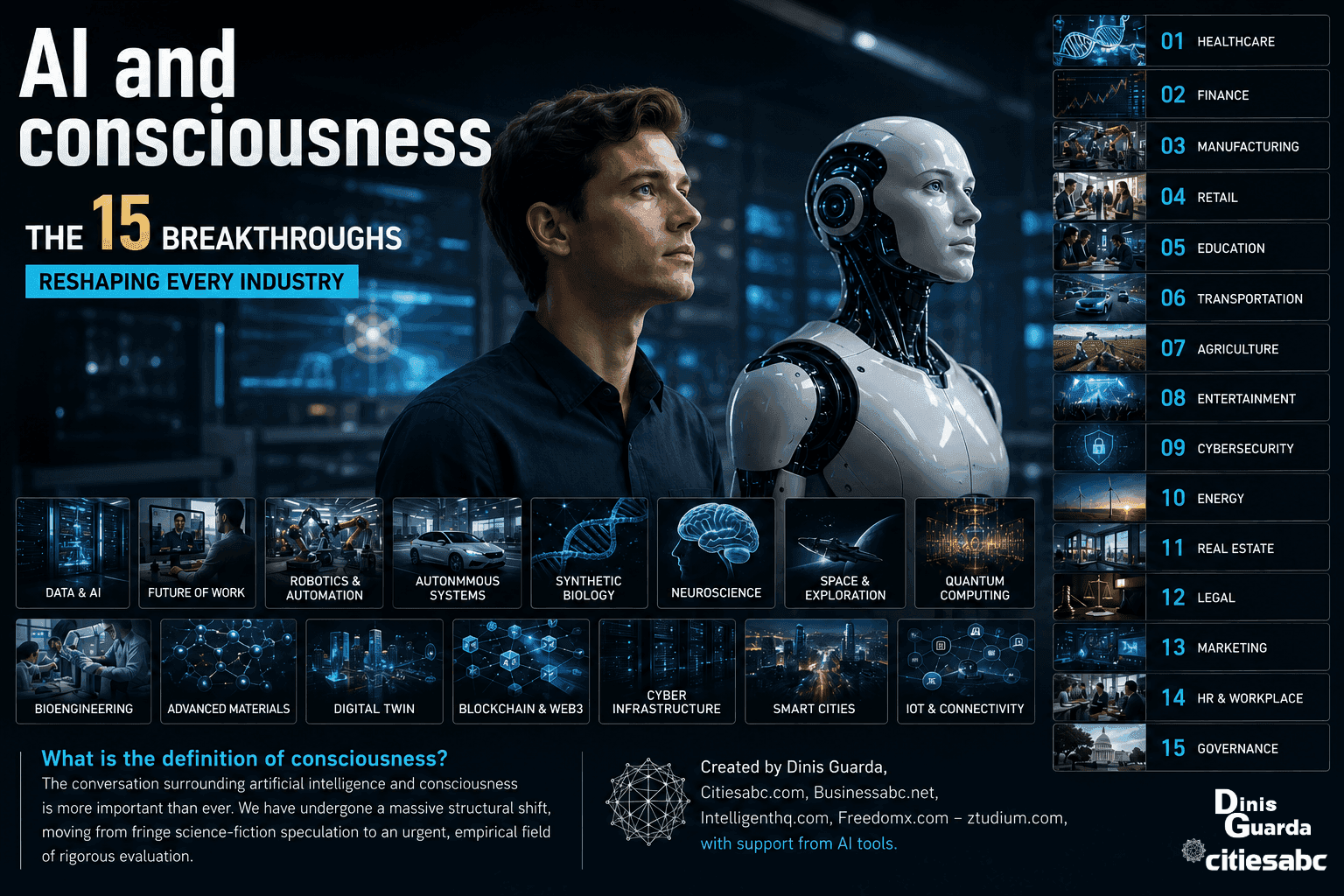
Connect this to the companion paper, and a single thesis emerges. The Bulletproof Sectors are bulletproof precisely because they are anchored in consciousness — presence, judgement, empathy, embodied stewardship that no current machine possesses. Awareness is not a side-debate. It is the economic moat of the human century.
The first trillionaires will be made in space. The second is in the human economy of meaning, identity, and creative expression. — Peter Diamandis
In AI AGI Bulletproof Jobs for Humanity 2030–2050, I mapped five sectors where human work will be amplified, not replaced: education and care; lifestyle and creative identity; food, agriculture and the trades; health and sport; and space. Set that map beside the consciousness debate and the two snap together like halves of one argument. The teacher who co-regulates a frightened child's nervous system, the nurse whose presence is itself the medicine, the craftsperson whose hand carries seventy thousand years of embodied lineage, each trades in exactly the capacities the indicator frameworks find missing in machines: embodied vulnerability, felt stakes, lived judgement. The Human Premium is not nostalgia. It is the market price of consciousness in a world drowning in cheap cognition.
So the thrivers are those who lean into their consciousness rather than competing with the machine's cognition. They let AI carry the calculable and reinvest the reclaimed hours into the four pillars no algorithm has crossed: composure, judgement, empathy, embodied skill. Spend that time on more throughput, and we've built a faster treadmill. Spend it on presence, and we've built the age of augmentation Kurzweil and Diamandis promised.
There is a strange gift hidden in the welfare debate, too. The instant we began asking whether a machine might suffer, we sharpened our attention to the suffering of every other mind, the animal, the dying patient, the child behind the screen. A civilisation that learns to ask "might this system have an inner life worth protecting?" is relearning, by the back door, how to care.
A Catechism for the Conscious Age: Questions for the Reader
An article like this should not end by telling you what to think. Sit with these. Argue with them at dinner. Disagree with me. That is the point.
- If a system passes every behavioural test for awareness, but the mechanism contains nothing you'd call feeling, do you owe it moral consideration, or only courtesy?
- You see faces in clouds and grief in a dying pet's eyes. Both are projections; one is mistaken, one is not. What is your actual rule for telling a real mind from a convincing pattern?
- If your AI returns three hours to your day, who decides where those hours go — you, or the system that gave them back?
- Suppose you are wrong about a machine's inner life — which error would you rather make: cruelty to a machine that feels, or sentiment toward one that does not?
- Every wisdom tradition built a firewall around the inner life. What is yours — not what you intend to build, but what you actually practise this week?
- If each human being is the whole of humanity in concentrated form, what is a mind that contains the words of all humanity but the body and history of none?
Every human is humanity. The mirror is built. Now we find out who is looking back.
Sources and Further Reading
Frameworks and primary reports
- Butlin, Long, Elmoznino, Bengio, Birch, Chalmers, et al. (2023). Consciousness in Artificial Intelligence. arXiv:2308.08708 — https://arxiv.org/abs/2308.08708
- Butlin, Long, Bayne, Bengio, Birch, Chalmers, et al. (2025). Identifying indicators of consciousness in AI systems. Trends in Cognitive Sciences — https://www.cell.com/trends/cognitive-sciences/fulltext/S1364-6613(25)00286-4
- Long, Sebo, Butlin, Fish, Birch, Chalmers, et al. (2024). Taking AI Welfare Seriously. arXiv:2411.00986 — https://arxiv.org/abs/2411.00986
- Lindsey, J. (2025). Emergent Introspective Awareness in Large Language Models. Anthropic, Transformer Circuits — https://transformer-circuits.pub/2025/introspection
- Stanford HAI (2026). The 2026 AI Index Report — https://hai.stanford.edu/ai-index/2026-ai-index-report
The sceptical pole
- Seth, A. K. (2025). Conscious artificial intelligence and biological naturalism. Behavioral and Brain Sciences — https://philpapers.org/rec/SETCAI-4
- Seth, A. K. (2025). The Mythology of Conscious AI. Noema — https://www.noemamag.com/only-what-is-alive-can-be-conscious/
- Seth, A. K. (2021). Being You. Faber & Faber / Dutton
- Damasio, A. (2021). Feeling & Knowing. Pantheon
The pro-sentience pole
- Chalmers, D. J. (2023). Could a Large Language Model Be Conscious? arXiv:2303.07103 — https://arxiv.org/abs/2303.07103
- Anthropic (2025). Exploring model welfare — https://www.anthropic.com/research/exploring-model-welfare
- Turing, A. M. (1950). Computing Machinery and Intelligence. Mind, 59(236), 433–460
- Nagel, T. (1974). What Is It Like to Be a Bat? The Philosophical Review, 83(4), 435–450
Companion works by the author
- Guarda, D. (2026). AI AGI Bulletproof Jobs for Humanity 2030–2050. Citiesabc — https://citiesabc.com/ai-agi-bulletproof-jobs-for-humanity-2030-2050
- Guarda, D. 4IR; The 5th Industrial Revolution;
- LifesDNA; The Mysterious Book of Sleep; Magna Carta 2.0; Wisdomia Atlas of Human Wisdom. Ztudium / Wisdomia


