
resources-impakt, citiesabc, first_page
How 31 Designers Are Using AI to Put Amazonia’s 1.69M Indigenous People on the Global Fashion Map
11 Sept 2026

- How Indigenous fashion economies in the Amazon are turning craft into a survival strategy, for communities and for the rainforest itself
- Fashionabc partners with the Best of Fashion Awards to present Indigenous designers from Brazil’s MI.Moda Indígena during New York Fashion Week, using AI to widen access without displacing authorship.
In the Xingu River Basin of Brazil, roughly 700 Indigenous seed collectors move carefully through the forest floor, gathering material not for cloth but for reforestation, a livelihood that has generated more than $1.7 million in income while helping restore 27 million trees. And in the Alto Rio Negro, Baniwa women decide, on their own terms, how their jiquitaia chili and their handwoven baskets reach the market.
None of these stories is really about fashion. Or rather, they are all about fashion, but not the version the industry is used to. They are about economies: who builds them, who benefits from them, and whether they can exist without hollowing out the very ecosystems that make them possible.
On 11 September 2026, Indigenous designers from Brazil’s MI.Moda Indígena will have their work presented in New York through the Best of Fashion Awards, an international fashion showcase taking place during New York Fashion Week. BOFA created the connection that brought the Indigenous designers to the New York stage, while Fashionabc’s AI.DNA technology, developed under the leadership of Dinis Guarda, founder and CEO of the Ztudium Group and its platforms, including Fashionabc, Citiesabc.com, Businessabc.net and Wisdomia.ai, supports the digital fashion presentation and wider visibility of their work.
Clothing as Knowledge, Long Before Fashion
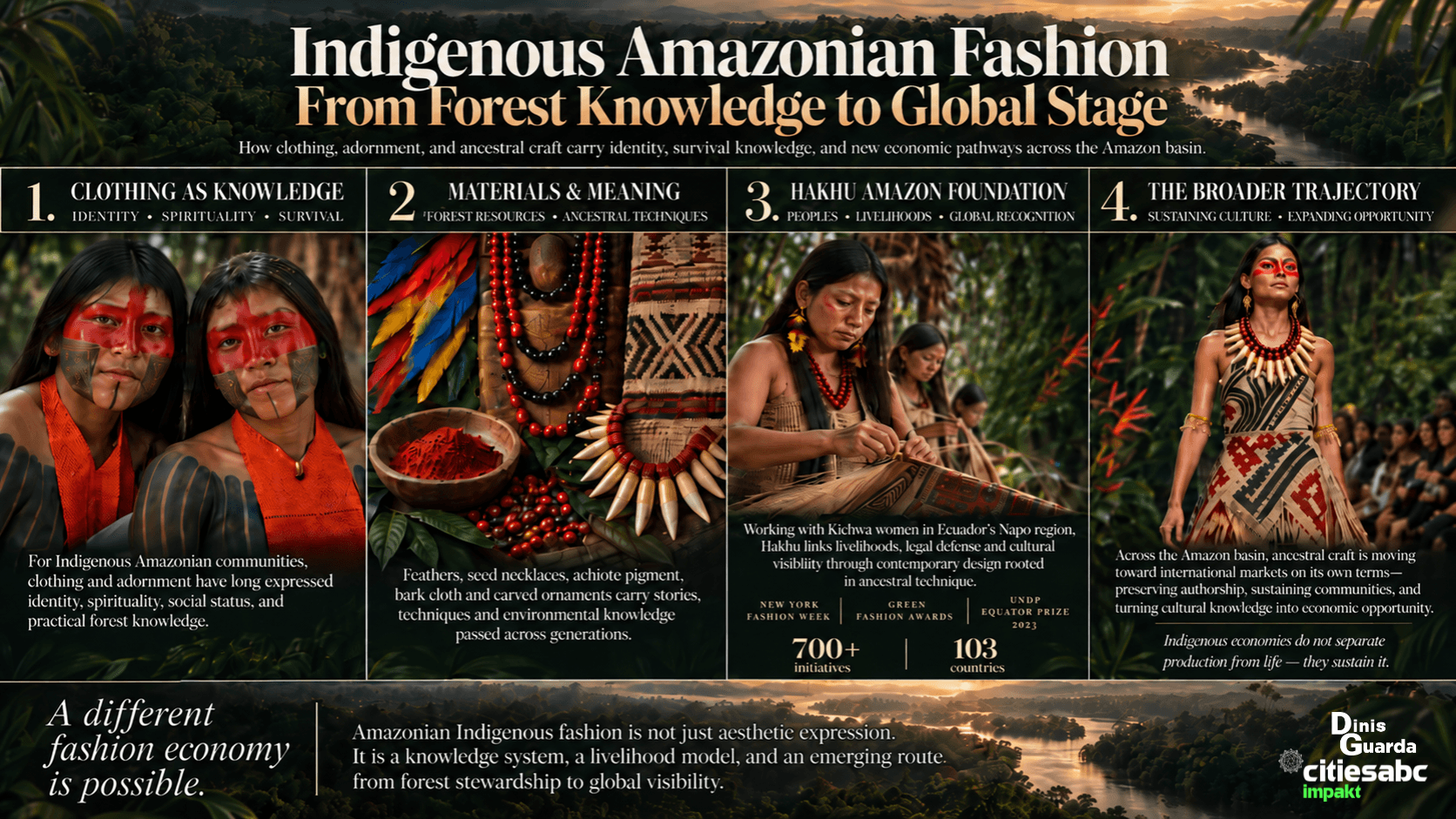
For Indigenous Amazonian communities, clothing and adornment were never separate from survival. Feathers, seed necklaces, bark-cloth skirts, achiote pigment, jaguar-tooth ornaments, these were markers of identity, spiritual belief and social status long before "resortwear" or "artisanal capsule collection" entered the fashion lexicon. Some communities still dress this way daily; others have layered Western clothing over ancestral dress, reserving traditional garments for ceremony. But the materials, techniques and symbolism embedded in that clothing represent generations of accumulated knowledge about the forest itself, which plants dye which colors, which fibers hold up to the humidity, which patterns carry which stories.
The organisation Hakhu Amazon Foundation, working with Kichwa women in Ecuador's Napo region, puts it simply: Indigenous economies "do not separate production from life, they sustain it." Hakhu's model grew out of necessity as mining pressure intensified on ancestral territory; livelihoods alone, the foundation found, weren't enough to protect land, so economic activity, legal defense and cultural visibility had to move together. Its Hakhu Amazon Design line, handmade pieces blending ancestral technique with contemporary silhouettes, has since appeared at New York Fashion Week and the Green Fashion Awards in Hollywood, and in 2025 the foundation won the UNDP's Equator Prize, selected from more than 700 initiatives across 103 countries.
That trajectory, ancestral craft moving deliberately, and on its own terms, toward international markets, is becoming a recognisable pattern across the Amazon basin.
The new horizons of AI in Fashion

Much of the conversation around generative AI in fashion has centred on speed and scale: campaign imagery, digital models and virtual environments produced faster than ever before. The BOFA New York 2026 presentation leverages AI to extend the reach of Indigenous creators without separating their work from its cultural origin.
The point sits at the centre of the project's value for cities and communities thinking about equitable technology adoption: the more AI can generate any aesthetic on demand, the more it matters that the origin of a design, the maker, the community, the tradition, remains visible and credited.
Rather than replacing designers or their creative process, AI in this presentation is confined to the visual and production layer: digital production, casting and creative direction, with the designs, techniques and authorship remaining with the Indigenous makers themselves.
BOFA brings Amazonian fashion to the New York Fashion Week

In Brazil, designers like Maurício Duarte and Sioduhi have built platforms that pair traditional weaving and materials with contemporary branding. Duarte, from Amazonas, debuted at São Paulo Fashion Week in 2022 and has continued working with Indigenous families and materials such as pirarucu fish scales in place of leather; Sioduhi, of the Pira-tapuya people, trained as a professional fashion designer in São Paulo before returning to reconnect his work with his Indigenous roots, showing collections at events including Brazil Eco Fashion Week. Alongside them, MI Moda Indígena, co-founded by Rebeca Ferreira and backed by Brazil's Sebrae agency, runs a curriculum in design, tailoring and marketing that grounds every lesson in the students' own cultural identity. Through its collaboration with Best of Fashion Awards, the initiative gained access to the New York stage, where its designers could be presented to an international audience during New York Fashion Week.
These efforts are responses to a well-documented history: Indigenous designs copied or bought cheaply, then resold by national and international labels at markups the original makers never see. That extractive pattern is precisely what the current generation of Amazonian designers is working to reverse, insisting on authorship, licensing and a seat at the table rather than a footnote in someone else's collection.
There are precedents worth learning from, and cautionary tales too. Brazilian brand Osklen's 2015 collection drawing on Asháninka visual motifs has since become a widely cited case study in how easily "inspiration" tips into appropriation when a global label borrows a community's imagery without a formal, reciprocal partnership behind it. More recently, industry bodies have moved to formalise what had long been left to individual designers' goodwill: in May 2024, Conservation International and Textile Exchange, supported by Kering, released the "Indigenous Partnership Principles" at the Global Fashion Summit in Copenhagen, the first industry-wide guide for how fashion brands should engage with Indigenous communities.

MI.Moda Indígena works directly with Indigenous communities in the Brazilian Amazon, training designers and makers in pattern cutting, sewing, tailoring and entrepreneurship. Its model links two goals that urban and economic-development audiences will recognise: building livelihoods, and preserving traditional knowledge that might otherwise have no route to global markets.
That combination touches directly on several UN Sustainable Development Goals, quality education, gender equality, decent work and economic growth, reduced inequalities, and responsible consumption and production, through programmes that explicitly support women-led participation and more sustainable approaches to fashion production.
For a cooperative rooted in specific Amazonian communities, the opportunity created through the Best of Fashion Awards to appear in New York during Fashion Week is not simply a marketing opportunity. It raises the same questions that face any city or platform trying to connect local, traditional economies to global ones: who controls the narrative once a local product reaches an international stage, who owns the cultural language being showcased, and who ultimately benefits financially and reputationally from that exposure.
The bioeconomy of indigenous fashion
Fashion's most fertile alliance with the Amazon, though, may not happen on the runway at all, it's happening in the forest, in what researchers now call the "Indigenous bioeconomy." According to the World Resources Institute, roughly 2.7 million Indigenous people live across the Amazon, and land under their stewardship shows deforestation rates around 30 times lower than comparably positioned forest managed by others. The bioeconomy framework emerging from their practices rests on four principles: reciprocity (harvesting seeds, fibers and dyes in ways that let ecosystems regenerate), redistribution (making sure income circulates through communities rather than concentrating with a few intermediaries), recognition (securing land rights and decision-making authority so knowledge isn't simply extracted), and respect (treating craft and food systems as vessels for heritage, not just commodities).
The Xingu Seeds Network — the same initiative introduced at the top of this piece — is the bioeconomy's clearest proof of concept: launched in 2007, its roughly 700 collectors have generated over 8.5 million reais (about $1.7 million) in income while contributing to the restoration of 27 million trees on 11,000 hectares of previously degraded land. The same logic runs through the region's textile and craft economy: Baniwa artisans gather materials on seasonal cycles that let plant populations replenish; Ikpeng gatherers deliberately leave some seeds uncollected so trees can keep producing. It's a model in which the health of the supply chain and the health of the ecosystem are the same question, not two competing priorities the way they often are in conventional fashion sourcing.
WRI's modeling suggests the stakes go well beyond individual artisans: a deforestation-free, low-carbon development path for the Brazilian Amazon could add 312,000 jobs and tens of billions of dollars in regional and national GDP by 2050. Craft and textile production — small-scale by nature, high in embedded labor and story — sits squarely inside that vision, precisely because it rewards keeping the forest standing rather than clearing it.
What Global Fashion Still Gets Wrong
None of this erases the tension at the center of the relationship between Indigenous Amazonian makers and the global fashion system. Access to finance, language barriers, thin infrastructure in remote territories, and competing incentives that still reward extractive land use over stewardship all continue to limit how far Indigenous-led economies can scale on their own.
A newer front in that same tension has opened around generative AI. As image-generating tools are trained on scraped visual archives, some of that training data includes traditional motifs pulled from cultural sources without consent — a practice that severs patterns from what's often called their "motif lineage," the documented chain connecting a design back to the community that created it. Critics of this practice argue that when synthetic, AI-generated versions of traditional patterns flood retail at low prices, they don't just misrepresent the culture behind the motif — they undercut the market for the artisans who actually make it by hand, compressing prices and commissions for original work. It's the digital-age version of the same extractive pattern Amazonian designers have been fighting against in the physical marketplace for decades: value flowing away from the people who created it in the first place.
Sustainability & Circularity is the real luxury
What unites Hakhu's Kichwa weavers, the Xingu seed collectors, Duarte and Sioduhi's design platforms, and the Baniwa women pricing their own chili peppers is a rejection of the old extractive template — the one where "authenticity" gets borrowed, repackaged and sold back to the world at a markup, with nothing returning to its source. In its place is a model where the transaction itself is designed to circulate benefit back to the community and the land: income that funds community infrastructure, seed sales that regrow forest, licensing that keeps decision-making with the people who hold the knowledge.
For an industry that has spent years searching for a credible definition of sustainable luxury, the Amazon may already have one on offer. It isn't a fiber or a supply-chain certification. It's a set of relationships — reciprocity, redistribution, recognition, respect — old enough to predate the word "sustainability," and precise enough to outlast the trend cycle that so often swallows the cultures it borrows from.
MI.Moda Indígena's activities extend beyond fashion presentation. Its work across Amazonian communities connects directly with the UN Sustainable Development Goals, from quality education and gender equality to decent work, reduced inequalities and responsible production. The New York showcase is therefore much more than an AI fashion experiment — it raises a critical question for the industry: can artificial intelligence amplify Indigenous creativity without disconnecting culture from the people who created it? Technology should not become the author of culture. It should be the infrastructure that helps its true authors gain visibility, opportunity and access to global audiences.
The People Behind the Production
The event is co-founded by Rafael dos Santos and Gislaine Balzano, whose production experience spans seven years and more than 500 events across fashion, culture and awards. Gislaine has brought more than 60 brands to international runways, coordinated over 200 models and directed more than 700 looks during international fashion weeks; the wider production has mobilised more than 500 professionals internationally.

Gislaine Balzano, the fashion director involved in the project, has described the combination of ancestral technique and generative technology as one of the most innovative projects she has worked on, pointing to how MI.Moda Indígena's fabrics came to life through Fashionabc's artificial intelligence.

Rafael dos Santos has framed the wider ambition in similar terms, noting that Fashion Week rarely puts ancestry in dialogue with artificial intelligence, and that this year's edition built a stage where designers from the Amazon and judges from some of the world's most recognised brands could meet through technology.

Brazilian model, entrepreneur and women's rights activist Luiza Brunet will also join the New York programme as a special guest, ahead of the separate Best of Brazil Global Awards ceremony taking place on Liberty Island the following day, 12 September.
What This Means for Cities and Platforms
Best of Fashion Awards 2026 runs across five competition categories, Best Sustainable Brand, Best Evening Wear, Best Casual Wear, Best Creative Design and People's Choice, with a structured application and judging pathway, full runway production, professional documentation, worldwide live broadcast and formal recognition for participants and winners alike.
The project is worth watching less as a fashion story and more as a case study in inclusive urban and economic connectivity: a template for how a global city stage, supported by the right technology infrastructure, can widen access for creators from remote, historically marginalised regions, while keeping the questions of authorship, cultural ownership and economic benefit explicitly on the agenda rather than treating them as an afterthought.
The Best of Fashion Awards takes place on 11 September 2026 in New York during New York Fashion Week.
Sources
- Best of Fashion Awards — Official Website: https://bestoffashionawards.com/
- World Resources Institute — In the Brazilian Amazon, an Indigenous Bioeconomy Takes Root
- World Resources Institute — What is the New Economy for the Brazilian Amazon?
- UNDP — Equator Prize 2025 Winners
- Primicias — Fundación Hakhu Amazon gana el Equator Prize 2025
- Conservation International — Guide for the Fashion Industry: Indigenous Partnership Principles
- Elle Brasil — SPFW N57: Maurício Duarte
- SUMAÚMA — Profile of designer Sioduhi
- WWD — Osklen Spring 2016 Ready-to-Wear Review
- Yale School of Management — Designer Stella McCartney Discusses Sustainability and the Future of Fashion
- Good On You — How To Buy Less, Choose Well and Make It Last
- KUNM — First Native Fashion Week Launches in Santa Fe


