
Fashion Trends & Future, Fashion Education, Designers & Ateliers
Ancient Foundations — Mesopotamian Innovations (3500–539 BCE)

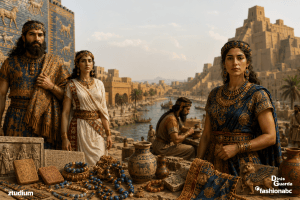
Ancient Foundations — Mesopotamian Innovations (3500–539 BCE) – Created by Dinis Guarda with AI tools for Fashionabc
“From the cradle of civilisation flowed not just rivers, but ribbons of innovation that would dress humanity for millennia.”
Between the Tigris and Euphrates, clothing stopped being just a personal matter and became something closer to a system. Fashion in Mesopotamia, garments, footwear, ornament, was never purely functional. It grew alongside the region’s earliest cities, moving from a simple loincloth in the Ubaid period (roughly 5000–4100 BCE) to the richly coloured robes and dresses worn centuries later under the Sassanian Empire (224–651 CE).
What set Mesopotamia apart wasn’t just that people dressed well, it’s that they organised dressing. This is where fashion first became an industry rather than a craft practiced in isolation. The Mesopotamians treated clothing as a kind of language: fabric quality signalled rank, colour carried symbolic weight, and construction itself became a marker of skill and prestige. These are, in many ways, the first fashion “rules”, ones we still recognise today.
The Sumerian Foundation
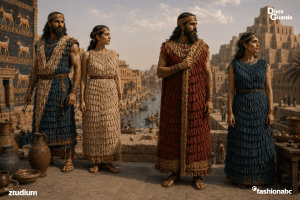
The Sumerian Foundation – Created by Dinis Guarda with AI tools for Fashionabc
The Sumerians gave fashion one of its earliest signature garments: the kaunakes, a woollen mantle built from tufted rows that suggested overlapping petals or feathers, either sewn onto the fabric or looped directly into the weave. It wasn’t just decorative; it was legible. The length of the garment told you exactly where its wearer stood in the social order. Servants, slaves, and soldiers wore it short. Royalty and deities wore it long. Clothing, in other words, had already become a form of public rank.
Textile Triumph
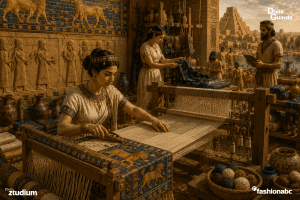
Textile Triumph – Created by Dinis Guarda with AI tools for Fashionabc
Weaving technology advanced early and quickly. Looms capable of producing fine fabric were in use by around 3000 BCE, and the results were genuinely impressive; some linen fragments recovered from royal tombs are woven almost as finely as modern textile production. This wasn’t a cottage craft. Abundant raw materials, skilled labour, and an active merchant class turned textile manufacturing into one of Mesopotamia’s major industries and a real source of regional wealth.
Colour as Communication
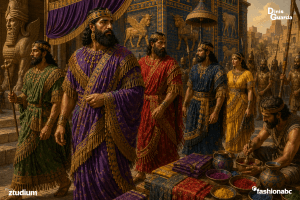
Colour as Communication – Created by Dinis Guarda with AI tools for Fashionabc
Mesopotamian fashion didn’t shy away from boldness. The Assyrians in particular favoured fringed garments in vivid colour; deep purple, light green, bright red, dark indigo, vibrant yellow, all drawn from natural dyes. Their reputation for extravagant dress reached beyond their own borders; the Book of Ezekiel even describes them as “clothed most gorgeously,” a phrase that says as much about their neighbours’ impressions as it does about the Assyrians themselves.
Gender and Garments
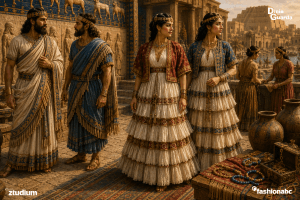
Gender and Garments – Created by Dinis Guarda with AI tools for Fashionabc
Both men and women typically wore a large draped piece of fabric, usually wool, later also linen, arranged over a skirt, often edged with tassels or fringe. Over time, women’s fashion developed its own distinct forms. By around 1750 BCE, women were wearing long, bell-shaped skirts constructed in flounced layers over a loincloth, paired with a short, bolero-style jacket that had elbow-length sleeves but stayed open at the front, a style that reflected shifting norms around modesty and display in Babylonian society.
Key Benchmarks

Key Benchmarks – Created by Dinis Guarda with AI tools for Fashionabc
| Period | Culture | Innovation | Significance |
| 3500–3000 BCE | Sumerian | Kaunakes garment | Status communicated through clothing length |
| 3000 BCE | Sumerian | Advanced looms | Industrial-quality weaving becomes possible |
| 2500 BCE | Sumerian | Gender-specific styles | Clothing differentiates by cultural role |
| 1750 BCE | Babylonian | Flounced skirts | Marks a leap in garment construction complexity |
| 700 BCE | Assyrian | Cotton introduction | New textile material enters the region |
By the time the Assyrian and Babylonian empires reached their height, Mesopotamia had already established the core logic of fashion as social communication, a logic that Egypt, Greece, and Rome would each inherit, adapt, and push in new directions.
Sources:
- Fashion & Dress in Ancient Mesopotamia — World History Encyclopedia
- Dress — Mesopotamian, Sumerian, Babylonian — Britannica
- Kaunakes — Wikipedia
- Kaunakes — Fashion History Timeline (FIT)
- Sumerian — Fashion History Timeline (FIT)
- Ancient Mesopotamian Clothing: Fashion, Characteristics & Types — Study.com
- Traditional Clothing of Mesopotamia — Nationalclothing.org
- Mesopotamian Fashion: Early Innovations — Timeless Fashion Hub
Previous articles in this series:
- Chapter 1: The Dawn of Dress — Prehistoric Origins (300,000–10,000 BCE) (link to be added on publication)


