
business resources
Beyond CRM: Why Growing Businesses Are Moving to Connected Business Platforms
06 Sept 2026

Most businesses do not deliberately set out to build a fragmented technology environment.
It happens one decision at a time.

A CRM is introduced to manage customers. Accounting software handles finance. Another platform manages email marketing. A separate tool is selected for projects. Customer support gets its own system, while appointments, documents, spreadsheets and reporting are handled elsewhere.
Each application may solve the problem it was purchased to address.
The challenge appears later.
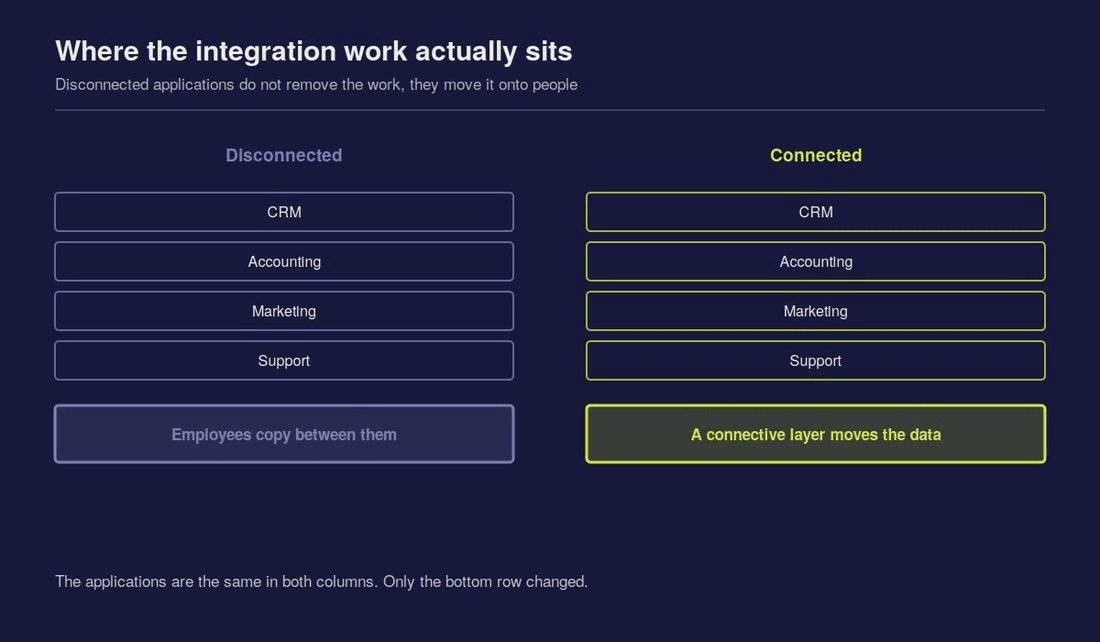
As the business grows, employees spend increasing amounts of time moving information between applications, checking multiple sources and reconciling slightly different versions of the same customer.
At that point, the strategic question changes.
It is no longer, “Which application do we need next?”
It becomes, “How should our business systems work together?”
The hidden cost of disconnected software
The most obvious cost of disconnected applications is duplicate data entry.
A new customer appears in CRM. Someone then enters the same customer into accounting software. Information may be recreated in project software, support platforms or spreadsheets.
But duplication is only part of the problem.
Disconnected systems make simple questions surprisingly difficult to answer.
Has the quote been accepted? Has the invoice been paid? Is there an unresolved customer issue? When was the last communication? What work is scheduled next?
The organisation may possess every piece of information required to answer the question, but employees have to assemble it manually.
That fragmentation creates friction throughout the customer journey.
CRM is becoming the connective layer
The traditional perception of CRM was largely centred on contact management and sales pipelines.
That definition is becoming increasingly narrow.
Modern CRM platforms can become the connective layer between customer-facing and operational processes.
A sales opportunity can trigger a quote. An accepted quote can initiate delivery. Customer information can flow into finance, support and marketing processes. Relevant operational information can flow back into the customer view.
This is one reason platforms such as Zoho CRM are increasingly considered in the context of wider business architecture rather than only sales management.
For organisations considering Zoho CRM implementation, the important questions therefore extend well beyond how contacts and deals should be configured.
Where does an enquiry originate? What happens after it becomes a customer? Which applications need the information? What can happen automatically? What should management be able to see?
The answers can expose opportunities that are invisible when every application is considered separately.
From CRM product to connected ecosystem
Zoho provides a particularly relevant example because CRM can form part of the much broader Zoho One business platform.
Zoho One brings together applications spanning areas such as sales, finance, marketing, collaboration, service and operations.
The strategic value is not simply having access to more applications.
The opportunity is the connection between them.
Instead of treating every department as a separate technology project, organisations can design processes that cross functional boundaries.
A customer does not experience a business as separate sales, finance, support and operations departments.
The technology architecture should increasingly reflect that reality.
Integration does not mean removing every specialist platform
Moving towards connected business systems does not necessarily mean abandoning every existing application.
Specialist tools often remain valuable.
A company may want to retain its accounting system, ecommerce platform, industry-specific application, communication infrastructure or specialist operational software.
The objective should be to determine where important information belongs and how systems communicate.
APIs, connectors and workflow automation allow organisations to maintain valuable specialist technology without forcing employees to manually transfer information between it.
This creates a more pragmatic model.
The organisation may have several applications, but customers and employees experience one connected process.
Low-code changes how systems can be built
Historically, tailoring enterprise software could involve lengthy specifications and substantial custom development.
Low-code technology changes the implementation model.
Configurable fields, modules, workflows, automations, interfaces and custom applications can be adapted much more quickly than traditional software development.
That matters because users frequently discover requirements only after they see a system operating.
A written specification may describe a process perfectly on paper and still fail to capture how people actually work.
Australian Zoho Partner Dynamic Digital Solutions uses a prototype-first approach across both ready-to-go and custom Zoho CRM solutions, configuring workflows collaboratively and then extending them through automations, integrations and custom functions where required.
The process makes CRM implementation more iterative.
Business users can help shape the platform rather than receiving the final system only after the design decisions have already been made.
The next challenge is AI readiness
Connected business platforms are also becoming increasingly relevant because of artificial intelligence.
Businesses are rapidly adopting general-purpose AI tools such as ChatGPT and Claude, while Zoho is developing native AI capabilities through Zia.
But AI is only as useful as the context available to it.
An isolated AI assistant may be excellent at generating text or analysing a document. A connected AI system has the potential to understand the business event surrounding that task.
Who is the customer? What have they previously purchased? Which stage is the opportunity at? What happened in the last interaction? Which action is required next?
This makes structured CRM data increasingly valuable.
AI readiness is therefore not simply an AI project.
It is also a data and systems architecture project.
Build the foundation first
This distinction matters because businesses can easily repeat their previous software mistake with AI.
They may accumulate independent AI tools just as they accumulated independent cloud applications.
One AI application writes marketing content. Another assists sales. Another handles documents. Another handles calls.
Without an underlying systems strategy, the organisation simply creates a new generation of technology silos.
A stronger approach is to establish a connected customer and operational foundation first.
AI tools can then interact with structured processes.
Dynamic Digital Solutions currently positions its Zoho CRM solutions as AI-ready environments that can use technologies such as Claude or Zoho Zia alongside configured CRM workflows.
The choice of AI platform may evolve over time.
The underlying structured business information remains valuable regardless.
Voice AI shows why integration matters
Voice technology provides a useful example.
AI voice platforms such as Retell AI can support automated telephone conversations.
But the real business value is not simply having AI answer a telephone call.
The value increases when the interaction becomes part of the broader customer process.
A voice agent might capture a new enquiry, qualify requirements, book an appointment and record the conversation outcome.
If that information immediately enters CRM, the next employee starts with context rather than starting again.
Dynamic Digital Solutions currently connects Retell AI voice agents into Zoho CRM so inbound and outbound call activity can feed back into customer records.
That is a good illustration of the wider architecture principle: communication channels should connect into the customer system rather than exist beside it.
Connected systems create better automation
Once information can move between systems, automation becomes substantially more useful.
A change in CRM can trigger activity in another application. An event in finance can change what a customer service employee sees. An incoming form can create the next workflow automatically.
AI can then contribute where interpretation is required.
This creates a progression:
Data becomes structured.
Systems become connected.
Processes become automated.
AI adds intelligence to those processes.
Trying to begin with the final step while ignoring the earlier foundations is much more difficult.
Governance matters as systems become more connected
Greater connectivity also requires clearer governance. Businesses should define who can access customer, financial and operational information, which systems are authoritative, and what automated actions can occur without human approval. This becomes especially important when AI is added to workflows.
An AI assistant may be permitted to summarise customer history or prepare a draft response, while a pricing change, contract commitment or financial transaction may still require a person to approve the action. Connected architecture should therefore make controls easier to enforce, not bypass them.
Good governance also improves scalability. When data ownership, access rules and automation responsibilities are clear, new systems and AI capabilities can be introduced without rebuilding the operating model each time.
From application collection to business architecture
For many growing businesses, digital transformation has historically meant adding technology.
The next phase may involve simplifying it.
Organisations need to understand which systems perform strategic roles, where important information should live and how processes cross the boundaries between applications.
CRM is central to this discussion because customer information touches so many functions.
The objective is not necessarily to run an entire company from one screen or eliminate every specialist platform.
It is to create an environment where information moves without employees constantly becoming the bridge.
That shift changes how companies should think about technology.
Instead of collecting software, they can start designing business architecture.
And as AI becomes increasingly integrated into ordinary workflows, having that connected foundation may prove even more important than choosing the next individual application.


