
Coalition for Content Provenance and Authenticity (C2PA): Building the Trust Infrastructure Behind Digital Content
23 Jul 2026

Why Provenance Became a Civilisational Question
There is a particular kind of vertigo that comes from not knowing whether what you are looking at is real. A photograph, a video clip, a voice recording, for most of human history, these things carried an implicit guarantee. The camera does not lie, we used to say, half-joking even then. Generative AI has quietly dissolved that guarantee. When a machine can produce a convincing image, video or voice in seconds, the old habit of trusting our eyes and ears becomes a liability rather than an instinct worth keeping.
The Coalition for Content Provenance and Authenticity, known by its initials C2PA, was built to answer a deceptively simple question: not "is this content fake?" but "where did this content come from, and what happened to it along the way?" That reframing, from detection to provenance, from suspicion to disclosure, is arguably the organisation's most important intellectual contribution to the digital trust debate.
What Is the Coalition for Content Provenance and Authenticity?
C2PA is a global standards body that develops open, interoperable technical specifications for tracing the origin and edit history of digital content; images, video, audio and documents. Rather than trying to detect manipulated media after the fact, C2PA's approach is to attach tamper-evident provenance data at the point of creation, so that every subsequent viewer, platform or verification tool can check where a piece of content came from and how it has changed.
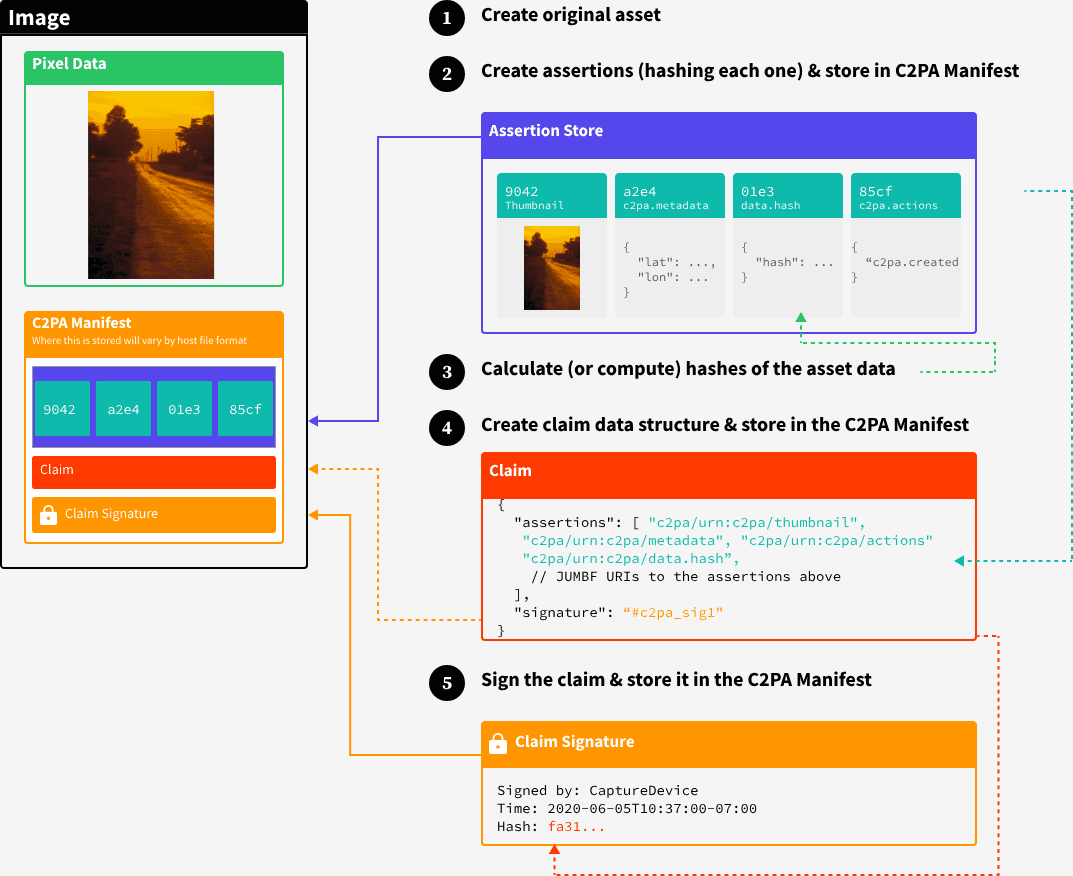
The practical output of this work is a specification known as Content Credentials; a cryptographically signed, machine-readable manifest that can travel with a photo, video or document. Content Credentials have been described as something like a nutrition label for digital media: a small, structured disclosure that does not tell you whether the content is good or bad, true or false, but tells you plainly what went into making it.
C2PA operates as a project hosted by the Joint Development Foundation, and its specifications are freely available for anyone, camera manufacturers, software developers, publishers, platforms and AI companies — to implement.
The Origins: Two Initiatives Become One
C2PA's story begins with two parallel efforts that recognised the same problem from different angles. Adobe had been running the Content Authenticity Initiative (CAI), focused on giving creators and publishers tools to disclose how an image had been edited. Around the same time, Microsoft and the BBC were developing Project Origin, aimed at helping news organisations verify and label authentic broadcast content in an environment increasingly crowded with synthetic media.
On 22 February 2021, these efforts merged into a single coalition. The founding members,Adobe, Arm, the BBC, Intel, Microsoft and Truepic, chose to combine forces rather than compete on separate, incompatible standards, recognising that a provenance system only works if it is universal. A fractured landscape of proprietary "authenticity" badges would have solved nothing; an open standard, adopted broadly, had a chance.
The technical work moved quickly by industry standards. C2PA released its first draft specification for public review in September 2021, and Version 1.0 followed in January 2022. Since then, the specification has continued to evolve, expanding coverage from still images to video, audio and documents, and refining how AI-generated and AI-edited content is disclosed within a manifest. By early 2026, the coalition had grown to more than 6,000 members and affiliates, spanning technology companies, camera manufacturers, news organisations and AI developers, and the specification itself had reached version 2.3 with live video provenance support for broadcast and streaming.
Goals and Purpose: Trust Without Gatekeeping
C2PA's mission is deliberately narrow in a way that gives it strength: it does not attempt to be an arbiter of truth. The coalition's stated purpose is to establish open technical standards that allow creators, publishers and technology providers to securely record the origin and edit history of digital assets, while preserving privacy, accessibility and interoperability across the ecosystem.
In practice, this means C2PA's work spans several tracks at once:
- Technical specification development, the open standard that defines how provenance manifests are structured, signed and verified.
- Implementation guidance and reference tools, helping hardware and software makers build Content Credentials into their products correctly.
- Trust infrastructure, the Conformance Programme and official Trust List, which govern which certificate authorities and implementations can be recognised as trustworthy signers, succeeding the coalition's earlier Interim Trust List, which was formally frozen on 1 January 2026.
- Industry and policy engagement, working with standards bodies, platforms and regulators so that provenance information is not just created but preserved and displayed as content moves across the internet.
That last point matters more than it might first appear. A provenance credential is only useful if it survives the journey from creation to consumption — and much of the internet's plumbing, from email clients to messaging apps to certain content management systems, was never built to carry that kind of metadata. C2PA's quieter, less glamorous work is convincing the rest of the digital ecosystem to stop stripping this information out.
Impact: From Technical Curiosity to Infrastructure
For its first few years, C2PA's work could reasonably be described as important but niche — a promising standard without the adoption to make it matter at scale. That changed as generative AI moved from novelty to ubiquity.
By 2026, Content Credentials had been implemented, in varying degrees, by a genuinely wide cross-section of the digital world:
- Camera manufacturers including Leica, Sony, Nikon, Canon and Samsung now sign images with C2PA credentials at the point of capture on select models, establishing what the coalition calls a "root of trust" — provenance that begins the moment a photo is taken, not after it has already been edited and distributed.
- Major AI developers, including Adobe (across Photoshop, Lightroom and its Firefly generative tools), Microsoft (Bing and Designer), OpenAI and Google, have adopted C2PA conformance for AI-generated and AI-edited content, several pairing it with complementary watermarking technologies such as Google's SynthID.
- Platforms, including Meta, LinkedIn, TikTok and, more recently, X, have begun reading and, to varying degrees, preserving or displaying Content Credentials on uploaded media.
- News organisations, including the BBC, the New York Times, the Wall Street Journal, Reuters, AFP and the Associated Press, are actively signing published content, treating provenance disclosure as an emerging standard of editorial practice.
Regulation has accelerated this trajectory considerably. The European Union's AI Act, through Article 50, introduces transparency obligations for AI-generated content that take full effect in August 2026, obligations that machine-readable provenance systems like C2PA are well positioned to satisfy, alongside complementary approaches such as watermarking and centralised logging.
It would be a mistake, however, to describe C2PA's job as finished. Independent trackers of the ecosystem note that signing content and building a fully verified trust infrastructure remain two different achievements and that C2PA has made far more progress on the first than the second. Content Credentials can still be stripped by a simple screenshot or file re-encode. Certificate governance is young, the Conformance Programme that now issues trusted signing certificates only began enrolling in earnest in late 2025, and at least one early hardware implementation has already needed to revoke certificates after a signing vulnerability was discovered. C2PA itself has also had to publicly clarify what its standard does not do, for instance, stating plainly that Content Credentials contain no assertion related to text-and-data-mining opt-outs after confusion arose during EU policy discussions.
None of this undermines the coalition's core achievement. It reframes it. C2PA has not solved the problem of trust in digital media, no single technical standard could. What it has done is give the internet's major players a shared, open vocabulary for disclosure at the precise moment such a vocabulary became urgently necessary.
Why C2PA Matters
The deeper significance of C2PA is philosophical as much as technical. For most of the modern era, authenticity was assumed by default and had to be disproven, a photograph was trusted until evidence suggested otherwise. Generative AI inverts that default. In a world where synthetic media can be produced instantly and convincingly, authenticity increasingly has to be actively demonstrated rather than assumed.
C2PA's answer to that inversion is not to ask the public to become forensic experts, nor to hand a handful of companies the power to declare what is real. It is to build the plumbing, open, freely implementable, governed by a broad coalition rather than a single gatekeeper,so that provenance information can simply travel with content, the way a recipe travels with a nutrition label. Whether that plumbing succeeds at internet scale is still being written. But as of 2026, it has become one of the most consequential quiet infrastructure projects of the generative AI era.
Sources
- C2PA Wiki Profile — Businessabc
- C2PA Official Website
- C2PA Charter
- C2PA Specifications
- C2PA Founding Press Release
- C2PA News
- Content Credentials
- Joint Development Foundation
- Content Authenticity Initiative — Adobe
- Project Origin Overview — BBC Research
- Content Credentials — Wikipedia
- C2PA.ai — Independent Coverage of Content Provenance and Authenticity
- C2PA Adoption Tracker: Which Platforms Support Content Credentials in 2026 — Editors Weblog
- OpenAI and Google Align on C2PA and SynthID — C2PA Viewer
- The C2PA Trust Layer in 2026: Where It Works and Where It Breaks — SoftwareSeni


