
business resources
Effective Strategies for Investment Banking Deal Sourcing
28 Jan 2026

Investment banking deal sourcing refers to the structured process of identifying, initiating, and qualifying potential M&A, capital raising, or advisory opportunities.
In this guide, we’ll share the 5 effective strategies for investment banking deal sourcing, including proprietary outreach, data-driven targeting, and systematic pipeline management.
TL;DR:
- Investment banking deal sourcing identifies and qualifies M&A and capital raising opportunities that match defined mandates and sector theses.
- Affinity supports investment banking deal sourcing through relationship intelligence and CRM-driven pipeline visibility.
- High-performing sourcing combines proprietary outreach, trigger-based intelligence, and continuous pipeline tracking.
- Data signals such as ownership change, leadership moves, and capital events raise engagement probability.
What Is Deal Sourcing?
Deal sourcing is the process investment banks use to identify, assess, and initiate potential transactions that match client or internal mandates. It supports mergers, acquisitions, divestitures, and capital raising.
Origination teams work within sector or regional coverage units to track target companies, monitor market signals, and engage stakeholders. Many also use private equity deal flow software like Affinity to manage contacts, automate workflows, and qualify opportunities based on sector fit and deal readiness.
5 Investment Banking Deal Sourcing Strategies
Effective investment banking deal sourcing depends on structure, focus, and consistent execution.
The following strategies will help you generate repeatable deal flow, reduce time wasted on mismatched opportunities, and increase the quality of live mandates.
1. Build a clear sector and mandate thesis
Start with a detailed sourcing thesis that defines exactly what you’re looking for.
A strong thesis outlines the ideal company profile in terms of size, sector, ownership, location, and strategic fit. Without this clarity, outreach becomes reactive and unscalable.
You should:
- Break your market into logical, investable subsectors
- Define relevant triggers (e.g. succession, non-core asset sales, capital needs)
- Align your criteria with current sponsor interest or corporate buyer demand
- Maintain a live document so your thesis evolves with market changes
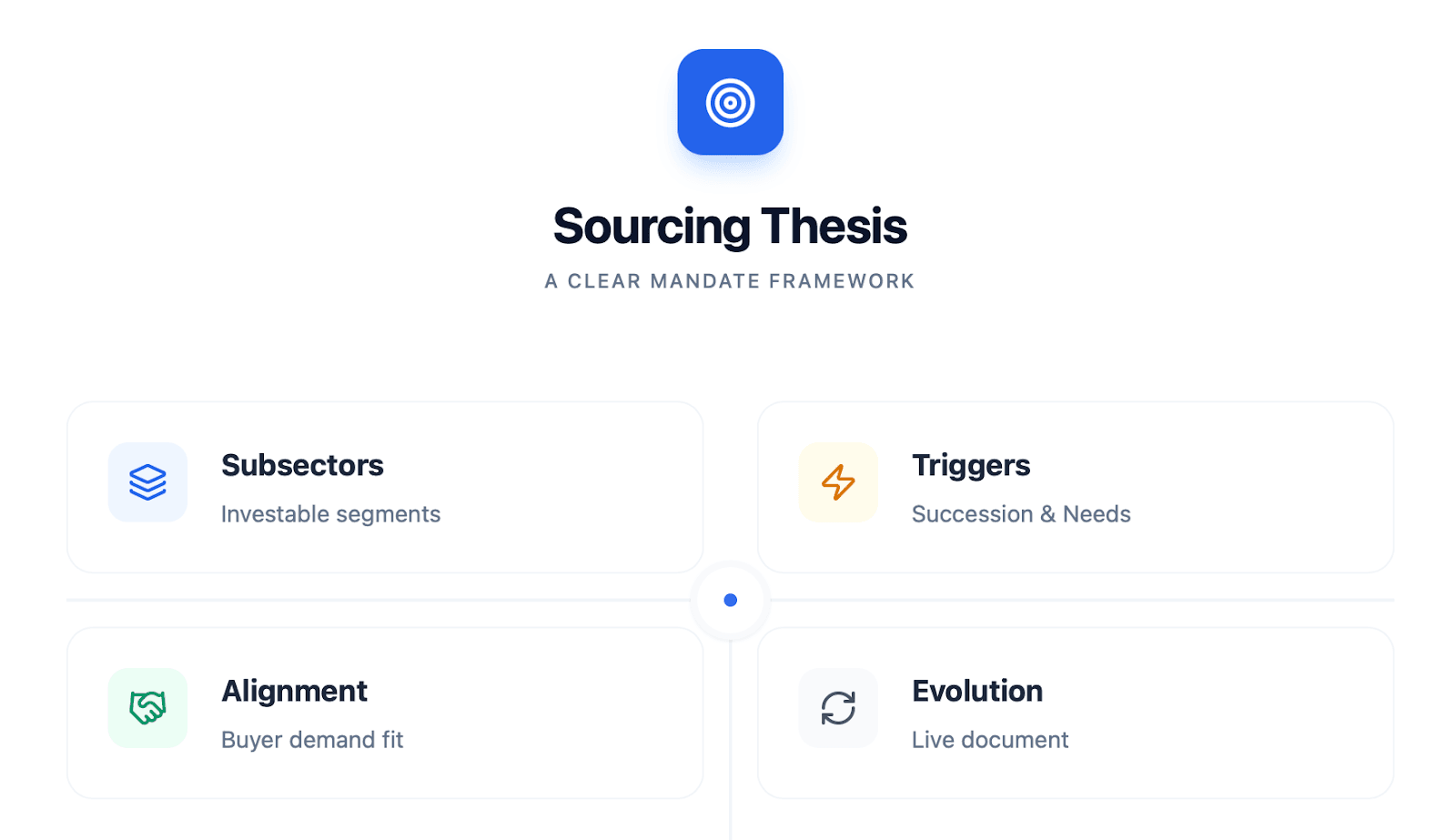
A clear thesis helps you spend time only on opportunities that meet real client or internal mandates.
2. Map and prioritise targets systematically
Use structured market mapping to identify and track companies that fit your thesis.
Avoid relying on static databases or outdated lists. Instead, build and maintain long lists with real-time data to stay current on high-potential targets.
You can:
- Develop subsector heatmaps to identify where deal activity is likely
- Pull company data from platforms like PitchBook, Orbis, or Crunchbase
- Track indicators like ownership changes, revenue milestones, or hiring spikes
- Assign qualification scores to sort companies based on fit and timing
With this method, you avoid random outreach and focus on targets with both relevance and readiness.
3. Activate proprietary sourcing channels
Relying only on advisor-led auctions limits control over pricing, timelines, and positioning.
Proprietary sourcing gives you earlier access, less competition, and a higher chance of winning mandates.
To build these channels:
- Maintain regular contact with founders, CFOs, and decision-makers — even before they’re ready to transact
- Build structured referral programs with lawyers, accountants, and consultants who often hear of deals first
- Re-engage past clients and sponsors who may refer you into new situations
- Document conversations and updates in your CRM to track deal signals over time
Proprietary channels take time to develop but consistently lead to better-qualified, off-market opportunities.
4. Use data and trigger-based intelligence
Track real-world signals to time your outreach and personalise your message.
Many high-potential opportunities don't come through intermediaries — they appear from changes inside companies. Using structured data helps you find these early.
You should monitor:
- Leadership changes (e.g. new CFO or COO appointments)
- Ownership transitions, including succession in family-owned firms
- Recent funding rounds, debt raises, or asset disposals
- Revenue acceleration, geographic expansion, or product launches
- Distress indicators such as covenant breaches, layoffs, or credit downgrades
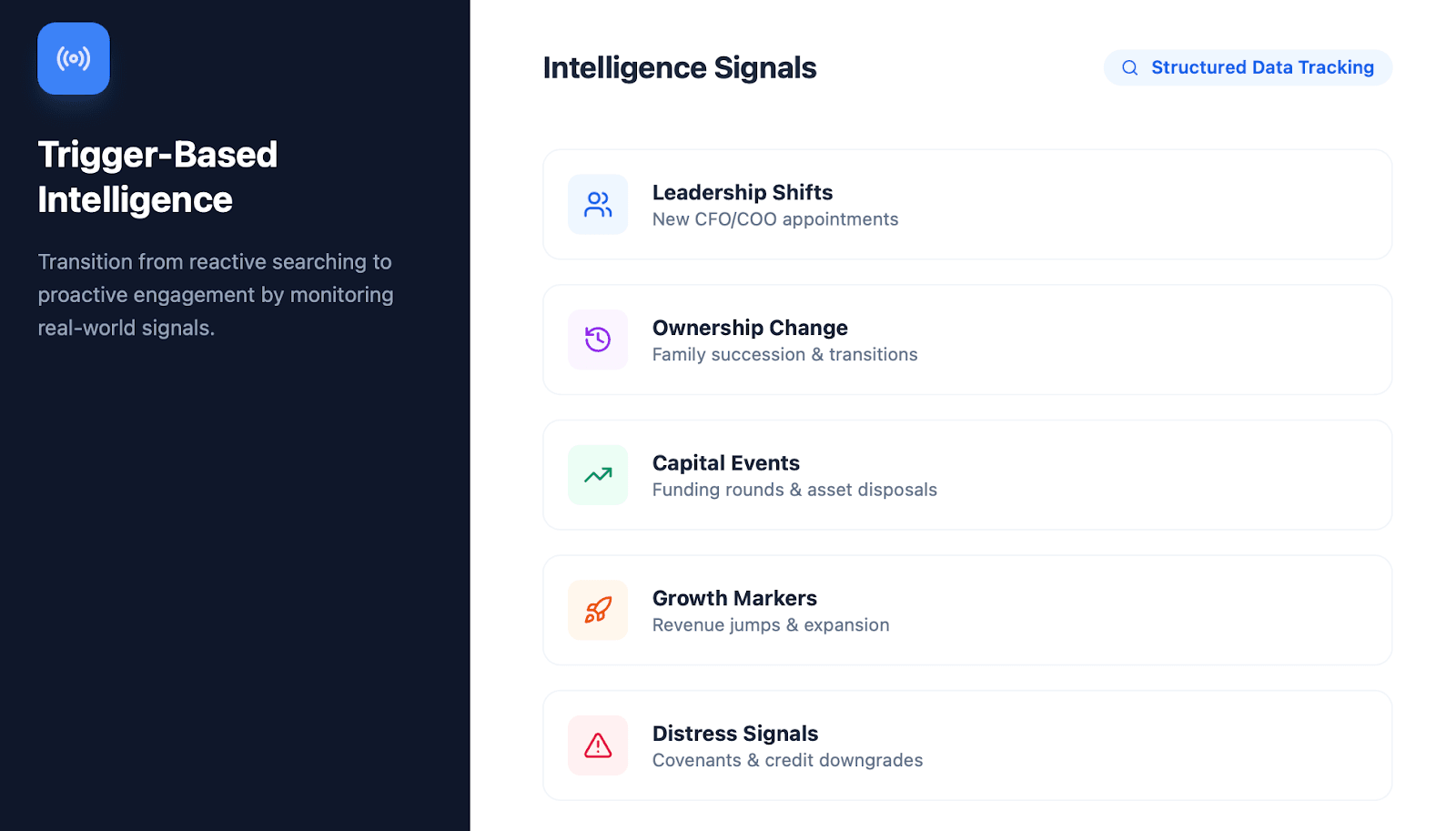
Combine these signals with your target list to prioritise outreach when companies are most likely to engage. Use tools like Grata, SourceScrub, or LinkedIn Sales Navigator to collect and act on these signals efficiently.
5. Run deal sourcing like a pipeline
Treat origination as an operational process, not a series of one-off campaigns.
Set up a clear funnel that tracks each opportunity from first contact through to mandate. This gives you visibility into what works and where deals get stuck.
Structure your sourcing pipeline into stages such as:
- Long list: all companies that fit your thesis
- Qualified: targets showing early interest or signal-based relevance
- Contacted: outreach completed, relationship initiated
- Engaged: live conversations or ongoing dialogue
- Mandated: exclusivity secured or RFP received
Use CRM tools to track activity, log meetings, and manage follow-ups. Review metrics regularly — conversion rates by banker, sector, or sourcing channel — and move effort toward the most productive areas.
Over time, this structured approach helps you reduce leakage, maintain momentum, and build an institutional memory that survives staff turnover. A well-managed pipeline turns deal sourcing into a repeatable engine rather than a manual chase.
Common Mistakes In Investment Banking Deal Sourcing
Investment banking deal sourcing underperforms when the process lacks focus, consistency, or follow-up discipline.
Many teams lose mandates or waste time on mismatched opportunities due to poor execution. To build a reliable origination engine, avoid these 8 common mistakes:
- Reaching out without a defined sector or mandate thesis
- Using outdated or generic target lists
- Ignoring data signals that show deal readiness
- Over-relying on inbound or intermediated deals
- Failing to track outreach or manage a sourcing pipeline
- Letting conversations go cold due to weak follow-up
- Not using CRM systems to capture interactions and next steps
- Neglecting to review lost deals and missed opportunities
Final Thoughts
Investment banking deal sourcing works best as a structured, ongoing process.
Focus on building clear theses, mapping targets, using direct outreach, tracking data signals, and managing a live pipeline. These strategies help you source better-fit opportunities and convert them into mandates faster.
Avoid generic outreach, outdated lists, and missed follow-ups. Use data, maintain relationships, and review outcomes regularly. A consistent, disciplined sourcing process leads to stronger deal flow and better execution.
FAQs
What is investment banking deal sourcing?
Investment banking deal sourcing is the process of identifying and qualifying potential advisory transactions such as M&A, divestitures, and capital raises. Coverage and origination teams track companies, owners, and market activity to surface opportunities that match defined mandates. The objective is to build a pipeline of deal-ready opportunities.
How does deal sourcing differ from general business development?
Deal sourcing focuses on transaction intent and mandate fit. Business development covers broader relationship management. In investment banking, sourcing applies filters such as deal size, ownership structure, sector focus, and timing to avoid unqualified outreach.
What strategies do investment banks use for deal sourcing?
Banks use proprietary outreach, intermediated auctions, and data-driven targeting. Proprietary sourcing relies on direct contact with founders and referrals. Intermediated sourcing comes from advisor-led sale processes. Data-driven sourcing uses ownership, financial, and growth signals to prioritise targets.
What is proprietary deal sourcing?
Proprietary deal sourcing involves direct engagement with company owners before a formal sale begins. This approach reduces competition, improves economics, and increases mandate win rates. Banks prioritise it for differentiated and off-market opportunities.
How do banks use data and technology in deal sourcing?
Banks use company databases, CRM platforms, and market intelligence tools to track ownership changes, leadership moves, and capital events. These tools support target prioritisation, outreach timing, and pipeline management across teams.
What are common challenges in investment banking deal sourcing?
Common issues include unclear theses, outdated target lists, weak follow-up, and over-reliance on auctions. Poor pipeline tracking and limited post-deal analysis also reduce sourcing effectiveness.
How do banks measure deal sourcing performance?
Banks track metrics such as outreach-to-meeting rates, meeting-to-mandate conversion, and closed-deal outcomes. Teams review results by sector, channel, and banker to refine sourcing strategies.


