
business resources
Empathy Maps: A Visual Tool for User-Centric Design
26 Nov 2024

Empathy, which is distinct from sympathy, is all about being able to put yourself in someone else’s shoes. By imagining oneself in another’s position, one can gain valuable insight into the user’s thoughts and feelings.
This practice has many applications, including in the development of user-centric software, which closely relates to the all-important developer-consumer relationship.
One particular area where empathy is key is in user experience (UX) design, which focuses on the aspects of a product that a user interacts with directly. UX designers are tasked with putting the user’s interests forward.
Many forward-thinking companies employ what is known as an ‘empathy map’ to put themselves in the position of the consumer, so that their products and services can be better tailored to the user’s needs.
What is an empathy map?
Essentially, an empathy map is a visual tool that helps designers to consider the various ways in which a consumer might relate to a product. It enables UX professionals to better understand the feelings, thoughts and behaviours of their target market. Also, empathy maps help to remove biases and focus on the things that matter most.
There are a few variations of how an empathy map can be laid out, but here’s a fairly typical one:
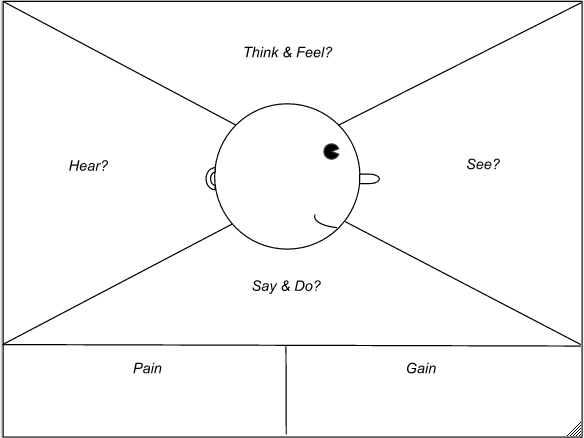
Using an empathy map
Using an empathy map to enhance research is easy. The map itself will generally be brought in once an amount of initial research has been done, such as demographic market analysis and user interviews.
You can print out your blank empathy maps, or even draw the diagram on a board and populate it with post-it notes. Basically, the various elements of your research, and ideas from your team, should either be fitted into one of the corresponding quadrants or the lower two rectangles.
The four quadrants of the main rectangle represent the different angles that designers can take when considering the user. Here’s what they mean:
Think & Feel
How a consumer feels about a particular product or service is an essential thing to consider, even if it does seem a bit vague. The questions that you should ask include ‘What really matters to this user?’ and ‘What are their goals and aspirations?’. Consider these and more, and see if you can hone in on what their true thoughts and feelings are (which may not be the same as the things they say). Think about their emotions in relation to the product, and how these might reflect on their spending behaviours.
Hear
This is about more than simply what they hear in terms of sound. In this context, what a user ‘hears’ refers to all information they receive from major influences. Consider marketing, and which channels of information they are exposed to. Is it social media or television? Or do they prefer print media, and what exactly do they read? Consider all incoming sources of information, and how the user interacts with them.
See
What does the user see in terms of the market? Are they aware of your competitors? Are they even aware that your product exists? Does the user experience your competitors products at work? Consider all of these questions, and think about how you would want them to see your product in the wider context of the marketplace. Interpreting this information about users thoughtfully is a great way to better understand their buying behaviours.
Say & Do
Have a good look at how your target user behaves. This includes what they say, whether that’s aloud, in public, or on social media. Don’t necessarily take everything a user says at face value; there’s often a subtext that should be considered, but there are plenty of clues in what people say. What is their general disposition? How positive are they? What do they say about products and services such as yours?
Pain
The two boxes at the bottom of the empathy map relate to pains and gains. Pains are negative things that the user is experiencing, including obstacles or missed opportunities. By considering these, you may discover a problem that your product can solve, or an area with room for improvement. Identifying weaknesses opens up opportunities for progress.
Gain
Gains are the benefits that an end user stands to receive when they decide to purchase your product or engage with your service. Being aware of your own strengths is just as important as knowing your weaknesses. Your strengths and ‘gains’ are the key to distinguishing your business from its competitors. Consider your user’s desires, and how these are satisfied by your product.
Why you should use an empathy map
When in the development process, it can be easy to lose sight of the end user, and this is why UX is such a valuable area. Empathy maps are a great way to keep the consumer in mind throughout. After all, it’s them who will be engaging with your product and hopefully benefiting from it.
Read More:
pedrovazpaulo real estate investment


