
resources
Explore All Capital Cities in the US: A Comprehensive Guide
23 Jan 2026

Have you ever pondered the pivotal locations where major decisions are forged within the United States? We're referring, of course, to the capital cities—both the overarching federal capital for the entire nation and the individual capitals for each of its fifty states. It's quite fascinating, isn't it, how these urban centers intricately shape the country's operational framework? This comprehensive guide is dedicated to exploring these significant locales, offering you an in-depth understanding of their core functions and the profound reasons behind their importance. Let's embark on an enlightening tour of the capital cities across the US!
Key Takeaways
- While Washington, D.C. serves as the nation's capital, the bustling hub for federal government affairs, each of the 50 states also possesses its own distinct capital city.
- State capitals act as vital centers for state governance, famously housing the governor's office and the state legislature.
- Delving into the capital cities of the U.S. profoundly enhances our comprehension of the country's expansive geography and the intricate structure of its government.
- A fascinating historical spectrum exists among these capitals: some, like Santa Fe, boast venerable origins, while others are comparatively more modern, with their populations varying significantly.
- Examining capital cities, not only within the U.S. but also across North and South America, reveals a diverse tapestry of governmental structures and administrative approaches.
Understanding the Federal Capital and State Capitals
When discussing the United States, it's not uncommon to encounter a slight confusion between the primary federal capital and the myriad individual state capitals. Both fulfill crucial roles, yet their spheres of influence and responsibilities diverge significantly. Let's clarify these distinctions.
The Role of Washington, D.C.
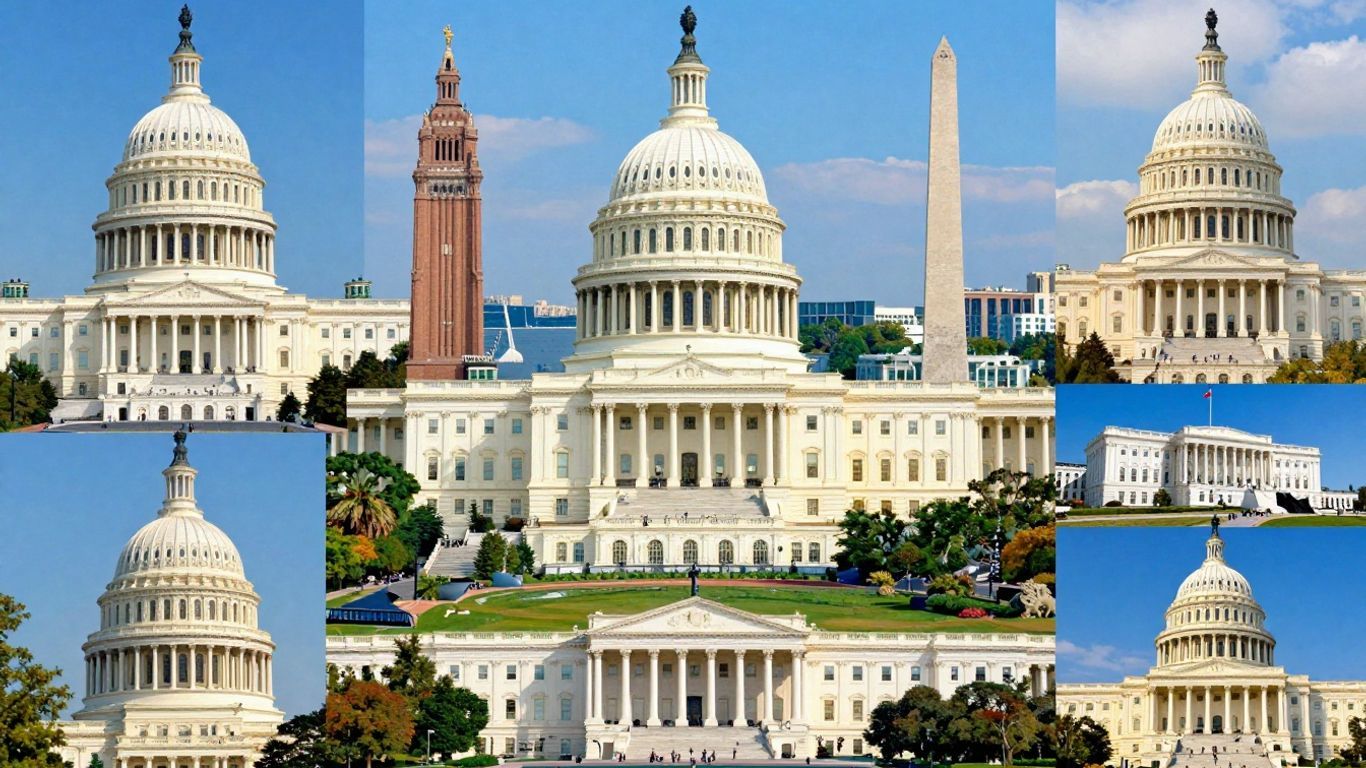
Washington, D.C. stands as the preeminent federal capital—the heart of the nation's governance. Intriguingly, it's not encompassed within any state; rather, it exists as its own entity, the District of Columbia. This is where the national government convenes: Picture the White House, the President's official residence and workplace, or Capitol Hill, where Congress diligently crafts and debates laws. The Supreme Court is also prominently located here, adjudicating legal matters that impact the entire country. Essentially, it's the undisputed epicenter of national politics, a city where iconic buildings and historic monuments gracefully punctuate every vista.
Distinguishing Federal and State Capitals
So, what truly sets them apart? The fundamental difference lies in their scope. Washington, D.C. caters to the entire nation, whereas each of the fifty states, on the other hand, proudly maintains its own capital city. These state capitals function much like smaller-scale versions of D.C., tailored specifically for their respective states. They serve as the seat of the state's governor, the meeting place for the state legislature, and the location for all critical state government offices. In essence, they meticulously manage the affairs pertinent to the administration of that particular state.
Here's a concise overview of this key distinction:
- Federal Capital: Washington, D.C. - The esteemed seat of the U.S. national government.
- State Capitals: Fifty diverse cities, each singularly serving as the political core for its individual state.
Significance of State Capitals
These state capitals, however, are far more than mere clusters of government buildings. They are often places steeped in history, strategically chosen for reasons that held profound relevance during the state's formative years. Sometimes, their selection was aimed at balancing political power, ensuring broad accessibility for citizens, or even driven by pressing economic considerations. They function as the essential hubs for all state-level decisions and frequently boast their own distinct character and rich history, which vividly reflect the very essence of the state itself. Indeed, these are the indispensable locations where state laws are formulated and where the state's highest officials are permanently based.
Exploring the Capitals of the United States
The United States, a truly vast nation comprising 50 distinct states, each proudly boasts its own unique capital city. These cities are certainly not arbitrary selections; instead, they function as the vital nerve centers for their respective states, housing the core machinery of state government and administration. Consider them the primary hubs where critical decisions are made, legislation is robustly debated, and the essential day-to-day operations of managing a state are diligently carried out.
A Comprehensive List of State Capitals
It’s quite an extensive roster when one considers all 50! Below, you'll find a detailed look at each state alongside its capital. It’s often intriguing to observe how some names may be instantly recognizable, while others remain perhaps less commonly known beyond their immediate state borders.
- Alabama – Montgomery
- Alaska – Juneau
- Arizona – Phoenix
- Arkansas – Little Rock
- California – Sacramento
- Colorado – Denver
- Connecticut – Hartford
- Delaware – Dover
- Florida – Tallahassee
- Georgia – Atlanta
- Hawaii – Honolulu
- Idaho – Boise
- Illinois – Springfield
- Indiana – Indianapolis
- Iowa – Des Moines
- Kansas – Topeka
- Kentucky – Frankfort
- Louisiana – Baton Rouge
- Maine – Augusta
- Maryland – Annapolis
- Massachusetts – Boston
- Michigan – Lansing
- Minnesota – Saint Paul
- Mississippi – Jackson
- Missouri – Jefferson City
- Montana – Helena
- Nebraska – Lincoln
- Nevada – Carson City
- New Hampshire – Concord
- New Jersey – Trenton
- New Mexico – Santa Fe
- New York – Albany
- North Carolina – Raleigh
- North Dakota – Bismarck
- Ohio – Columbus
- Oklahoma – Oklahoma City
- Oregon – Salem
- Pennsylvania – Harrisburg
- Rhode Island – Providence
- South Carolina – Columbia
- South Dakota – Pierre
- Tennessee – Nashville
- Texas – Austin
- Utah – Salt Lake City
- Vermont – Montpelier
- Virginia – Richmond
- Washington – Olympia
- West Virginia – Charleston
- Wisconsin – Madison
- Wyoming – Cheyenne
Geographical Distribution of Capitals
A glance at a map quickly reveals that state capitals are not always coincident with the largest cities within their respective states. Often, they are strategically centrally located to ensure maximum accessibility, while at other times, their placement is deeply rooted in historical circumstances. For instance, a notable number of capitals are nestled along major rivers or significant transportation routes that were of paramount importance during the state's inception. The East Coast, for example—the cradle of the original colonies—exhibits a high concentration of capitals relatively close to one another, a clear reflection of its early developmental trajectory.
Capitals as Centers of Governance
These cities truly represent the seats of power for their states. Consequently, one can expect to find the governor's mansion, the state legislature buildings, and a plethora of various state agencies all situated within the capital's confines. They are the essential venues where laws are meticulously drafted, budgets are painstakingly deliberated, and policies that will profoundly impact millions of residents are carefully molded. Indeed, the capital city is unequivocally the administrative heart of its state.
The function of a capital city extends well beyond merely accommodating government edifices. It frequently encapsulates the state's historical narrative, its primary economic drivers, and its distinctive cultural identity. These urban centers are often the locales of pivotal historical events and proudly host significant state museums and cherished cultural institutions.
Key Facts About U.S. Capital Cities
Oldest and Newest Capitals
When delving into the rich tapestry of American state capitals, some unequivocally stand out for their remarkable longevity. Santa Fe, New Mexico, proudly bears the distinction of being the oldest state capital, its establishment dating all the way back to 1610. Imagine, it has witnessed centuries of profound history unfold within its venerable streets. On the newer end of the spectrum, many states designated their capitals as they were admitted into the Union, with some of the more recent ones emerging in the late 19th and early 20th centuries. It's truly fascinating to observe how these cities—from their humble beginnings—have evolved into the pivotal centers of state government we recognize today.
Largest and Smallest Capitals by Population
The sheer scale of capital cities can, in fact, vary quite dramatically. Some are sprawling metropolises, teeming with activity, while others retain the charm of much smaller, more intimate communities. Here's a brief examination of these contrasting extremes:
- Largest Capital by Population: Phoenix, Arizona, proudly stands as the most populous state capital. It is an expansive urban center, boasting a truly significant populace.
- Smallest Capital by Population: Montpelier, Vermont, conversely, is recognized as the smallest state capital. It has remarkably preserved a more intimate, small-town atmosphere.
This notable disparity in size often directly reflects a state's overall population distribution and its dominant economic focus. It’s certainly worth noting that the capital with the largest population isn't necessarily the largest city within its state, and vice versa—a common misconception, wouldn't you say?
Unique Capital City Names
Beyond their varying sizes and ages, capital cities also possess distinct identities, frequently underscored by their very names. While a good many capitals share monikers with other cities or counties, a select few boast names that are quite unique within the broader U.S. context. Consider, for instance, places like Bismarck, North Dakota, or Topeka, Kansas—these names often carry deep historical or indigenous roots, thereby adding yet another fascinating layer to their story. It’s a seemingly minor detail, perhaps, but it undeniably contributes to the rich tapestry of American place names. Exploring these unique designations can indeed be an enjoyable and memorable way to recall which city serves as the capital for a particular state, especially when you're diligently trying to get a handle on all the different state capitals.
The designation of a capital city represents a profoundly significant decision, frequently influenced by historical events, its geographical placement, and often, by intricate political compromises. These cities naturally evolve into the focal points for state governance, attracting a diverse array of government employees, industrious lobbyists, and citizens keen on state affairs. They are not merely administrative hubs but also vibrant cultural and economic centers for their respective states.
The Importance of Learning About Capitals
Acquiring knowledge of the capital cities across the United States extends far beyond simply memorizing names for a geography quiz. In truth, it profoundly aids in developing a more comprehensive grasp of how the country is meticulously structured, both geographically and politically. Envision it as cultivating a dynamic mental map, one where all the vital administrative centers are clearly highlighted and interconnected.
Enhancing Geographical Knowledge
When you learn the capital of each state, you're inherently absorbing crucial information about its precise location. You'll begin to discern intriguing patterns—how some capitals are clustered along major rivers or coastlines, while others are situated further inland. This process organically constructs a more robust mental map of the U.S. It's not merely about knowing *where* Sacramento is; it's also about understanding its placement in California, on the West Coast, and how that positioning relates to surrounding cities and states. This kind of nuanced knowledge transforms geography from a dry list of facts into a vibrant, interconnected landscape.
Understanding Political Structures
Capital cities are, in essence, the nerve centers of state governments. They are the pivotal locations where laws are enacted, where the governor carries out official duties, and where major state agencies are strategically situated. Gaining insight into these cities provides you with a much clearer picture of how state-level politics operates. For example, knowing that Albany serves as New York's capital helps you appreciate that momentous decisions affecting millions of residents are deliberated and finalized there, rather than necessarily in New York City—which, despite its prominence, is often mistakenly perceived as the state's primary hub.
Cultural and Historical Significance
Each capital city possesses its own compelling narrative. Many were established during pivotal periods of American history, and their subsequent development frequently mirrors the growth and evolution of the state itself. Some capitals are venerable ancient settlements, while others were designated more recently as states progressively joined the Union. Consider Santa Fe, New Mexico, for instance—it ranks among the oldest capitals, with roots stretching back centuries, thereby offering a profound immersion into the region's historical depths. Others, such as Oklahoma City, boast a more recent, dynamically forged origin story intimately tied to historic land rushes.
Aiding Travel Planning
Should you ever decide to embark on a cross-country adventure and explore the nation, a solid understanding of the capitals can prove incredibly useful. These cities are often significant transportation hubs and typically present a wealth of attractions, ranging from profound historical sites to engaging cultural events. Planning a journey through the Midwest, perhaps? Knowing you'll potentially traverse cities like Springfield (Illinois), Indianapolis (Indiana), and Columbus (Ohio) can greatly assist in structuring your itinerary and identifying compelling points of interest along your route. Doesn't that make navigating the country feel a bit more straightforward and informed?
Capitals Across the American Continent
North American Capitals
When we cast our gaze beyond the immediate borders of the United States, the North American continent unveils a captivating array of capital cities, each serving as the indispensable nerve center for its respective nation. From the sprawling, diverse landscapes of Canada to the vivacious cultures of Mexico and Central America, these capitals function as crucial hubs of government, culture, and commerce. Canada's capital, Ottawa, is widely celebrated for its majestic Parliament Hill and impressive national museums, while Mexico City—one of the oldest and largest urban centers in the Americas—is a vast metropolis richly imbued with both colonial history and a profound Aztec heritage. Moving further south, we encounter capitals such as Guatemala City, Tegucigalpa, and San José, each with its own distinctive character and pivotal role in regional affairs. Even island nations, including Cuba (Havana) and the Dominican Republic (Santo Domingo), possess capitals that are absolutely vital to their national identity and governmental stability.
South American Capitals
South America, a continent renowned for its incredible diversity, proudly showcases a collection of capital cities that beautifully echo its varied geography and complex history. Brasília, Brazil's meticulously purpose-built capital, stands as a striking testament to modernist architecture—a vivid contrast to the enchanting colonial charm one might discover in cities like Buenos Aires, Argentina, or Santiago, Chile. Other prominent capitals include Bogotá, Colombia, gracefully nestled high in the Andes; Lima, Peru, a compelling coastal city with a deep Incan and Spanish colonial past; and Caracas, Venezuela, a bustling, dynamic urban center. It's particularly noteworthy that Bolivia uniquely maintains two capitals: Sucre, serving as the constitutional capital, and La Paz, which functions as the administrative seat of government. These cities are, of course, far more than mere political centers; they frequently represent the economic engines and vibrant cultural heartlands of their nations.
Comparing Capital City Roles
While all capital cities across the Americas invariably share the common fundamental role of housing their nation's government, their specific functions and inherent characteristics can, in fact, diverge quite significantly. Some capitals, such as Washington, D.C., or Mexico City, are veritable global metropolises, wielding immense economic and cultural influence. Others, by contrast—consider Montpelier, Vermont, for example (though we're talking about continental comparisons here, it perfectly illustrates the concept of a smaller capital)—are much more modest urban centers, primarily focused on state-level administration.
Here's a closer look at some general comparisons worth considering:
- Size and Influence: Capitals span a vast spectrum, ranging from sprawling megacities with far-reaching international influence to more modest, regionally focused urban centers.
- Historical Development: A fascinating aspect is that some capitals are truly ancient cities, boasting centuries of documented history, while others, like Brasília, were meticulously planned and constructed in relatively recent times.
- Administrative vs. Constitutional Roles: As highlighted by Bolivia's unique structure, some countries opt for distinct cities to fulfill different governmental functions.
- Economic Importance: While every capital serves as an administrative core, many also function as crucial economic hubs for their respective countries or regions, driving growth and innovation.
Grasping the diverse roles and rich histories of capital cities across both North and South America genuinely offers a more profound perspective on the continent's intricate political, cultural, and economic landscape. It vividly illuminates how governance is meticulously structured and how national identity is so often beautifully embodied in these central urban areas.
Wrapping Up Our Capital City Tour
So, we've journeyed through the entire spectrum of capital cities across the United States, from the most grand and bustling to the most intimate and charming. It's quite remarkable, isn't it, how each one possesses its own distinctive story and plays an integral part in the intricate machinery of our country's operations? Whether you were diligently researching facts for a school assignment, meticulously planning a memorable road trip, or simply satisfying a casual curiosity about American geography, we sincerely hope this guide has proven to be a valuable resource. There is, of course, always more to discover about these fascinating places and the diverse people who call them home. Keep that spirit of exploration alive, and perhaps, just perhaps, you'll even have the opportunity to visit some of them yourself!
Frequently Asked Questions
What's the difference between Washington, D.C. and a state capital?
Think of Washington, D.C. as the primary headquarters for the entire country—it's where the President and Congress conduct national business. State capitals, by contrast, function like the main administrative offices for each individual state, where the governor and state lawmakers fulfill their specific duties for that region.
How many state capitals are there in the U.S.?
Given that the United States comprises 50 distinct states, it logically follows that there are precisely 50 state capitals. Each state proudly designates its own special city to serve as its governmental center.
Why isn't a big city like New York City the capital of the U.S.?
The visionary leaders who founded the nation made a deliberate decision to establish a unique, separate location specifically for the national government, ensuring it remained distinct from any single state. This thoughtful approach was designed to prevent any one state from wielding undue influence, thereby guaranteeing that the capital city would serve as neutral ground for all.
What's the oldest capital city in the U.S.?
The venerable city of Santa Fe in New Mexico proudly holds the title of the oldest state capital. It was originally established way back in 1610, making it a place truly steeped in rich history!
Are there capitals in other countries besides the U.S.?
Absolutely! Virtually every country in the world designates a capital city, which typically serves as the primary location for its central government. For instance, Ottawa is the distinguished capital of Canada, and Mexico City proudly stands as the capital of Mexico.
Why is it useful to know about U.S. capital cities?
Knowing the capital cities genuinely helps you develop a far better understanding of the United States' geography. It also offers a fascinating glimpse into how the country is governed and reveals the rich historical narratives of various regions. Moreover, it can certainly make planning a cross-country trip considerably easier and more informed!


