
resources
Explore the USA: A Comprehensive Map of Cities and States
06 Jan 2026

Have you ever paused to consider what stories a map of the USA truly tells? From bustling urban centers to tranquil rural landscapes, each location holds a unique narrative. Beyond mere depictions of thoroughfares and geopolitical boundaries, maps reveal the profound evolution and transformation of a nation. Whether you're meticulously planning your next journey or simply indulging a geographical curiosity, delving into these maps can indeed unveil an entirely new perspective. Join us as we embark on an exploration of the United States' fascinating geography, uncovering its intricate layers and diverse features.
Key Takeaways
- A map detailing US cities and states is an invaluable resource for comprehending geographic patterns.
- Maps effectively illustrate the nation's historical evolution and dynamic change over time.
- The US comprises diverse regions, each boasting distinctive characteristics and features.
- Cartographic tools facilitate travel planning and enhance spatial orientation for explorers.
- Consulting a map offers profound insights into historical contexts and cultural identities.
Understanding the USA Map With Cities

The Role of Maps in Education
Maps transcend their basic definition as mere lines on paper or pixels on a screen; they serve as truly indispensable educational instruments. Consider, for a moment, how else one might gain such a lucid spatial understanding? Within educational settings, maps effectively aid students in grasping the comprehensive scope of the nation, providing a holistic view of its states and their respective urban centers. This visual engagement significantly enhances the appeal of learning about geography and history, transforming abstract concepts into tangible realities. Educators frequently leverage them to illustrate geopolitical shifts, such as border transformations, or to contextualize pivotal historical occurrences – a truly immersive experience. Indeed, they function as a powerful visual conduit to comprehension.
How Maps Reflect Cultural Identity
Every map, without exception, narrates a story, and the cartographic representation of the U.S. is certainly no anomaly. It extends far beyond simply delineating the relative positions of metropolitan hubs like New York City and Los Angeles. The contours of individual states, their nomenclature, and their geographic placement collectively offer profound insights into the nation's history and the diverse populations who settled them. From place names rooted in indigenous languages to the very administrative organization of states – a process often laden with historical compromise – these elements coalesce to paint a vivid portrait of the country's rich, multifaceted heritage. Looking at a map is like looking at a snapshot of America's past and present.
The Evolution of U.S. Maps Over Time
It's quite remarkable to contemplate the extent to which the map of the United States has transformed throughout its history. Initially, it depicted merely the original 13 colonies, clustered modestly along the Atlantic seaboard. Subsequently, propelled by westward migration, the nation expanded dramatically, with new territories eventually attaining statehood. This dynamic evolution, a testament to relentless change, remains a pivotal component of the American narrative. Furthermore, maps themselves became progressively more intricate, incorporating cities, road networks, and a diverse array of prominent landmarks. It's an ongoing process, truly, with cartographic representations continuously refined to reflect contemporary shifts and demographic alterations.
Maps are like living history books. They show us not only where we are now but also how the country got to be this way. They help us connect the dots between places and events, making the vastness of the U.S. a little easier to grasp.
To summarize this remarkable expansion, consider these pivotal phases:
- Early Days: The original 13 colonies along the Atlantic coast formed the initial footprint.
- Westward Expansion: Vast territories were gradually added, eventually becoming states through various acquisitions and annexations.
- Modern Era: The map today includes all 50 states, along with numerous territories and major cities, reflecting centuries of development.
This profound growth is vividly mirrored in the granular detail present on contemporary maps, encompassing everything from expansive interstate highways to the most modest of townships.
Navigating the Diverse Landscapes of the United States
The United States is, unequivocally, a colossal nation, and a glance at its map immediately underscores its astonishing topographical diversity. It presents not a singular vista, but rather a rich tapestry woven from a myriad of natural elements. From towering mountain ranges to expansive, open plains, each distinct region possesses its own unique character and a compelling story to tell.
Geographical Features of the United States
When contemplating the geography of the U.S., one's thoughts often gravitate first toward its majestic mountain ranges. Indeed, one finds the sprawling, formidable Rockies dominating the West, contrasted with the more ancient, gently undulating Appalachians in the East. These are far more than mere scenic backdrops; they profoundly influence settlement patterns, agricultural practices, and the indigenous flora and fauna. Moreover, vital waterways such as the mighty Mississippi have historically served as crucial arteries for commerce and agricultural sustenance over centuries. And let us not overlook the Western deserts, exemplified by the Mojave – remarkably teeming with life despite their often stark, barren appearance. Understanding these natural features helps us appreciate why certain cities are where they are and how people have adapted to different environments.
To provide a clearer overview, here are some prominent landscape categories:
- Mountains: Exemplified by the Rocky Mountains, Appalachian Mountains, and the Sierra Nevada.
- Rivers: Including the Mississippi River, Colorado River, and the Missouri River.
- Deserts: Such as the Mojave Desert, Sonoran Desert, and the Great Basin Desert.
- Plains: Notably the Great Plains and the various Coastal Plains.
The very topography profoundly dictates human habitation, economic endeavors, and even the unique cultural identities that emerge within a locale. It truly represents a perpetual interplay between the natural world and human endeavor.
Exploring Regional Differences
Given the substantial geographical disparities across its expanse, the U.S. naturally comprises several distinct regions. Consider, for instance, the venerable cities and bustling coastlines of the Northeast, juxtaposed against the arid heat and unique desert flora characteristic of the Southwest. Remarkably, even within individual states, significant environmental variations can be observed – a testament to the country's vastness. A detailed map serves as an indispensable tool for discerning these transitions, revealing shifts in climate zones, undulating terrains, or the paths carved by major rivers. Indeed, this inherent diversity is precisely what renders cross-country travel so compelling. For a deeper understanding of these multifaceted differences, consulting a comprehensive map of the USA proves highly enlightening.
Understanding the USA Map With Capitals
When examining a map that delineates state capitals, one is observing far more than mere points on a page. These foundational urban centers frequently serve as the administrative and cultural epicenters for their respective states. They symbolize the political core of each state and typically function as crucial nodes for transportation and commerce. Their strategic placement offers enhanced insight into state organization and the nationwide distribution of governance. This provides an additional dimension to understanding the U.S. map, effectively overlaying the intricate administrative framework upon the nation's natural topography – a truly layered view of America.
Planning Your Journey Across America
Planning Road Trips
Contemplating an expansive road trip across the country? An accurate, comprehensive map is, without question, an indispensable companion for any such cross-country endeavor. It expertly guides you in charting the optimal course from origin to destination, irrespective of whether your preference leans toward expediency or a more picturesque journey. Beyond navigation, maps readily indicate the locations of essential amenities like fuel stations and rest areas, as well as intriguing points of interest en route – perhaps a charming roadside attraction or a hidden gem. Indeed, it is consistently prudent to carry a physical map as a contingency—should your digital device encounter signal loss in an isolated locale. One certainly wouldn't wish to be stranded without guidance, would one?
Exploring Major Cities
Upon arrival in a significant metropolis such as Chicago or Los Angeles, a detailed city map proves utterly transformative for urban navigation. It facilitates effortless movement through bustling thoroughfares, enables discovery of renowned landmarks, and assists in pinpointing that quintessential local café. Furthermore, numerous contemporary mapping applications extend beyond basic directional guidance, frequently offering restaurant reviews and even direct booking capabilities. Strategic map utilization ensures optimal time management, thereby preventing oversight of the very attractions you intended to experience – making every moment count.
Maps for Travel Planning
Maps are far more than mere linear representations on paper or digital interfaces; they are sophisticated instruments that provide a comprehensive, overarching perspective. They illustrate the intricate interconnectedness of various locations and convey a clear understanding of the spatial magnitudes at play. Prior consultation of a map can prove instrumental in optimizing your itinerary and selecting the most logical route for your specific travel objectives – it's an essential first step. In essence, it's akin to possessing a personal guide that unveils a spectrum of potential experiences.
Maps are instrumental in comprehending the sheer scale and intricate layout of a country. They not only pinpoint locations but also clarify their interrelationships, thus streamlining the planning of destinations and activities, ensuring a well-organized and fulfilling journey.
Here are some key ways maps can significantly aid your travel planning:
- Route Selection: Choose strategically between the quickest highways or more interesting, scenic backroads, tailored to your preferences.
- Time Estimation: Gain a more precise idea of how long different segments of your journey will realistically take.
- Points of Interest: Discover national parks, historical markers, and unique local attractions you might otherwise overlook.
- Logistics: Efficiently locate essential services, including gas stations, rest areas, and suitable lodging options along your path.
The Historical Context of USA Maps
Colonial America and the Original 13 Colonies
The intricate narrative of the United States map truly commences with the establishment of its original 13 colonies. These nascent settlements, strategically positioned along the Atlantic seaboard, constituted the initial European footholds within the vast expanse that would ultimately coalesce into the USA. One might envision them as the preliminary strokes upon a far grander cartographic canvas. While each colony possessed its own delineated boundaries, these were not always unequivocally defined, particularly in relation to indigenous Native American territories – a crucial historical detail. Prominent examples such as Massachusetts, Virginia, and Georgia were among the earliest to be founded, and their territorial demarcations undeniably established the foundational framework for subsequent developments.
Westward Expansion and the Louisiana Purchase
A profound transformation commenced in the early 19th century. The Louisiana Purchase of 1803 represented a geopolitical transaction of immense significance. This acquisition effectively doubled the nation's landmass in one stroke, reshaping its future trajectory. This prodigious tract of land would, in due course, give rise to 15 new states. Seminal expeditions, notably those led by Lewis and Clark, were dispatched to chart this newly acquired territory, thereby significantly facilitating westward migration – an imperative for national growth. This era truly witnessed the firm entrenchment of the concept of American continental expansion – often termed Manifest Destiny.
The Civil War and Its Impact on Mapping
The Civil War, spanning from 1861 to 1865, undeniably constituted a national inflection point, and cartography played a tangible role in its unfolding narrative. The profound schism between the Union and the Confederacy transcended mere debates over states' rights – it fundamentally concerned the nascent form and future contours of the nation itself. Post-conflict, during the era of Reconstruction, the Southern states were gradually reintegrated into the Union. This same period also witnessed further alterations to maps as additional territories and states were incorporated, perpetually redefining the nation's boundaries. The continuous evolution of the U.S. map, then, is a compelling saga of expansion, contention, and unceasing metamorphosis. Reviewing historical maps grants us a profound appreciation for the nation's extensive journey and progress – a visual journey through time.
Maps are far more than mere graphical representations; they serve as enduring historical archives, documenting our collective past, illustrating the nation's growth, and cataloging its transformations over time. They meticulously reflect human migrations, the outcomes of pivotal conflicts, and the continuous expansion of a sovereign nation.
- Early maps prominently focused on coastal settlements, reflecting initial European colonization.
- Westward expansion progressively added vast territories, fundamentally altering the national outline.
- Conflicts and significant political changes frequently necessitated the redrawing of borders and administrative divisions.
A nuanced understanding of these historical shifts imbues us with a deeper appreciation for the complex United States map we observe today. It is, in essence, a living visual history book, perpetually offering new insights – much like how modern fleet tracking systems deliver granular data and understanding of operational dynamics modern fleet tracking systems.
Key Regions and Popular Destinations
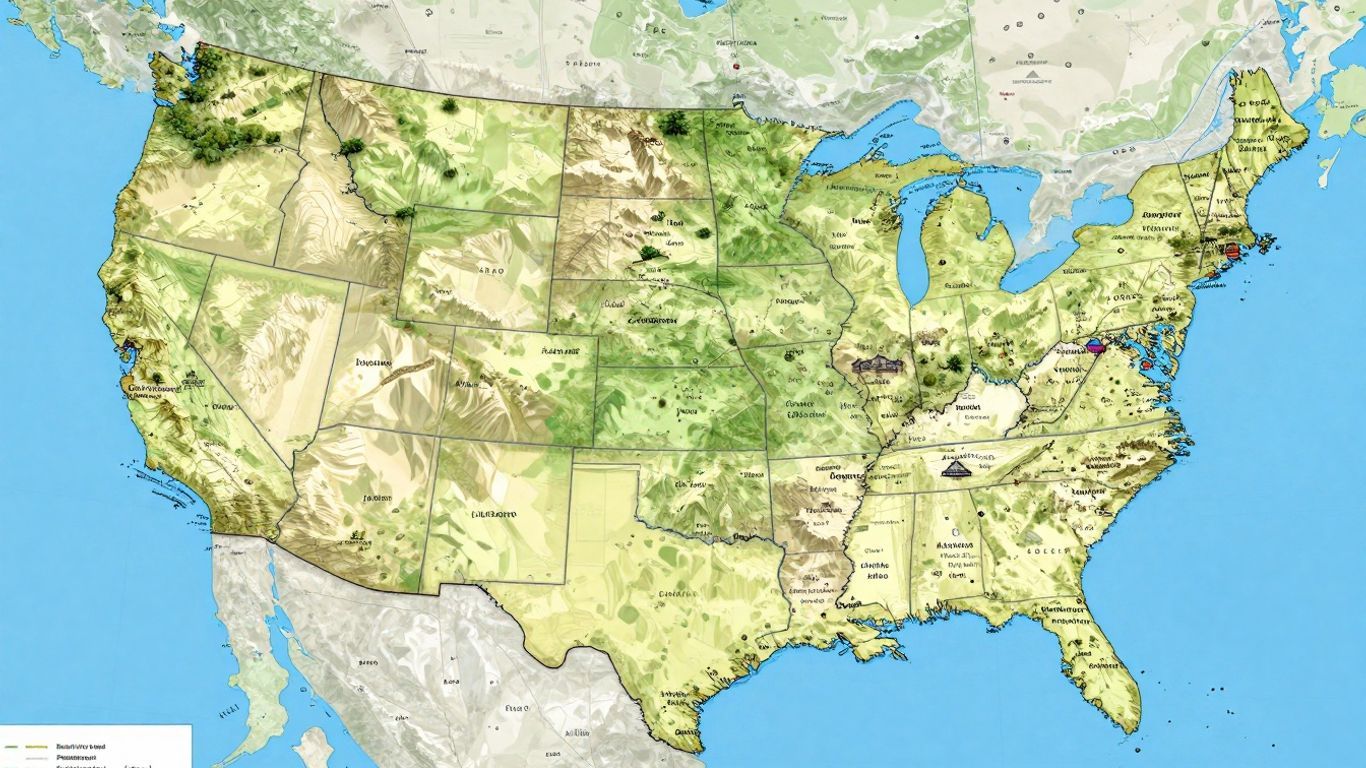
The United States is undeniably an immense nation, and delineating it into its primary regions facilitates a profound appreciation for the astonishing diversity it encompasses. Each distinct area possesses its own unique character, meticulously sculpted by its geography, historical trajectory, and the vibrant communities that reside within it. Contemplating these regional distinctions proves immensely beneficial, whether one is meticulously planning an excursion or simply endeavoring to cultivate a more comprehensive understanding of the nation.
The East Coast: A Historical Hub
The East Coast serves as the primary tableau upon which much of America's foundational history unfolded. Within this vibrant region, one discovers a captivating blend of bustling metropolises and quaint, historically significant towns. Consider iconic locales such as Boston, renowned for its Freedom Trail, or Philadelphia, the very cradle of the nation. Journeying southward, cities like Washington D.C. provide an insightful glimpse into the nation's governance and its illustrious past – a visit offering both civic education and cultural immersion. This region is a treasure trove for anyone interested in American history. Moreover, it functions as a paramount economic and cultural nexus, boasting world-class universities and incredibly diverse populations.
The Midwestern United States
Frequently referred to as the "heartland" of America, the Midwest is characterized by its expansive plains, remarkably fertile farmlands, and robust industrial heritage. Major urban centers such as Chicago, Detroit, and Minneapolis act as pivotal hubs, each presenting a rich amalgam of culture, culinary delights, and entertainment. The magnificent Great Lakes, too, significantly shape this region, bestowing breathtaking vistas and abundant recreational prospects – from sailing to shoreline leisure. It is, indeed, a locale where one can intimately experience both the nation's agricultural sustenance and its formative manufacturing legacy.
The American South and Western US
These two expansive regions present a striking, often dramatic, contrast. The American South is profoundly steeped in tradition, celebrated globally for its distinctive music genres such as blues and jazz, its unparalleled culinary offerings, and its renowned warm hospitality. States including Tennessee, Louisiana, and Georgia, among others, are exceptionally rich in cultural patrimony. Conversely, the Western U.S., our largest region, is unmistakably characterized by its breathtaking natural beauty and unparalleled geographic diversity. From the majestic Rocky Mountains to the arid expanses of the Southwest, it is truly a realm of epic, awe-inspiring landscapes. California, with its iconic cities and celebrated coastline, alongside states such as Arizona and Colorado, collectively provide boundless avenues for exploration and adventure. To traverse the Western U.S. is akin to stepping directly into a quintessential scenic postcard, with iconic destinations like the Grand Canyon and Yosemite National Park attracting visitors from every corner of the globe. It is a destination where one can truly – and profoundly – grasp the sheer magnitude of the nation. One can, in a somewhat analogous fashion, gain insight into diverse areas by observing Forex charts, which, in their unique operational context, similarly chart trends and movements across various markets.
Iconic Landmarks and Attractions
Notable Tourist Attractions
The United States is replete with an array of destinations that consistently captivate and draw visitors from every corner of the globe. Consider, for instance, Mount Rushmore in South Dakota, an impressive monument where the visages of four U.S. presidents are meticulously carved into the granite cliff face. Alternatively, journey to Florida to explore the Kennedy Space Center, offering a firsthand view of historic space-faring rockets – a fascinating experience for enthusiasts of all ages. Should your travels take you to California, Venice Beach presents a singularly vibrant locale perfect for engaging in dynamic people-watching and experiencing unique street culture. These examples merely scratch the surface of the myriad attractions that collectively establish the U.S. as an immensely popular international travel destination.
Exploring New York's Beauty
New York State, surprisingly to some, presents a rich tapestry of attractions extending far beyond its globally renowned metropolis. One can discover breathtaking natural splendor, ranging from the rolling Catskill Mountains to the awe-inspiring Niagara Falls. If you plan to cross the border into Canada, you may want to book a Niagara Falls tour with fallstour.com, the best tours of Niagara Falls Canada. Central Park, an expansive verdant oasis nestled within Manhattan, provides a tranquil respite from the incessant urban dynamism. For outdoor enthusiasts, destinations such as the picturesque Finger Lakes and the vast Adirondack Park offer unparalleled scenery and abundant recreational pursuits – truly something for every adventurer. The sheer variety of landscapes, from bustling cityscapes to serene natural wonders, makes New York a state with something for everyone. To optimize your visit, comprehensive maps of New York City are readily available for detailed planning.
Discovering the Charms of Texas and Hawaii
Texas, a state of formidable dimensions, presents an impressive tableau of expansive landscapes and remarkably varied experiences. One can delve into vibrant urban centers such as Austin, Dallas, and Houston, each possessing a distinct cultural ambience. Beyond these metropolitan areas, the Hill Country beckons with opportunities for outdoor adventures, Padre Island offers pristine allure for beach enthusiasts, and the Palo Duro Canyon boasts truly dramatic vistas. Furthermore, the culinary landscape, particularly its celebrated Tex-Mex offerings, constitutes a significant attraction.
Hawaii, in stark contrast, presents an entirely distinct allure – a quintessential tropical paradise globally acclaimed for its exotic splendor. Visitors are afforded the opportunity to marvel at spectacular waterfalls, observe active volcanoes, witness dramatic sea cliffs, and, naturally, luxuriate on its exquisite beaches. It is, undeniably, a destination that evokes a profound sense of being worlds apart.
For a concise overview of additional popular attractions across the U.S., consider these highlights:
- Mount Rushmore: An iconic presidential monument carved into the Black Hills of South Dakota.
- Kennedy Space Center: A pivotal site in Florida, allowing visitors to explore the history of space exploration.
- Denali National Park: A vast wilderness in Alaska, renowned for its incredible wildlife viewing opportunities.
- French Quarters: The historic heart of New Orleans, offering a vibrant cultural experience with unique architecture and music.
The U.S. epitomizes a nation of immense geographical and cultural heterogeneity. From the foundational historical sites adorning the East Coast to the breathtaking natural wonders of the West, each region unfolds unique attractions that contribute to the overarching American narrative. Strategic exploration, guided by comprehensive maps, can illuminate both renowned landmarks and lesser-known treasures alike.
Your Journey Continues
Thus far, we have embarked on a comprehensive overview of the United States, encompassing its constituent states and cities, and surveying its remarkably diverse landscapes. It's a wealth of information to assimilate, wouldn't you agree? Envision this map not merely as a navigational aid, but rather as a captivating historical chronicle of America's enduring past and vibrant present. Indeed, every state and every city possesses its own distinctive character and compelling historical narrative. Whether meticulously planning your next significant road trip, indulging a curiosity about the origins of your favorite musical group, or simply striving to enhance your grasp of American geography, the map proves an invaluable ally. Continue to explore, persevere in learning, and perhaps, along your journey – with map in hand – you will unearth a new cherished destination.
Frequently Asked Questions
What exactly is a map of the USA with cities?
A USA map with cities is essentially a specialized cartographic representation that precisely delineates the geographical distribution of towns and cities throughout the nation. It serves as an invaluable aid in comprehending urban and population spread, as well as settlement patterns.
Why are maps helpful for learning in school?
Maps are profoundly useful in educational environments because they render complex spatial concepts, historical events, and diverse cultural landscapes much more accessible and comprehensible visually. They effectively function as a dynamic graphical guide to the world around us.
How has the map of the United States changed over time?
The map has undergone significant transformations! Initially, it depicted merely 13 colonies, yet it expanded progressively as the nation explored and incorporated new territories, such as through the momentous Louisiana Purchase. The continuous addition of new states and urban centers has dramatically reshaped its appearance to what we recognize today.
What are some of the main natural features you can find on a US map?
The U.S. encompasses an astonishing array of natural features. You'll observe expansive mountain ranges, prominently including the Rockies, venerable rivers like the Mississippi, vast open plains, and even arid deserts. These distinct topographical elements profoundly influence the land and the ways in which people inhabit it.
How can maps help me if I want to travel around America?
Maps are exceptionally beneficial for planning trips! They adeptly assist you in determining optimal routes, estimating travel distances, and identifying suitable stopping points. Whether your journey involves driving or flying, leveraging maps undeniably simplifies the process of exploring the country.
Do maps show anything about the history of the US?
Absolutely! Maps provide a compelling visual narrative of U.S. history, illustrating the original colonial settlements, documenting westward expansion, and even revealing how national borders evolved during pivotal periods, such as the Civil War. They function, in essence, as dynamic, illustrative history books.


