
resources-impakt
FAQ: The Risks of Climate Change for Cities and Countries
13 Jul 2026

Introduction
Climate change is something we have to take seriously and look at in our lives, communities, cities and countries. It presents the biggest civilisational risks for humanity and constitutes a severe and escalating risk for cities and countries, acting as a disruption "stress multiplier" that intensifies existing problems like instability, poverty, infrastructure decay, and resource scarcity. Key hazards include disrupting rising temperatures, severe flooding, drought, wildfires, and sea-level rise.
Frequently Asked Questions About Climate Change
This document includes detailed answers, and considerations based on science and research to some frequently asked questions about climate change and its consequences namely for cities and countries.
What is climate change?
Climate change is the long-term shift in the planet's average weather patterns — temperature, precipitation, wind, and the frequency of extreme events — measured over decades rather than days. It is not a single storm or a single hot summer; it is the slow rewriting of the operating system that every city, farm, supply chain, and coastline depends on. What makes today's climate change historically unusual is speed: shifts that once unfolded over thousands of years are now compressing into a human lifetime, driven overwhelmingly by greenhouse gas emissions from human activity since industrialisation.
What is the difference between weather and climate?
Weather is the mood of the atmosphere on a given day — rain tomorrow, a heatwave next week. Climate is the character of a place over the long run — the pattern you'd expect if you averaged 30 years of those days together. A useful way to think about it: weather is what you check before deciding whether to bring an umbrella; climate is what you check before deciding where to build a city, plant a crop, or price a 30-year mortgage. Weather is volatile and local; climate is the slow-moving current beneath it.
What is the difference between global warming and climate change?
Global warming refers specifically to the rise in Earth's average surface temperature, largely driven by the build-up of greenhouse gases. Climate change is the broader story — it includes that warming, but also everything the warming sets in motion: shifting rainfall belts, stronger storms, retreating ice, and disrupted ocean currents. Global warming is the engine; climate change is the whole vehicle it's driving, with all its downstream consequences for ecosystems, economies, and human settlement patterns.
What is the difference between climate change and climate variability?
Climate variability describes the natural ups and downs a climate system has always had — El Niño and La Niña cycles, decade-long droughts, volcanic cooling. These are the normal rhythms baked into the system. Climate change is a shift in the baseline itself — the average around which that variability oscillates is moving, and moving in one direction, driven by a sustained external forcing (principally human emissions). Variability is the system breathing; climate change is the room itself heating up around it.
Today's Climate Change
Do natural variations in climate contribute to today's climate change?
Yes, but as a modifier, not as the primary driver. Natural factors — solar cycles, volcanic activity, ocean oscillations like El Niño — still influence year-to-year and even decade-to-decade variation. What the scientific record makes clear, however, is that these natural drivers cannot account for the scale or the persistence of the warming observed since the mid-20th century. Natural variability adds noise and occasional extremes on top of a signal that is overwhelmingly attributable to human-driven greenhouse gas emissions. Think of it as static riding on top of a very clear, very strong broadcast signal.
Is climate change happening in the same way everywhere on the planet?
No — and this is one of the most misunderstood aspects of the crisis. Climate change is not a uniform blanket of warming; it is redistributive and uneven. The Arctic is heating three to four times faster than the global average. Some regions face intensifying drought while others face more extreme rainfall. Small island states and low-lying coastal megacities face existential exposure that a landlocked, high-elevation nation simply does not. This unevenness is precisely why the risk conversation has to be local and city-specific, not just global and abstract — the same one-degree global average can mean drought in one region and catastrophic flooding in another.
Why has my town experienced record-breaking cold and snowfall if the climate is warming?
This is one of the most common — and most understandable — points of confusion, and it comes down to the difference between climate and weather explained above. A warming planet doesn't mean every place gets warmer every day; it means the overall system holds more energy and becomes more erratic. Counterintuitively, a warming Arctic can destabilise the polar vortex, causing pockets of extremely cold air to spill further south than usual, producing record local cold snaps even as the global average trends upward. A single cold week in one city says very little about the 30-year trend; it's a bit like judging the tide by a single wave.
Risks for Cities
Urban areas are particularly vulnerable because they house over half the world's population, most built assets, and generate roughly 70% of CO2 emissions.
- Heat Stress & Urban Heat Islands: Cities are often significantly warmer than surrounding rural areas due to paved surfaces, resulting in heatwaves that endanger public health, increase energy demand for cooling, and damage infrastructure like roads and rail.
- Infrastructure Failure: Intense rainfall and flash floods can exceed capacity for sewage and drainage, leading to urban flooding. Heatwaves can lead to power grid failures and public transport disruptions.
- Impact on the Urban Poor: Marginalized communities often live in high-risk zones, such as flood-prone informal settlements or steep slopes, and are most affected by heatwaves and resource shortages.
- Coastal Risks: Two-thirds of cities with populations over 5 million are located in low-elevation coastal zones, exposing them to sea-level rise and storm surges.
Risks for Countries
Nations face structural damage to their economies, food systems, and environmental stability.
- Food and Water Insecurity: Droughts and shifting rainfall patterns threaten agricultural productivity and reduce access to safe drinking water, with global crop failures projected to increase drastically.
- Economic Losses: Extreme weather events cost billions in damages, with significant impacts on agricultural income and infrastructure repair. Some small island developing states have reported losses equivalent to over 200% of their GDP.
- Disease Spread: Warmer conditions allow diseases to move into new regions, increasing the spread of vector-borne illnesses like malaria and dengue fever.
- Conflict and Migration: Resource scarcity, particularly regarding food and water, can drive conflict, forcing people to abandon their homes and causing increased migration.
Key Vulnerabilities
- Coastal Regions: Vulnerable to flooding, erosion, and saltwater intrusion into freshwater tables, damaging agriculture and drinking water supplies.
- Mountain Regions: Face risks from thawing permafrost, reduced snow cover, and flooding.
- Vulnerable Populations: Elderly, children, and people with poor health are most at risk during extreme weather events.
Adaptation Measures
To reduce these risks, cities and countries are implementing adaptation strategies, including:
- Nature-based Solutions: Using floodplains, mangroves, and green infrastructure to absorb water and reduce heat.
- Improving Infrastructure: Building, designing, or retrofitting infrastructure to be more resistant to hazards.
- Early Warning Systems: Establishing warnings for cyclones, floods, and droughts to save lives and protect livelihoods.
- Disaster Management: Investing in planning to reduce urban sprawl in hazardous areas.
Many countries are revising their National Adaptation Plans (NAPs) to incorporate these measures, although many plans are outdated, and significant financial gaps exist in supporting developing countries.
Climate Change Risks: A Contex
The risks of climate change are no longer just "future" problems; as of 2026, we are seeing many of these impacts manifest in real-time. The Arctic acts as the world's "refrigerator," and as it melts, it triggers a domino effect that impacts the entire planet.
Major Risks: The Arctic "Multiplier"
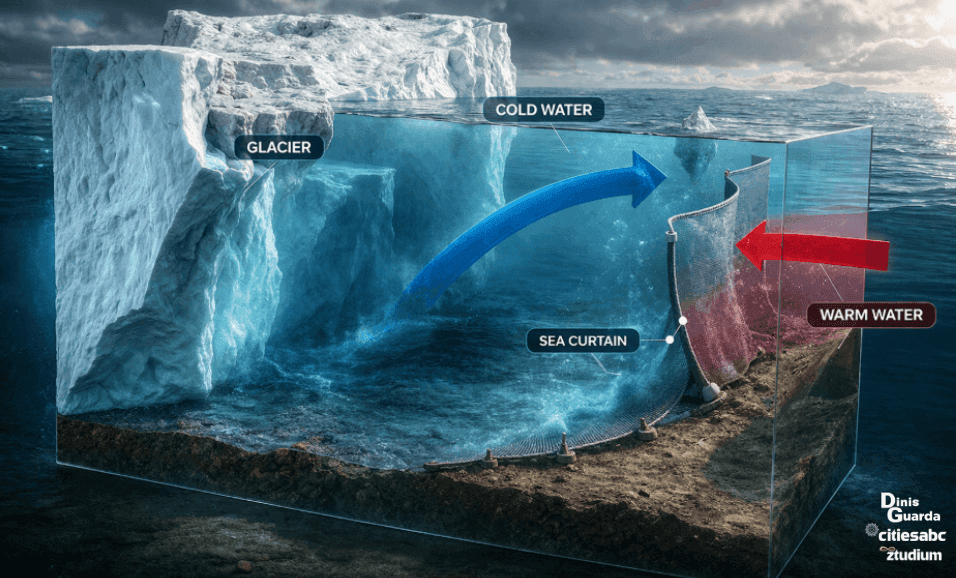
The Arctic is warming roughly three to four times faster than the rest of the globe. This creates several specific risks:
- Albedo Effect (Loss of Reflectivity): White sea ice reflects about 80% of solar radiation back into space. As it melts, it exposes dark ocean water, which absorbs 90% of that heat instead. This creates a "vicious cycle" that accelerates global warming.
- Permafrost Thaw: The Arctic ground (permafrost) holds massive amounts of trapped methane and CO2. As it thaws, these gases release, further heating the atmosphere.
- Disruption of Ocean Currents: Massive amounts of freshwater melting from Greenland can dilute the saltiness of the North Atlantic. This threatens to slow or collapse the AMOC (Atlantic Meridional Overturning Circulation), which regulates weather for Europe and North America.
Sea Level Rise: The Global Impact
While melting sea ice doesn't raise sea levels (like ice cubes melting in a glass), the melting of land-based ice (Greenland and Antarctic ice sheets) and the thermal expansion of warming water do.
- Coastal Inundation: Major cities like New York, Mumbai, Shanghai, and London face increased "nuisance flooding" and catastrophic storm surges.
- Saltwater Intrusion: Rising seas push salt water into freshwater aquifers, ruining drinking water and farmland in low-lying areas like the Mekong Delta or Florida.
- Economic Displacement: Research in 2026 suggests that a 1-meter rise could displace over 130 million people globally.
Timeline of "Imminent Disaster"
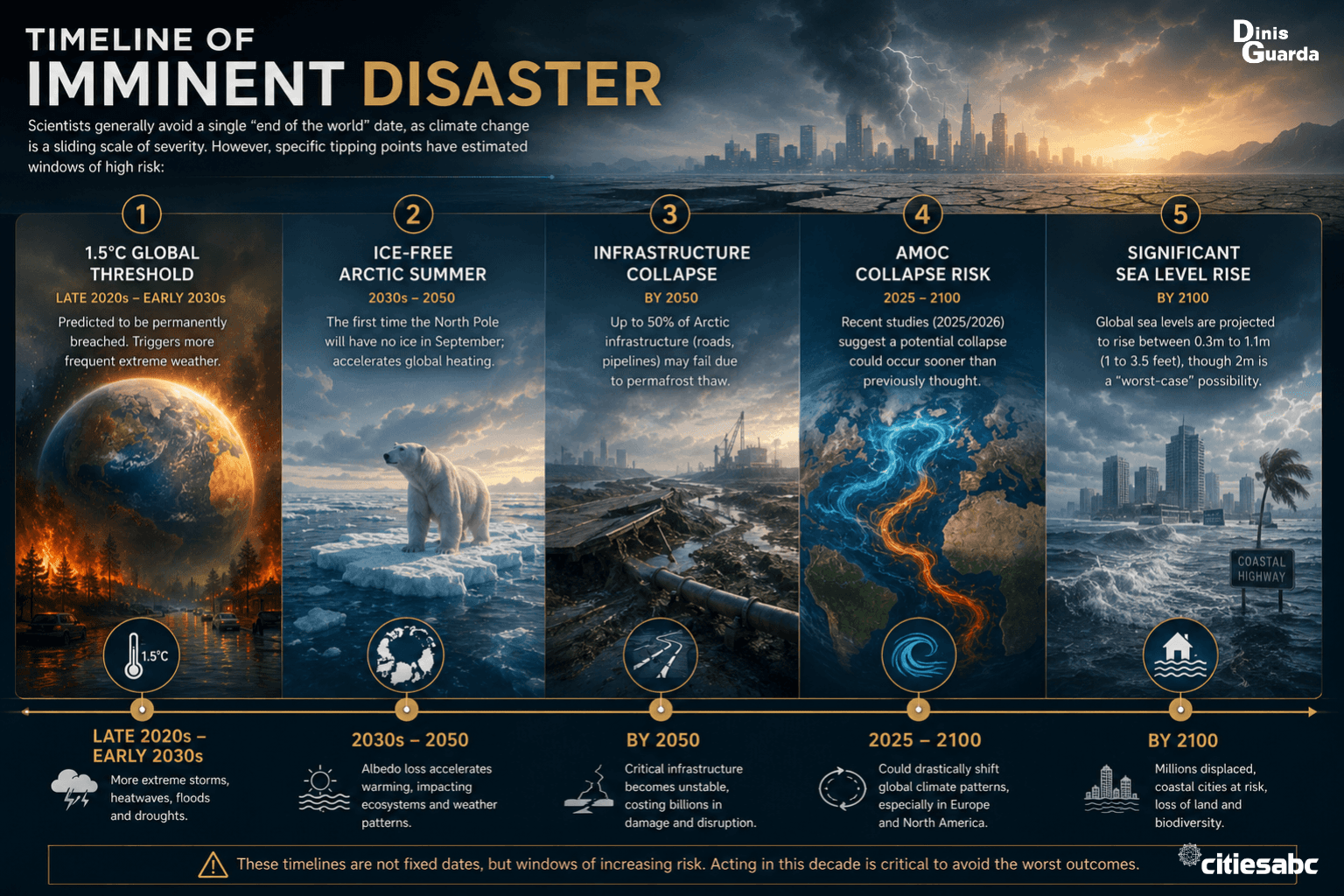
Scientists generally avoid a single "end of the world" date, as climate change is a sliding scale of severity. However, specific tipping points have estimated windows of high risk:
Milestone / Tipping Point | Estimated Timeline | Impact |
| 1.5°C Global Threshold | Late 2020s – Early 2030s | Predicted to be permanently breached. Triggers more frequent extreme weather. |
| Ice-Free Arctic Summer | 2030s – 2050 | The first time the North Pole will have no ice in September; accelerates global heating. |
| Infrastructure Collapse | By 2050 | Up to 50% of Arctic infrastructure (roads, pipelines) may fail due to permafrost thaw. |
| AMOC Collapse Risk | 2025 – 2100 | Recent studies (2025/2026) suggest a potential collapse could occur sooner than previously thought. |
| Significant Sea Level Rise | 2100 | Global sea levels are projected to rise between 0.3m to 1.1m (1 to 3.5 feet), though 2m is a "worst-case" possibility. |
Summary of "Imminent" vs. "Long-term"
The "disaster" isn't a single event but a rapid increase in frequency. By 2050, many coastal "once-in-a-century" flood events are expected to occur annually in many locations.
The primary goal of current policy is to ensure that if we "overshoot" the 1.5°C limit in the 2030s, we bring temperatures back down quickly enough to prevent the total, irreversible collapse of the Greenland and West Antarctic ice sheets, which would eventually raise sea levels by over 10 meters (33 feet) over several centuries.
The short answer is yes. While "disaster" is often a slow-moving process, the scale of human loss and displacement is potentially staggering. As of 2026, new data suggests we have underestimated sea level rise by about 30cm globally, and in parts of Southeast Asia, it could be up to 1.5 meters higher than previously thought.
The Most Affected Countries and Cities
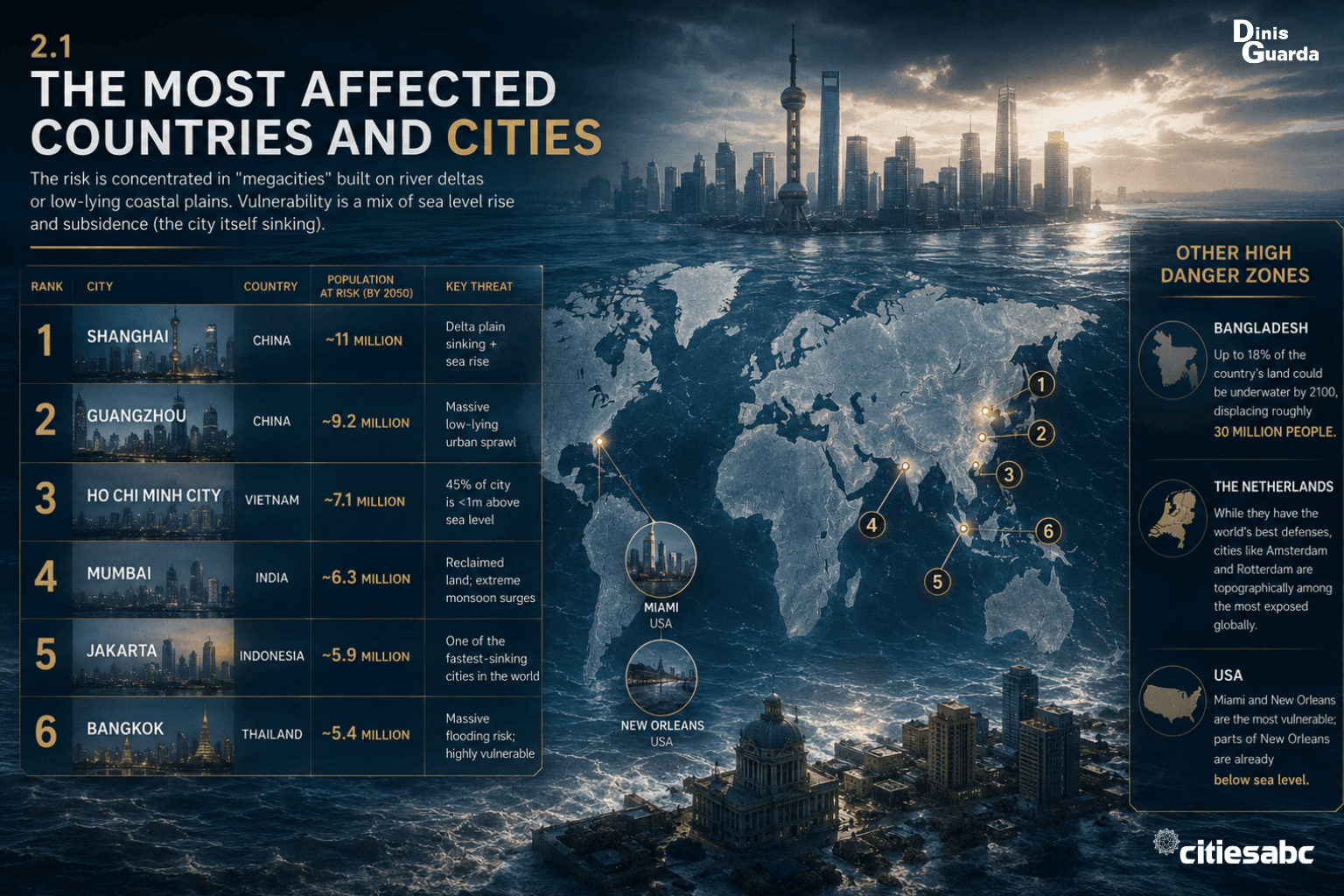
The risk is concentrated in "megacities" built on river deltas or low-lying coastal plains. Vulnerability is a mix of sea level rise and subsidence (the city itself sinking).
Rank | City | Country | Population at Risk (by 2050) | Key Threat |
| 1 | Shanghai | China | ~11 Million | Delta plain sinking + sea rise |
| 2 | Guangzhou | China | ~9.2 Million | Massive low-lying urban sprawl |
| 3 | Ho Chi Minh City | Vietnam | ~7.1 Million | 45% of city is <1m above sea level |
| 4 | Mumbai | India | ~6.3 Million | Reclaimed land; extreme monsoon surges |
| 5 | Jakarta | Indonesia | ~5.9 Million | One of the fastest-sinking cities in the world |
| 6 | Bangkok | Thailand | ~5.4 Million | Massive flooding risk; highly vulnerable |
Other "High Danger" Zones:
- Bangladesh: Up to 18% of the country's land could be underwater by 2100, displacing roughly 30 million people.
- The Netherlands: While they have the world's best defenses, cities like Amsterdam and Rotterdam are topographically among the most exposed globally.
- USA: Miami and New Orleans are the most vulnerable; parts of New Orleans are already below sea level.
Can it kill millions of people?
Directly? Unlikely. Indirectly? Absolutely. Drowning from a single wave is rare for millions, but the "cascading failures" are what lead to mass mortality:
- Flooding & Disease: The World Economic Forum (2024/2026) projects that floods alone could cause 8.5 million deaths by 2050 through waterborne diseases and immediate trauma.
- Wet-Bulb Temperature: This is a "silent killer." In regions like South Asia and the Middle East, a combination of heat and humidity can reach a point where the human body cannot cool itself down, leading to death in hours for anyone without air conditioning.
- Famine: Saltwater intrusion into rice paddies (like the Mekong Delta) and extreme droughts could trigger global food shortages.
Current Estimate: The World Health Organization (WHO) and WEF estimate climate change will cause an additional 14.5 million deaths by 2050 across all factors (heat, flood, disease, and malnutrition).
The "Biggest Disasters Possible" (The Tipping Points)
Scientists track specific events that, if triggered, change the Earth's climate permanently. These are the "nightmare scenarios":
- The AMOC Collapse: If the "conveyor belt" of ocean currents in the Atlantic fails, Europe could see temperatures drop by 5°C to 10°C within decades, while the tropics overheat and sea levels on the US East Coast rise much faster.
- The "Doomsday Glacier" (Thwaites): This Antarctic glacier is the size of Florida. If it collapses, it acts like a cork being pulled out of a bottle, potentially leading to a 3-meter (10-foot) sea level rise over a few centuries, but causing catastrophic storm surges almost immediately.
- Permafrost Methane Bomb: If the Arctic thaws too fast, it could release billions of tons of methane. Since methane is roughly 80 times more potent than CO2 at trapping heat over a 20-year period, this would cause "runaway" warming that we cannot stop.
- The Great Displacement: The biggest disaster may be a geopolitical one. If 100+ million "climate refugees" are forced to move across borders simultaneously, it could lead to total economic collapse and widespread conflict.
Deep Dive: The "Doomsday Glacier" and the Case for Physical Intervention
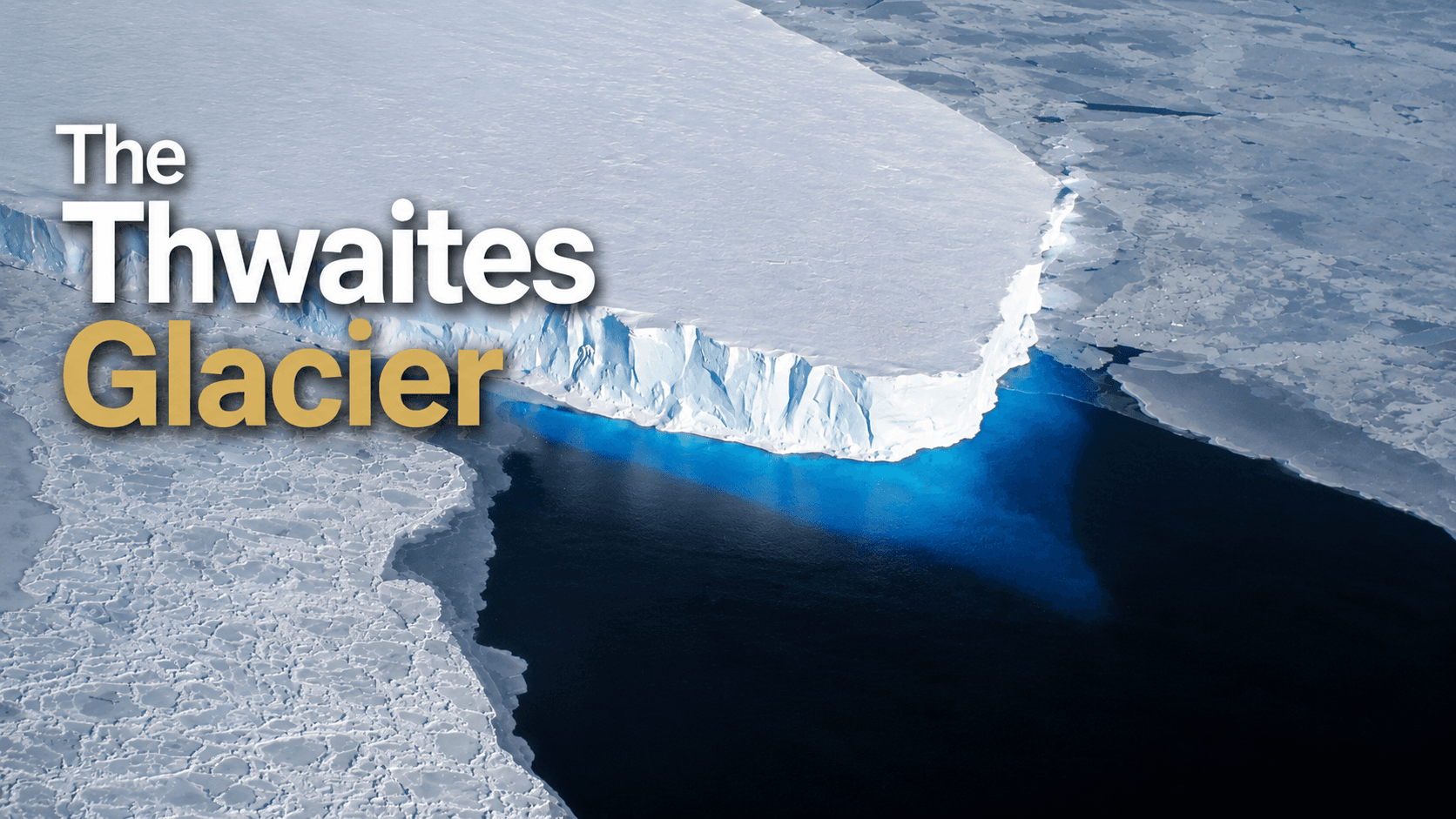
Everything above describes the general mechanics of Arctic and Antarctic ice loss and its knock-on effects for cities and countries. One glacier in particular — Thwaites, in West Antarctica — has become the sharpest illustration of why these risks are no longer theoretical, and of how far scientists are now willing to go in response.
Why Thwaites matters more than most glaciers
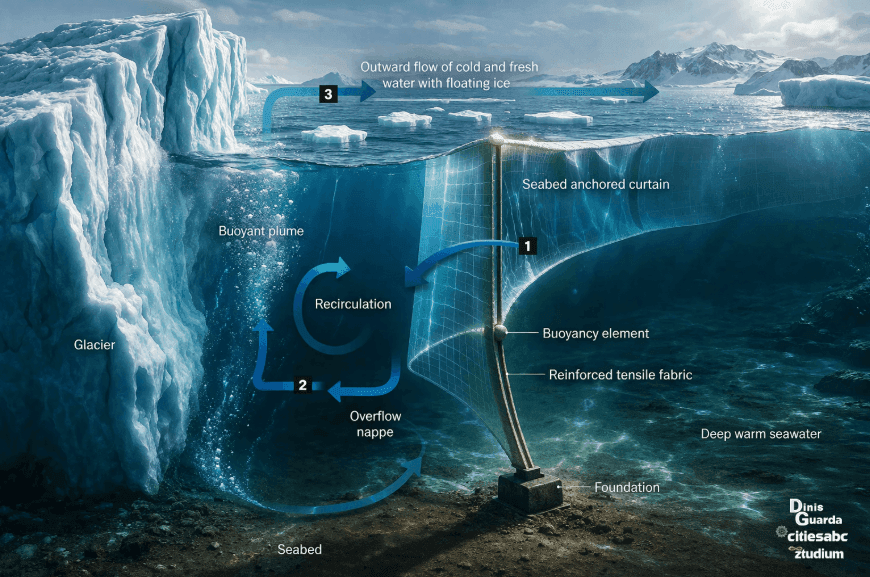
Thwaites is the widest glacier on Earth, roughly the size of Great Britain or Florida, and holds enough ice to raise global sea levels by about 65 centimetres on its own. It also acts as a natural "cork" holding back the rest of the West Antarctic Ice Sheet — a further 2.35 metres of potential sea level rise sits behind it. Unlike glaciers that melt from warm air above, Thwaites is being eaten away from below, by warm ocean water working its way under the ice shelf and destabilising the point where the glacier meets the seabed. It is currently losing about 50 billion tonnes of ice a year and already accounts for roughly 4% of global sea level rise.
Why it's called the "Doomsday Glacier"
The nickname isn't sensationalism — it reflects what happens if Thwaites crosses a threshold known as marine ice sheet instability, after which its retreat becomes self-sustaining regardless of future temperatures. Its collapse would remove the buttress holding back neighbouring glaciers, potentially triggering a broader West Antarctic collapse measured in metres, not centimetres, of sea level rise. Scientific opinion has hardened considerably on this in recent years, moving from uncertainty toward something closer to consensus that a collapse is likely without intervention.
A proposed fix: the Seabed Curtain Project
Rather than treat collapse as inevitable, an international research consortium — coordinated through the University of the Arctic and backed by groups including Outlier Projects and the Tom Wilhelmsen Foundation — has proposed an engineered barrier: a flexible curtain roughly 80 km long and around 150 metres high, anchored to the seabed at about 650 metres depth in front of the glacier, designed to block the warm deep water reaching the ice. Estimated at $40–80 billion to build, versus an estimated $40 billion a year in ongoing coastal protection costs if the ice is left to collapse, proponents argue the economics favour trying. A small-scale prototype is planned for testing off Norway before any Antarctic deployment is considered, and the project's own backers are explicit that this is a bridge to buy time — not a substitute for cutting emissions.
Why this belongs in a cities-and-countries risk conversation
Every centimetre of sea level rise is estimated to expose roughly six million more people to coastal flooding worldwide. A full Thwaites collapse alone could put on the order of 390 million people at risk; a broader West Antarctic collapse pushes that toward the billion mark. That is precisely the "megacity and small-island" risk map covered in Parts 1 and 2 of this FAQ — Shanghai, Mumbai, Jakarta, the Maldives, Bangladesh — playing out from a single point of failure on the other side of the planet.
For the full story: the science, the engineering, and the people behind the proposed curtain — see the original feature: Can We Create a Sea Curtain to Shield the 'Doomsday Glacier' from Melting? — Dinis Guarda, citiesabc, 09 Apr 2026.
Sources
- https://www.citiesalliance.org/newsroom/news/results/climate-change-and-cities-infographic
- https://www.epa.gov/climatechange-science/frequently-asked-questions-about-climate-change
- https://citiesabc.com/can-we-create-a-sea-curtain-to-shield-the-doomsday-glacier-from-melting — Dinis Guarda, citiesabc, 09 Apr 2026


