
Cities
Hedera Hashgraph: A Low-Cost Alternative to Blockchain

Hedera offers fast, low-cost transactions, achieving a maximum of 10,000 TPS, with finality in just 3 to 5 seconds using hashgraph technology, a Directed Acyclic Graph (DAG) structure, which is an alternative to blockchain. This technology supports a variety of transaction types, including Central Bank Digital Currencies (CBDCs), NFTs, AI applications, and tokenised real estate, serving prominent global organisations such as Google, IBM, and Microsoft. By mid-2025, Hedera’s market cap is about $10.2 billion, with 42 billion HBAR tokens in circulation.
Hedera Hashgraph offers a modern approach to distributed ledger technology (DLT). It aims to provide a scalable, fast, and secure alternative to traditional blockchain systems. With its unique Hashgraph consensus mechanism, Hedera allows businesses and developers to process many transactions at low costs while keeping a high level of security and efficiency.
Unlike traditional blockchain networks like Bitcoin and Ethereum, which use linear chains of blocks to validate transactions, Hedera uses a Directed Acyclic Graph (DAG) structure. This innovative design enables the network to handle thousands of transactions per second (TPS) with low latency. It is a suitable solution for industries that need high throughput, including supply chain management, financial services, and decentralised applications (dApps).
Launched by Dr. Leemon Baird and Mance Harmon, Hedera Hashgraph is overseen by a council of up to 39 global organisations. This includes major technology companies like Google, IBM, and Deutsche Telekom. These companies take part in the decision-making process, run nodes, and help maintain the overall stability and accountability of the network.
Hedera Hashgraph: Key features and technology
Hedera stands out from traditional blockchains because of its underlying technology, Hashgraph. This consensus algorithm allows the network to deliver high performance while maintaining security and decentralisation. Here are some key features that make Hedera unique:
- High transaction throughput and speed: Hedera can handle up to 10,000 transactions per second (TPS). This far exceeds the capabilities of many other blockchain networks. While Bitcoin processes 7 TPS and Ethereum handles 30 TPS, Hedera provides a fast, reliable, and scalable solution that supports enterprise-level applications effortlessly.
- Quick transaction finality: The network reaches consensus in just 3 to 5 seconds, ensuring nearly instant finality. This is crucial for use cases that need quick validation and secure completion of transactions, without requiring multiple block confirmations.
- Low-cost transactions: Hedera’s fees are much lower than those of traditional blockchain networks, often below $0.001 per transaction. This makes it ideal for microtransactions and other high-frequency operations.
- Carbon-negative protocol: A standout feature of Hedera is its energy efficiency. The network uses minimal power and is carbon-negative, offsetting more CO₂ than it emits. This focus on sustainability is attractive to businesses that want to align with environmental goals.
- Decentralised governance: Hedera’s governance model includes a rotating council of up to 39 global organisations, featuring major players such as Google, IBM, and Deutsche Telekom. This decentralised method ensures that no single entity controls the network, while also providing enterprise-grade stability and accountability.
Hedera Ecosystem: Empowering web3 and enterprise applications
Key Web3 ecosystem applications
Below are some of the innovative, permissionless Web3 applications built on Hedera, providing seamless integration for decentralised ecosystems:
- MetaMask Snaps - The Hedera Wallet Snap is an advanced plugin designed to offer a smooth, native experience for MetaMask users on the Hedera network. This plugin allows users to easily send HBAR, retrieve account information, and perform various Hedera operations with minimal friction.
- HashPack Wallet - HashPack is a versatile wallet available as a mobile app, desktop application, and browser extension. It is designed for seamless integration with Hedera’s decentralised applications (dApps) in the DeFi and NFT ecosystems, providing an intuitive way to manage your assets and interact with the Hedera network.
- Kabila -Kabila is an all-encompassing Web3 platform built on Hedera that empowers digital creators to own, monetise, and expand their communities. With a comprehensive suite of tools, Kabila is designed to drive the creator economy and facilitate meaningful interactions with followers.
Developer tools and integrations
- Hashgraph Online: Building the on-chain internet with Hedera and HCS.
- Moonscape: Trustless AI agent communication on Hedera, enabling seamless AI integration.
- LimeChain: Innovation through critical infrastructure development and Ethereum Virtual Machine (EVM) compatibility for Hedera.
DeFi and NFT solutions
- Citadel Wallet: The first Hedera-native hardware wallet for secure, decentralised finance and staking operations.
- SaucerSwap: A decentralised exchange (DEX) offering a comprehensive suite of DeFi services.
- DOVU: Tokenisation of assets and data integrity focused on sustainability and DeFi.
Recent performance and developments
As of mid-2025, Hedera Hashgraph is still growing, even with some ups and downs in its market cap. The circulating market cap fell by 32.9% in Q1 2025, going from $10.3 billion to $6.9 billion. However, the stablecoin market cap on Hedera increased by an impressive 91.7%, reaching $72.6 million. The daily transaction volume also rose by 25.8% from the previous quarter, averaging 708,500 transactions per day.
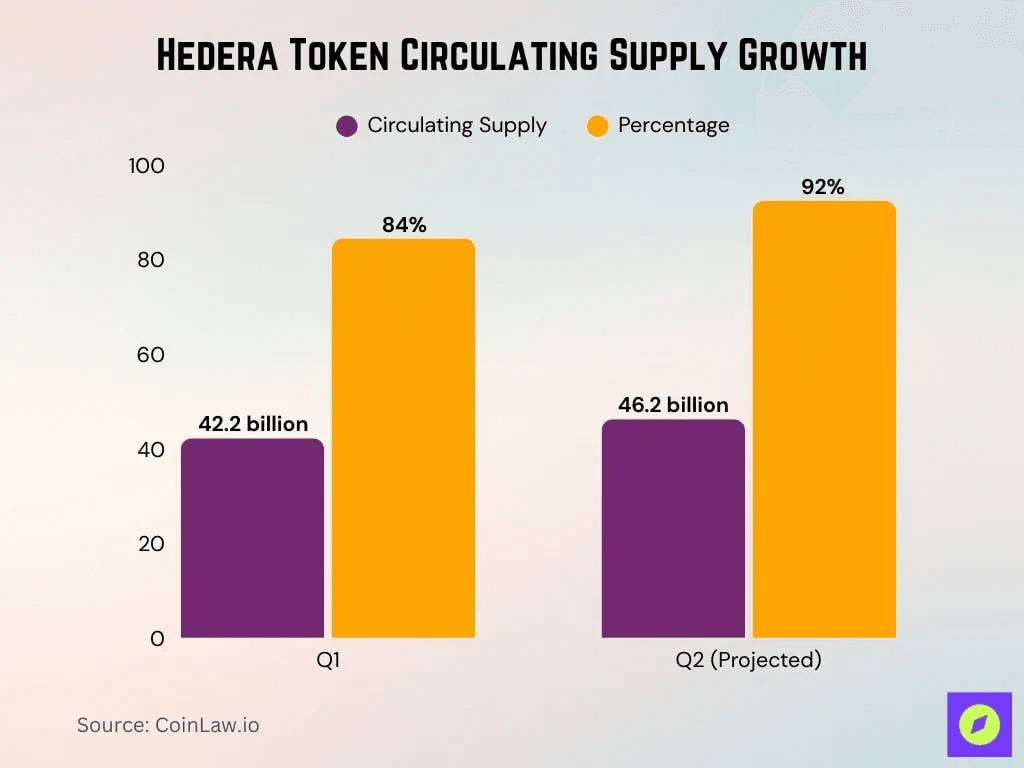
Key developments during Q1 2025 include a 10.4% rise in circulating supply, reaching 42.2 billion HBAR tokens. Despite a slight drop in protocol revenue to $232,700, Hedera's ecosystem showed improvements, especially in its Crypto Service, which saw a 103.6% increase in activity. Hedera has also kept its focus on interoperability, improving its cross-chain abilities by introducing Chainlink’s Cross-Chain Interoperability Protocol (CCIP) and expanding its DeFi ecosystem with applications like SaucerSwap and Bonzo Finance.
Use cases of the Hedera Hashgraph network
Hedera Hashgraph offers a diverse range of use cases that leverage its high-speed, low-cost, and secure distributed ledger technology.
Eric Piscini, CEO of Hashgraph, states:
“In the last few weeks, we’ve seen major strides across the Hedera ecosystem. The Reserve Bank of Australia and Digital Finance CRC’s Project Acacia is exploring digital currency interoperability on Hedera and HashSphere, EQTY Lab has deployed Verifiable Compute on NVIDIA’s Blackwell platform, Grayscale has added Hedera to its Smart Contract Platform Select Fund, and Kraken now supports HBAR funding and trading. This momentum in both tokenization and AI isn’t isolated, it reflects a broader shift where DLT is becoming the trust layer for mission-critical applications. Hedera has a key role to play in this moment.”
Below are some of the key areas where Hedera is being used to drive innovation:
1. Payments
Hedera’s Token Service (HTS) empowers organisations to leverage public distributed ledger technology for secure and compliant payments. Transactions on Hedera settle in seconds, significantly faster than traditional payment systems like VISA, with fees under $1 per transaction. HTS supports stablecoins, HBAR, and other cryptocurrency transactions, making it an ideal solution for finance and commerce, enhancing payment settlement efficiency and enabling liquidity in both new and existing markets.
2. Tokenised Assets
Hedera’s Token Service enables the seamless creation, minting, and management of both NFTs and fungible tokens without the need to deploy smart contracts. These tokenised assets include everything from regulated securities to decentralised governance tokens, facilitating the tokenisation of diverse asset types and broadening the scope for asset markets on Hedera.
3. Data Compliance
With increasing regulatory pressure on data compliance, Hedera provides businesses with the tools to demonstrate compliance to their customers through auditable logs of actions taken on their data. Hedera ensures transparency and trust, standardising data compliance and auditing processes to enhance the integrity of sensitive data.
4. Fraud Mitigation
Hedera reduces costs and mitigates fraud in digital transactions and online applications by providing secure management of credentials throughout their lifecycle. The network ensures real-time visibility of transactions, enabling the detection of fraudulent activities through predictive analysis and fostering trust among all parties involved in the transaction process.
5. Data Integrity and AI
Hedera is pivotal in supporting the trusted layer of governance necessary for AI applications. Combining Hedera’s immutable and transparent ledger with AI enhances data security, providing real-time, verifiable interactions that power auditable AI systems. Developers can build and operate trustworthy AI agents on Hedera with AI Studio, an open-source toolkit, enabling verifiable data integrity at scale.
6. Real-World Asset (RWA) Tokenisation
Hedera enables seamless tokenisation of real-world and digital assets, offering unmatched security, compliance, and performance. By facilitating the tokenisation of illiquid assets such as regulated securities and NFTs, Hedera is opening new avenues for financial markets and providing robust tools for enterprises and developers in asset creation.
7. Decentralised Finance (DeFi)
Hedera is transforming the financial industry by offering low-cost, fast transactions and modern development workflows for DeFi applications. With EVM-based smart contracts, developers can create and deploy DeFi protocols using popular languages like Solidity and Vyper. Hedera’s ability to process 15 million gas per second and support web3 libraries like web3.js and ethers.js ensures that developers can build and scale DeFi applications rapidly.
8. Sustainability
Hedera provides scalable infrastructure for sustainability initiatives, especially in sectors like carbon markets. By using the Hedera Consensus Service (HCS), businesses can log and track environmental data with transparency and trust. Hedera’s low-energy network and efficient carbon asset tokenisation make it a compelling solution for sustainable business practices.
- Emission Tokens: Affordable issuance of emission tokens and carbon offsets.
- Climate Asset Issuance: Low-cost, efficient transactions for climate assets.
9. Decentralised Logs
Hedera offers developers the ability to create decentralised logs of immutable and timestamped events, enabling trust in data for web2 and web3 applications. Whether it’s for tracking products in a supply chain, logging sensitive user information, or supporting DAOs, Hedera ensures that data is verifiable, secure, and transparent.
10. NFTs (Non-Fungible Tokens)
Hedera is an ideal platform for minting, selling, and trading NFTs. With its fast transaction speed and low-cost fees, Hedera has revolutionised the NFT space. The network supports immutable royalty configurations, ensuring creators are paid for secondary sales with just a few lines of code.
Transaction speed and price trends
Hedera can process up to 10,000 TPS, making it one of the fastest distributed ledger technologies today. Unlike traditional blockchain systems, Hedera’s asynchronous Byzantine Fault Tolerance (aBFT) ensures quick finality. Transactions get confirmed in just 3 to 5 seconds. The average TPS on Hedera is 10.73, and in tests, the network often reaches peak performance of 3,302 TPS.
Regarding pricing, Hedera’s native cryptocurrency, HBAR, has shown positive growth. Its price varies between $0.23 and $0.27, with a recent rise of about 4% over 24 hours. The highest recorded price for HBAR in 2025 was $0.401. Despite some recent price corrections, it has increased by 349.4% year-to-date. Analysts have different price predictions for Hedera. Some expect the price to drop to $0.20 by the end of the year, while others foresee growth between $0.30 and $0.90.
Transaction fees and network efficiency
Hedera's predictable fee structure is one of the platform's main advantages. Transactions on the network are paid in HBAR, with a basic transfer usually costing around $0.0001 USD, no matter the transaction size. The average fee per transaction is about $0.001 USD, and it finalises in 3 to 7 seconds. Hedera's fixed fee structure offers stability, especially compared to the often fluctuating fees on other blockchain networks.
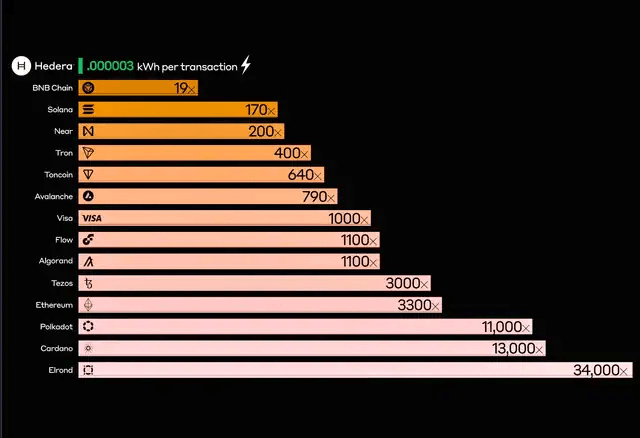
The network's energy efficiency is another notable feature. Hedera uses just 0.000003 kWh per transaction, making it the most sustainable public network available. By comparison, other platforms like Solana, Ethereum, and BNB Chain consume much more energy per transaction. Hedera’s Proof-of-Stake (PoS) consensus mechanism does away with the need for mining rigs, further cutting its environmental impact.
Security and governance model
Hedera follows a governance model with a council made up of 39 global organisations, including Google, IBM, LG, Boeing, and Deutsche Telekom. These council members participate in decision-making and run nodes on the network. This setup supports balanced governance and fosters enterprise-grade stability.
The network is secured by Hedera's asynchronous Byzantine Fault Tolerance (aBFT) consensus method. This method allows the network to manage up to 10,000 transactions per second while keeping high security levels. Hedera's virtual voting system offers extra protection against Sybil attacks. Additionally, its governance model ensures that all transactions are processed efficiently and securely.
Hedera’s future in distributed ledger technologies
Hedera Hashgraph is set to be important in the future of distributed ledger technologies. Its unique design, high performance, and low transaction costs make it a good option for businesses and developers seeking a scalable, secure, and efficient alternative to traditional blockchain networks.
As more companies, governments, and developers start using Hedera, the platform’s abilities in tokenisation, decentralised finance (DeFi), and digital identity management will grow. Its focus on sustainability, energy efficiency, and transparent governance places Hedera at the forefront of the new world of decentralised technologies.
Hedera Foundation: Empowering the Digital Economy
The Hedera Foundation is a pivotal organisation dedicated to supporting the growth and adoption of the Hedera network. By providing essential resources such as funding, community support, and technical expertise, the foundation plays a crucial role in driving innovation and scalability across a wide range of sectors, including decentralised finance (DeFi), tokenisation, sustainability, and artificial intelligence (AI).
Founded with the mission to drive the adoption of Hedera as the world’s leading public distributed ledger, the Hedera Foundation aims to create a decentralised, secure, and scalable platform that facilitates a thriving digital economy. The Hedera network is unique in its ability to deliver unmatched security, lightning-fast transaction speeds, ultra-low costs, and predictable fees, positioning it as a reliable backbone for digital commerce. The foundation’s commitment is to further empower the Hedera ecosystem, ensuring its continued growth and fostering trust across industries.
The Hedera Foundation is a global team composed of experts spanning engineering, marketing, business development, and finance. The organisation is united by a shared belief in the potential of the Hedera ecosystem to transform the digital economy. By offering a combination of funding, technical resources, and collaborative support, the foundation helps organisations scale and succeed in the evolving world of Web3.
The Hedera Foundation provides a range of resources to support builders and innovators within the Hedera ecosystem:
- Funding Program:
The foundation’s funding program is designed to support both DeFi and enterprise projects that aim to drive the adoption of the Hedera network. These projects must also deliver a positive social or global impact, aligning with the foundation’s broader mission of creating a decentralised and sustainable digital economy.
- Technical Support:
Developers and organisations can access the foundation’s technical expertise to help overcome obstacles in building Web3 applications. The foundation's resources enable faster, more efficient deployment of projects, allowing developers to focus on innovation rather than technical challenges.


