
citiesabc
How Many SMEs Are There in London

Across the entire UK, SMEs broadly account for over 99% of all private businesses.
London doesn't just host businesses; it manufactures them, at a pace and density unmatched anywhere else in the United Kingdom. Behind the glass towers of Canary Wharf and the boutique studios of Shoreditch sits a quieter, more consequential story: a private-sector ecosystem of roughly 1.042 million businesses, of which an overwhelming 981,000, some 94.1%, are classified as Small and Medium Enterprises. This is not a footnote to London's economy. It is the economy.
Across the UK as a whole, SMEs account for more than 99% of all private businesses, but London's version of that story carries its own texture: higher density, sharper sectoral clustering, and a business culture that rewards agility as much as scale.
Key Statistics on London SMEs
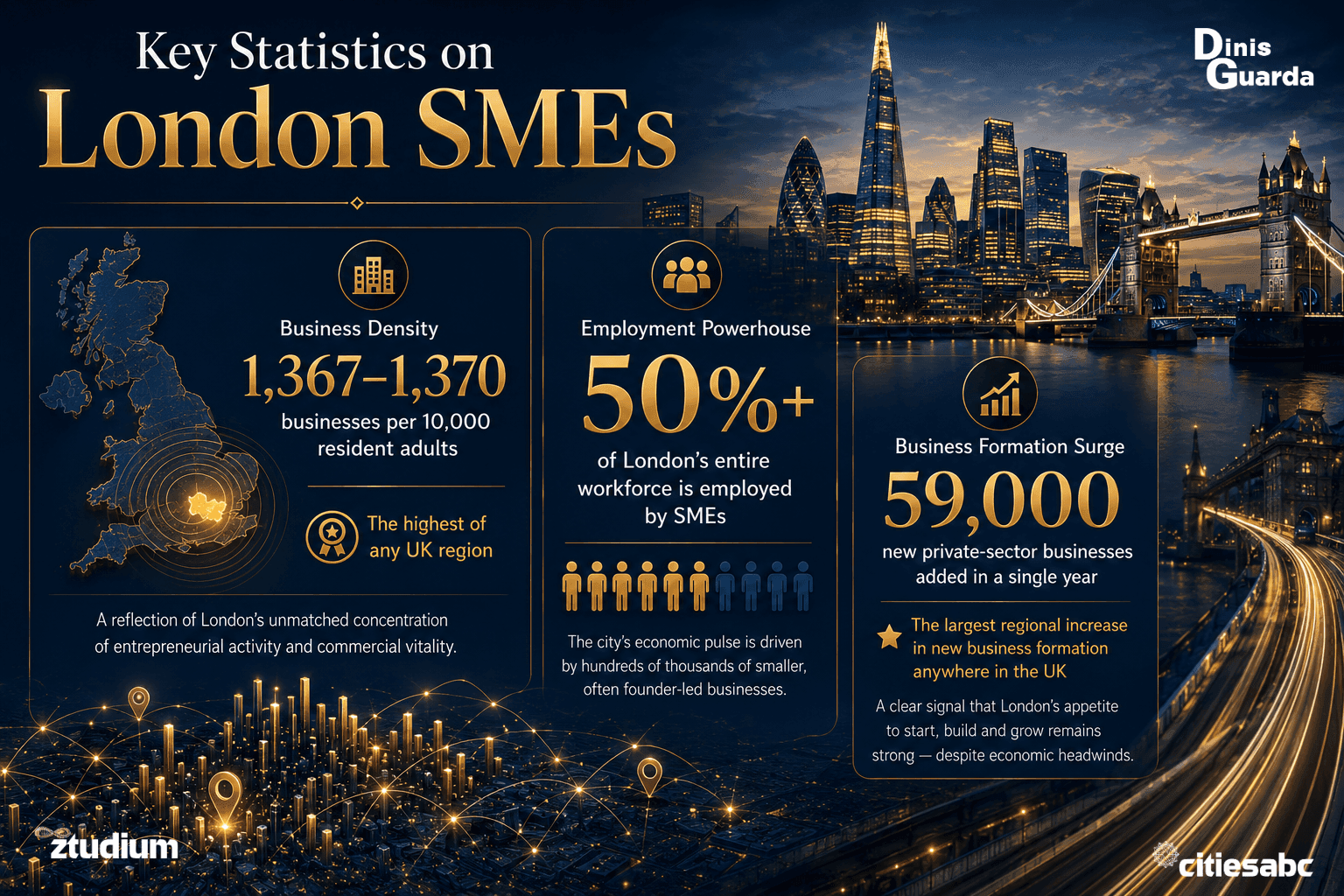
The numbers tell a story of concentration and momentum. London reports a business density of 1,367 to 1,370 businesses per 10,000 resident adults; the highest of any UK region, a figure that reflects both the sheer volume of entrepreneurial activity and the compactness of the city's commercial geography. Density like this doesn't happen by accident; it's the product of decades of infrastructure, capital access, and talent pooling that keeps drawing founders back to the same postcodes.
The economic weight of these enterprises is just as striking. SMEs employ more than half of London's entire workforce, meaning the city's economic pulse is set not by a handful of multinational headquarters but by hundreds of thousands of smaller, often founder-led operations. And the trajectory is upward: London recently posted the largest regional increase in new business formation anywhere in the UK, adding 59,000 new private-sector businesses in a single year, a signal that despite economic headwinds, the appetite to start something in London remains undiminished.
Top Sectors for London SMEs
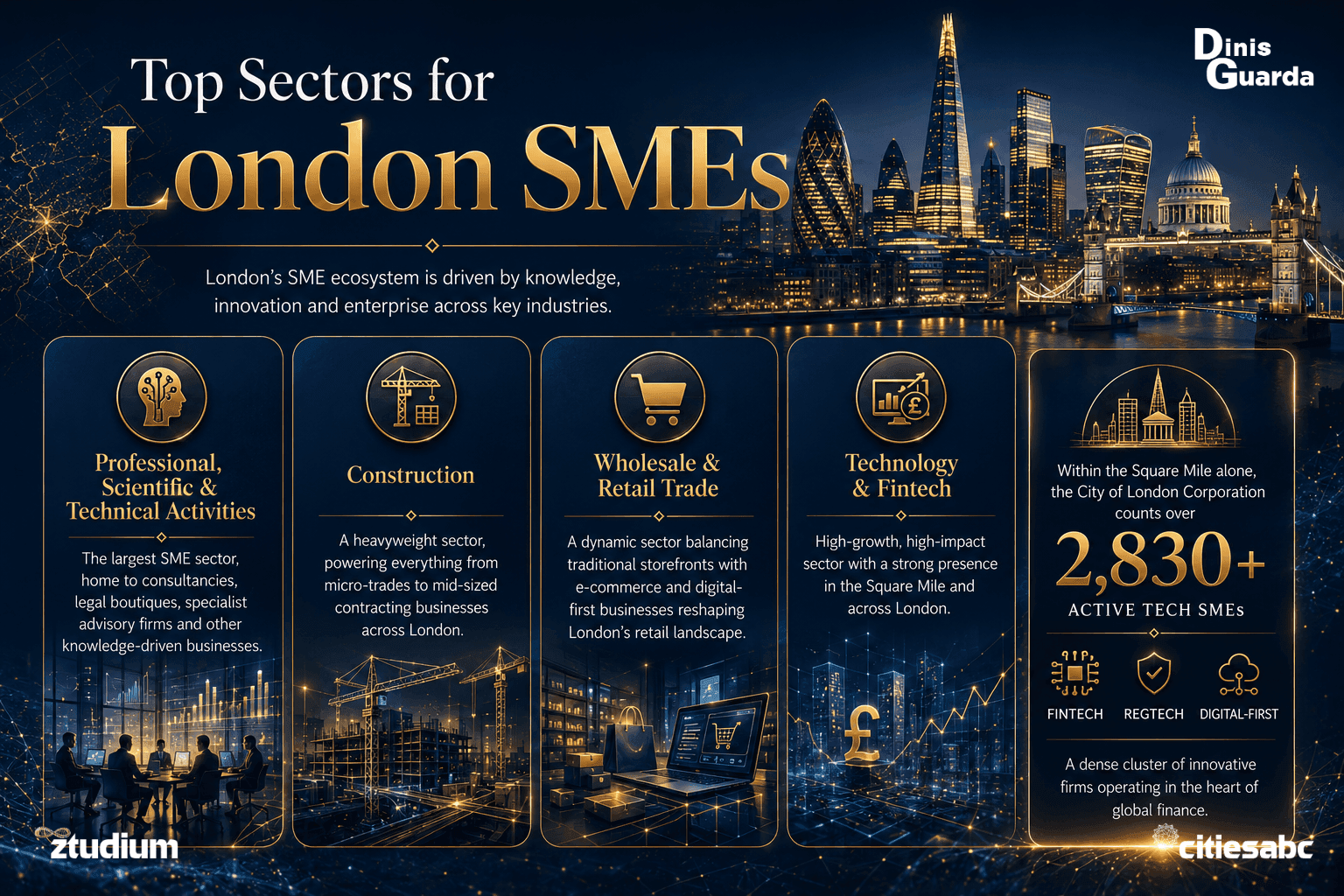
What kind of businesses make up this ecosystem? The distribution mirrors London's broader economic identity as a global services and innovation hub.
Professional, Scientific and Technical Activities sit at the top of the pile; a catch-all category that includes the consultancies, legal boutiques, and specialist advisory firms that thrive in a city built on knowledge work.
Construction remains a heavyweight too, powering everything from micro-trades to mid-sized contracting outfits across both inner and outer boroughs.
Wholesale and Retail Trade continues to evolve, straddling traditional storefronts and the e-commerce operations that have redrawn the retail map since the pandemic.
Technology & Fintech, which punches well above its numerical weight in terms of visibility and investment: within the Square Mile alone, the City of London Corporation counts over 2,830 active tech SMEs, a dense cluster of fintech, regtech, and digital-first firms operating in the shadow of the traditional financial institutions they're increasingly disrupting.
Business Support Resources
For founders looking to launch, scale, or fund a business in the capital, the infrastructure of support is more developed than many realise. Grow London Local, run by London & Partners, functions as the primary gateway for local business support — offering practical tools, dedicated community managers, and a calendar of events designed to connect founders with the resources and networks they need. Complementing this is the Business & IP Centre (BIPC), housed at the British Library, which provides free intellectual property advice, hands-on workshops, and access to business data that would otherwise cost a small fortune to license privately. Together, these resources form a quiet but essential scaffolding beneath London's entrepreneurial density.
The Shape of London's SME Landscape: Size Matters
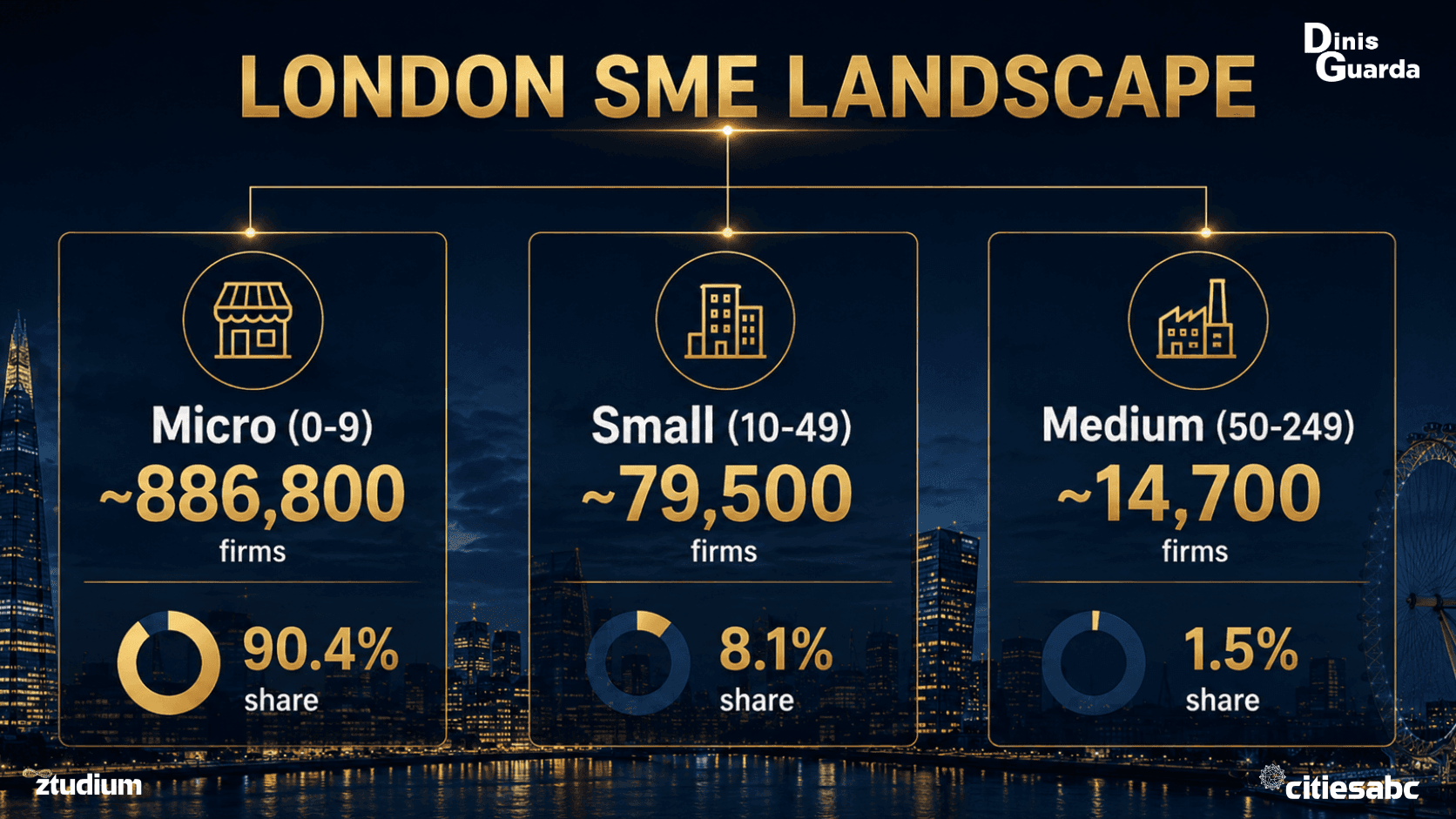
Zoom into the size distribution and a clear hierarchy emerges. The micro-business category (0–9 employees) dominates, accounting for roughly 90.4% of all London businesses, around 886,800 firms. Small businesses (10–49 employees) represent about 8.1% of the total, roughly 79,500 firms, while medium businesses (50–249 employees) make up a comparatively modest 1.5%, or around 14,700 firms. Large firms with more than 250 employees round out the remaining 0.5% or less.
SME Size Band Definitions (per ONS classification):
- Micro-enterprises: 0–9 employees (includes sole traders)
- Small enterprises: 10–49 employees
- Medium enterprises: 50–249 employees
This pyramid, heavily weighted toward the smallest operators, is the defining structural feature of London's business base. It's a city built disproportionately on the backs of sole traders, freelancers, and small founding teams rather than sprawling mid-market firms.
Geographic Distribution Across London Boroughs
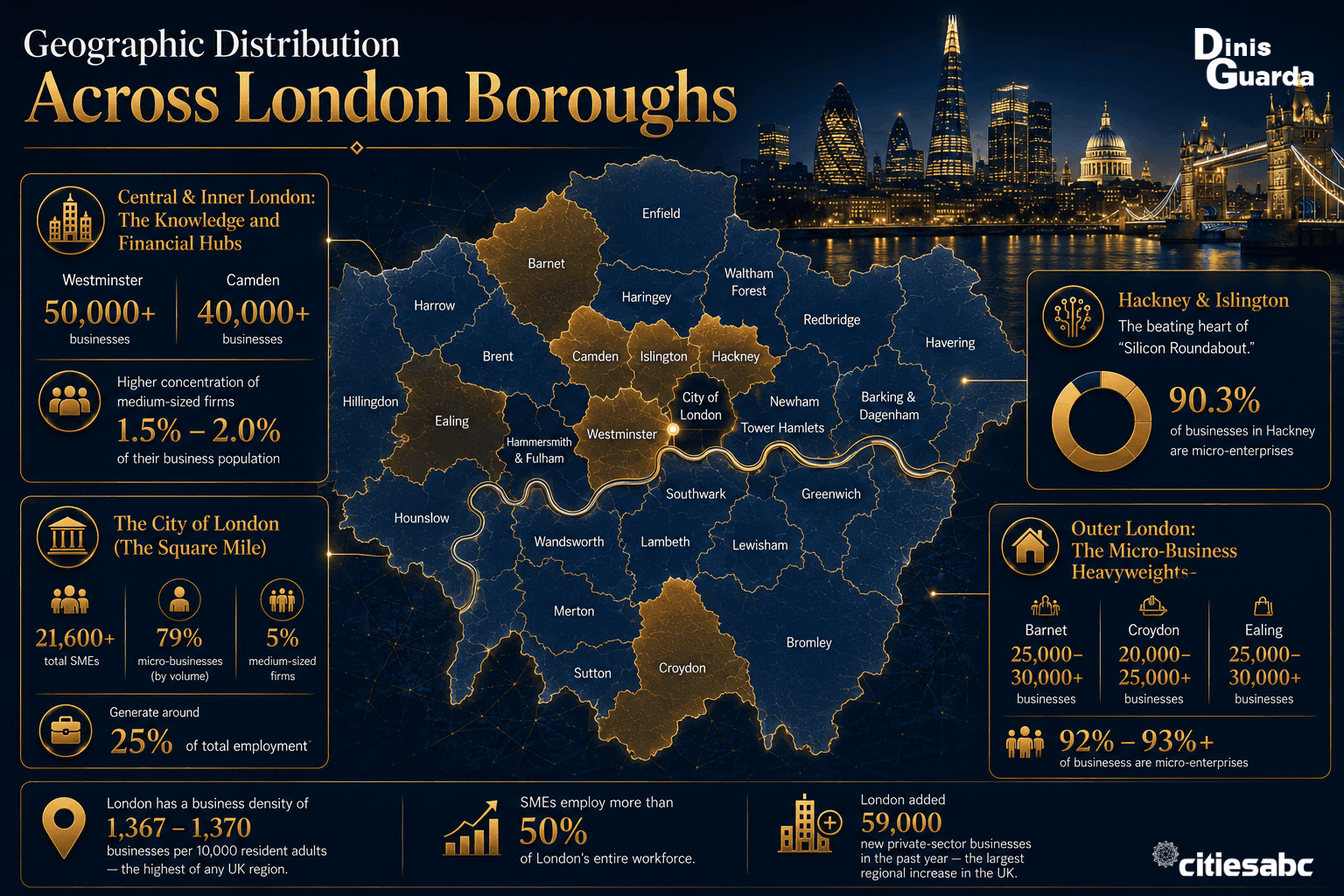
London's SME map is not uniform. It splits into recognisable zones, each with its own economic personality.
Central & Inner London: The Knowledge and Financial Hubs
City of Westminster & Camden anchor the highest absolute business counts in the capital. Westminster alone typically hosts more than 50,000 businesses, with Camden close behind. These boroughs carry a noticeably higher concentration of medium-sized firms, between 1.5% and 2% of their business population, reflecting the dense presence of corporate headquarters, media agencies, and professional service firms that gravitate toward central London addresses.
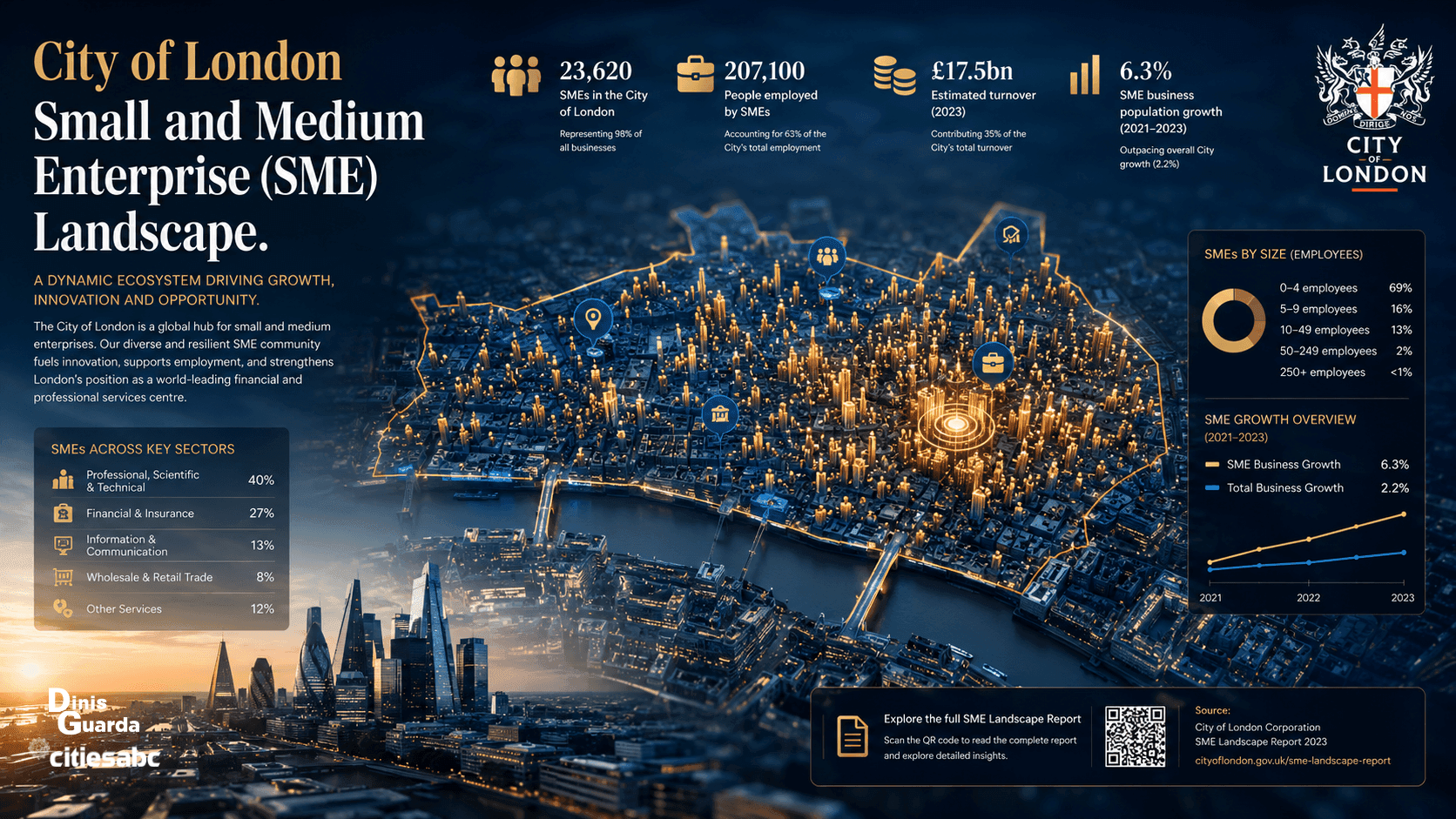
The City of London (the Square Mile) is a category unto itself: a compact geography packing in more than 21,600 total SMEs. Micro-businesses still dominate by sheer volume (79%), but it's the medium-sized firms — just 5% of the Square Mile's SME population, that generate the single largest share of employment, around 25%. It's a vivid illustration of how, in financial services, a small number of larger operations can carry outsized economic weight.
Hackney & Islington, the beating heart of "Silicon Roundabout," skew even more heavily toward the smallest operators. In Hackney, roughly 90.3% of businesses are micro-enterprises — a footprint shaped by independent tech start-ups, freelance designers, and creative consultancy practices that have made the area synonymous with London's start-up culture.
Outer London: The Micro-Business Heavyweights
Move outward to Barnet, Croydon, and Ealing, and the picture shifts again. These large, largely residential boroughs still hold significant SME volumes — typically between 20,000 and 30,000 registrations each — but lean even more heavily into micro-enterprises, sometimes exceeding 92–93% of their business population. This reflects the thousands of self-employed tradespeople, local retailers, domestic construction firms, and logistics operators who keep outer London's local economies running, often with fewer than ten staff on the books.
High-Level Summary Matrix
Location Category | Typical Total SME Volume | Micro % (0–9) | Small % (10–49) | Medium % (50–249) | Primary Industries |
| West End Hubs (Westminster/Camden) | 45,000–55,000+ | ~89.0% | ~9.2% | ~1.8% | Professional Services, Media, Hospitality |
| The Square Mile (City of London) | ~21,600+ | ~79.0% | ~16.0% | ~5.0% | Fintech, Finance, Legal, Tech Services |
| Tech/Creative Inner (Hackney/Islington) | 20,000–25,000+ | ~90.3% | ~8.4% | ~1.3% | Software Dev, Marketing, Arts |
| Large Outer Boroughs (Barnet/Croydon) | 22,000–28,000+ | ~92.5% | ~6.5% | ~1.0% | Construction, Local Retail, Transport |
While the precise headcounts shift year to year with each ONS update, this proportional pattern has proven remarkably stable, a structural signature of how London's economic geography actually functions.
The Creative Thread: London's Fashion and Textile SMEs
Woven through this broader business landscape is a smaller but culturally outsized sector: fashion and textile creative industries. Somewhere between 10,000 and 12,000 SMEs operate in this space across London, a number that requires some unpacking, because official statistics draw a firm line between creative design-and-making and mass-market retail.
The Data Breakdown
1. Creative "Design & Making" — The Pure Creative Core
Drawing on the UKFT Powerhouse Report and Greater London Authority data, more than 20,000 people are directly engaged in "creating and making" fashion, apparel, and textiles across London. That workforce translates into roughly 3,500 to 4,500 registered SMEs; the true creative nucleus of the sector.
This core segment mirrors the broader UK fashion landscape almost exactly: nationally, 99.7% of the UK's 59,000 fashion businesses qualify as SMEs, and London's independent design studios, specialist garment makers, and textile innovators follow the same pattern, with virtually 99% operating as micro or small businesses.
2. The Broader Creative Fashion Ecosystem
Widen the lens to include creative brand management, fashion PR agencies, wholesale showrooms, styling agencies, and boutique e-commerce operations, and the footprint expands considerably. London is home to roughly 92,750 creative industry business sites in total, and fashion, apparel design, and textile-related creative services consistently account for 10% to 12% of that wider pool, bringing the extended network to more than 10,000 active SMEs.
Industry Composition: Size and Structure
If London's broader SME base leans small, the fashion and textile creative sector leans smaller still.
- Micro-studios (0–9 employees) make up over 93% of the sector — independent fashion labels (including those showcasing at London Fashion Week), freelance textile designers, bespoke tailors along Savile Row, and specialist pattern-cutters who form the invisible backbone of the industry.
- Small to medium operations (10–249 employees) account for the remaining roughly 6% — established contemporary labels, sustainable textile manufacturing facilities, and the digital fashion-tech agencies increasingly bridging design and technology.
Geographic Hotspots
The sector clusters in recognisable pockets across the capital. East London, Hackney, Tower Hamlets, Newham, remains the historical and modern heart of fashion manufacturing, sampling, and streetwear entrepreneurship. Central London, particularly Westminster and Camden, hosts the luxury fashion houses, established design studios, and the major fashion universities feeding the industry's talent pipeline.
Closing Thought
Taken together, these figures describe a city whose economic identity is inseparable from its small businesses; from the tailors of Savile Row to the fintech founders of the Square Mile to the tradespeople keeping outer London running. It's a structure worth understanding not just for its scale, but for what it reveals about how a global city actually works day to day: not through a handful of giants, but through hundreds of thousands of small, often overlooked engines of activity.
Sources
- Office for National Statistics — UK Business: Activity, Size and Location, 2024 https://www.ons.gov.uk/businessindustryandtrade/business/activitysizeandlocation/bulletins/ukbusinessactivitysizeandlocation/2024
- Department for Business and Trade / GOV.UK — Business Population Estimates for the UK and Regions, 2024 https://www.gov.uk/government/statistics/business-population-estimates-2024/business-population-estimates-for-the-uk-and-regions-2024-statistical-release
- Department for Business and Trade / GOV.UK — Business Population Estimates for the UK and Regions, 2025 https://www.gov.uk/government/statistics/business-population-estimates-2025/business-population-estimates-for-the-uk-and-regions-2025-statistical-release
- House of Commons Library — Business Statistics (research briefing SN06152) https://commonslibrary.parliament.uk/research-briefings/sn06152/
- City of London Corporation & Beauhurst — Tech Small and Medium Enterprise (SME) Landscape Report, 2024 (source for the 2,830 active tech SMEs and Square Mile fintech clustering figures) https://www.cityoflondon.gov.uk/supporting-businesses/economic-research/research-publications/tech-small-and-medium-enterprise-landscape-report https://www.beauhurst.com/research/tech-small-medium-enterprise-landscape/
- City of London Corporation — City of London Unveils First SME Strategy (source for the "21,000+ SMEs, highest concentration in the UK" figure and SME Gateway/finance-access initiatives) https://news.cityoflondon.gov.uk/city-of-london-unveils-first-sme-strategy-strengthening-its-position-as-premier-destination-for-business-growth/
- UK Fashion & Textile Association (UKFT) — London's Fashion and Textile Industry: A Powerhouse of Economic Impact and Job Creation (source for the 20,000 "creating and making" workers and East/Central London cluster mapping) https://ukft.org/londons-fashion-textile-industry-report/
- UKFT — Industry Reports and Statistics hub (source for the UK-wide 59,000 fashion businesses / 99.7% SME figure) https://ukft.org/industry-reports-and-stats/
- Greater London Authority — Fashion District: The East London Fashion Cluster https://www.fashion-district.co.uk/publications/the-east-london-fashion-cluster/
- London & Partners — Grow London Local https://www.growlondonlocal.london/
- British Library — Business & IP Centre (BIPC) https://www.bl.uk/bipc


