
citiesabc, first_page
How Much Money Should You Save Before Moving to a New City?
moving to a new city budget, relocation savings, cost of moving to a new city, moving emergency fund
20 Aug 2026

Moving to a new city can require far more cash than the price of transportation. Rent deposits, temporary accommodation, utility activation, replacement furniture and a possible gap between paychecks can quickly turn an affordable-looking move into a financial strain.
There is no responsible national savings figure that works for every relocation. A practical target should be calculated from four components:
Moving savings target = upfront housing costs + relocation and setup costs + financial runway + contingency reserve
As a general planning range, someone moving with confirmed employment may aim for two to three months of essential expenses after paying relocation costs. Without secured income, four to six months creates a safer runway. These are CitiesABC planning guidelines, not universal financial rules.
Key takeaways
- Calculate savings using costs in the destination city.
- Keep relocation expenses separate from emergency savings.
- Housing may require several payments before move-in.
- Save a longer runway when moving without confirmed employment.
- Do not count reimbursements until their timing and conditions are confirmed.
- Compare neighbourhood-level housing and transport costs—not rent alone.
The Citiesabc relocation savings formula
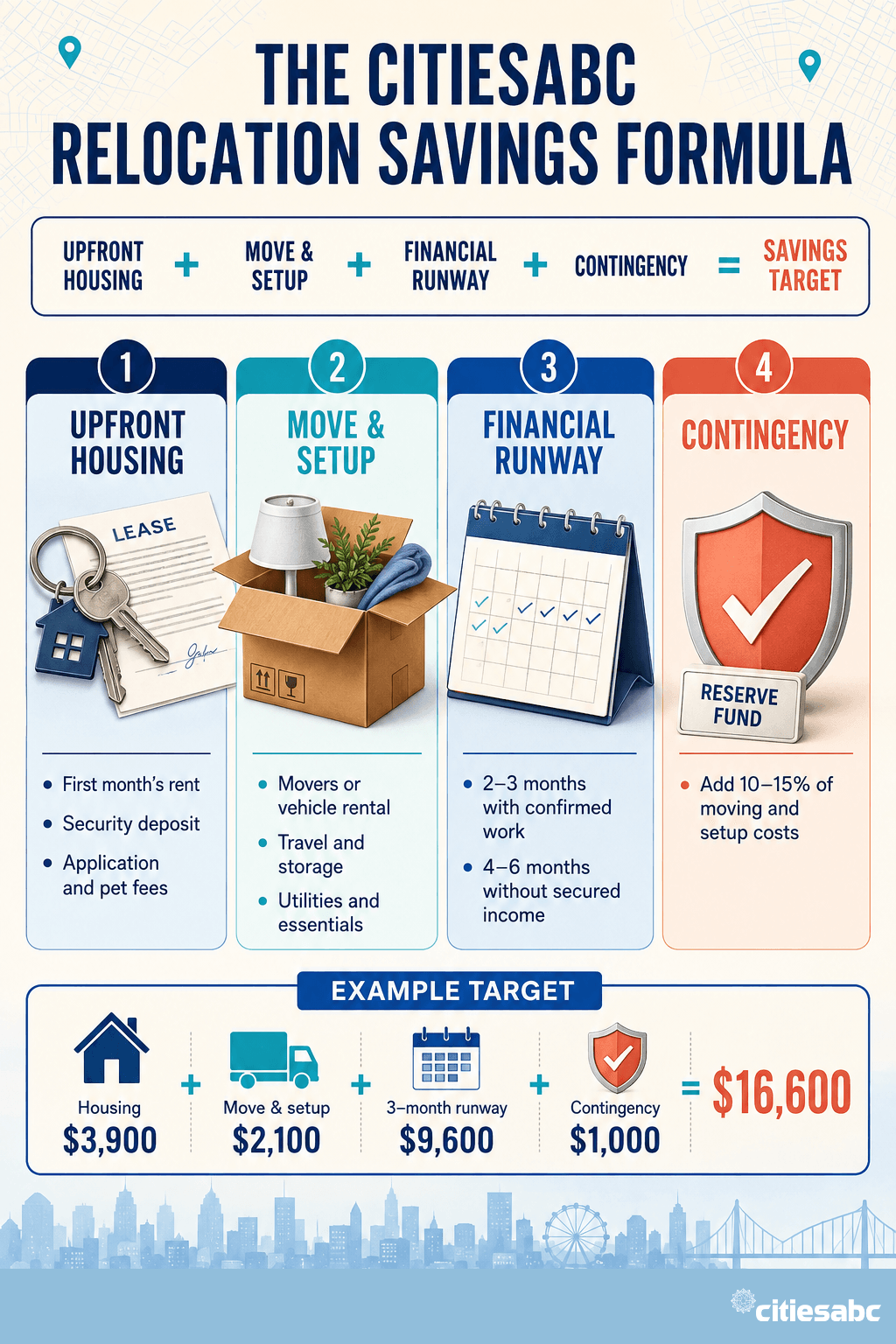
A useful estimate contains four separate funds.
1. Upfront housing costs
Depending on the property and local law, these may include:
- First month’s rent
- Security deposit
- Application or screening fees
- Holding deposit
- Broker or administrative fees
- Pet deposit
- Parking payment
- Renters insurance
- Temporary accommodation
Some landlords may request additional rent in advance, while certain states or cities limit the amount that can be charged. Verify the rules governing the destination rather than assuming that common practice elsewhere applies.
Do not send a deposit until the property, landlord or authorised agent and lease have been verified.
2. Moving and setup costs
The relocation budget should cover the process of reaching and establishing the new home:
- Moving company or vehicle rental
- Fuel, flights, tolls and accommodation
- Packing materials
- Storage
- Utility activation
- Internet installation
- Basic furniture and household supplies
- Building access, lift or parking charges
- Vehicle registration or local permits
- Childcare or pet-related moving costs
For an interstate US move, obtain written estimates and verify the mover through the Federal Motor Carrier Safety Administration. A low initial quote may exclude packing, stairs, long carries, storage or other additional services.
Citiesabc’s complete checklist for moving to a new city covers the practical checks to complete before signing a lease or hiring a mover.
3. Financial runway
Your runway is the amount required to cover essential living costs while income is interrupted or the move takes longer than planned.
Include:
- Housing
- Utilities and internet
- Groceries
- Transport
- Insurance
- Healthcare and medication
- Debt minimums
- Childcare
- Essential subscriptions
- Taxes for self-employed workers
Use local figures. National averages are useful for context but poor relocation budgets. The US Bureau of Labor Statistics reported that housing and transportation together represented just over half of average household expenditure in 2024. Both categories vary substantially between cities and even between neighbourhoods.
The MIT Living Wage Calculator provides county- and metropolitan-level estimates for housing, food, transport, healthcare and other necessities. HUD’s Fair Market Rent data can provide a second housing benchmark, although neither source replaces current property listings.
4. Contingency reserve
Add a separate contingency of approximately 10% to 15% of known moving and setup costs, or a fixed amount based on the largest plausible surprise.
This reserve could cover:
- A delayed moving truck
- Extra hotel nights
- A higher utility deposit
- Lost or damaged belongings
- Urgent travel
- A delayed first paycheck
- Immediate home repairs or replacements
The contingency should not replace the financial runway. One covers relocation surprises; the other supports normal living expenses.
Example relocation budget
Consider someone moving alone with confirmed employment:
| Budget item | Example amount |
|---|---|
| First month’s rent | $1,800 |
| Security deposit | $1,800 |
| Application and setup charges | $300 |
| Moving and travel costs | $1,500 |
| Essential household setup | $600 |
| Three months of essential expenses | $9,600 |
| Contingency reserve | $1,000 |
| Suggested savings target | $16,600 |
This is an illustration, not a national average. If the same person could rent a room, move fewer belongings and begin receiving income immediately, the target might be significantly lower. Someone moving without employment, supporting children or entering a high-cost city may require substantially more.
For lower-cost destinations, Citiesabc’s guide to the cheapest US cities to live in can support initial research. Always confirm present-day neighbourhood rents and transport requirements before deciding.
How much runway do you need?
Moving with a confirmed job
A target of two to three months of essential expenses after relocation costs may be reasonable when:
- The offer and start date are in writing.
- The job does not depend on an unresolved background, licensing or immigration condition.
- Housing has been secured.
- Health coverage and paycheck timing are understood.
- The position provides stable income.
Confirm when the first paycheck will arrive. Beginning work on the first day of a pay cycle does not necessarily mean being paid immediately.
Moving without a job
Consider four to six months of essential expenses, excluding the money already allocated to the move.
Increase the runway when:
- Employment prospects are uncertain.
- The industry has long recruitment processes.
- Income depends on commission or freelance work.
- The move requires professional licensing.
- You have dependants or significant medical expenses.
- Returning home would be expensive.
A move based only on expected future income carries more risk than one backed by a signed offer.
Moving for freelance or self-employed work
Variable-income workers should calculate runway using a conservative monthly income estimate, not their best recent month. They may also need funds for:
- Estimated taxes
- Health insurance
- Business registration
- Equipment
- Coworking space
- Payment delays
- Client acquisition
Invoices issued immediately after arrival may not convert into cash for several weeks.
Do not count every available dollar
Your moving budget should not reduce your bank balance to zero. The Consumer Financial Protection Bureau describes emergency savings as a reserve for unplanned expenses or financial shocks. That means planned rent, moving fees and furniture purchases should ideally be funded separately.
A simple structure is:
- Account 1: committed relocation expenses
- Account 2: post-move living runway
- Account 3: emergency reserve
This separation prevents the same money from being counted three times.
Likewise, include employer relocation assistance only after confirming:
- Whether it is paid in advance or reimbursed
- Which costs qualify
- When claims must be submitted
- Whether receipts are required
- Whether repayment is required if employment ends
- Whether the payment has tax consequences
A reimbursement received after moving cannot fund a deposit that is due beforehand.
How to lower the savings required
Reducing the cost of the move is safer than simply accepting a smaller reserve.
Practical options include:
- Renting a room before committing to a full apartment
- Selling bulky furniture rather than transporting it
- Negotiating relocation assistance
- Using temporary accommodation while inspecting neighbourhoods
- Comparing transit access with the cost of keeping a car
- Moving outside peak periods
- Delaying non-essential furniture purchases
- Securing remote or freelance income before departure
- Choosing a neighbourhood with lower combined housing and transport costs
The cheapest rent does not always produce the lowest living cost. A distant property may add vehicle payments, fuel, insurance, parking and substantial commuting time.
Final savings check
Before setting a moving date, confirm that your savings can answer “yes” to these questions:
- Can I pay all verified housing costs without borrowing?
- Can I complete the move and establish essential services?
- Can I cover several months of necessary living expenses?
- Can I absorb a delayed paycheck or job search?
- Do I still have cash for an actual emergency?
- Have I used destination-specific figures?
- Have I avoided counting uncertain reimbursements or future income?
If not, consider postponing the move, reducing its scope or securing income and housing first.
Final thoughts
The amount to save before moving to a new city is not a fixed multiple of rent. It is the cost of entering the new home, completing the relocation, maintaining essential life until income stabilises and absorbing one meaningful setback.
For many movers, that means saving relocation costs plus two to three months of essentials with confirmed employment, or four to six months without it. The most reliable figure, however, is the one built from the destination, household and employment circumstances—not a national headline.
Sources
- Consumer Financial Protection Bureau: Guide to Building an Emergency Fund
- US Bureau of Labor Statistics: Housing and Transportation Accounted for 50% of Household Spending
- MIT Living Wage Calculator: Methodology and Local Cost Categories
- US Department of Housing and Urban Development: Fair Market Rents
- Federal Motor Carrier Safety Administration: Estimating Moving Charges


