
How to Become a CEO: The Complete Guide to Leading Yourself First
10 Jul 2026

I do not think that there is any other quality so essential to success of any kind as the quality of perseverance. It overcomes almost everything, even nature. – John D. Rockefeller, late Founder and CEO of Standard Oil Company
It takes 20 years to build a reputation and five minutes to ruin it. If you think about that, you’ll do things differently. – Warren Buffett, CEO of Berkshire Hathaway
Before you command a company, you can only command yourself.
That single sentence is the whole of this article, and yet almost nobody starts there. We talk about becoming a CEO as if it were a title to be awarded, a corner office, a board seat, a headline. It isn't. It is a continuous journey of self-command that, if done well, eventually earns you the right to lead others.
There is an old proverb that captures it best: a chain is only as strong as its weakest link. A CEO is that chain. Every organisation, every strategy, every culture is only as strong as the person holding it together, and that strength starts inside, long before it shows up on a balance sheet.
“The value of an idea lies in the using of it.” – Thomas Edison, late Founder of Edison General Electric Company
Start by Becoming the CEO of Your Will
Leadership begins as an inside job. Guidance, direction, control, supervision, every synonym for leadership describes something you must first practise on yourself before you can offer it to others. Monetising a business starts with monetising passion, and passion only compounds when it's backed by discipline.
Every day, you are either the CEO of your will or a passenger in your own life. There is no third option. You need to put your heart into your work, translate that emotional drive into consistent action, and keep returning to the biggest version of your dream, in writing, until it becomes undeniable.
Steve Jobs put it simply when he reflected on being pushed out of the company he built: "Getting fired from Apple was the best thing that could have ever happened to me." The heaviness of success was replaced by the lightness of beginning again, and that lightness is where real leadership is often forged.
Don’t bunt. Aim out of the ballpark. Aim for the company of immortals. – David Ogilvy, late Founder of Ogilvy & Mather
Become the CEO of Your Emotions
Neuroscience has confirmed what the old strategists already knew: decisions are made in the same part of the brain that processes emotion. We tag our memories and experiences with feeling precisely so we can retrieve them at the moments that matter most. Persuasion is emotional. Inspiration is emotional. And so, on the road to becoming a CEO, every leader has to learn to educate their own unconscious emotional patterns before they can hope to guide anyone else's.
This isn't a soft add-on to leadership in 2026; it is a leadership skill. Daniel Goleman, the psychologist whose research popularised the field, calls emotional intelligence "the sine qua non of leadership", without it, he argues, even the sharpest analytical mind and the best training in the world won't make someone a great leader. Research continues to confirm the same pattern: emotional intelligence is now considered one of the most in-demand executive capabilities of the decade, and studies link high-EQ leadership teams to measurably stronger performance under pressure. Technical brilliance has become table stakes; composure, self-awareness and the ability to read a room without losing your own centre are the real differentiators. The CEOs who thrive are the ones who can sit with uncertainty publicly, acknowledging it, naming it, and still moving the room forward, rather than pretending to have all the answers.
Sun Tzu wrote it 2,500 years ago, and it has never ceased to be true:
If you know the enemy and know yourself, you need not fear the result of a hundred battles.
Leadership today is less about enemies and more about alignment, but the self-knowledge demanded is exactly the same.
Educate Yourself — Then Keep Unlearning
Most top CEOs still begin with a strong educational foundation: an undergraduate degree, years of hands-on experience, often an MBA earned after, not instead of, real operating experience. That pattern hasn't disappeared. What's changed is the half-life of what you learn.
Employers now expect roughly four in ten core workplace skills to shift by the end of the decade, and the gap between what AI tools can do and how well people actually use them has become one of the defining challenges for leaders everywhere. Professionals with demonstrable AI fluency are commanding higher pay than peers who don't have it, but fluency doesn't mean writing code. For a CEO, it means understanding how AI changes strategy: which decisions can be delegated to a system, which must remain human, and how to build a culture that treats continuous relearning as normal rather than remedial.
So the modern answer to "how do I educate myself to become a CEO?" has a second half nobody used to have to say out loud: get your degree, do the years on the ground and then never stop treating your education as finished. Learning agility has become as valuable as the learning itself.
If you are not embarrassed by the first version of your product, you’ve launched too late. – Reid Hoffman, Co-Founder of LinkedIn
Be Entrepreneurial, Stay Flexible
CEOs and entrepreneurs share the same DNA, and the fastest way to develop one's instincts is often to become the other, even briefly. Building something from nothing, a side project, a small team, a startup, teaches a kind of ownership no corporate ladder can replicate. If an opportunity to build appears and it looks like a faster path to real leadership than your current role, don't wave it away out of caution. Every rung climbed on your own build is a credential that no business school issues.
But ambition without flexibility burns out fast. The leaders who last are the ones willing to change direction under pressure, to take the assignment nobody else wants, to move cities or industries when the moment calls for it. In an environment increasingly defined by geopolitical shifts, automation and volatile markets, the ability to provide strategic clarity without pretending to have false certainty has become one of the clearest markers of a future-ready CEO. As Gunter Beitinger, SVP Manufacturing at Siemens, put it in a recent World Economic Forum roundtable, "the future of jobs will be shaped less by technology than by leadership choices."
We are living through an age of both scarcity and abundance at once, information has never been more abundant, but sound judgement, discernment and the willingness to decide under ambiguity remain scarce. That scarcity is exactly where a real CEO earns their seat.
Build the Team, Then Get Out of Its Way
No CEO exists without a team, and no team performs without clarity. Set clear KPIs. Set a clear culture. Give people the briefing and the tools, then hold them to a standard, and own your share of the blame when something goes wrong, because it usually traces back further up the chain than anyone wants to admit.
The best leaders in 2026 are increasingly judged less by their own individual brilliance and more by the strength of the leadership ecosystem they build around them, and by their capacity to empower a genuinely capable team rather than centralising every decision. As more organisations blend human and AI-driven workflows, that orchestration skill, knowing what to delegate to a person or to a system, and what to hold onto personally, is becoming the real test of executive capability. Sulaekha Kolloru, Chief Strategy Officer at Pearson, frames the priority well: the organisations that win will be the ones investing in "critical thinking, creativity, and discernment" in their people, not just AI fluency. Cultural stewardship, shaping behaviour by example rather than instruction, is what separates leaders people follow out of respect from managers people follow out of obligation.
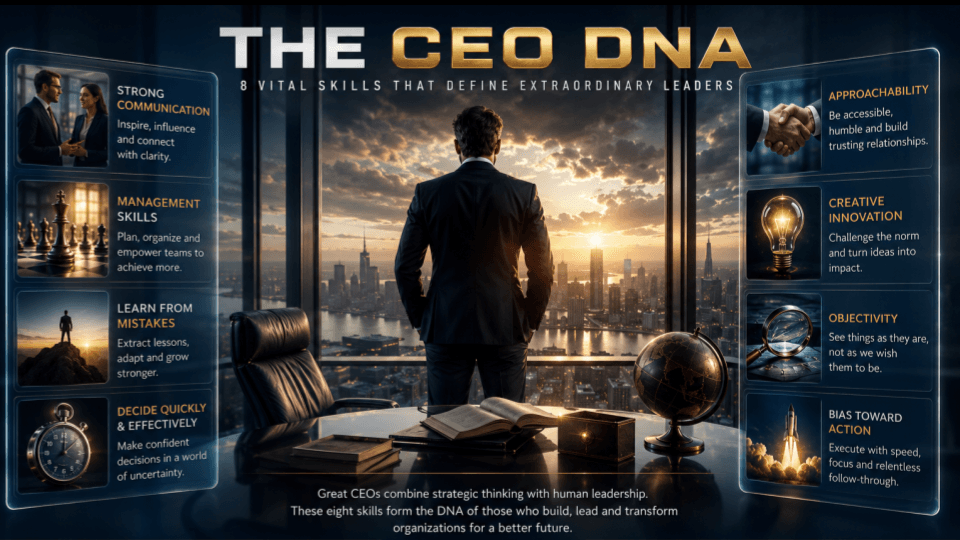
Ask yourself the questions that have always mattered, updated for the world we're actually in: Do you believe in your people enough to let them struggle before you rescue them? Are you persistent through disappointment? Are you thinking big while everyone around you thinks small? Are you willing to leave your comfort zone repeatedly, not once? Do you make decisions quickly and wisely, and act on them without delay?
The CEO Within You
Becoming a CEO was never really about the title. It was always about the daily, unglamorous work of leading your own will, managing your own emotions, staying educable, staying flexible, and building people up faster than you build yourself up. That was true when Machiavelli wrote that "where the willingness is great, the difficulties cannot be great," and it remains true now, in an age where machines can calculate faster than any of us but still cannot want anything at all.
The chain is only as strong as its weakest link. Make sure that link isn't you.
Further Reading & Sources
- Gunter Beitinger (Siemens) & Sulaekha Kolloru (Pearson), quoted in World Economic Forum, "The future of jobs: 6 decision-makers on AI and talent strategies" — weforum.org
- Daniel Goleman, quoted in Vistage, "Why Emotional Intelligence Makes the Best Leaders" — vistage.com
- World Economic Forum, Four Futures for Jobs in the New Economy: AI and Talent in 2030 — weforum.org
- World Economic Forum, Davos 2026: Jobs and Skills Transformation — weforum.org
- PwC, 2026 Global AI Jobs Barometer — pwc.com
- Cornerstone, Key Leadership Qualities Every CEO Should Have in 2026 — cornerstone.co.in


