


business resources
How to Sell a Rental Property With Tenants Still in Place: A Landlord's Guide
23 Aug 2026

imported-image-1787450857796.png
Selling a rental property used to mean a simple choice: wait for the tenancy to end, or serve notice and wait for the tenants to leave. Since the Renters' Rights Act abolished Section 21 evictions on 1 May 2026, that choice has changed for good. More landlords are now turning to tenanted sales, selling a property with the existing tenant still living there, as one of the fastest ways to move a rental on without months of legal process. It suits investors too, who get rental income from day one. This guide walks through what a tenanted sale actually involves, what it costs you in value, and how to get it right from listing to completion.
Key Takeaways
- Selling with tenants in situ lets you keep collecting rent right up to completion, with no void period.
- Since 1 May 2026, landlords need a specific legal ground (Ground 1A) to gain vacant possession for a sale, with four months' notice.
- A sitting tenant typically reduces a property's value by 20 to 40%, depending on the type of tenancy.
- Buyers are almost always other landlords or investors, so marketing and paperwork need to speak to them directly.
- Clear, early communication with your tenant is usually the single biggest factor in a smooth, fast sale.
What Does It Mean to Sell With a Tenant Still There?
A tenant in situ, also called a sitting tenant, is someone who continues living in a rental property while it changes hands. Their tenancy agreement transfers automatically to the new owner on completion, along with the deposit, the rent, and every legal obligation that comes with being a landlord.
If you are new to selling house with tenants, the first thing to understand is that the tenancy itself does not end when you sell. The buyer simply steps into your shoes as landlord. Nothing about the tenant's rights, rent level, or notice protections changes because the property has a new owner.
This is different from selling with vacant possession, where the property is empty on completion. Vacant sales usually attract a wider pool of buyers, including owner-occupiers, but they take longer to arrange and mean a gap with no rental income while the property sits empty.
Why More Landlords Are Choosing This Route in 2026
What Changed for Landlords Wanting to Sell
Tenanted sales have become far more common since Renters' Rights Act 2025 came into force on 1 May 2026. The Act abolished Section 21 'no-fault' evictions, which previously let landlords recover a property without giving a reason.
Landlords who now want vacant possession to sell must rely on Ground 1A instead. This ground brings a four-month notice period, cannot be used within a tenancy's first 12 months, and carries fines as high as £40,000 if misused. The full rules are set out in the government's official guidance on Renters' Rights Act rules for landlords.
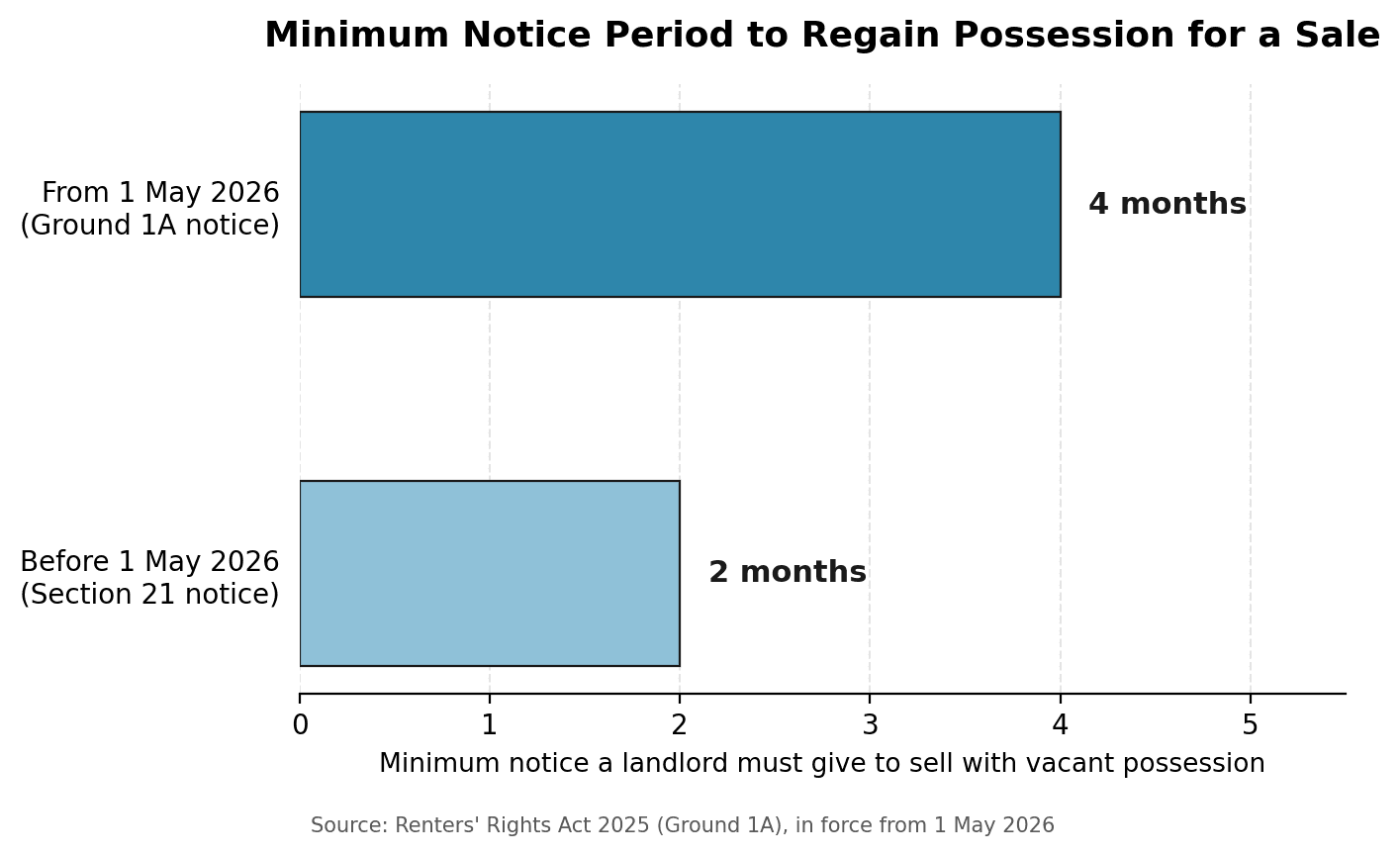
Minimum notice a landlord must give to regain an empty property for sale.
For many owners, that longer timeline makes a tenanted sale the more practical option. You keep receiving rent throughout the marketing and legal process, avoid a lengthy possession claim, and hand the tenancy straight to the buyer on completion. Investors, meanwhile, get a property that already earns rent from the outset, which is exactly why buy-to-let buyers actively seek out tenanted stock.
“Since 1 May 2026, ending a tenancy to regain vacant possession calls for at least four months' written notice under Ground 1A, and landlords cannot serve it during a tenancy's first year.”
Tenanted Sale vs Vacant Possession: Weighing Your Options
Choosing between the two routes comes down to what matters more for your situation: speed and continued income, or a wider buyer pool and a higher price.
| Factor | Tenanted Sale | Vacant Possession |
| Rental income during sale | Continues uninterrupted | Stops once the tenant leaves |
| Likely buyer pool | Landlords and investors only | Owner-occupiers and investors |
| Typical timeline | No possession process needed | Notice period plus moving-out time |
| Sale price | Usually lower | Usually higher |
| Extra paperwork | Tenancy and compliance documents | Standard conveyancing only |
How Much Value Do You Lose With a Sitting Tenant?
Keeping a tenant in place when you sell almost always means accepting a lower price than an equivalent empty property. Industry estimates suggest a sitting tenant on an assured shorthold tenancy typically reduces value by around 20 to 25%, because the buyer pool narrows to investors who price in the hassle of managing an existing tenancy. Older regulated tenancies, which carry stronger long-term protections, can reduce value by as much as 35 to 40%.
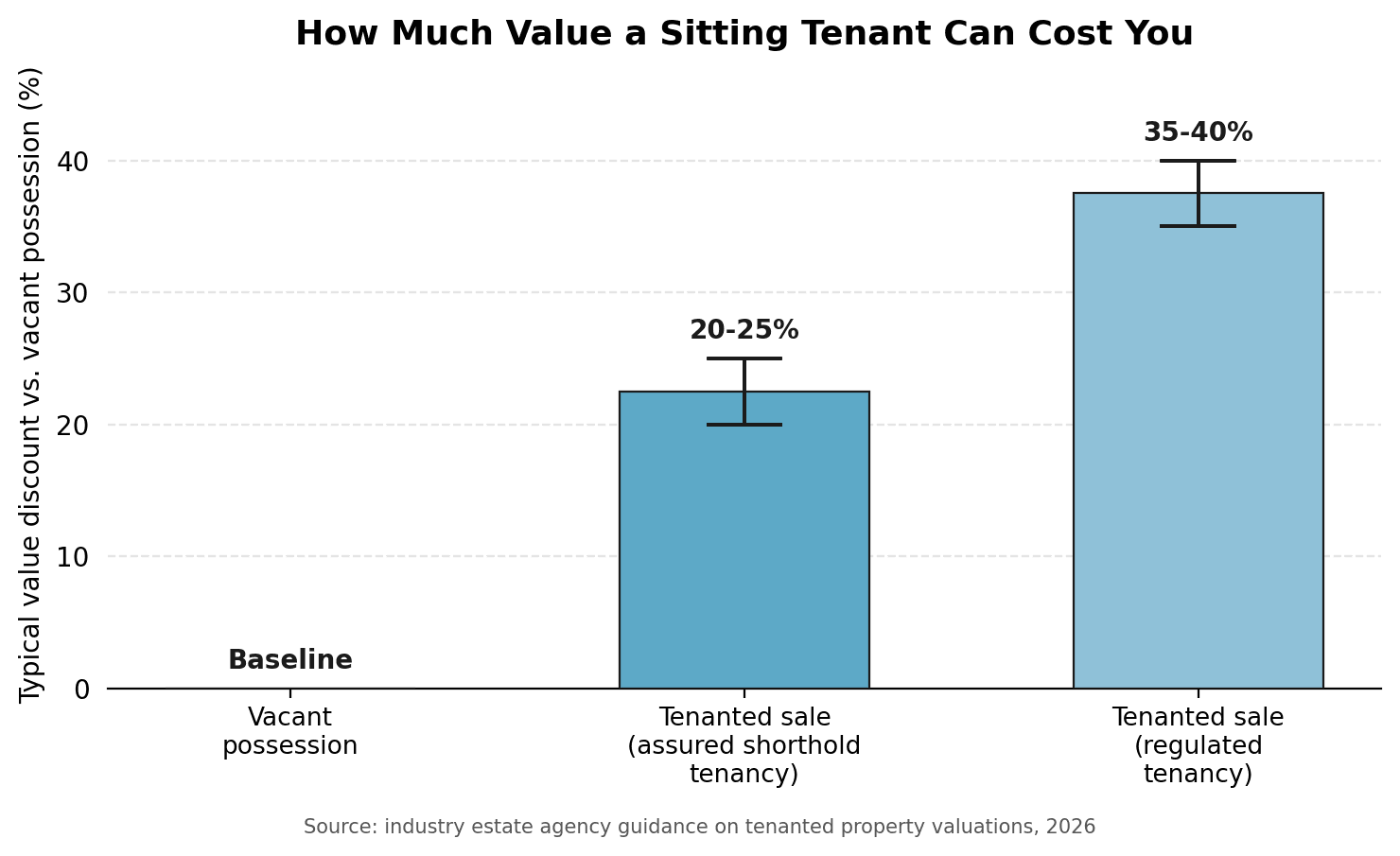
Typical value discount for tenanted sales compared with vacant possession.
The gap varies by area. In strong rental markets, where investors are actively hunting for ready-made income, the discount can be much smaller. A well-presented property, a reliable tenant, and a fully compliant paperwork file all help narrow it.
| Pro tip Ask your agent for two valuations before deciding which route to take: one for vacant possession, one tenanted. The difference tells you exactly what speed and certainty are costing you. |
The Paperwork and Compliance Checklist Before You List
Buyers' solicitors will ask for every certificate before exchange, so gathering these early keeps momentum:
- A valid, in-date gas safety certificate
- A current Energy Performance Certificate (EPC)
- Confirmation the tenancy deposit is registered with a government-backed scheme
- An up-to-date electrical safety (EICR) certificate
- Right to Rent checks on file for each tenant
- A copy of the written tenancy agreement or statement of terms
- The Act's Information Sheet, which must have been issued to every tenant by 31 May 2026, with penalties of up to £7,000 for missing this
| Watch out Missing paperwork is the most common reason a tenanted sale stalls. The same record-keeping discipline that helps commercial teams keep larger portfolios compliant, as covered in this guide on building more resilient commercial properties, applies just as well to a single rental home. |
For a fuller rundown of what has changed for sellers specifically, the National Residential Landlords Association has published detailed guidance for landlords selling under the new rules.
How to Talk to Your Tenant About Selling
How you break the news matters. Tenants who feel blindsided are far less likely to cooperate with viewings, and an uncooperative tenant can slow a sale by months. Explain your reasons plainly, confirm that their tenancy and deposit protection are unaffected, and give at least 24 hours' written notice before every viewing.
Reviews of London letting agencies show how much difference good handling makes in practice. One landlord on Trustpilot summed up their experience of a tenanted letting: “Huge thank you for Erica for taking care of tenants and flats.” Agents who brief tenants early, coordinate access respectfully, and keep everyone informed at each stage tend to keep stress low and sales on schedule.
Small, cost-effective updates before listing can also help offset some of the valuation gap. This guide to renovating a home for the best return is a useful starting point, even for a tenanted property where major works are not practical.
Step-by-Step: Marketing and Completing a Tenanted Sale
- Get a tenanted valuation from at least two local agents
- Gather your compliance paperwork before going live
- Brief your tenant and agree viewing protocols together
- Market the property specifically to investors and portfolio landlords
- Instruct a solicitor experienced in tenanted transactions
- Transfer the deposit and tenancy file to the buyer's solicitor at completion
[Video: “Buying or Selling a Property in the UK with tenant in situ”, https://www.youtube.com/watch?v=PUPqsNqvkts] This short video walks through the practical pros and cons that sellers and buyers weigh up when a tenancy is already in place.
Kerb appeal still matters to investor buyers, and small exterior improvements, such as those covered in this piece on restoring weathered masonry, can lift first impressions without a full renovation budget.
Frequently Asked Questions
Can I sell a house with tenants in the UK?
Yes. This is legal and common, and the occupant does not need to move out for the sale to proceed. The tenancy simply carries over to whoever buys the property, and the tenant's rights continue exactly as before under the new landlord.
Do I need my tenant's permission to sell?
No, but you must give reasonable notice for viewings, usually at least 24 hours in writing, and respect their right to quiet enjoyment of the property throughout the process.
What happens to the deposit when I sell?
The deposit transfers to the new landlord through the existing protection scheme. Your solicitor handles this as part of the completion paperwork, alongside the tenancy file.
Will selling with tenants get me a lower price?
Usually yes. Industry estimates put the discount at around 20 to 25% for assured shorthold tenancies, and higher for older regulated tenancies, though strong local rental demand can narrow this.
Can I still evict a tenant to sell with vacant possession?
Only by using Ground 1A, introduced through this 2025 reform. It needs four months' notice in writing and only applies once a tenancy is at least a year old.
How long does a tenanted sale take?
Timelines are similar to a standard sale, and often faster since there is no possession process to complete, typically three to six months from start to finish.
Conclusion
Selling a rental home while the occupant stays put is no longer a fallback option; for many landlords, it has become the sensible one. It keeps the rent coming in, sidesteps the longer notice periods the new law now demands, and hands investors exactly the kind of ready-made income property they are searching for. Get the paperwork in order, keep your tenant informed, and price the sale realistically against a tenanted valuation, and the process can move faster than many landlords expect. A local agent who regularly handles tenanted transactions can help you weigh the numbers against your own circumstances before you list.
References
GOV.UK, Renters' Rights Act: an overview for landlords, 2026. https://www.gov.uk/guidance/renters-rights-act-an-overview-for-landlords
National Residential Landlords Association, Selling under the Renters' Rights Act, 2026. https://www.nrla.org.uk/news/selling-under-the-renters-rights-act
Osbornes Law, Abolition of Section 21 Notice: Key Dates, 2026. https://osborneslaw.com/blog/section-21-abolition-key-dates/
Woodward Estate Agents, Learn How to Sell a Property with Tenants in Situ: A Complete Guide. https://www.woodward.co.uk/news/learn-how-to-sell-a-property-with-tenants-in-situ-a-complete-guide/
Trustpilot, Oliver Jaques Estate Agents Reviews. https://www.trustpilot.com/review/o-j.co.uk
Fact Check: All statistics and data points in this article were verified against original sources as of 21 August 2026. Sources are listed in the References section.


