
first_page, citiesabc
India’s Data Center (Part 4/4): Case Study: The AI Public Infrastructure Initiative as a Catalyst for Data Centre Expansion
24 Feb 2026

Context and Rationale
Acknowledging compute as a foundational input for artificial intelligence, the Government of India has launched a public AI infrastructure strategy within the broader IndiaAI Mission. In contrast to previous digital initiatives that emphasised connectivity and applications, this program specifically addresses compute availability, affordability, and geographic distribution as critical constraints on AI adoption.
The initiative marks a policy shift by positioning AI compute infrastructure as public digital infrastructure, comparable to roads, power grids, or telecommunications, rather than viewing it solely as a private-sector responsibility.
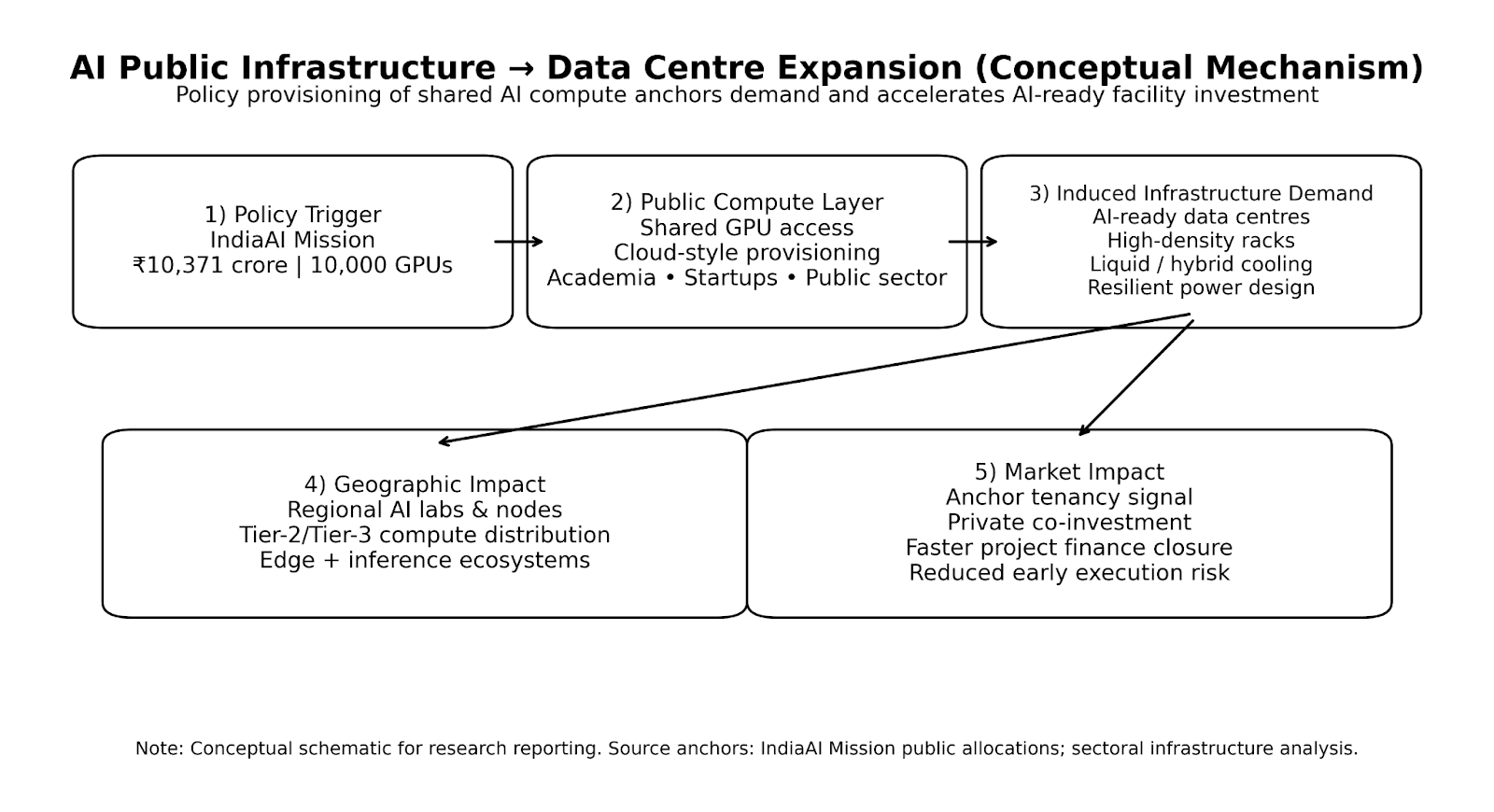
A core component of this strategy is the government's allocation of ₹10,371 crore (approximately USD 1.25 billion) for the procurement and provisioning of 10,000 GPUs. These resources are intended to support research institutions, startups, academia, and public-sector applications. This intervention aims to address market failures resulting from high entry costs, limited domestic GPU availability, and the concentration of AI compute resources among a few hyperscale operators.
Infrastructure Design and Implementation Model
The AI public infrastructure initiative employs a shared-access, platform-based model in which compute resources are provided through cloud-like interfaces rather than dedicated ownership. This approach reduces barriers to entry for smaller firms and research institutions while maximising the utilisation of costly GPU assets.
Notably, the initiative extends beyond a single centralised facility; policy documents indicate an intention to support distributed AI laboratories and compute nodes across multiple regions, consistent with broader goals of decentralisation and regional capacity building.
From the perspective of data centers, this model creates anchor demand for AI-optimised facilities, such as high-density racks, liquid cooling systems, and resilient power architectures. Public procurement of AI compute reduces risk for early-stage infrastructure investment, establishing baseline utilisation that can stimulate private-sector co-investment in additional capacity.
Related Content: surat economy
Implications for the Data Centre Ecosystem
The AI public infrastructure initiative produces several secondary effects on India's data center market.
- Accelerating AI-Ready Infrastructure Standards: The initiative prompts operators to implement higher rack densities, advanced cooling technologies, and enhanced power efficiency. As government facilities establish operational benchmarks, private operators must match or exceed these standards to remain competitive for enterprise and hyperscale clients.
- Geographic Dispersion of AI Compute: By promoting geographic distribution of AI compute, the initiative strengthens the economic rationale for Tier-2 data center locations, particularly for inference, training, and disaster-recovery workloads associated with regional AI laboratories. This aligns with broader infrastructure decentralisation goals and reduces concentration risk in Tier-1 metros.
- Data Localisation Alignment: The initiative aligns with data localisation requirements under the Digital Personal Data Protection Act, thereby reinforcing demand for domestic storage and processing of AI-generated and AI-training data. In contrast to purely commercial hyperscale expansion, public AI infrastructure ensures policy continuity and long-term demand visibility, mitigating exposure to short-term market fluctuations.
- De-Risking Private Investment: Public procurement establishes baseline utilisation and validates market demand, reducing risk for private operators considering AI-optimised facility investments. This anchor tenant model parallels successful infrastructure development strategies in telecommunications and renewable energy sectors.
Challenges and Limitations
Despite its strategic importance, the initiative encounters several implementation challenges.
- GPU Supply Chain Constraints: GPU availability is limited by global supply chain constraints, with lead times extending 12-18 months for advanced chips. Competition with hyperscale operators and international governments for limited supply creates procurement uncertainty.
- Technology Obsolescence Risk: Rapid technological advancement in AI hardware shortens asset lifecycles. GPUs procured today may face performance limitations within 3-5 years as newer architectures emerge, requiring continuous refresh cycles and sustained capital commitments.
- Complementary Infrastructure Requirements: Effective GPU utilisation requires complementary investments in power reliability, cooling infrastructure, skilled personnel, and software orchestration layers. Without these supporting elements, compute resources risk underutilisation or performance bottlenecks.
- Governance Complexity: Coordination among central ministries, state governments, and private data center operators adds governance complexity. Successful execution requires alignment across technology policy (Ministry of Electronics and IT), power infrastructure (Ministry of Power), state-level incentives, and private facility operators.
- Measurability Timeline: Measurable outcomes such as utilisation rates, cost reductions, or innovation spillovers will only become apparent over the medium term, limiting the possibility of immediate empirical validation. This creates challenges for policy evaluation and iterative refinement.
Research Insight
India's AI public infrastructure initiative constitutes an innovative policy mechanism that connects digital sovereignty, innovation capacity, and physical infrastructure development. By socialising early-stage compute investment and relying on private operators for facility development and operations, the model integrates public provisioning with market-based execution.
For the data center sector, this approach serves as both a demand anchor and a technology accelerator, influencing infrastructure design decisions and geographic distribution. More broadly, it demonstrates how governments can shape capital-intensive digital infrastructure markets through targeted public compute investments rather than direct facility ownership.
The initiative reflects recognition that AI compute capacity constitutes strategic infrastructure requiring government intervention to ensure equitable access, prevent market concentration, and support domestic innovation ecosystems. This represents a departure from purely market-driven infrastructure development and establishes a model potentially applicable to other emerging technologies requiring high-capital, high-utilisation infrastructure.
As India competes globally for AI leadership and digital sovereignty, the success of this public infrastructure initiative will significantly influence the country's position in the global AI value chain and its ability to capture economic value from AI-driven innovation.


