
resources
Interactive Map of California Cities: Find Your Next Destination
05 Jan 2026

Considering a journey to the Golden State? California, with its immense span, presents a breathtaking array of landscapes, from its iconic coastline to its majestic mountains, and myriad captivating locales in between. Deciphering where to go and how best to navigate this diverse state can, at times, feel a little overwhelming, can't it? That's precisely where an insightful map of California's cities and regions becomes an invaluable planning tool. We're about to explore how various mapping resources can significantly enhance your adventure preparations, whether your interests lie in bustling urban centers, breathtaking scenic drives, or historically significant landmarks. Let's embark on this journey to simplify your California trip planning.
Key Takeaways
- California’s geography is remarkably varied, encompassing distinct regions like the coast, mountains, and deserts, each promising unique and unforgettable experiences.
- Major highway maps are essential for comprehending travel routes and distances across this expansive state, effectively linking its cities and attractions.
- Specialized maps can illuminate particular interests, such as the historic Spanish missions, celebrated architectural designs, or significant geological features like the famed San Andreas Fault.
- Interactive travel applications are increasingly popular tools for trip planning, offering customized itineraries, invaluable local tips, and real-time, on-the-go information.
- Visualizing California's diverse landscape through detailed relief maps and clear distance charts provides a more profound understanding of potential travel times and the state's intricate physical layout.
Navigating California's Diverse Regions
Understanding California's Geographic Divisions
California isn't merely a wide state; it stretches an impressive distance from north to south—approximately 800 miles from the Oregon border all the way down to Mexico. This sheer magnitude necessitates a natural division into markedly different areas, each possessing its own distinctive character and appeal. Notably, two major mountain ranges traverse the state, running predominantly north and south, effectively acting as natural separators. This topographical arrangement often means that traveling from one side of the state to the other can involve quite a journey, even if two points appear relatively close on a flat map. For instance, a direct, "as the crow flies" distance of only 100 miles between two towns might translate into a 400-mile road trip, purely because you must navigate around or over these imposing mountain barriers.
The way the land is shaped in California really influences how people travel and what they see. It's not just about the cities and towns; the mountains and valleys play a huge role in the state's character and how you get around.
Exploring Coastal and Inland Areas
When most people conjure an image of California, it's often the sun-kissed coastline that first springs to mind. And it's true, the Pacific coastline is world-renowned, stretching majestically from the Mexican border northward to Oregon. This beloved strip is brimming with popular destinations, pristine beaches, and some of the most scenic drives imaginable. Many visitors understandably gravitate towards this coastal expanse, and for excellent reason—it's simply stunning!
However, one shouldn't overlook the state's rich and varied inland areas. These regions are incredibly diverse. Consider the vast Central Valley, which serves as the agricultural heartland, producing an astonishing proportion of the nation's food supply. Then there are the southern deserts, famed for their unique, often stark, landscapes and dramatic temperatures. And, of course, don't forget the magnificent mountains, such as the Sierra Nevada, which provide everything from exhilarating winter skiing to sublime summer hiking and picturesque alpine lakes. Each inland area, distinct in its offerings, presents both unique attractions and engaging challenges for the discerning traveler.
Discovering Northern and Southern California
California is typically conceptualized as comprising two principal sections: Northern California and Southern California. These two halves, while part of the same grand state, possess quite distinct atmospheres and identities.
- Northern California: This vibrant region encompasses the celebrated San Francisco Bay Area, home to iconic landmarks and leading technology hubs. Further northward, one discovers the rugged beauty of the North Coast with its ancient redwood forests and the Shasta Cascade region—a veritable paradise for outdoor enthusiasts. Gold Country, nestled in the Sierra foothills, offers a captivating journey into the state's rich history.
- Southern California: Here, you'll find the expansive Los Angeles County, synonymous with the entertainment industry and magnificent beaches. Orange County is globally recognized for its world-class theme parks and charming coastal communities. The desert regions offer a starkly beautiful, contrasting landscape, while San Diego County boasts mile upon mile of sunny coastline and a wonderfully relaxed ambiance. The Inland Empire, situated east of Los Angeles, provides a compelling blend of suburban living and accessible natural escapes.
Grasping these broad regional divisions proves immensely helpful in planning a trip, as the experiences and natural settings can genuinely differ enormously from one area to the next.
Key Maps for California Exploration
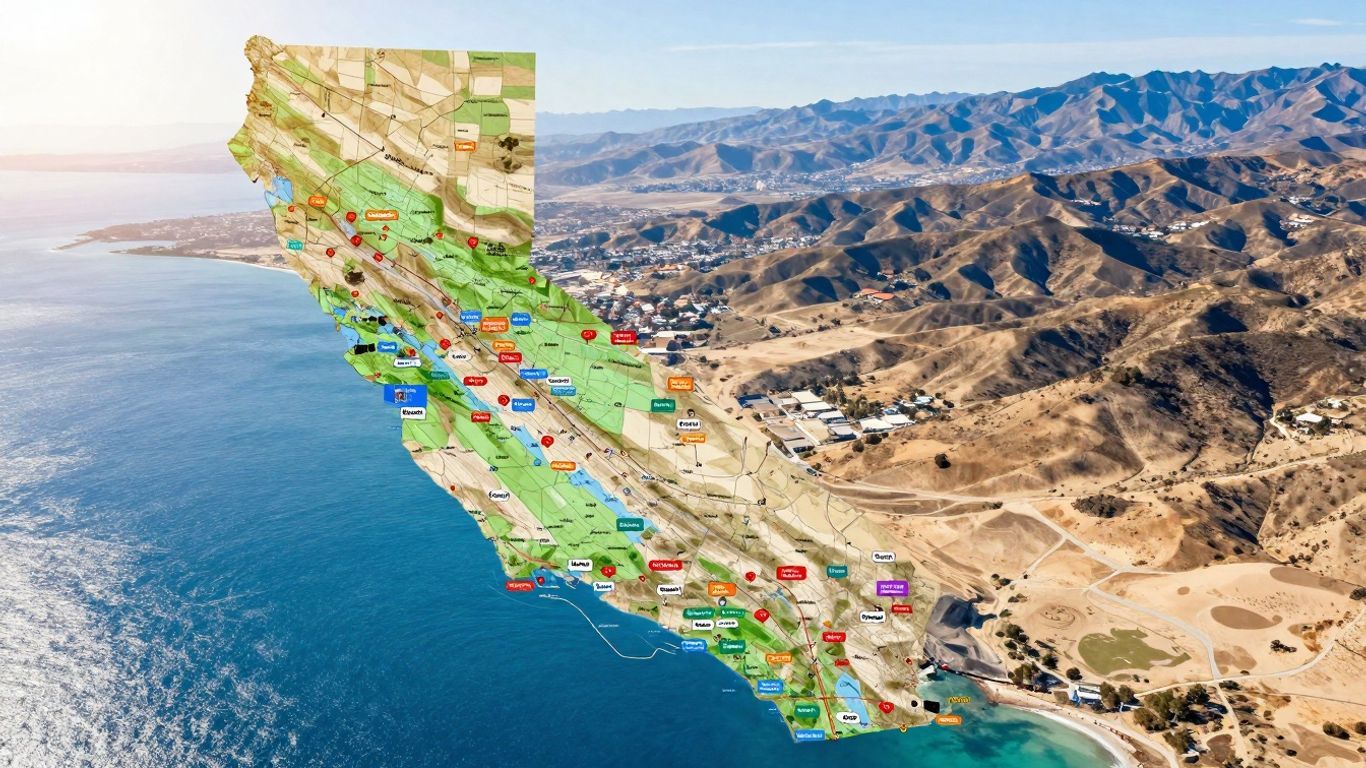
Major Highway Routes Across the State
Embarking on a road trip across California can, admittedly, feel a bit overwhelming given its sheer scale. With the state spanning approximately 800 miles from north to south, gaining a clear understanding of its primary transportation arteries is truly your essential first step. This particular map thoughtfully emphasizes the major highways, skillfully omitting the smaller roads that might otherwise clutter your perspective. It's specifically designed to help you outline a general route, whether your ambition is to journey from the Oregon border all the way down to Mexico or to thoroughly explore a specific region. You’ll quickly discern how California’s two prominent north-south mountain ranges significantly influence travel times—sometimes transforming what appears to be a short distance on a map into a considerably longer drive in real-world conditions.
Mapping California's Scenic Coastline
For a great many visitors, the irresistible draw of California lies in its truly spectacular Pacific coastline. This specialized map thoughtfully highlights all the popular points of interest along this iconic stretch, from the Mexican border northward to Oregon. It's absolutely perfect for those eager to soak in the refreshing ocean breezes, discover charming beach towns, and marvel at dramatic coastal cliffs. Consider it your indispensable guide to crafting the ultimate coastal drive, carefully pointing out key areas and attractions that you simply won't want to miss.
Locating Historic California Missions
California's rich history is profoundly interwoven with the 21 Spanish missions originally established by early Franciscan priests. These venerable historic sites are thoughtfully distributed across the state, each preserving its own compelling narrative and distinctive architectural style. This particular map precisely pinpoints the exact location of every mission that still graces the California landscape today. It serves as an exceptional resource for anyone captivated by California's colonial past and offers a truly unique method for tracing the state's foundational development.
Understanding the state's geography and historical routes through these specialized maps can make trip planning much more effective and enjoyable.
Specialized Maps for Unique Interests

Tracing the San Andreas Fault Line
California is a state undeniably shaped by powerful geological forces, and among them, the San Andreas Fault is arguably the most famous. This colossal fault line slices for hundreds of miles through the state, precisely marking the boundary between the Pacific Plate and the North American Plate. While one can't literally 'drive' along its entire length, specialized maps are incredibly helpful in visualizing its intricate path and even observing some of its dramatic effects on the landscape. These maps frequently highlight areas where the earth has visibly shifted, creating unique geological formations. You might discover features such as offset streams, distinctive sag ponds, and pronounced scarps clearly delineated. Understanding the fault's trajectory can truly offer a fascinating perspective on California's dynamic geology—a powerful reminder of the profound natural processes that continue to sculpt the Golden State.
Following Historic Route 66
Route 66, affectionately known as the "Mother Road," holds a truly special place in the annals of American history and culture. While much of the original highway has since been decommissioned or superseded by modern interstates, dedicated maps can skillfully guide you along its most iconic stretches within California. These invaluable maps typically trace the route from the Arizona border all the way to its historic terminus in Santa Monica. Along this journey, you’ll find marked points of interest, including classic diners, charming vintage motels, quirky roadside attractions, and significant historic markers. It’s an authentic journey back in time, offering a captivating glimpse into a bygone era of American travel. Planning such a trip often involves consulting maps that meticulously detail:
- Original alignments of Route 66
- Key towns and cities situated along the path
- Notable historical sites and attractions
- Modern road segments that still closely follow the historic route
Discovering Frank Lloyd Wright's California Designs
For those with a keen interest in architecture, California proves to be a true treasure trove of Frank Lloyd Wright's groundbreaking designs. While he's perhaps most famously associated with the Midwest, Wright undeniably left a substantial architectural footprint across the Golden State. Specialized maps can precisely pinpoint the locations of his surviving buildings, encompassing everything from private residences to significant commercial structures. These maps are utterly invaluable for anyone eager to experience his unique Prairie School and Usonian styles firsthand. You might well be surprised by the sheer variety and often unexpected locations of these structures, some of which are nestled in truly unconventional settings. Exploring these sites presents a remarkable opportunity to appreciate Wright's visionary approach and observe how his designs elegantly integrate with the diverse California landscape.
Interactive Tools for Trip Planning
Leveraging Destination-Specific Apps
Planning a memorable trip to California can, at first glance, seem like quite a formidable undertaking, can't it? Fortunately, many regions across the Golden State now offer their very own dedicated applications. Think of them as your personalized, pocket-sized guides, always at your fingertips. These apps are meticulously crafted by local experts, meaning they’re perfectly positioned to reveal unique attractions and experiences you might otherwise miss. You can effortlessly search for popular landmarks, discover local events, and even explore dining options. The most appealing aspect? You can often integrate these directly into your saved trip plan with a simple tap.
Some applications are particularly adept at helping you curate activities based on your specific preferences. For instance, while an app for Greater Palm Springs might highlight museums and architectural tours, another, like artsGPS, could exclusively focus on compelling outdoor art installations. It’s truly like having a custom-tailored tour designed just for you.
- Easily find local events and attractions.
- Receive personalized recommendations based on your interests.
- Save desired locations to your itinerary with a single tap.
- Get timely alerts for local news or valuable travel tips.
These destination-specific apps are rapidly growing in popularity. Their primary goal is to provide you with a genuinely personalized experience, showcasing what truly makes that particular corner of California special. It's an efficient way to access reliable, localized information, all conveniently housed in one place.
Customizing Your Itinerary with Digital Guides
Once you've identified potential places to visit, these sophisticated digital guides seamlessly assist you in piecing everything together. Many apps provide the capability to construct your own detailed trip plan. You have the freedom to select activities, restaurants, and sights, then arrange them in a sequence that makes the most logistical sense for your journey. Some even offer turn-by-turn directions that ingeniously incorporate local landmarks, which can prove incredibly beneficial once you're on the ground.
It's not merely about seeing the sights; it's fundamentally about optimizing the trip to suit your individual needs and pace. If, for example, you're heading to a destination like Big Bear, an app might furnish you with highly detailed trail maps for hiking or biking—complete with difficulty ratings and precise parking information. This level of granular detail truly empowers you to plan your days more effectively and preempt any unforeseen surprises.
Utilizing Mobile Features for On-the-Go Planning
When you're actively traveling, your smartphone undeniably transforms into your most indispensable planning companion. Many applications boast features specifically designed to assist you precisely when you need them most. For instance, some apps can provide real-time information, such as immediate traffic updates or even current crowd levels at popular spots, often courtesy of integrated webcams. Others might offer specialized transit services, perhaps free on-demand rides in particular areas, to facilitate effortless local movement.
The most advantageous mobile features frequently include real-time updates and direct, easy access to booking or reservation links. This means you can secure a last-minute dinner reservation or book a fascinating tour directly from your app while you're out exploring. Such capabilities undoubtedly streamline the entire travel experience, allowing you to immerse yourself more fully in enjoying California and spending less time fretting over logistical intricacies.
Visualizing California's Landscape
California is a state defined by its extraordinary geographic diversity, and truly grasping its physical layout is paramount to successfully planning any visit. From its towering mountain ranges and expansive deserts to its long, intricately winding coastline, the state's remarkable landscape profoundly influences everything from estimated travel times to the variety of activities you can thoroughly enjoy.
California Relief Map for Topographical Insights
A relief map, by design, illustrates the elevation of the land, providing a vivid sense of the state’s mountains, valleys, and plains. This particular type of map is exceptionally useful for comprehending how California's major mountain ranges—such as the formidable Sierra Nevada and the coastal Coast Ranges—naturally segment the state. These inherent topographical barriers can significantly affect travel logistics, often making direct routes considerably longer than they might appear on a two-dimensional map. For instance, navigating from one side of these mountains to the other frequently necessitates substantial detours, easily adding hours to your drive. A deeper understanding of these topographical features helps explain why certain regions remain more remote or why specific routes serve as the primary conduits for travel.
Mapping California's Mountain Ranges
California is graced with several prominent mountain ranges that not only define its unique character but also profoundly influence its climate and accessibility. The Sierra Nevada, stretching along the state's eastern flank, is celebrated for its dramatic, sky-piercing peaks, including Mount Whitney—the highest point in the contiguous United States. To the west, the Coast Ranges form a natural barrier between the vast Pacific Ocean and the fertile inland valleys, thereby shaping the state's iconic coastline. These ranges are far more than just picturesque backdrops; they are also cherished homes to national parks, renowned ski resorts, and wonderfully diverse ecosystems.
Here’s a glimpse at some of California's pivotal mountain ranges:
- Sierra Nevada: Home to the iconic Yosemite, Sequoia, and Kings Canyon National Parks. This range is famous for its towering granite cliffs, ancient giant sequoia trees, and pristine alpine lakes.
- Coast Ranges: A series of mountains and hills extending gracefully along the Pacific coast. They significantly influence regional weather patterns and contribute to the dramatic coastal scenery.
- Transverse Ranges: Located in Southern California, these unique mountains run east-west and encompass areas like the San Gabriel and San Bernardino Mountains, which often receive substantial snowfall.
- Modoc Plateau: Situated in the northeast, this volcanic region is characterized by its intriguing lava beds and striking cinder cones.
Understanding Travel Distances and Routes
When meticulously planning an excursion across California, it's absolutely crucial to remember that the state measures roughly 800 miles from its northernmost point to its southernmost. While distances might deceptively appear short on a standard map, the varied and often rugged terrain can make actual travel considerably slower than anticipated. Consider this: a drive between two points separated by a formidable mountain range could easily be hundreds of miles longer than a direct, straight-line measurement. Although major highways are engineered to traverse these barriers, they frequently involve winding roads and significant changes in elevation. Therefore, always allocate ample extra travel time, particularly when moving between coastal areas and the expansive Central Valley or attempting to cross the majestic Sierra Nevada.
The sheer scale of California means that what appears close on a map can be a full day's drive. Considering the state's varied topography is not just about appreciating its beauty, but also about practical travel planning to avoid unexpected delays and make the most of your time.
Exploring California's Iconic Destinations
Mapping the San Francisco Bay Area
The San Francisco Bay Area is, without a doubt, a region brimming with universally recognized sights. Imagine the Golden Gate Bridge, a true marvel of modern engineering, or the historic cable cars that continue to charmingly ascend the city's famously steep hills. The distinctive Victorian homes lend an undeniable, unique allure to its diverse neighborhoods. Beyond the immediate cityscape, the broader Bay Area boasts a rich tapestry of landscapes, ranging from the rolling, verdant vineyards of Napa and Sonoma to the bustling tech hubs of Silicon Valley. It's a fascinating confluence where deep history meets cutting-edge innovation, all set amidst natural beauty that beautifully frames the urban energy.
Discovering Los Angeles County Attractions
Los Angeles County is an expansive and vibrant area, globally celebrated for its powerhouse entertainment industry and incredibly diverse range of attractions. Hollywood is, naturally, a colossal draw, featuring its iconic Walk of Fame and legendary studios. Yet, there's so much more to uncover. Visitors can explore a wealth of world-class museums, revel in thrilling theme parks like Universal Studios Hollywood, or simply unwind on its numerous famous beaches. The county is also distinguished by its array of unique neighborhoods, each possessing its own distinct character—from the exclusive, high-end boutiques of Beverly Hills to the dynamic arts scene vibrant in Downtown LA. Truly, it’s a place that genuinely offers something compelling for everyone.
Navigating San Diego County's Coastal Charm
San Diego County perfectly encapsulates the quintessential Southern California experience, particularly along its extensive and inviting coastline. With more than 70 miles of stunning beaches, it stands as a veritable paradise for sun-seekers and enthusiasts of water sports alike. Beyond the sandy shores, one discovers an array of charming beach towns, each radiating its own unique vibe. Balboa Park remains a cultural jewel, housing numerous renowned museums and meticulously maintained gardens. The county also boasts popular attractions such as the world-famous San Diego Zoo and a rich collection of historic sites. The climate here is famously pleasant year-round, rendering it an ideal destination for both invigorating outdoor pursuits and tranquil relaxation.
Your California Adventure Awaits
So, there you have it. California, a state of immense proportions offering an endless array of experiences, and we've explored several invaluable methods to assist you in charting your course. Whether your aspirations involve an epic cross-state road trip or a focused exploration of a particular region, these maps and planning tools should provide an excellent foundation. From the sun-drenched coast to the snow-capped mountains, from the vast deserts to the picturesque wine country—there truly is a California destination awaiting every traveler. We sincerely hope this guide inspires you to discover your next favorite spot. Happy travels!
Frequently Asked Questions
What makes these California maps different from regular ones?
Traditional maps primarily display geographical locations and roadways. These specialized maps, however, are meticulously designed with travelers in mind! They offer deeper insights into how various destinations connect, highlight points of interest nearby, and generally facilitate more effective trip planning—much like advice you’d receive from an experienced travel writer.
Are there maps for specific interests, like history or nature?
Yes, absolutely! You can indeed discover maps tailored to specific interests. These might pinpoint historic missions, trace the dramatic path of the famous San Andreas Fault, outline the legendary old Route 66, or even mark buildings designed by celebrated architect Frank Lloyd Wright, offering a focused exploration.
How can I use technology to plan my trip in California?
Many destinations throughout California now feature their own dedicated mobile applications! These apps function as comprehensive digital guides, helping you discover engaging activities, book accommodations, and even provide precise directions. You can easily save your preferred locations and construct your personalized travel itinerary right on your smartphone.
What are the main regions of California?
California is an expansive state composed of several distinct geographical areas. These include the vibrant coast, majestic mountains, arid deserts, and fertile valleys. Maps are instrumental in visualizing these diverse regions, such as the bustling San Francisco Bay Area, Southern California's major urban centers, or the untouched natural splendor of the High Sierra mountains.
Is it hard to travel between different parts of California?
At times, yes, it can be! Significant mountain ranges traverse the state, which can often make driving between various locations take considerably longer than a quick glance at a map might suggest. Consulting detailed maps is highly recommended to visualize these distances and plan your routes thoughtfully.
Where can I find maps of California's coastline?
Certainly, there are specialized maps that concentrate exclusively on California's magnificent coastline. They highlight popular spots along this breathtaking stretch, from the Mexican border all the way up to Oregon, making them perfect for planning an unforgettable scenic drive.
Share

citiesabc resources
Citiesabc is a digital transformation platform dedicated to empowering, guiding, and indexing cities worldwide. Established by a team of global industry leaders, academics, and experts, it offers innovative solutions, comprehensive lists, rankings, and connections for the world's top cities and their populations


