
business resources
Is Gamification the Next Great HR Innovation for Employee Management?
29 Mar 2026

Gamification continues to transform the way we engage with employees in 2026. As an evolving HR innovation, the trend of ‘gamifying’ employee management tasks such as training, team building, and monitoring is quickly becoming an operating model for boosting employee engagement, productivity, and retention.
According to experts at PeopleHR, the use of gamified systems in HR can increase employee productivity by 50% and make 89% of workers happier in their roles.
By applying game-like mechanics to work-life scenarios, HR teams can create a more interactive and rewarding working environment.
As we step into a new era of gamified HR, could it transform your business’s employee management strategy? Let’s find out.
What Does Gamification in the Workplace Look Like?
Gamification in the workplace is the process of tapping into what motivates employees and strategising a management approach that drives engagement and productivity in a corporate environment.
We’re not talking about introducing video games into the office. Instead, work-based gamification centres around employee recognition and reward systems that power productive behaviour.
Key Areas of Impact
Training and Onboarding: Transforming the mundane into interactive, scenario-based training schemes are the key to boosting motivation during a training session. Better still, turning an onboarding session into an adventure with quests, badges, and more helps new employees ease into a role and significantly improves knowledge absorption.
Team Building: Gamification brings co-workers together. Studies show that stepping away from traditional workplace hierarchies and on-the-job tasks to engage with employees in a different setting, such as a virtual escape room or an in-office competition, raises morale and boosts team collaboration outside the game.
Performance Management: Gamification is also transforming performance management, replacing annual reviews with real-time feedback and visual progress trackers. This is crucial in an era where workers want to be involved in their development and want regular feedback.
It’s therefore no surprise that 69% of employees are twice as likely to remain with a company for more than three years if it uses gamification.
Gamification for Employee Management
When it comes to employee management, gamified experiences really stand out as a key motivator in the workplace.
HR teams prioritising gamified strategies experience, on average, a 50% increase in productivity alone. Alongside this, employees are happier in the workplace and feel they have something to work towards, such as points, a badge, or a level-up in a system that rewards them for their contributions.
Let’s take a deeper dive into the role gamification plays in employee management in 2026:
Gamification for Employee Monitoring and Feedback
Gamification continues to support the performance management process in 2026. With the ability to give employees immediate insights into their development within an organisation, gamified progress features such as visual trackers and progress bars are second-to-none for a modern HR team.
Take Microsoft, for example. Their use of a hangman-style game linked to staff progress was ingenious. To improve the accuracy of machine testing, the leaderboard tracked each employee’s progress and knocked players out who made too many mistakes.
This game alone boosted system checks by 4x, a brilliant result for the HR department.
Investing in HR software that includes a built-in appraisal system and easy access via mobile or an app is crucial for progress-based gamification, as it streamlines real-time progress updates and makes it easy for employees to track their growth.
Gamification also encourages a culture of 360-degree feedback. By introducing opportunities for employees to earn points and badges for giving feedback on their progress, HR teams find it easier to gather frequent feedback from their workers.
Gamification for Training and Onboarding
In 2026, a third of employees would like to see more game-like features in their training software.
As workplace learning evolves, most training programs are centred on overcoming a challenge, whether that is interacting with a difficult customer or becoming an expert in a specific skill. We all have to jump through one hoop or another in the workplace.
Gamification makes it easier to teach employees how to jump through these hoops. Whether this is a fully-fledged immersive game experience that encourages employees to interact with real-life scenarios or a points-based system that rewards the colleague who retains the most knowledge from the session. The key is to enhance the narrative and training journey, rather than replace it.
Take Amazon, for example. Their Alexa Academy is a perfect demonstration of how gamification can boost expertise surrounding core products.
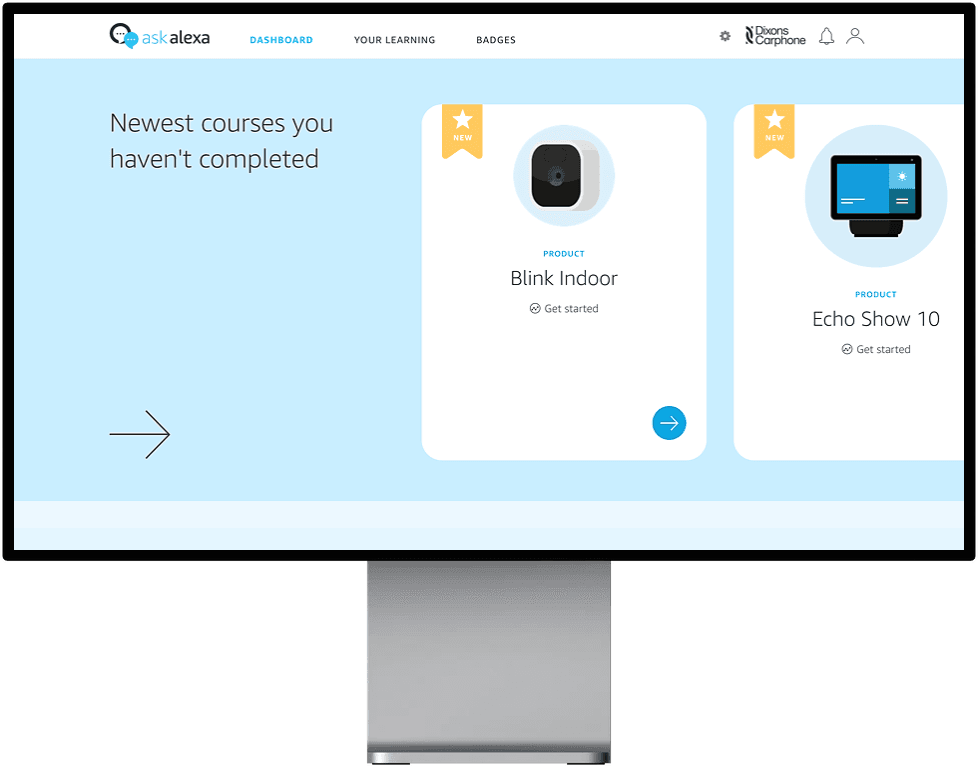
To encourage workers to complete training modules on popular products such as the Kindle, Alexa, and Echo, Amazon rewarded learners with completion-based badges that granted them expert status at work.
These badges also came with benefits for employers, such as vouchers, redeemable in their online marketplace.
Gamification for Team Building
Team building is crucial in an increasingly hybrid working world. Gamified experiences can be completely digital, allowing employees in and out of the office to collaborate.
When it comes to building team morale, there are plenty of ways to use gamification.
Virtual escape rooms can be fantastic if you have the budget, requiring teams to work together to solve puzzles and escape within a time-limit. This is a great way to improve communication and collaboration outside the workplace, fostering a stronger bond in-house.
However, team-building-focused gamification can be as simple as introducing office competitions. The key here is to have every employee working towards the same goal. With a shared reward at play, you’ll find that teams are more motivated to work together and enjoy the prize.
Are There Any HR Challenges?
While highly effective, gamification cannot solve all HR employee management challenges. Known for breeding unhealthy workplace competition and veering from strategic alignment, gamification can certainly lead teams off course if not implemented correctly.
To avoid these pitfalls, ensure that your gamified experiences naturally enhance specific business goals and encourage workers to perform better, not clock off sooner.
Gamification is the easiest way to ‘add fun’ to the workplace. If your HR team uses it effectively, your business will reap the rewards.


