
Fashion Trends & Future, Fashion Education, Fashion Weeks & Events, Designers & Ateliers
Medieval Metamorphosis — European Evolution (476–1485 CE)

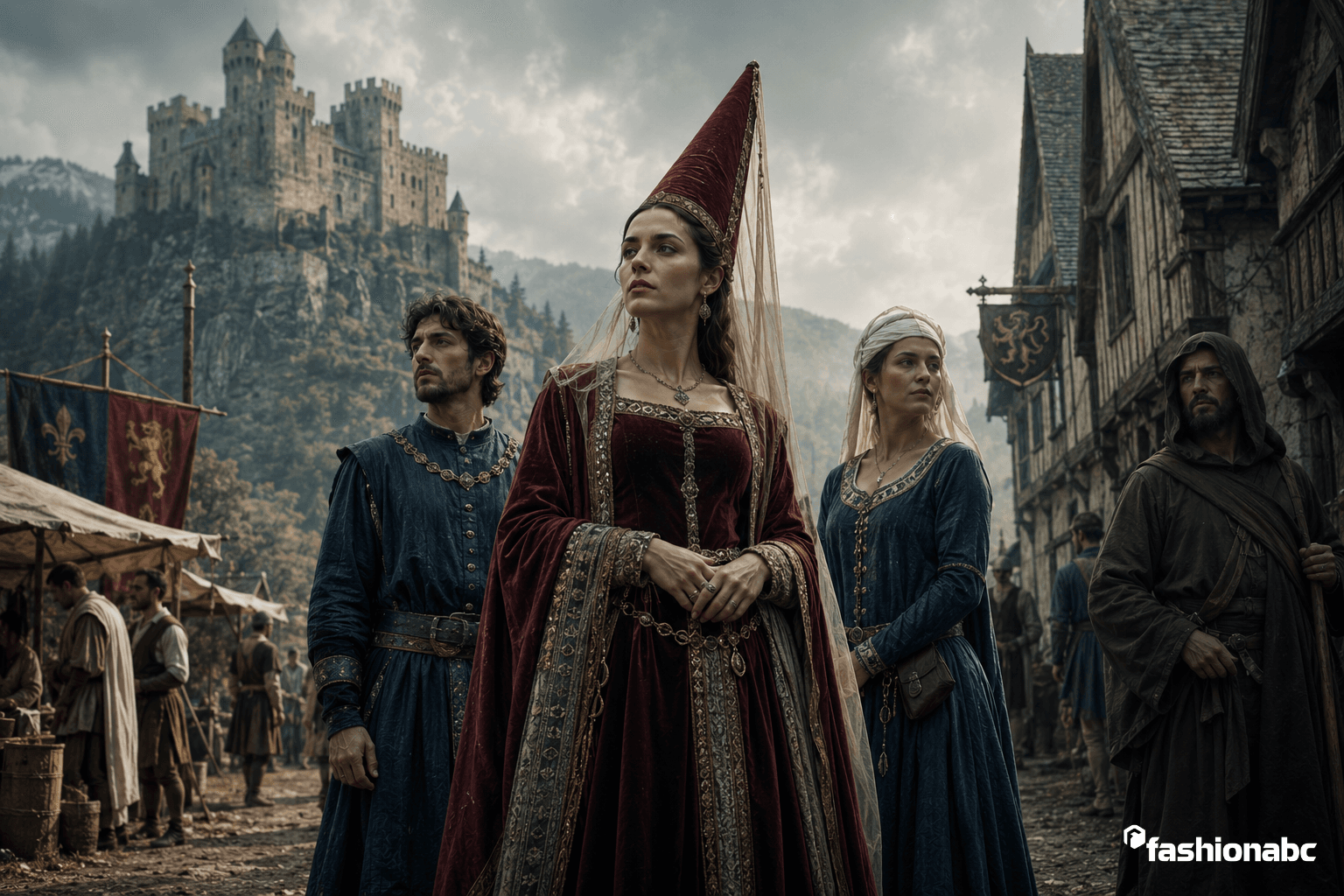
This article is part of an ongoing series adapted from The ABC History of Fashion*, a whitepaper to be published in full at a later date.*
“In the shadows between empires, fashion found its soul in the marriage of necessity and beauty.”
When Rome’s western empire collapsed, European fashion didn’t leap forward — it regrouped. Clothing shaped less by Roman convention than by Germanic, Norse, and Celtic tradition took over, and for a few centuries dress across the continent stayed loose, plain, and practical: wool and linen garments built for warmth and labour rather than display. Even among nobles, who could afford finer fabric and richer dye, early medieval clothing remained fairly modest by later standards.
That began to change as European society reorganised itself. By the 11th and 12th centuries, cities were growing and trade was expanding, and clothing started reflecting that new complexity. Fashion in this era wasn’t simply about staying warm — it became one of the clearest ways to signal wealth, occupation, and rank at a glance. Wool clothed the working majority; velvet and silk were kept largely for nobility. Even colour carried near-legal weight: purple signalled royalty, red suggested power, blue implied virtue — associations reinforced in no small part because these dyes were genuinely expensive and hard to produce.
The Rise of Tailoring
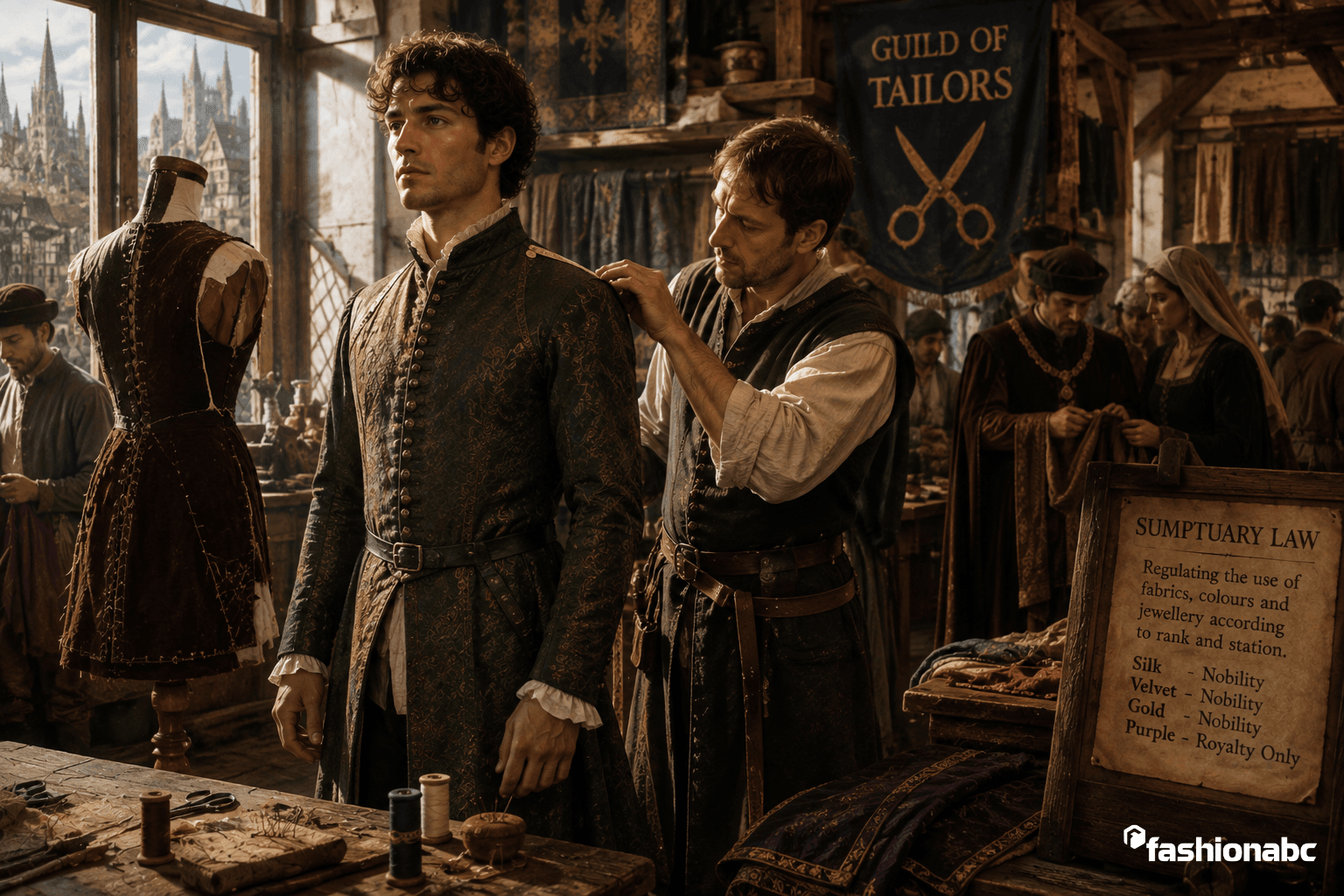
The Rise of Tailoring – created by Dinis Guarda and Sara Srifi for Fashionabc
The 12th century marked fashion’s real turn toward fitted construction. Clothing that had been loose and simple for centuries began tightening at the waist, with garments like the cotte becoming increasingly close-fitting as tailors experimented with new cuts. This shift didn’t happen overnight or evenly — looser tunics remained standard for ordinary people well into the 14th century — but among the wealthy, a genuine appetite for fitted, sculpted clothing was taking hold.
By the 14th and 15th centuries, that appetite had matured into a real fashion industry. Advances in textile production, expanding trade, and growing urban wealth allowed for something resembling seasonal trends for the first time, with styles shifting decade by decade rather than generation by generation. Professional tailors, organised into guilds, became central to this shift — clothing was no longer just something people made for themselves or had servants assemble, but a specialised craft in its own right. Tight-fitting garments held together with buttons, laces, and shaped panels became achievable, and sumptuary laws followed quickly behind, formally regulating which fabrics, colours, and jewellery each social class was permitted to wear.
Gothic Extremes

Gothic Extremes – created by Dinis Guarda and Sara Srifi for Fashionabc
Gothic fashion, roughly 1150 to 1400, pushed this new tailoring toward genuine spectacle. The period’s aesthetic borrowed directly from Gothic architecture’s obsession with verticality — the same instinct that built soaring pointed arches also produced pointed shoes (poulaines) that could stretch absurdly long, and towering conical headdresses (hennins) that sometimes reached a yard in height. Bodices grew tight and structured, skirts flared dramatically, and the overall silhouette elongated the body in every direction, as if fashion itself were trying to reach toward heaven alongside the cathedrals that inspired it.
Buttons, once rare, became both functional and decorative fixtures. Headdresses, meanwhile, carried real social meaning: loose hair was considered provocative, so married women in particular covered their hair with increasingly elaborate veils and hennins that doubled as signals of piety, status, and wealth all at once.
Key Benchmarks

Key Benchmarks – created by Dinis Guarda and Sara Srifi for Fashionabc
| Period | Innovation | Significance |
| 476–1000 CE | Germanic, Norse, and Celtic influence | Reshapes post-Roman European dress toward simple, practical garments |
| 1100s | Emergence of fitted cotte and tunic | Marks the first real move toward body-conscious tailoring |
| 1200s–1300s | Rise of professional tailoring guilds | Establishes tailoring as a specialised, organised craft |
| 1150–1400 | Gothic fashion | Introduces poulaines, hennins, and dramatic vertical silhouettes |
| 1300s–1400s | Sumptuary laws expand | Fabric, color, and jewelry formally tied to social rank |
By the close of the 15th century, European fashion had built the essential grammar the Renaissance would soon elaborate on: fitted construction, guild-trained craftsmanship, and clothing understood as a language of rank as much as protection from the cold.
Sources:
- Dress — Medieval, Europe, Fashion — Britannica
- Medieval Clothing: Fashion, Fabrics, and Social Status in the Middle Ages — Medieval Chronicles
- Medieval People’s Clothing: Fashion of the Common Folk and Nobility — Medieval Chronicles
- 1100–1200 in European Fashion — Wikipedia
- Clothing of the Middle Ages — Encyclopedia.com
- Medieval Fashion: Tunics, Underclothes, Pointed Shoes, and More — History Cooperative
- Gothic — Baike
- Early Medieval Costume: Romanesque and Gothic Styles — Fiveable
- Getting to the Point of Medieval Shoes — Victoria and Albert Museum
Previous articles in this series:
- Introduction: History of Fashion — The ABC Thread of Humans, The History of Us
- Chapter 1: The Dawn of Dress — Prehistoric Origins (300,000–10,000 BCE)
- Chapter 2: Ancient Foundations — Mesopotamian Innovations (3500–539 BCE)
- Chapter 3: Divine Drapery — Egyptian Elegance (3100–30 BCE)
- Chapter 4: Classical Columns — Greek & Roman Refinement (800 BCE–476 CE)


