
citiesabc, first_page
Most Expensive Cities in California: Housing, Taxes and Lifestyle Costs
01 Sept 2026

California contains some of the most expensive housing markets in the United States. The pressure is most visible around San Francisco, Silicon Valley and the coastal cities of Southern California, where high-paying industries, limited housing supply and desirable locations compete within tightly constrained markets.
High salaries can soften the impact, but they do not remove it. Residents must consider rent or mortgage payments alongside state income tax, local sales taxes, transportation, insurance and the everyday premium attached to living in a high-demand city.
This guide ranks the most expensive cities in California in 2026 using current rental costs among cities with at least 100,000 residents. It then examines housing, taxes and lifestyle expenses that determine how much income residents actually need.
For national context, see the Citiesabc report on the most expensive cities in the US in 2026.
How This California Ranking Was Created
There is no single measure that can capture the full cost of living in a city. Renters, recent homebuyers and longtime property owners can face very different monthly costs even when they live on the same street.
This ranking uses April 2026 Zillow Observed Rent Index figures compiled by RentDataNow for California cities with populations of at least 100,000. ZORI estimates the typical asking rent for the middle tier of the rental market and provides a consistent basis for comparing cities.
Rental costs are used as the central ranking measure because housing is normally the largest household expense and current home prices are less comparable across cities with very different property types. The discussion also considers Census housing and income data, California tax rules and the wider expenses associated with each location.
The figures are market estimates rather than quotations for a particular property. Actual rent varies according to neighbourhood, size, condition and lease date.
California’s Most Expensive Cities in 2026
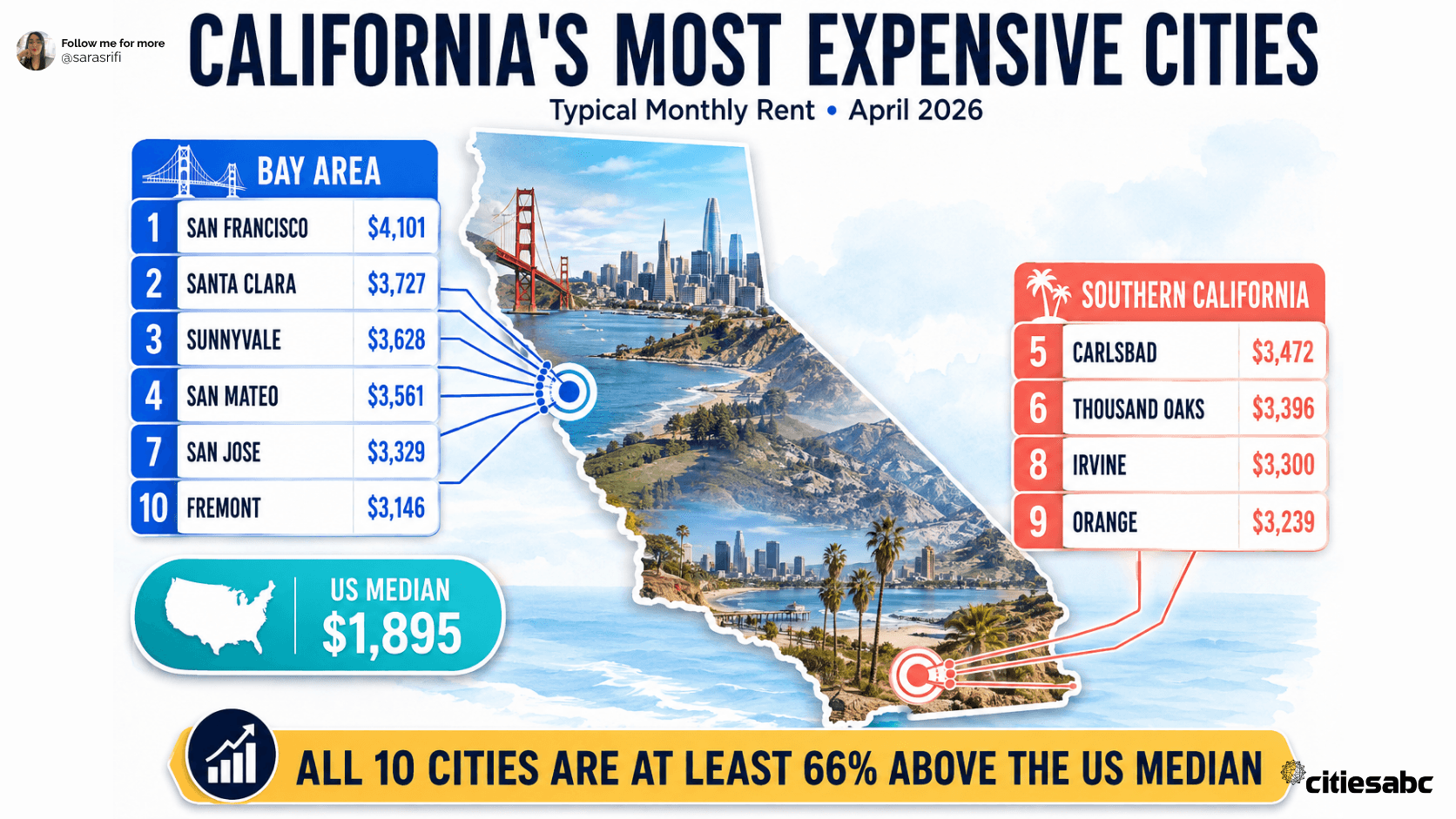
| Rank | City | Typical monthly rent | Above the US median |
|---|---|---|---|
| 1 | San Francisco | $4,101 | 116% |
| 2 | Santa Clara | $3,727 | 97% |
| 3 | Sunnyvale | $3,628 | 92% |
| 4 | San Mateo | $3,561 | 88% |
| 5 | Carlsbad | $3,472 | 83% |
| 6 | Thousand Oaks | $3,396 | 79% |
| 7 | San Jose | $3,329 | 76% |
| 8 | Irvine | $3,300 | 74% |
| 9 | Orange | $3,239 | 71% |
| 10 | Fremont | $3,146 | 66% |
The US median used in the source comparison was $1,895 per month. Every city in California’s top ten was therefore at least two-thirds more expensive than the national benchmark.
Related Contents:
1. San Francisco
San Francisco is the most expensive large city in California for renters, with a typical monthly rent of approximately $4,101 in April 2026. It was also the most expensive large rental market in the United States under the same methodology.
The city’s housing market combines severe supply constraints with demand from technology, finance, biotechnology and professional services. Its location on a peninsula limits outward expansion, while development restrictions and construction costs make it difficult to add housing quickly in established neighbourhoods.
The income figures are high, but so are the barriers to entering the market. The Census Bureau reports a median household income of $140,970 in 2020–2024 dollars. The median value of owner-occupied housing was almost $1.4 million, while the owner-occupancy rate was only 38.2%.
San Francisco can allow some residents to reduce car dependence through public transport and walkable neighbourhoods. However, food, services, childcare and entertainment can still carry substantial urban premiums. The city is therefore expensive even for households that avoid the cost of owning and parking a vehicle.
2. Santa Clara
Santa Clara sits at the centre of Silicon Valley and recorded a typical rent of approximately $3,727 per month.
The city benefits from proximity to major technology employers and employment centres across the South Bay. That economic strength supports high salaries, but it also increases competition for housing within commuting distance of corporate campuses.
Santa Clara’s costs are not limited to rent. Many households still depend on cars, adding insurance, fuel and parking to the monthly budget. Electricity arrangements differ from much of the surrounding region because the city has its own municipal utility, but total household costs depend on the property, consumption and service plan.
For professionals working nearby, Santa Clara can reduce commute time compared with more distant parts of the Bay Area. The trade-off is paying a premium to live close to the employment market.
3. Sunnyvale
Sunnyvale’s typical monthly rent reached approximately $3,628, placing it third in the California ranking.
Like Santa Clara, Sunnyvale is closely connected to Silicon Valley’s technology economy. Its location provides access to employers across Mountain View, Cupertino, Santa Clara and San Jose, making the city particularly attractive to highly paid professionals.
Yet high income does not automatically mean strong affordability. A household may earn significantly more than the national median while still spending a large share of its take-home income on housing. Families must also account for childcare, transport and the cost of obtaining additional space.
The market illustrates one of California’s central affordability problems: employment growth can occur faster than the supply of housing near those jobs.
4. San Mateo
San Mateo recorded a typical rent of approximately $3,561 per month.
Its position between San Francisco and Silicon Valley gives residents access to two major employment centres. Caltrain can provide an alternative to driving for some journeys, but proximity to transport and established commercial districts can itself be reflected in housing prices.
San Mateo offers a suburban environment while remaining closely connected to the wider Bay Area economy. That combination keeps demand high among professionals and families seeking access to employment without living directly in San Francisco.
The financial calculation depends heavily on commute patterns. A household accepting a higher rent near a station may reduce travel time and car use, while moving farther away can lower housing costs but increase transport expenses.
5. Carlsbad
Carlsbad is the highest-ranked Southern California city in the table, with a typical monthly rent of approximately $3,472.
Its cost reflects a different combination of pressures from those affecting Silicon Valley. Carlsbad offers coastal access, employment in technology and life sciences, established neighbourhoods and proximity to the wider San Diego economy.
The lifestyle premium is substantial. Coastal location, schools, recreation and access to beaches all contribute to demand. Households are also more likely to depend on cars than residents of central San Francisco, meaning that fuel, maintenance and insurance must be added to already high housing costs.
Carlsbad demonstrates why cost-of-living comparisons cannot be reduced to rent alone. A household may be paying for climate, space and coastal access, but it must still test whether its income can support the complete lifestyle.
6. Thousand Oaks
Thousand Oaks recorded a typical rent of around $3,396 per month.
Located in Ventura County and connected to the wider Los Angeles employment region, the city is known for lower-density neighbourhoods, access to open space and a family-oriented suburban environment. Those characteristics can make it attractive to households seeking more space than central Los Angeles offers.
The trade-off is greater dependence on private transport. Commuting towards employment centres elsewhere in Southern California can add considerable time and cost, especially when traffic conditions are unpredictable.
Housing may therefore appear more spacious than in San Francisco or Silicon Valley, but the full household budget must include vehicle ownership and the practical cost of long journeys.
7. San Jose
San Jose’s typical rent was approximately $3,329 per month. Although that is lower than several smaller Silicon Valley cities, its scale makes its housing pressure particularly important.
The city sits within one of the most productive technology regions in the world. High salaries and strong demand for specialised workers support the housing market, but they also create a substantial entry barrier for households outside the highest-paying industries.
Buying can be even more challenging than renting. The wider San Jose metropolitan area has repeatedly appeared among the country’s most expensive home-purchase markets, with prices that can require large deposits and exceptionally high household incomes.
San Jose is more geographically spread out than San Francisco. Many residents therefore face both elevated housing costs and car-related expenditure, although public transport can help with certain routes.
8. Irvine
Irvine recorded a typical monthly rent of approximately $3,300.
The city’s planned communities, employment base, schools and proximity to Orange County’s business centres create sustained demand. Irvine is also associated with newer housing and carefully managed neighbourhoods, which can command a premium.
For families, the calculation often includes more than the rent itself. The number of bedrooms, access to schools, commuting distance and childcare can materially change the required income.
Irvine’s planned form does not eliminate transport costs. Many residents still rely on cars for work, education, shopping and recreation, making vehicle expenses a significant addition to housing.
9. Orange
The city of Orange had a typical rent of approximately $3,239 per month.
Its location provides access to employment and amenities across Orange County while retaining established neighbourhoods and a recognisable historic centre. Demand is supported by its connections with Anaheim, Santa Ana, Irvine and the wider Southern California economy.
Orange may be less internationally associated with high costs than San Francisco or San Jose, but its rental level was still approximately 71% above the national median used in the comparison.
This illustrates how California’s affordability pressure extends beyond its most famous cities. Households can encounter nationally high housing costs across entire regional labour markets rather than only in a few central districts.
10. Fremont
Fremont completes the top ten with a typical monthly rent of approximately $3,146.
Its position between Silicon Valley and the East Bay gives residents access to several employment centres. Fremont can appeal to workers seeking an alternative to the South Bay while remaining connected through roads and regional public transport.
That position also creates competition for housing. A household may choose Fremont to balance space, schools and access to employment, but the resulting rent remains significantly above the national benchmark.
Commuting costs vary sharply depending on the workplace. Proximity to a BART station or employer shuttle can change the budget, while a long car commute can weaken the savings achieved by living outside the most expensive Silicon Valley cities.
Why Los Angeles Is Not in the Top Ten
Los Angeles is widely regarded as one of America’s most expensive cities, yet it does not appear in this rent-based top ten.
This does not mean Los Angeles is affordable. Its enormous size produces a wide range of housing markets, from exceptionally expensive coastal and central neighbourhoods to relatively less expensive areas farther from major employment centres.
A citywide rent measure blends these neighbourhoods together. Smaller cities such as Santa Clara and San Mateo contain a greater concentration of high-cost housing within their boundaries, pushing their citywide figures higher.
Los Angeles residents can also face a severe combination of housing and transport costs. Lower rent in a distant neighbourhood may require a long commute, substantial fuel use and continued car ownership. Citywide rankings can therefore understate the pressure experienced by particular households.
How California Taxes Affect the Cost of Living
Housing dominates the ranking, but taxes change how much income remains available to pay for it.
California uses a progressive personal income-tax system. The applicable amount depends on taxable income, deductions and filing status. High earners can face one of the highest marginal state income-tax rates in the country, although a marginal rate applies only to income within the relevant band—not to the entire income.
Sales tax also varies by location. California has a statewide base sales-and-use tax rate, with local district taxes increasing the final rate in many cities. This means two California households can pay different rates on taxable purchases depending on where they live and shop.
Property tax requires additional explanation. Proposition 13 generally limits the statewide property-tax rate to 1% of assessed value, plus amounts required for voter-approved debt and other applicable charges. It also generally caps annual growth in assessed value at 2% until a change in ownership or qualifying new construction triggers reassessment.
As a result, two owners of similar properties can receive very different tax bills when one purchased many years earlier. A recent buyer entering an expensive market may be assessed near the current purchase value, while a longtime owner may have a much lower assessed value.
Taxes change over time and depend on individual circumstances, so residents should confirm current figures with California and local authorities rather than relying only on a general city comparison.
The Lifestyle Costs Behind the Ranking
The highest rent does not always produce the highest complete household budget.
San Francisco may allow a resident to live without a car, potentially avoiding insurance, fuel, maintenance and parking. A household in Carlsbad, Thousand Oaks or Irvine may obtain more space but face greater vehicle dependence.
Childcare can reshape the ranking for families, while insurance, healthcare, utilities and food affect households differently. Homeowners must also consider maintenance, property insurance, assessments and the opportunity cost of a deposit.
Lifestyle preferences matter as well. Coastal access, cultural institutions, restaurants and proximity to employment can justify a higher cost for one household but provide little financial value to another.
Someone considering a move should therefore build a personal budget rather than treating a citywide average as a prediction. Citiesabc’s guide to how much money to save before moving to a new city explains how to combine moving expenses, setup costs and an emergency reserve.
Is a Higher California Salary Enough?
A higher salary should be evaluated after taxes and essential costs.
Suppose a job in Silicon Valley pays substantially more than an alternative elsewhere. The difference may appear attractive until the household accounts for rent, tax, commuting, childcare and the amount required to save for a home.
The relevant question is not simply, “What will I earn?” It is:
How much disposable income, financial security and time will remain after living and working in this city?
Remote and hybrid work can change the calculation, but employees should confirm how often they must travel to the workplace. A distant location may be manageable twice a month and exhausting three times a week.
Citiesabc’s framework for choosing which city to move to can help compare income, housing, transport and quality of life together.
Final Thoughts
The most expensive cities in California are concentrated in the Bay Area, Silicon Valley and desirable parts of coastal Southern California.
San Francisco leads the 2026 rental ranking, followed by Santa Clara, Sunnyvale and San Mateo. Carlsbad is the highest-ranked Southern California city, while Thousand Oaks, Irvine and Orange show that high housing costs extend well beyond the state’s best-known urban centres.
Housing is the largest pressure, but it is not the only one. State income tax, local sales taxes, transport, childcare and lifestyle choices determine whether a salary is genuinely sufficient.
The best comparison is therefore personal. Estimate the housing available within a realistic commute, calculate after-tax income and add the costs required to maintain the intended lifestyle. A city is affordable only when the complete budget works, not when the salary or rent is considered alone.
Frequently Asked Questions
What is the most expensive city in California in 2026?
San Francisco is the most expensive California city in this rental-based ranking, with typical monthly rent of approximately $4,101 in April 2026.
Why is housing so expensive in California?
Demand from high-paying industries, limited construction, geographic constraints, development costs and the desirability of coastal locations all contribute. The causes and severity vary between cities.
Is San Jose more expensive than San Francisco?
San Francisco had higher typical rent in the data used here. However, the San Jose metropolitan area can be more expensive for homebuyers, so the result depends on whether the comparison considers rent, home prices or total living costs.
Does California have high property taxes?
Proposition 13 limits the general property-tax rate and assessment growth, but high home values mean recent buyers can still face large annual bills. Local voter-approved debt and other charges may also apply.
How much income is needed to live comfortably in California?
There is no single figure. It depends on the city, household size, housing arrangement, debt, transport, childcare and savings goals. Residents should calculate the income required for their own complete budget.
Sources
Share

Sara Srifi
Sara is a Software Engineering and Business student with a passion for astronomy, cultural studies, and human-centered storytelling. She explores the quiet intersections between science, identity, and imagination, reflecting on how space, art, and society shape the way we understand ourselves and the world around us. Her writing draws on curiosity and lived experience to bridge disciplines and spark dialogue across cultures.


