
Businesses
Marketing Fundamentals: Strategy, STP, 4Ps, Funnels and Measurement Explained
01 Sept 2026

Marketing is often associated with advertising, social media, email campaigns and content. These activities matter, but they are not where marketing begins.
Marketing begins with deciding which customers a business will serve, what problem it will solve and why people should choose its offer instead of an alternative. Product development, pricing, distribution and promotion should follow those decisions.
This guide explains how the main marketing fundamentals—strategy, STP, the 4Ps, customer funnels and measurement, work together as one commercial system.
Marketing Starts With Strategy
Before choosing a channel or launching a campaign, a business must define what marketing is expected to achieve.
A company entering a new market faces a different challenge from one trying to retain existing customers. A startup introducing an unfamiliar product may need to educate potential buyers before it can generate sales. An established company with strong awareness but weak margins may need to improve its pricing or customer mix rather than increase its advertising budget.
A useful marketing objective connects a commercial outcome with a defined audience, period and target. “Increase brand awareness” is too broad to guide a team. “Increase qualified demonstration requests from medium-sized UK logistics companies from 40 to 65 per month by the end of the fourth quarter” provides a clearer basis for planning and measurement.
Marketing performance should ultimately support a business result. A campaign may generate impressive reach while attracting people who are unlikely to become customers. A smaller campaign can be far more valuable if it consistently reaches a relevant group with a genuine reason to buy.
Businessabc’s guide to the five key steps for growing a small business provides a wider framework for connecting marketing with sustainable expansion.
Research Replaces Assumptions With Evidence
Once the objective is clear, the company needs evidence about its customers, competitors and market.
Market research helps determine whether demand exists, how customers currently solve the problem and what may prevent them from changing their behaviour. It can also reveal how large the opportunity is, which alternatives customers consider and whether the business can compete profitably.
Primary research comes directly from potential or existing customers. Interviews can reveal how people describe a problem in their own language. Sales conversations show which objections prevent a purchase. Product tests demonstrate whether customers use an offer as expected, while support requests and cancellation feedback expose weaknesses in the experience.
Secondary research adds a wider view through government statistics, industry reports, competitor information, company accounts, search behaviour and public reviews.
The important distinction is between what customers say, what they do and what the company assumes. A founder may believe that customers prioritise convenience when the real decision is driven by price, trust or compatibility. Customers may also describe a feature as valuable but refuse to pay for it.
Strong marketing research therefore gives greater weight to observable behaviour such as purchases, renewals, cancellations, referrals and responses to real offers.
STP: Choosing Where and How to Compete
After understanding the market, the business must decide which customers it will prioritise and how it wants to be perceived by them. This is the purpose of STP: segmentation, targeting and positioning.
Segmentation divides a broad market into groups with meaningful differences. Targeting selects the groups the company can serve most effectively. Positioning establishes why those customers should choose its offer.
Without STP, businesses often create broad messages for an undefined audience. The result may apply to everyone, but it rarely feels especially relevant to anyone.
Segmentation: Identifying Meaningful Customer Groups
A market rarely consists of customers with identical needs, resources and buying behaviour. Two people may purchase the same product for completely different reasons, while companies in the same industry may have different procurement processes and technical requirements.
Consumer markets can be segmented according to age, income, location, lifestyle, values or behaviour. However, demographic characteristics do not always explain the purchase. Behavioural differences—such as frequency of use, price sensitivity, loyalty and the benefits being sought—often produce more useful insight.
A fitness company could segment customers by age, for example, but it may learn more by distinguishing between people seeking competitive performance, rehabilitation, weight management or social motivation. These customers want different outcomes even when their demographic characteristics overlap.
B2B segmentation considers the organisation as well as the individual buyer. Industry, company size, operational complexity, technology, regulatory exposure and purchasing authority can all influence the decision.
A useful segment should be recognisable, reachable and commercially meaningful. Most importantly, it should change a real marketing decision. “People who value quality” is too broad to guide a strategy. “Independent restaurant groups operating between five and twenty locations that want to reduce food waste but lack an internal data team” offers much greater direction.
Targeting: Deciding Who Receives Priority
Targeting evaluates the available segments and determines which ones deserve the company’s attention and resources.
The largest segment is not necessarily the best opportunity. It may be highly competitive, expensive to reach or difficult to serve profitably. A smaller segment may contain customers with a more urgent problem, greater willingness to pay and fewer suitable alternatives.
The choice should reflect the strength of the customer need, competitive pressure, expected retention, acquisition cost and the company’s ability to deliver the required experience.
A startup may initially concentrate on one niche, build evidence and expand later. A larger organisation may develop separate offers for several customer groups. Some B2B companies focus on a small number of individual accounts rather than attempting to reach an entire market.
Choosing a target requires discipline because it also means accepting that some potential customers will not receive the same priority.
Positioning: Establishing a Reason to Choose
Positioning defines how the company wants its offer to be understood relative to the alternatives available to the target customer.
It is more than a slogan. Positioning should influence the product, price, customer experience and communication.
A useful positioning statement identifies the target customer, the problem being addressed, the relevant product category, the principal benefit and the evidence supporting the promise.
A demand-planning platform might position itself in the following way:
For independent retailers that struggle to predict inventory requirements, the platform is a demand-planning system that reduces stockouts without requiring a dedicated data team because it connects directly with existing sales and inventory records.
The customer may never see this exact statement. Its purpose is to create internal clarity.
A position becomes credible when the wider experience supports it. A company cannot convincingly promise simplicity while offering confusing pricing and a lengthy onboarding process. A premium brand needs more than expensive visual design; its product, service and customer experience must justify the difference.
Businessabc’s analysis of how smaller brands can improve their visibility explains how a focused identity can help a business compete for attention.
The 4Ps: Turning Positioning Into an Offer
After defining the target customer and position, the business can develop its marketing mix. The traditional 4Ps of marketing are product, price, place and promotion.
These are not four isolated decisions. They should reinforce the same position.
Product
In marketing, the product includes the complete solution the customer receives. It covers features and design, but also packaging, onboarding, delivery, support, warranties and returns.
The starting point should be the customer’s desired outcome. Someone buying accounting software may not want more technology; the person may want faster reporting, fewer mistakes and greater confidence in the company’s finances.
Product decisions must also reflect the target segment. Large organisations may require integrations, security reviews and dedicated support, while smaller companies may value simplicity and transparent pricing.
Price
Price influences demand, revenue, margins, customer expectations and positioning.
Cost-based pricing begins with the cost of producing and delivering the offer before adding a margin. Competition-based pricing uses similar products as a reference. Value-based pricing considers the economic or emotional benefit created for the customer.
Each approach provides useful information, but none should be used without context. Copying competitors can be dangerous when their costs or strategic goals are different. Focusing only on costs may ignore what customers are willing to pay, while value-based pricing requires credible evidence of the outcomes being created.
Pricing must also connect to customer acquisition, retention and gross margin. Businessabc’s guide to startup financial modelling explains how these factors determine whether growth is economically sustainable.
Place
Place describes how customers discover, purchase and receive the offer.
A company may sell directly through its website, physical stores or sales team. It may also use retailers, marketplaces, distributors, agents or resellers.
Direct distribution provides greater control over pricing, customer information and the buying experience, but the company must manage acquisition, fulfilment and service itself. Indirect distribution can provide access to an established audience, although it reduces control and introduces another margin into the process.
Place also includes convenience. Website performance, mobile access, delivery speed, payment options, installation and returns all affect whether customers can obtain value with reasonable effort.
Promotion
Promotion includes advertising, public relations, content, search marketing, social media, email, events, partnerships and personal selling.
The appropriate channels depend on the audience and buying process. A company considering complex software may require research, case studies, demonstrations and several conversations. A customer purchasing an inexpensive everyday product may respond more strongly to availability, recommendations and repeated exposure.
Channel selection should therefore follow customer research and positioning. Businessabc’s guide to the best digital marketing strategies for small businesses examines search, content, email, social media and paid advertising in greater detail.
How the Marketing Funnel Works
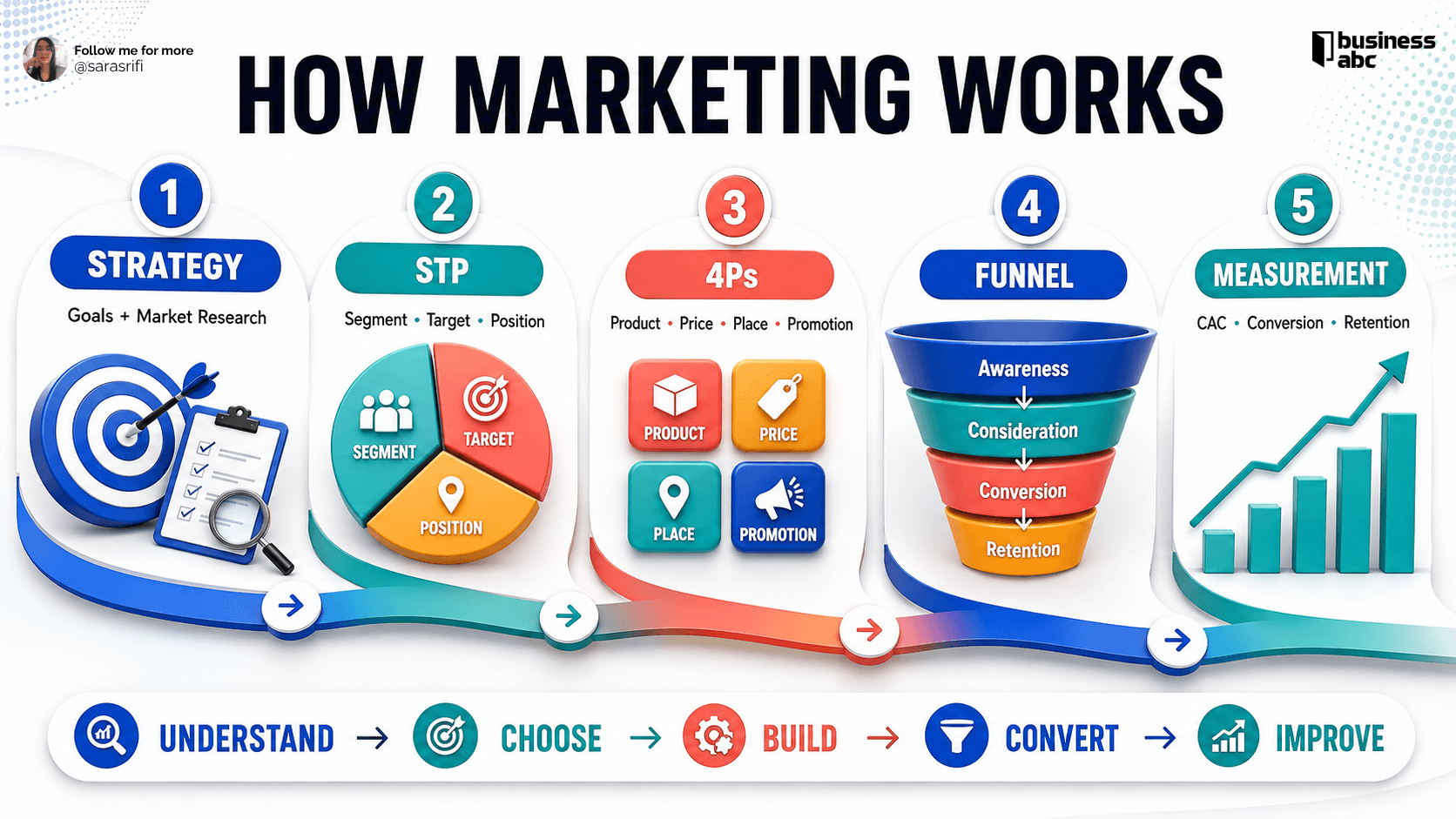
The 4Ps define the offer. The marketing funnel helps explain how customers move towards and beyond a purchase.
A typical funnel includes awareness, consideration, conversion, retention and advocacy. It is a planning model rather than a literal route followed by every customer.
At the awareness stage, potential customers encounter the brand, product category or problem. Search visibility, media coverage, advertising, events and recommendations can all contribute. The objective should not be exposure alone, but visibility among people who could realistically need the offer.
During consideration, customers define their requirements and compare alternatives. Detailed product information, demonstrations, case studies and reviews help reduce uncertainty. Effective marketing addresses the questions that could prevent a decision, whether they concern price, risk, implementation or compatibility.
Conversion occurs when the customer takes a commercially meaningful action. That may be a purchase, qualified demonstration request, subscription or appointment. Improving conversion may require changes to the offer, message, proof, price, form, checkout or sales response—not simply a different button colour.
Marketing continues after the purchase. Onboarding, product quality, support and communication influence whether customers remain, purchase again or recommend the company. Acquisition growth can conceal serious problems if existing customers are leaving at an unsustainable rate.
Businessabc’s guide to turning B2B visibility into qualified leads and revenue examines how awareness should connect to lead quality and commercial outcomes.
Measuring Marketing Performance
Measurement completes the marketing system by showing whether the strategy is reaching the right audience and producing valuable behaviour.
Awareness can be evaluated through relevant reach, branded search and visits from the target market. Consideration may be reflected in return visits, product engagement and demonstration requests. Conversion measurement can include sales, qualified opportunities and customer acquisition cost. Retention introduces measures such as repeat purchases, renewals and churn.
A conversion rate shows the proportion of eligible people who complete the desired action:
Conversion rate = completed conversions ÷ eligible visitors or leads × 100
Customer acquisition cost estimates the sales and marketing investment required to gain each new customer:
CAC = attributable sales and marketing costs ÷ new customers acquired
These figures are meaningful only when the terms are defined consistently. A lead is not necessarily a qualified opportunity, and a website visit does not prove genuine consideration.
Marketing attribution creates another challenge. A customer may encounter media coverage, receive a recommendation, read an article and later search directly for the company. Giving all the credit to the final search would ignore the earlier influences.
Attribution should therefore be treated as an analytical model rather than proof of causation. Experiments, customer interviews and sales feedback can provide valuable evidence that tracking software cannot capture alone.
Common Marketing Mistakes
Many marketing strategies fail because their components contradict one another.
A business may target premium customers while competing mainly through discounts. It may promise simplicity while offering a complicated product. It may generate more leads than the sales team can qualify or focus on acquisition while ignoring rapid customer churn.
Another mistake is selecting channels before defining the customer and offer. Asking whether a business should use social media, email or paid search is premature when the intended audience and position remain unclear.
Marketing also becomes misleading when attention is reported as business value. Reach, impressions and followers may support awareness, but they are not equivalent to customers, revenue or profit.
The strongest companies treat marketing as a connected process. They begin with evidence, make deliberate choices and change the system when performance reveals a specific weakness.
Final Thoughts
Marketing fundamentals are not theories that become irrelevant when new platforms or technologies appear. They are the structure that makes those tools useful.
Strategy establishes what the business needs to achieve. Research replaces assumptions with evidence. Segmentation and targeting determine who receives priority, while positioning gives those customers a reason to choose.
The 4Ps turn that position into a coherent offer. The marketing funnel explains how customers move from awareness to purchase and retention. Measurement then shows where the system is working and where it needs to change.
A business does not need to use every available channel or report every possible metric. It needs to understand its customer, make a credible promise and build a consistent system for delivering that promise profitably.
Frequently Asked Questions
What are marketing fundamentals?
Marketing fundamentals are the principles used to understand customers, select target markets, position an offer and make decisions about product, price, distribution, promotion and measurement.
What does STP mean in marketing?
STP stands for segmentation, targeting and positioning. It divides a market into meaningful groups, selects the customers a company will prioritise and defines why they should choose its offer.
What are the 4Ps of marketing?
The 4Ps are product, price, place and promotion. Together, they describe the offer, its cost, how it reaches customers and how its value is communicated.
Is the marketing funnel always linear?
No. Customers may use several channels, return to earlier stages and involve multiple decision-makers. The funnel is best treated as a planning and diagnostic framework.
Which marketing metrics matter most?
The appropriate metrics depend on the business objective. Qualified leads, conversion rate, customer acquisition cost, gross profit, retention and customer lifetime value are generally more meaningful than impressions alone.


