
Businesses
Startup Financial Modelling: Revenue, Cash Flow, Burn, Runway and Unit Economics
25 Aug 2026

A startup financial model translates a business strategy into numbers. It connects customer acquisition, pricing, hiring and operating decisions to revenue, cash requirements and the company’s remaining runway.
Its purpose is not to predict the future perfectly. Early-stage companies rarely have enough evidence for precise forecasts. A useful model exposes assumptions, shows what must be true for the business to survive and allows founders to adjust decisions as evidence changes.
Key takeaways
- Build the model around operational assumptions, not arbitrary growth percentages.
- Model profit and cash separately; a profitable company can still run out of money.
- Calculate burn and runway using actual cash movements.
- Connect customer acquisition, retention, pricing and gross margin to revenue.
- Use base, upside and downside scenarios instead of one “official” forecast.
- Compare actual performance with the model every month.
- Investors are more interested in understandable assumptions than artificial precision.
What is startup financial modelling?
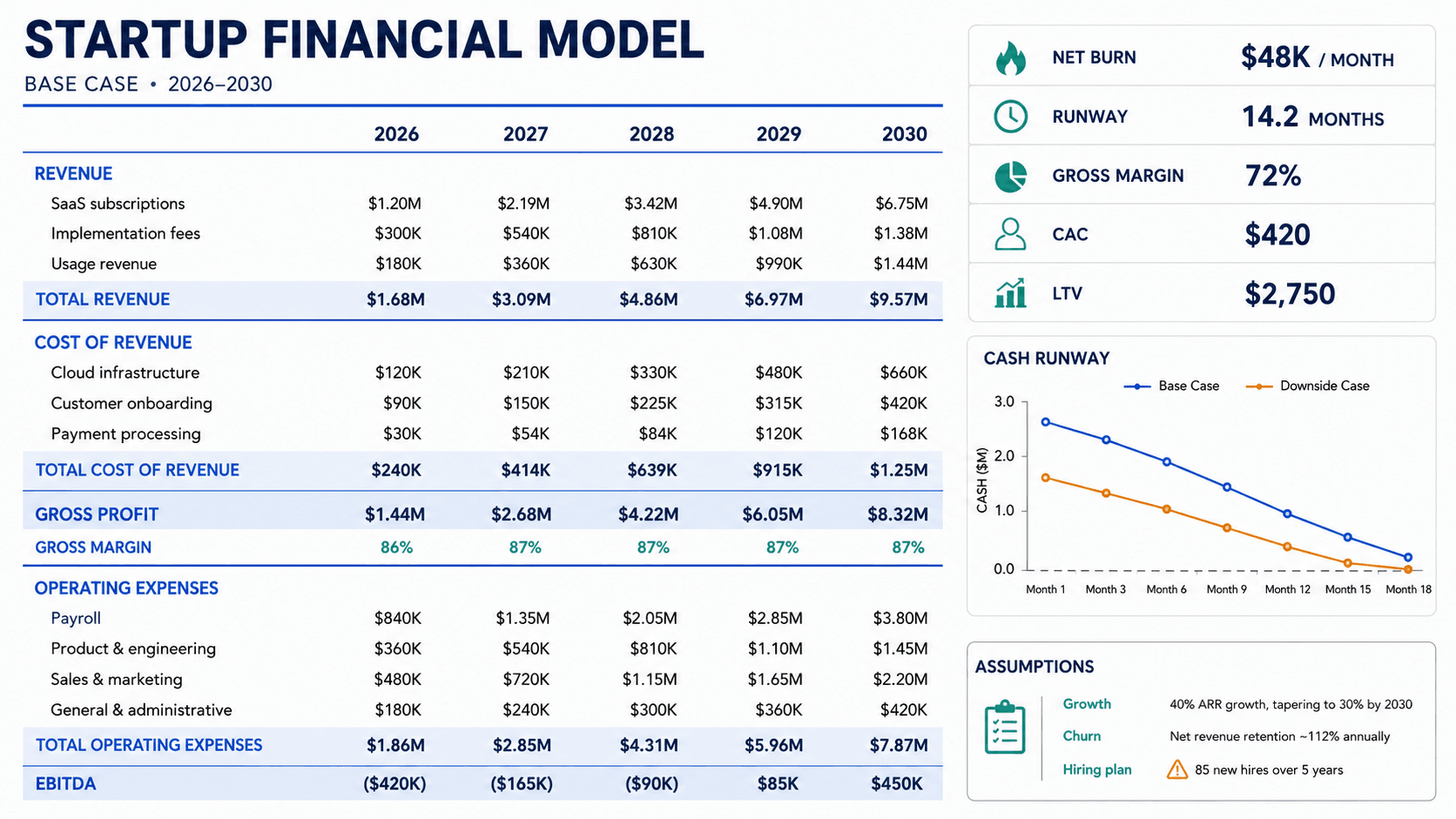
Startup financial modelling is the process of forecasting how a company’s operational decisions could affect its income statement, balance sheet and cash flow.
A model normally attempts to answer five questions:
- How will the startup generate revenue?
- What will it cost to deliver the product or service?
- How much cash will the company spend?
- How long can it operate before requiring more capital?
- Does each customer, order or contract create sustainable economic value?
If the business idea is still being selected, use Businessabc’s framework for choosing the right business before producing a detailed forecast. A spreadsheet cannot compensate for an untested customer problem.
What should a startup financial model contain?
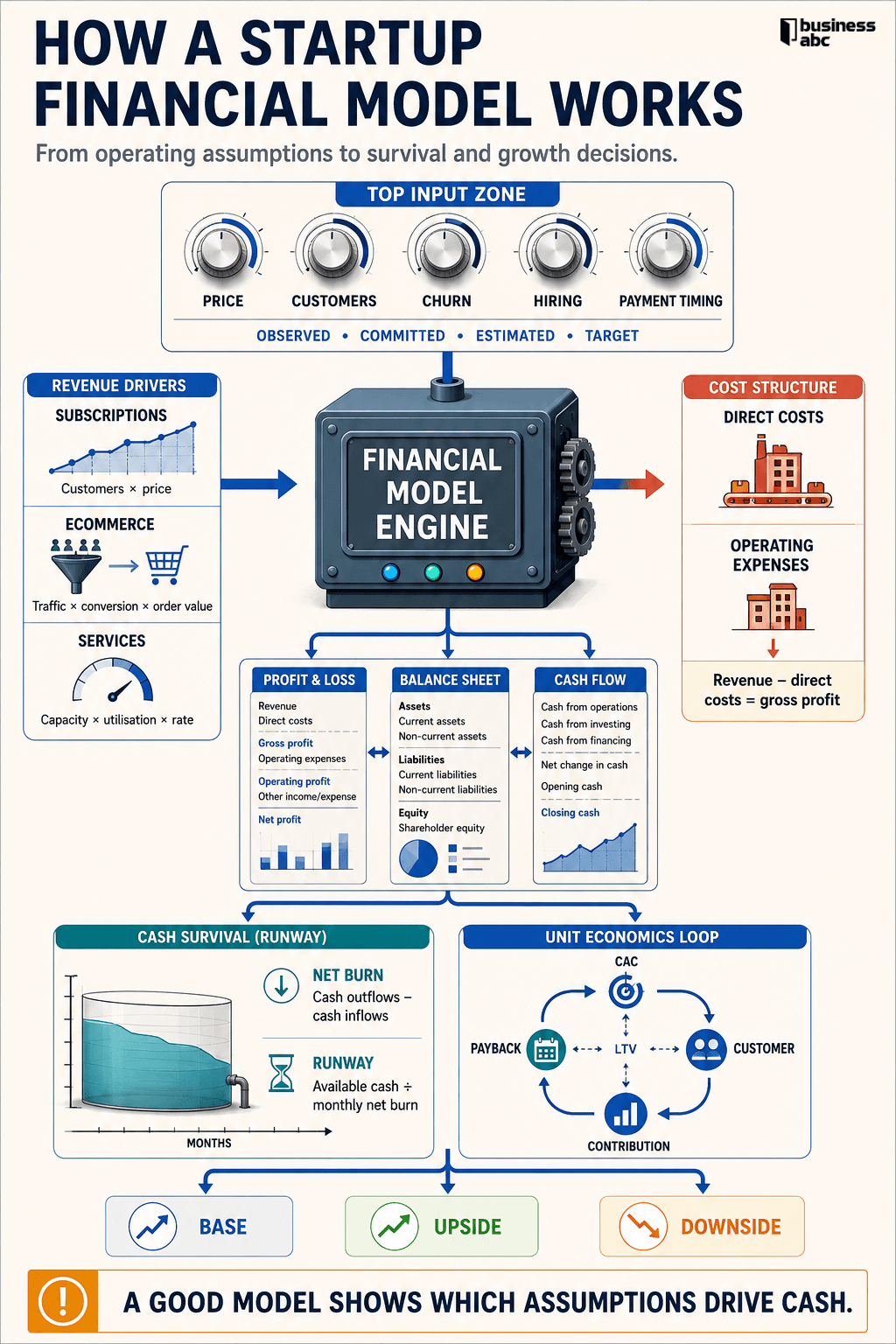
A practical model can be organised into seven connected sections.
| Model section | What it should contain |
|---|---|
| Assumptions | Pricing, customer growth, churn, hiring, salaries and payment timing |
| Revenue | Customers, transactions, contracts, usage and recognised revenue |
| Costs | Direct costs, payroll, marketing, technology and overhead |
| Financial statements | Profit and loss, balance sheet and cash flow |
| Cash and runway | Opening cash, inflows, outflows, burn and financing needs |
| Unit economics | Gross margin, contribution margin, CAC, retention and LTV |
| Scenarios | Base, upside and downside cases |
Keep assumptions separate from calculations. A founder should be able to change a price, hiring date or conversion rate once and see the effect throughout the model.
The Businessabc assumption-confidence system
A model becomes misleading when facts, estimates and ambitions are presented as equally reliable. Label every significant assumption using four confidence levels:
- Observed: supported by actual company data.
- Committed: fixed through a signed contract, salary offer or agreed payment.
- Estimated: supported by market research or comparable evidence.
- Target: an outcome management wants but has not yet validated.
For example, a signed annual software contract is committed revenue. A founder’s expectation of converting 8% of website visitors is only a target until conversion data exists.
This distinction allows readers to identify which assumptions create the greatest forecast risk.
1. Build the revenue model from operating drivers
Avoid forecasting revenue by typing “20% monthly growth” into a spreadsheet. Begin with the activity that creates revenue.
Subscription business
A basic subscription model may use:
Ending customers = opening customers + new customers − churned customers
Monthly recurring revenue = average paying customers × average monthly revenue per customer
New customers should connect to acquisition channels, leads, conversion rates and sales capacity.
Ecommerce business
Revenue = website sessions × conversion rate × average order value
The model should also include refunds, discounts, payment fees, fulfilment and product costs.
Service business
Revenue = billable staff × available hours × utilisation × hourly rate
Alternatively, model the number of projects, average contract value and delivery capacity.
Marketplace
Gross transaction value = buyers × transactions per buyer × average transaction value
Platform revenue = gross transaction value × take rate
Gross transaction value is not the same as the marketplace’s revenue. Only the platform’s fee or commission should usually be recognised as revenue, depending on the arrangement and applicable accounting rules.
2. Separate direct costs from operating expenses

Direct costs change with the delivery of a sale. Operating expenses support the wider company.
Common direct costs
- Materials and manufacturing
- Cloud infrastructure linked to usage
- Shipping and fulfilment
- Transaction fees
- Customer-facing delivery labour
- Sales commissions
- Third-party licences required for each customer
Common operating expenses
- Salaries and benefits
- Office or coworking costs
- Legal and accounting
- Product development
- General software
- Insurance
- Brand and administrative spending
This separation supports gross-margin and contribution-margin analysis.
Gross profit = revenue − cost of revenue
Gross margin = gross profit ÷ revenue × 100
A business can increase revenue while weakening its economics if fulfilment, support or acquisition costs grow faster than sales.
3. Connect the three financial statements
A complete model links three statements.
Profit and loss statement
The profit and loss statement records revenue, expenses and accounting profit over a period.
Balance sheet
The balance sheet shows what the company owns, what it owes and the equity remaining at a particular date.
Important startup items may include:
- Cash
- Accounts receivable
- Inventory
- Equipment
- Accounts payable
- Deferred revenue
- Loans
- Shareholders’ equity
Cash-flow statement
The cash-flow statement explains how operating, investing and financing activities change the cash balance.
The statements must connect. A sale made on credit may increase revenue and accounts receivable without immediately increasing cash. Purchasing equipment can reduce cash without appearing entirely as an expense in the same month.
This is why revenue, profit and cash should never be treated as interchangeable.
4. Build a monthly cash-flow forecast
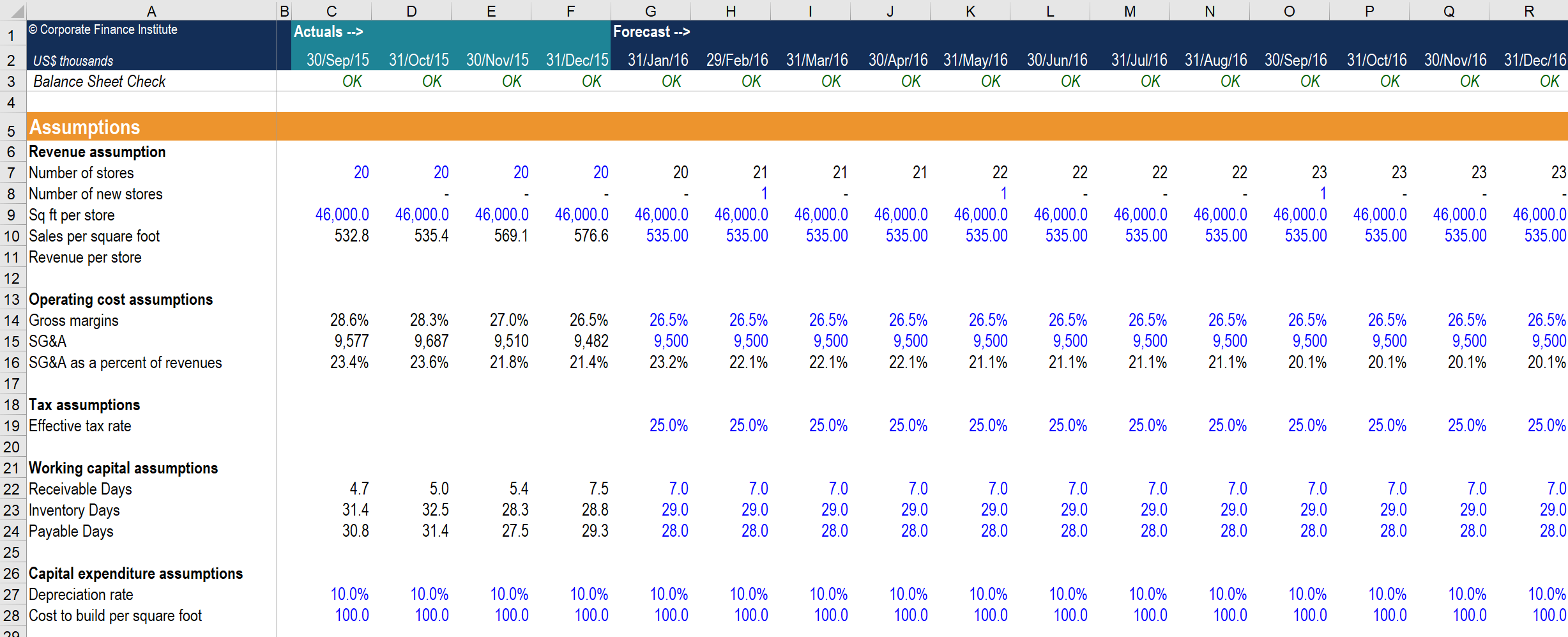
Cash timing determines whether the startup can continue operating.
Model:
- When customers pay
- Supplier payment dates
- Payroll
- Tax payments
- Inventory purchases
- Capital expenditure
- Debt repayments
- Fundraising proceeds
- One-time setup costs
Annual totals can hide shortfalls. A company may appear adequately funded for the year while running out of cash before a large customer payment arrives. Early-stage models should therefore normally be monthly for at least the first 12–24 months.
Founders operating with minimal capital can connect the model to Businessabc’s guide to starting a business with no money, which prioritises deposits, pilots and customer-funded delivery.
5. Calculate burn rate and runway correctly
Gross burn
Gross burn measures total monthly cash operating expenditure.
Gross burn = monthly cash operating outflows
Net burn
Net burn measures how quickly cash declines after operating cash inflows.
Net burn = operating cash outflows − operating cash inflows
Runway
Runway = current unrestricted cash ÷ monthly net burn
Suppose a startup holds $240,000 in available cash, receives $60,000 in monthly operating cash and spends $100,000.
- Gross burn: $100,000
- Net burn: $40,000
- Simple runway: six months
This calculation is only a starting point. If hiring, revenue or payment timing changes each month, runway should be read directly from the projected cash balance rather than calculated using one average burn figure.
Do not include cash that is legally restricted or unavailable for ordinary operations.
6. Measure startup unit economics
Unit economics test whether an individual customer, order or contract produces enough economic value to support growth.
Customer acquisition cost
CAC = sales and marketing cost attributable to acquisition ÷ new customers acquired
The calculation should state whether it includes salaries, commissions, software, agency fees and brand spending.
Contribution margin
Contribution margin = revenue − costs caused by serving and retaining that customer
Contribution margin goes further than gross margin by including variable costs such as payment processing, fulfilment, support and usage-based infrastructure.
Customer lifetime value
For a relatively stable subscription model, a simplified gross-profit LTV calculation is:
LTV = average monthly revenue per customer × gross margin percentage ÷ monthly customer churn
This formula becomes unreliable when churn is unstable, customer groups behave differently or the company has limited history. Cohort-based analysis is preferable once sufficient data exists.
LTV-to-CAC ratio
LTV-to-CAC ratio = customer lifetime value ÷ customer acquisition cost
A high ratio is not automatically good. It may indicate underinvestment in growth, an overstated lifetime value or the exclusion of important acquisition costs.
CAC payback period
CAC payback = CAC ÷ monthly contribution profit per customer
Payback shows how long the company must finance acquisition before recovering its cost.
7. Model headcount explicitly
Payroll is often one of a startup’s largest cash commitments. Build a hiring schedule containing:
- Role
- Planned start date
- Salary
- Employer taxes
- Benefits
- Recruitment cost
- Equipment
- Commission or bonus
- Expected capacity or outcome
Do not add employees as a single annual expense. The timing of each hire affects monthly cash and runway.
Hiring should also connect to operating drivers. Sales capacity may limit customer acquisition; engineering capacity may constrain delivery; support requirements may rise with active customers.
Businessabc’s article on when a growing company has outgrown its finance setup explains when financial reporting and planning may require more specialised support.
8. Create three scenarios
A single forecast creates false certainty. Build at least three internally consistent cases.
Base case
The most defensible outcome based on current evidence.
Upside case
Improved conversion, retention, pricing or sales capacity but not every positive assumption simultaneously.
Downside case
Slower revenue, delayed customer payments, higher costs, weaker retention or postponed fundraising.
Each case should answer:
- When does cash reach its lowest point?
- When must spending change?
- How much capital is required?
- Which hiring decisions can be delayed?
- What operating milestone must be reached before the next investment?
A downside case is useful only when it leads to predefined actions.
A simple startup model example
Consider a subscription startup entering a new financial year.
| Assumption | Base case |
|---|---|
| Opening customers | 200 |
| New customers per month | 25 |
| Monthly churn | 4% |
| Monthly price | $100 |
| Gross margin | 80% |
| CAC | $600 |
| Opening cash | $240,000 |
| Initial monthly cash costs | $100,000 |
The model should calculate customer movement, recurring revenue, acquisition spending, gross profit, monthly cash flow and remaining cash.
It should then test questions such as:
- What happens if churn rises to 6%?
- What if customers take 60 days to pay?
- Can the company hire two additional employees?
- How much runway remains if fundraising takes three months longer?
- Does faster acquisition improve cash generation or deepen short-term burn?
The value lies in understanding these relationships not producing an impressive revenue curve.
How to build the model step by step
- Define the business model: customer, offer, price, channel and delivery process.
- Choose a monthly timeline: generally 12–24 months for operating decisions and a longer annual view if required.
- Create the assumptions section: include confidence labels and sources.
- Build operational drivers: customers, sales capacity, transactions or billable hours.
- Forecast revenue: include churn, refunds, discounts and payment timing.
- Model costs and headcount: separate direct costs from operating expenses.
- Connect the financial statements: confirm that the balance sheet balances.
- Calculate cash, burn and runway: identify the lowest cash point.
- Add unit economics: use cohorts where possible.
- Create scenarios: link each downside threshold to a management response.
- Test the model: change one assumption and confirm that every connected section updates correctly.
- Compare forecast with actual results monthly: investigate material variances.
Common startup financial-modelling mistakes
Forecasting from market share
Claiming the business will capture 1% of a large market does not explain how customers will be reached or acquired.
Confusing bookings, revenue and cash
A signed contract, recognised revenue and collected cash may occur in different months.
Ignoring working capital
Inventory, customer payment delays and supplier terms can consume cash even when sales are growing.
Treating targets as evidence
A management goal should not be presented as an observed conversion or retention rate.
Underestimating payroll cost
Salary is only one part of the cash commitment. Include taxes, benefits, recruitment, equipment and bonuses.
Using one scenario
The most important decision may be what happens when the base case fails.
Hiding errors inside complexity
A detailed spreadsheet is not necessarily a reliable one. Separate inputs, calculations and outputs, and avoid unnecessary formulas.
Adjusting assumptions to satisfy investors
Investors may challenge optimistic projections more severely than conservative ones. Our analysis of due-diligence mistakes that can damage venture-capital deals shows why inconsistent financial information can weaken confidence.
What investors expect from a financial model
The US Securities and Exchange Commission advises companies preparing to raise capital to maintain current financial statements, calculate runway needs and explain how investment proceeds will be used.
An investor-ready model should make it possible to understand:
- What creates revenue
- Which assumptions are supported by evidence
- How cash will be spent
- When additional financing may be required
- What milestones the financing should achieve
- Which risks have the greatest impact
How the model reconciles with historical accounts and the fundraising presentation
Investors know that startup forecasts will change. The model earns credibility by showing disciplined reasoning and allowing assumptions to be tested.
How often should the model be updated?
Update actual financial results monthly. Review cash more frequently when runway is short or payment timing is uncertain.
For every reporting period:
- Replace forecast figures with actual results.
- Calculate the variance.
- Identify whether the difference came from timing, volume, price or cost.
- Update future assumptions only when new evidence justifies the change.
- Record the reason for every material revision.
Do not rewrite historical forecasts. Preserving earlier versions reveals whether management repeatedly overestimates sales or underestimates spending.
Final thoughts
A startup financial model is a decision system, not a fundraising decoration.
The strongest models connect customer behaviour, delivery capacity, hiring and payment timing to financial outcomes. They distinguish evidence from ambition, show when cash could run out and identify which actions management should take before that happens.
Begin with a simple model that the founding team understands. Add complexity only when it improves a real decision.
Frequently asked questions
How many years should a startup financial model cover?
Use monthly forecasts for at least the first 12–24 months. A three-to-five-year annual view may support strategy or fundraising, but long-term estimates should contain less detail and wider uncertainty.
Does a pre-revenue startup need a financial model?
Yes. It should focus on spending, hiring, pricing assumptions, launch milestones, financing requirements and runway rather than presenting unsupported revenue precision.
What is the difference between burn rate and operating loss?
Burn measures the reduction in cash. Operating loss is an accounting measure and may include non-cash expenses or exclude investing and financing movements.
Should founders use cash or accrual accounting in the model?
The model should normally show both accounting performance and cash movement. The applicable accounting and tax method depends on the company and jurisdiction.
What is the most important startup financial metric?
There is no universal metric. Cash and runway determine immediate survival, while retention, gross margin, contribution margin and acquisition payback help determine whether growth is economically sustainable.
Can AI build a startup financial model?
AI can help organise assumptions, explain formulas and identify inconsistencies. Founders remain responsible for source data, accounting treatment, scenario judgement and verifying every calculation.
Sources
- US Small Business Administration: Creating Realistic Financial Projections for Your Small Business
- US Securities and Exchange Commission: Ready to Raise Capital
- US Small Business Administration: Write Your Business Plan
- IFRS Foundation: IAS 7—Statement of Cash Flows
- Stripe: Customer Acquisition Cost in SaaS
- US Securities and Exchange Commission: Financial Statements


