
Businesses
What Business Should I Start? How to Choose the Right Business Idea
10 Aug 2026

A practical decision framework for matching your skills, budget, market access and risk tolerance to a business people will actually pay for.
What business should I start? Begin with evidence, not trends
A good business idea is not simply an industry that is growing or a product that looks exciting on social media. It is a specific offer for a specific buyer, delivered through a model that fits the founder’s resources and produces enough margin to survive.
That distinction matters because starting activity is far more common than building an operating company. The US Census Bureau reported 531,423 seasonally adjusted business applications in June 2026, while projecting 29,741 employer business formations from that application cohort within four quarters. The measures are not directly comparable as a failure rate, but they illustrate an important point: filing or exploring is only the beginning.
If you need a broader catalogue before narrowing your options, explore Small Business Ideas in 2026: 50 Realistic Businesses You Can Start. Return to this framework with three candidates rather than trying to compare all 50 at once.
DECISION PRINCIPLE Do not ask only, ‘Is this a good business idea?’ Ask, ‘Is this a good business for me, for this customer, in this market, with the resources I can commit now?’ |
The four-part business idea fit
1. Founder fit
List the skills, experience, reputation, licences, tools, relationships and local knowledge you already possess. An existing advantage reduces the time and money required to become credible. Enjoyment matters, but competence, stamina and willingness to perform the daily work matter more.
- Strong signal: People already ask you for help with the problem or trust your judgment in the field.
- Weak signal: You like the image of owning the business but dislike its core sales, service or operational work.
2. Customer fit
Define one reachable customer and one costly, urgent or recurring problem. ‘Everyone’ is not a market. A useful starting segment might be independent dental practices with overdue patient follow-up, landlords with frequent unit turnovers or working parents seeking reliable after-school tutoring.
- Strong signal: Buyers already spend money, time or staff effort on an imperfect alternative.
- Weak signal: Potential users praise the concept but cannot explain when, why or how much they would pay.
3. Economic fit
Estimate price, direct delivery cost, customer-acquisition cost, capacity and payment timing. A popular offer can still be a poor business if travel, materials, labour, returns, rework or advertising consume the margin.
CORE CALCULATION Contribution per sale = selling price − direct labour − materials − transaction fees − delivery or travel − other costs caused by that sale. Contribution must eventually cover fixed costs, taxes and the owner’s income. |
4. Operating fit
Choose a model compatible with your available time, location, health, family responsibilities and tolerance for uncertainty. A route-based service rewards local density; consulting requires credibility and selling; ecommerce needs product, fulfilment and returns; a digital product needs distribution and continued support.
- Strong signal: You can describe how the first ten customers will be found and served without hiring a large team.
- Weak signal: The model works only after high volume, outside funding or a perfect launch.
Seven questions to identify the right business
1. What results can I deliver now?
Start with outcomes, not job titles. Can you clean up a company’s books, photograph products, repair bicycles, organise moves, teach a language or automate an administrative workflow?
2. Who can I reach without mass advertising?
Warm contacts, former colleagues, professional groups, neighbourhood networks and referral partners lower the cost of learning and winning early customers.
3. Which problems are frequent or expensive?
Recurring, time-sensitive and risk-related problems usually create stronger demand than optional improvements with no deadline.
4. Will customers pay enough?
Ask what the problem currently costs and compare that with the value, time or risk your offer changes. Avoid setting price from personal comfort alone.
5. Can I deliver a useful first version quickly?
A service, diagnostic, workshop, preorder or paid pilot can create evidence before a full website, product range or permanent location.
6. What can make this business fail?
Consider regulation, safety, seasonality, customer concentration, platform dependence, inventory, long payment terms and the founder becoming the bottleneck.
7. Would I still choose it after seeing the daily work?
Interview operators and examine sales, administration, complaints, staffing and cash collection—not only the visible creative or technical work.
Choose a business model before choosing a brand
Two businesses selling similar outcomes can require very different capital, skills and patience. Compare the operating model as carefully as the idea.
| Model | Best when | Main constraint |
|---|---|---|
| Skill-based service | You can sell expertise or labour immediately | Capacity depends on time until delivery is systemised |
| Productised service | The same defined result can be sold repeatedly | Scope must stay standard enough to protect margin |
| Local route business | Customers need recurring service in a compact area | Travel density, staffing and equipment shape profit |
| Agency or consultancy | Clients pay for specialised outcomes or implementation | Credibility and uneven sales cycles |
| Digital product or education | Knowledge can be packaged for a defined audience | Distribution is harder than content creation |
| Ecommerce or physical product | A differentiated product has validated demand | Inventory, returns, cash cycle and acquisition cost |
| Subscription or membership | Customers receive continuing value | Retention and ongoing delivery must justify renewal |
A simple business idea scorecard
Score each candidate from 1 to 5. Use evidence rather than enthusiasm: a 5 requires customers, data or relevant experience; a 1 means the assumption is weak or untested.
| Criterion | 1 = weak | 5 = strong |
|---|---|---|
| Customer access | No clear path to buyers | Can reach buyers directly or through partners |
| Problem urgency | Optional or rare | Frequent, expensive, risky or time-sensitive |
| Founder advantage | No experience or trust | Relevant skill, proof, licence or network |
| Willingness to pay | Compliments only | Existing budgets, deposits or paid alternatives |
| Startup burden | Large irreversible cost | Can test cheaply and reversibly |
| Contribution margin | Unclear or thin after direct costs | Healthy room after realistic direct costs |
| Repeat demand | Mostly one-time purchases | Recurring, replenishment or referral potential |
| Operational fit | Conflicts with time and lifestyle | Matches capacity and preferred work |
| Risk and compliance | High exposure or unknown rules | Requirements understood and manageable |
| Differentiation | Generic offer in a crowded market | Clear niche, method, access or proof advantage |
Add the ten scores for a total out of 50. A high score does not prove the idea will succeed; it identifies which assumption deserves the first test. Reject any idea with a critical legal, safety or cash-flow problem even if its total is high.
Example: comparing three possible businesses
| Candidate | Why it fits | What must be tested first |
|---|---|---|
| Bookkeeping service for trades businesses | Relevant finance experience and recurring monthly need | Can the founder earn trust and price cleanup plus monthly close work profitably? |
| Mobile car-detailing route | Visible result, local demand and repeat packages | Will customers in one compact area pay enough after travel, labour and supplies? |
| Generic online clothing store | Creative interest but no validated audience or product advantage | Can a focused product win preorders before inventory is purchased? |
The bookkeeping or detailing idea may appear less exciting than ecommerce, but it offers a faster path to paid evidence. If the clothing concept later secures preorders from a defined community, its score can change. The framework is designed to update as evidence improves.
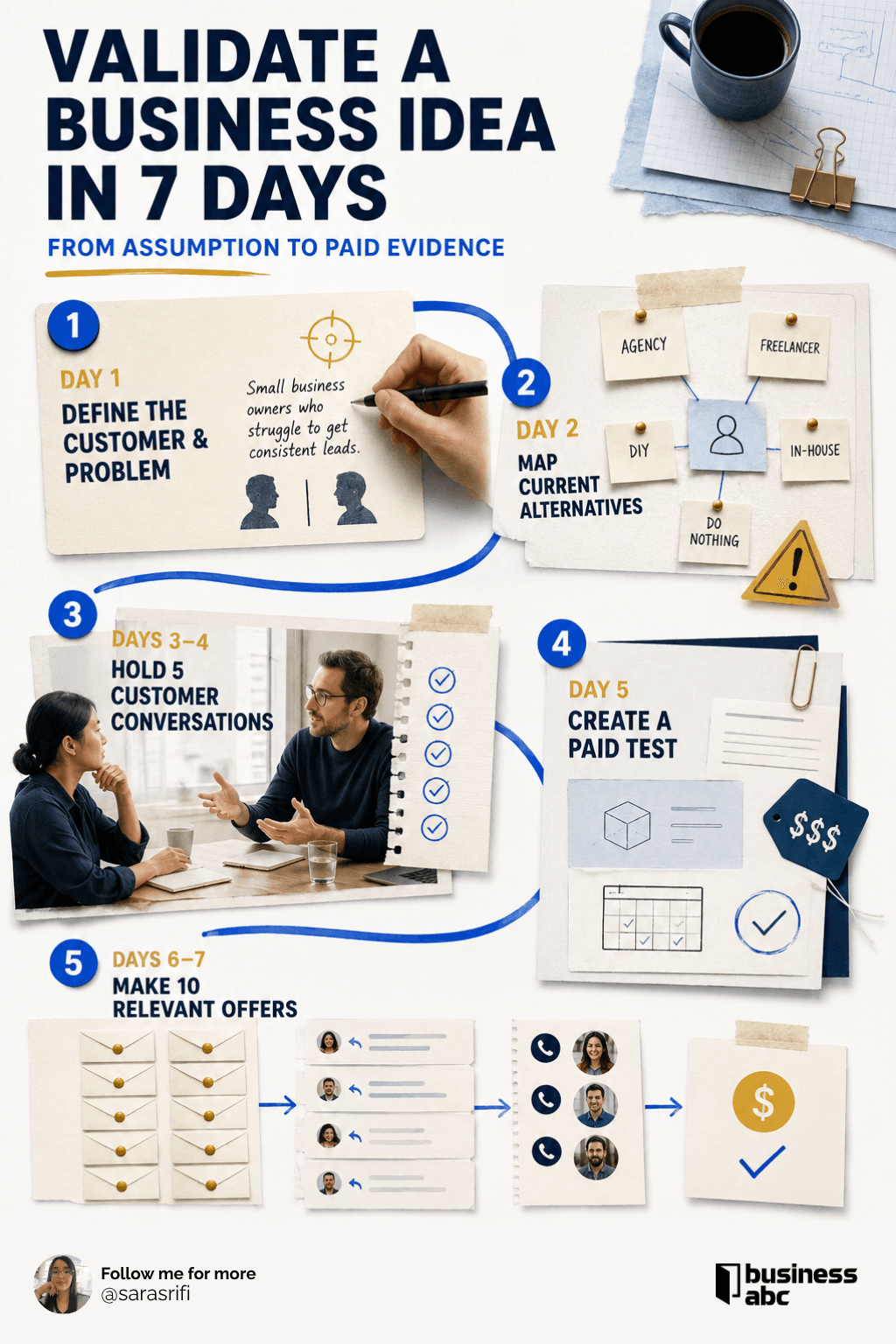
How to validate a business idea in seven days
Day 1: Define the customer and problem
Write one sentence: ‘I help [customer] solve [problem] by delivering [result].’
Day 2: Map current alternatives
List direct competitors, internal workarounds, do-it-yourself options and the cost of doing nothing.
Days 3–4: Hold five customer conversations
Ask about frequency, impact, current spend, dissatisfaction and buying process. Do not pitch until the problem is understood.
Day 5: Create a paid test
Define the smallest useful result, delivery time, price, exclusions and evidence of completion.
Days 6-7: Make ten relevant offers
Approach suitable prospects personally. Track replies, objections, calls, deposits and refusals.
VALIDATION STANDARD A booked call is useful; a signed letter of intent is stronger; a deposit, preorder or paid pilot is strongest. Likes, survey enthusiasm and compliments are weak evidence when no commitment is required. |
Should I start a business with no money, a small budget or capital?
Match the model to the financial risk you can safely carry. If cash is limited, begin with a service, brokerage, commission, preorder, deposit or customer-funded pilot. Do not force a capital-heavy product, lease or inventory model into a no-money strategy.
For a detailed low-cash launch process, see How to Start a Business With No Money: A Practical Step-by-Step Guide.
- Low-cash test: Founder-delivered service, workshop, diagnostic, referral or preorder.
- Moderate investment: Insurance, specialist tools, small equipment, initial stock or part-time support after demand is visible.
- Capital-intensive launch: Premises, vehicles, large inventory, regulated facilities or product development, only with stronger evidence and a cash buffer.
Common mistakes when choosing a business idea
- Choosing by market size alone: A large market does not help if you cannot reach a focused segment or offer a meaningful reason to switch.
- Copying a trend: Easy-to-copy tools and formats rarely create a durable advantage without customer access, domain knowledge or a proprietary process.
- Building before selling: A website, logo, app or inventory can feel productive while avoiding the harder test of willingness to pay.
- Ignoring sales work: The best technical operator still needs a repeatable way to start conversations, establish trust and ask for commitment.
- Confusing revenue with profit: Include delivery labour, payment fees, travel, returns, rework, software and acquisition cost in every estimate.
- Starting too broad: One customer, problem and offer produce clearer learning than a business attempting to serve everyone.
- Overlooking regulation: Licences, zoning, professional boundaries, taxes, insurance and employment rules can change whether an idea is viable.
When should you abandon or change an idea?
Stopping is rational when repeated tests show weak urgency, inaccessible buyers, insufficient pricing, unsafe delivery, unacceptable legal exposure or economics that cannot work at plausible volume. Change one major variable at a time, the customer, problem, offer, channel or delivery model—so the next test produces useful learning.
Do not abandon an idea merely because the first message received no reply. First check whether the prospects were appropriate, the message was specific and the offer addressed a real problem. Conversely, do not continue for months because people are encouraging. Require a defined evidence deadline.
Frequently asked questions
What business should I start as a beginner?
Start with a narrow service based on a skill, tool or relationship you already have. It should be simple to explain, cheap to test and useful enough for one customer to buy within days or weeks.
What is a good business to start in 2026?
Good business ideas in 2026 solve durable problems and use new tools only where they improve cost, speed or quality. Recurring local services, specialised B2B support, care-related services, education and workflow automation can be attractive when the founder has a real advantage.
How do I know whether a business idea will work?
You cannot know in advance. Reduce uncertainty through customer interviews, competitor research, a priced offer and a paid pilot. Evidence should become stronger before spending becomes less reversible.
Should I turn my hobby into a business?
Only if you also want the selling, pricing, deadlines, administration and customer expectations around it. Test whether buyers value a specific result rather than assuming personal enthusiasm creates demand.
Should I buy a franchise instead?
A franchise may provide a brand, system and support, but it can require significant fees, operating restrictions and continuing royalties. Review the disclosure document, unit economics and legal obligations carefully.
Should I start online or locally?
Choose the channel that offers the clearest access to customers and acceptable economics. Local businesses can benefit from trust and geographic focus; online businesses gain reach but often face stronger competition and higher acquisition costs.
How many ideas should I test?
Shortlist three, then validate the strongest one first. Testing many ideas superficially creates noise; a focused week of buyer conversations and offers produces better evidence.
Do I need a full business plan before choosing?
No. Use a one-page plan for the first test: customer, problem, offer, price, channel, delivery process, direct cost and main risk. Expand it when the evidence justifies commitment or external funding.
Final takeaway
The right answer to ‘What business should I start?’ is not hidden in a universal ranking. It emerges from the overlap between founder advantage, customer demand, workable economics and an operating model you can sustain.
Choose three candidates, score them honestly and test one with real customers. Commit more money only as the evidence becomes stronger. A modest idea with a paying customer is a better starting point than an exciting concept supported only by forecasts.
Sources
- US Small Business Administration: Plan your business
- US Small Business Administration: Market research and competitive analysis
- US Small Business Administration: Sample business plans
- US Census Bureau: Business Formation Statistics, June 2026
- Internal Revenue Service: Checklist for starting a business
- Internal Revenue Service: Starting a business
- US Bureau of Labor Statistics: Occupational Outlook Handbook


