
Top 10 Most Successful Businesses to Start in 2026
06 Aug 2026

Ten realistic US business models assessed for recurring demand, pricing power, startup burden, repeat purchases and potential to scale.
What does ‘most successful’ mean?
A list of successful businesses can easily become misleading. Industry demand does not guarantee that an individual company will survive, and employment growth is not the same as owner profit. This guide therefore does not rank ideas by hype or quote invented profit margins.
Instead, the assessment uses five practical signals: recurring or essential demand, ability to charge for measurable value, manageable startup requirements, repeat-purchase potential and a credible route from founder-delivered work to systems, staff or retainers. The US Census Bureau reported 531,423 seasonally adjusted business applications in June 2026, but projected only 29,741 employer startups from that application cohort within four quarters. Starting is common; building an operating business is the harder test.
Readers who want a wider catalogue should explore Small Business Ideas in 2026: 50 Realistic Businesses You Can Start.
Top 10 businesses at a glance
| # | Business | Why it can work | Main constraint |
|---|---|---|---|
| 1 | Commercial cleaning | Repeat contracts and essential upkeep | Hiring, quality control and insurance |
| 2 | Accounting and bookkeeping support | Recurring monthly financial work | Trust, credentials and automation |
| 3 | Property maintenance services | Local repeat demand and service bundles | Licensing, safety and scheduling |
| 4 | SMB cybersecurity services | High-value risk reduction | Expertise and professional liability |
| 5 | AI workflow consulting | Measurable time and process savings | Fast-changing tools and weak use cases |
| 6 | Non-medical senior support | Long-term demographic demand | Regulation, trust and staffing |
| 7 | Pet care and mobile grooming | Repeat household spending | Capacity, safety and route density |
| 8 | Landscaping and grounds care | Recurring routes and visible outcomes | Seasonality, equipment and labour |
| 9 | Specialist B2B consulting | High-value expertise with low overhead | Credibility and uneven sales cycles |
| 10 | Tutoring and workforce training | Clear outcomes and repeat sessions | Differentiation and customer acquisition |
1. Commercial cleaning company
Best for: Operators who can build routes, standards and dependable teams
Cleaning is not glamorous, but recurring office, clinic, retail and multifamily contracts can create predictable work. The opportunity is stronger when the company specialises, documents quality and prices travel, supplies, supervision and rework correctly.
- Business model: Recurring contracts, scheduled deep cleans and specialist add-ons.
- What can make it work: Dense routes, checklists, site inspections, reliable staffing and contract retention.
- Practical starting point: Win one narrow customer type in one local area before expanding services or geography.
2. Accounting and bookkeeping support
Best for: Financially skilled founders serving a defined small-business niche
Every operating business needs accurate records, cash visibility and timely compliance. BLS projects accountant and auditor employment to grow 5% from 2024 to 2034, with about 124,200 openings per year. Automation will remove routine entry work, so a defensible firm should sell clean close processes, interpretation and decision support—not keystrokes alone.
- Business model: Monthly bookkeeping, controller support, payroll coordination and reporting retainers.
- What can make it work: Industry specialisation, secure processes, responsiveness and advisory value.
- Practical starting point: Offer a paid clean-up or monthly-close package; do not perform regulated work without the required credentials.
3. Property maintenance and home-service company
Best for: Practical operators who can coordinate reliable local delivery
Busy owners, landlords and property managers repeatedly need turnover work, minor repairs, inspections, pressure washing and seasonal maintenance. A focused service can begin small and grow through route density, subcontractor coordination and property-management relationships.
- Business model: One-off jobs converted into seasonal plans or property retainers.
- What can make it work: Fast quoting, reliable arrival windows, photographic proof and disciplined scope control.
- Practical starting point: Choose services you can legally and safely deliver; refer licensed electrical, plumbing, structural or specialist work.
4. Cybersecurity services for small businesses
Best for: Experienced security practitioners with credible technical skills
Cybersecurity can command strong prices because the buyer is reducing operational and financial risk. BLS projects information-security analyst employment to grow 29% from 2024 to 2034. That demand signal does not make entry easy: clients need evidence of competence, careful contracts and trustworthy handling of sensitive systems.
- Business model: Security assessments, policy packages, awareness training and managed advisory retainers.
- What can make it work: Recognised expertise, clear boundaries, secure tooling and professional liability controls.
- Practical starting point: Start with a narrow, repeatable assessment for one regulated or exposed customer segment.
5. AI workflow automation consultancy
Best for: Operators who understand business processes as well as AI tools
Many companies do not need another generic chatbot; they need a measurable reduction in repetitive work, response time or errors. A credible consultancy maps the process, protects data, builds a limited pilot and measures the result before proposing broader automation.
- Business model: Paid workflow audit, implementation project, training and maintenance retainer.
- What can make it work: A defined business case, human review, security controls and vendor-independent advice.
- Practical starting point: Sell one paid pilot around a specific workflow such as document intake, knowledge retrieval or customer-service triage.
6. Non-medical senior support service
Best for: Trustworthy operators prepared for care-related compliance and staffing
Ageing-in-place creates demand for companionship, errands, meal support, appointment coordination and household help. BLS projects home health and personal-care aide employment to grow 17% from 2024 to 2034. The opportunity carries serious responsibility: permitted tasks, training, background checks, insurance and agency rules vary by state.
- Business model: Hourly visits, weekly service plans and family coordination packages.
- What can make it work: Trust, continuity of carers, documented boundaries and careful compliance.
- Practical starting point: Define non-medical services precisely and verify state and local requirements before accepting clients.
7. Pet care and mobile grooming
Best for: Animal-experienced founders in areas with sufficient household density
Pet sitting, dog walking, grooming and transport can generate repeat bookings and referrals. BLS projects animal-care and service employment to grow 11% from 2024 to 2034, with about 81,700 openings per year. A business succeeds by earning trust and using routes, packages and policies to control time.
- Business model: Recurring walks, grooming cycles, holiday care and membership packages.
- What can make it work: Safety protocols, insurance, booking discipline, route density and strong reviews.
- Practical starting point: Begin with one service and a tightly defined coverage area; add capacity only after utilisation is visible.
8. Landscaping and grounds-maintenance company
Best for: Operators comfortable with physical, seasonal and equipment-intensive work
Residential and commercial properties need mowing, pruning, cleanup and landscape maintenance. BLS projects grounds-maintenance employment to grow 4% from 2024 to 2034, with about 171,600 openings annually. The attractive model is a dense recurring route, not scattered low-priced jobs.
- Business model: Seasonal contracts, recurring routes and higher-value enhancement projects.
- What can make it work: Route planning, equipment utilisation, crew productivity and upsells tied to property needs.
- Practical starting point: Pre-sell a compact route and rent or buy equipment only when booked work justifies it.
9. Specialist B2B consulting firm
Best for: Experienced professionals with a narrow, valuable operating specialty
Consulting can start with little physical capital and produce high-value engagements, but generic advice is difficult to sell. BLS projects management-analyst employment to grow 9% from 2024 to 2034; 14% of management analysts were self-employed in 2024. Strong firms connect expertise to a costly decision or measurable operating result.
- Business model: Diagnostic project, implementation sprint, fractional leadership and retainer.
- What can make it work: Niche credibility, evidence, precise scope and a repeatable method rather than broad advice.
- Practical starting point: Package one outcome for one buyer—for example inventory reduction for regional distributors or compliance operations for clinics.
10. Tutoring and workforce-training business
Best for: Subject experts who can demonstrate learner or employer outcomes
Tutoring, language instruction, software training and professional upskilling can begin with limited overhead and move from individual sessions to cohorts, employer contracts or licensed materials. The risk is commoditisation, especially when the offer is simply access to information.
- Business model: Session packages, cohorts, employer workshops and recurring learning programmes.
- What can make it work: A defined learner, diagnostic assessment, visible progress and curriculum that solves a specific gap.
- Practical starting point: Run a paid small-group pilot before recording a course or building a learning platform.
How to choose between these businesses
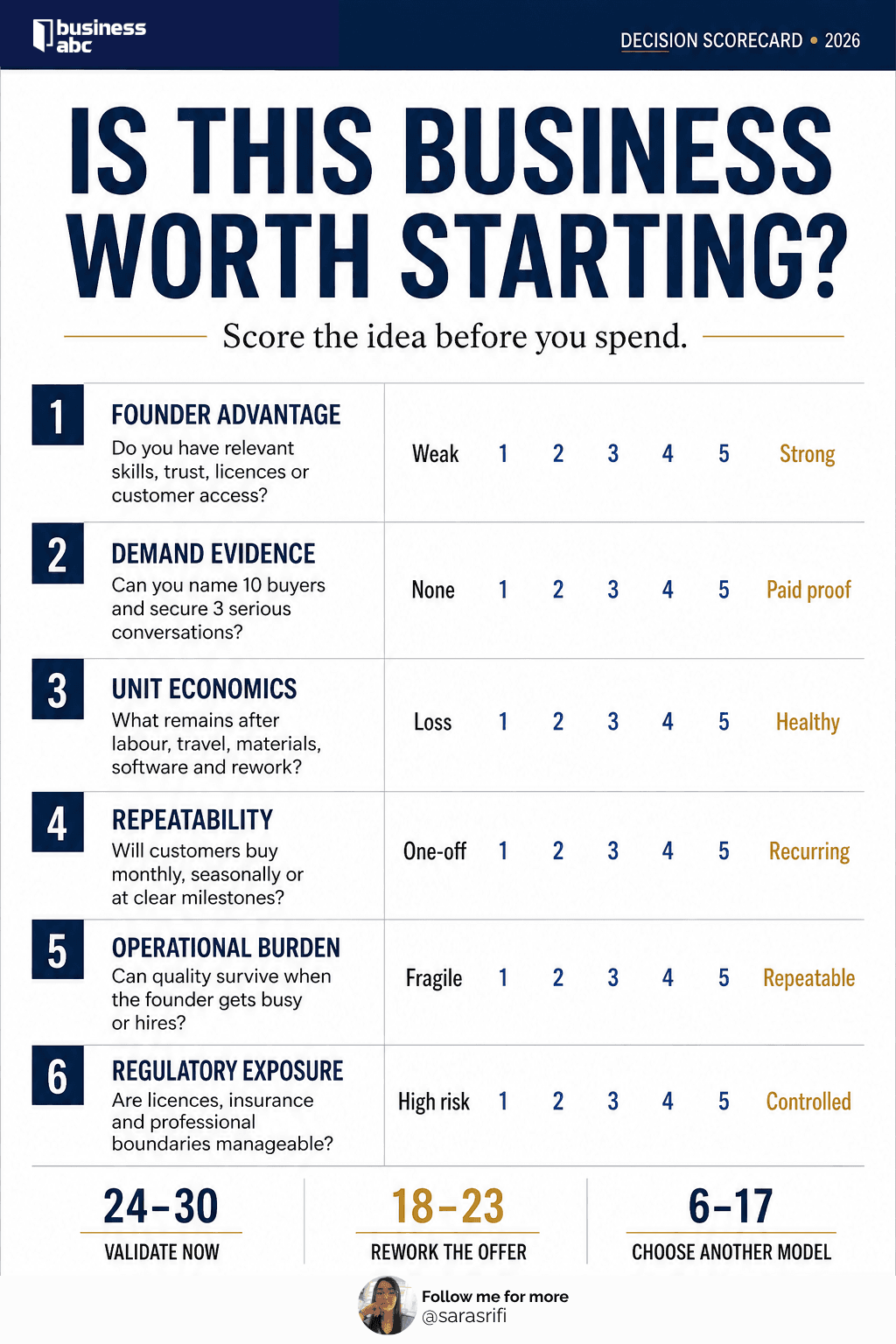
- Founder advantage: Which model matches experience, reputation, licences and customers you can already reach?
- Demand evidence: Can you identify ten buyers with the problem and secure three serious conversations?
- Unit economics: After labour, travel, materials, software, payment fees and rework, what remains per sale?
- Repeatability: Can the customer buy monthly, seasonally or at predictable milestones?
- Operational burden: Will quality collapse when the founder becomes busy or hires the first employee?
- Regulatory exposure: What registrations, licences, insurance, employment rules or professional boundaries apply?
DECISION RULE Prefer the business in which you have an unfair starting advantage and can obtain paid evidence quickly. A lower-ranked model with real customers is better than a fashionable model supported only by forecasts. |
A 30-day validation plan
| Period | Objective | Actions | Evidence |
|---|---|---|---|
| Days 1–5 | Choose a niche | Interview buyers; map alternatives, urgency and required trust | One precise customer and problem |
| Days 6–10 | Build the offer | Define scope, price, delivery time and exclusions | A one-page paid pilot |
| Days 11–20 | Sell manually | Use warm introductions, direct outreach and referral partners | One deposit or signed pilot |
| Days 21–27 | Deliver | Complete the work; measure time, cost, errors and questions | A completed result and feedback |
| Days 28–30 | Decide | Review contribution, sales friction and repeat demand | Continue, revise or stop |
Frequently asked questions
What is the most successful small business to start?
No single model wins for every founder. Commercial cleaning and accounting support can create recurring revenue; cybersecurity and specialist consulting can command higher prices; senior and pet services benefit from durable demand. The best choice matches proven demand with the founder’s capability.
Which businesses are most profitable?
Profit depends on price, labour efficiency, acquisition cost, utilisation and overhead—not the industry label alone. Expertise-led services may have low physical overhead, while route businesses can become attractive when schedules are dense and repeat contracts are retained.
What business is easiest to start in 2026?
A narrow service based on skills and tools you already possess is usually easiest to validate. Easy to launch does not mean easy to grow; customer acquisition and consistent delivery remain the real constraints.
Can I start one of these businesses with no money?
Some consulting, tutoring and service offers can be pre-sold with minimal upfront spending. Registration, licences, insurance, equipment, transport, tax and payment costs may still apply. See Businessabc’s guide to starting a business with no money.
Should I follow trends such as AI?
Only when the trend solves a budgeted customer problem. Sell measurable process improvement, not novelty. Avoid building a business whose only advantage is access to a tool that competitors can also buy.
How long should I validate an idea?
Set a short evidence window rather than researching indefinitely. Thirty focused days should produce buyer conversations, objections and ideally a paid pilot. If buyers will not progress, change the customer, offer or idea.
Final takeaway
The most successful businesses to start in 2026 are not necessarily the newest. They solve recurring, expensive or unavoidable problems and convert reliable delivery into repeat revenue. Cleaning, accounting, property services, security, senior support and specialist expertise all fit that pattern when the founder controls quality and economics.
Start with evidence: one customer, one painful problem, one clearly priced offer and one paid result. Then calculate what the business earns after every direct cost. If you are still comparing models, read our guide on Small Business Ideas in 2026 for a broader set of realistic options.
Sources and verification
- US Census Bureau — Business Formation Statistics, June 2026
- US SBA — Plan Your Business
- US SBA — Market Research and Competitive Analysis
- BLS — Information Security Analysts
- BLS — Home Health and Personal Care Aides
- BLS — Accountants and Auditors
- BLS — Management Analysts
- BLS — Animal Care and Service Workers
- BLS — Grounds Maintenance Workers
- BLS — Janitors and Building Cleaners


